- Food catching after a veneer is bonded usually means the contact point between teeth is off.
- A contact point causes problems whether it is too tight or too loose.
- Usually one adjustment or a small addition stops food from catching.
- If the spot is left alone, the gum swells and the tooth decays there.
"Food keeps getting stuck since my veneers." We hear this often in Seomyeon, Busan, and at Reset Dental Clinic the first step is a piece of floss. For patients living in or visiting Korea, we offer 1:1 English interpretation from the first consultation through the end of treatment.
Food catching seems minor, but you notice it at every meal. Fortunately, the cause is usually clear and the fix is simple.
Why does food get stuck between teeth after a veneer?
Is there supposed to be a gap between teeth?
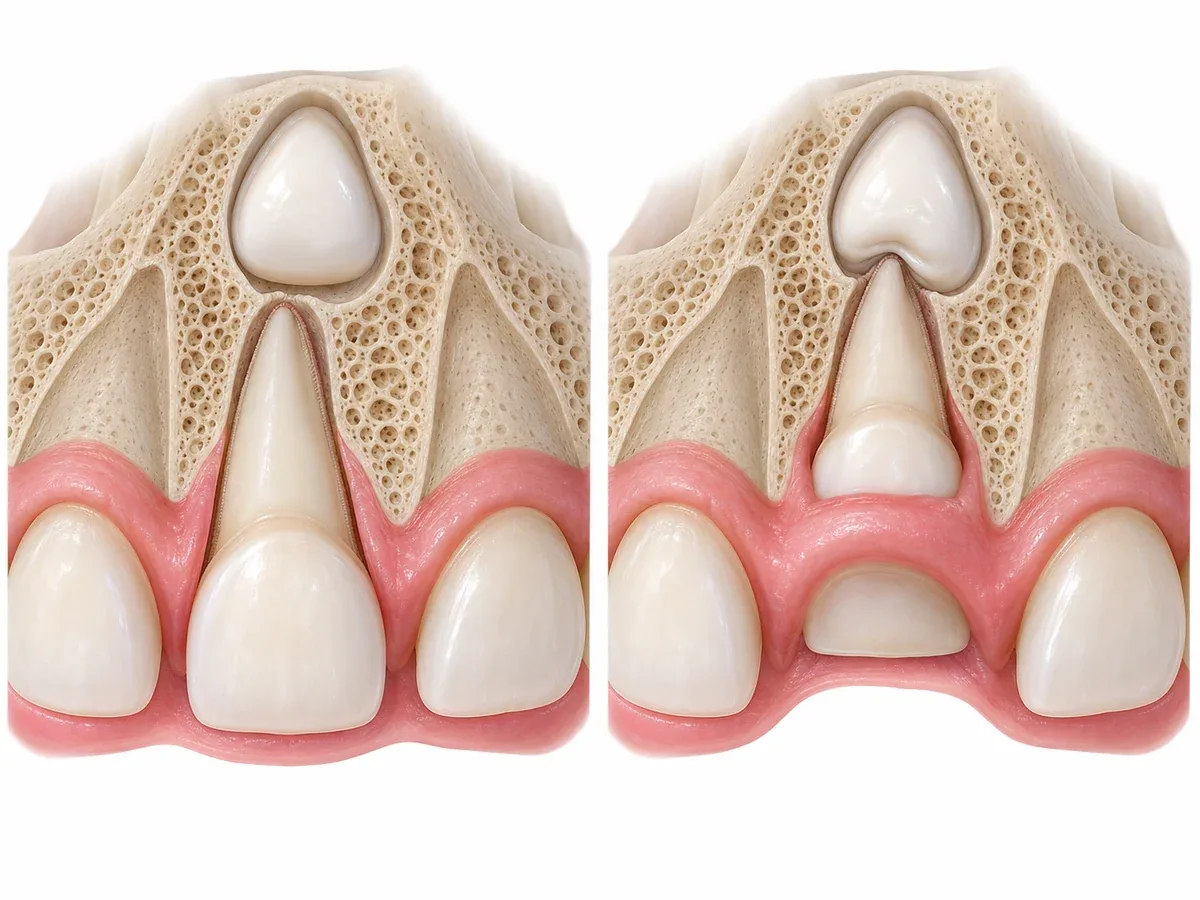
There is no gap, but a contact point. Two neighbouring teeth touch each other at one point.
Below that point lies a small triangular space. The gum normally fills it.
Why does the contact point matter?
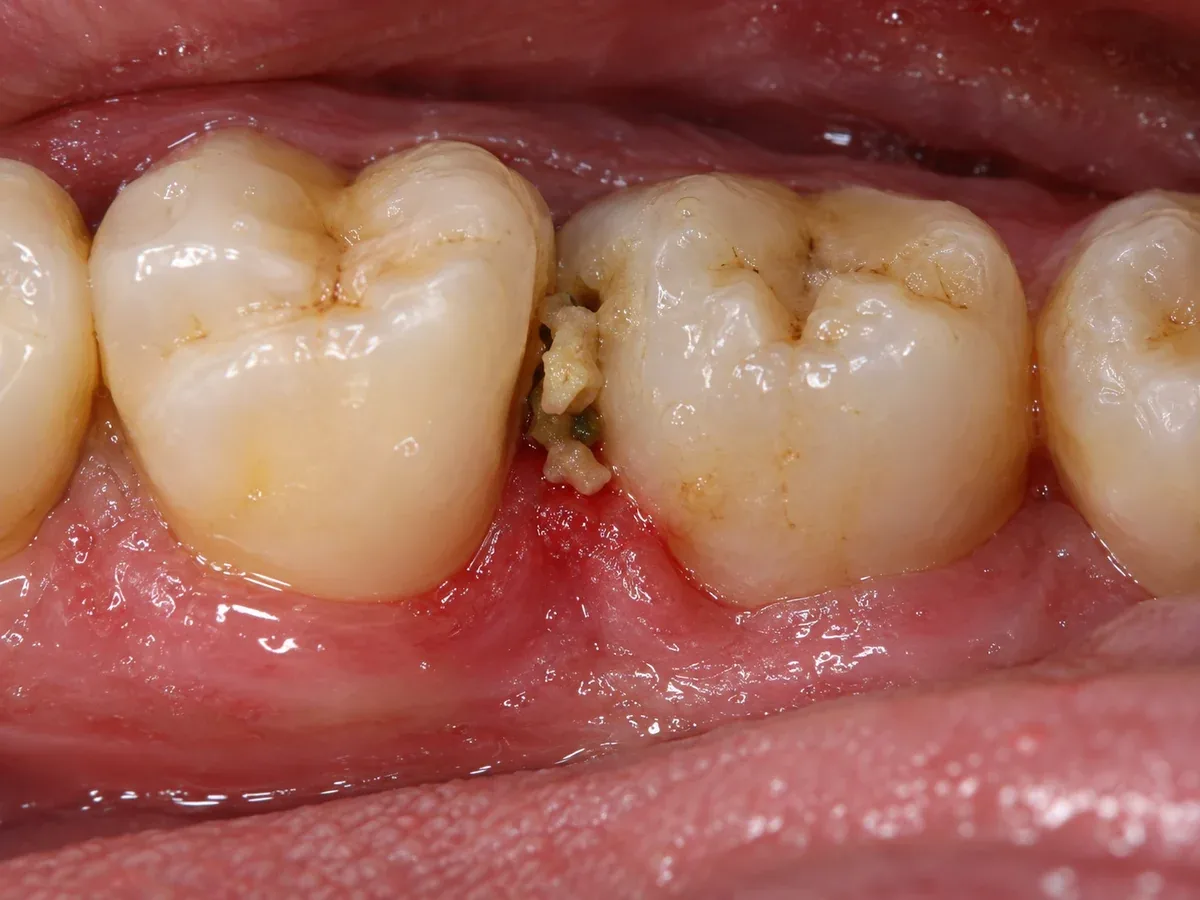
It blocks the path food would take. When you chew, food is pushed down between the teeth from above.
A firm contact point stops it there. A loose one lets it slide straight through.
Why does a veneer change that point?
Bonding a veneer means rebuilding the shape of the tooth. The position and height of the contact are set in the same step.
If the new surface sits even slightly further in, the contact loosens. That is why every contact must be checked with floss after bonding.
How can floss tell you whether the contact is right?
What should floss feel like?
You can tell by how it feels going in. A small snap before it slips through means the contact is right.
If it drops through with no resistance, the contact is loose. If it is so stiff that the floss tears, that also needs adjusting.
| Floss feel | Meaning | What we do |
|---|---|---|
| Snaps, then slides in | Right | Leave as is |
| Drops through freely | Loose | Restore the contact |
| Hard to get in | Too tight | Trim slightly |
| Tears on the way in | A ledge | Smooth the margin |
| Catches on the way out | Rough spot | Polish |
A single piece of floss sorts out most cases.
What if the contact is too tight?
Floss cannot get in, so the space cannot be cleaned, and a spot that is never cleaned eventually decays.
Teeth may also ache for a few days after bonding, because they push against each other. A slight trim usually brings relief at once, so there is no need to put up with it.

Does food catch more in the first few days?
Many people feel that way while the tongue gets used to the new shape. If floss shows food still catching after a week, it needs adjusting.
Why does the floss keep tearing in one spot?
It means there is a ledge there. The margin may be rough, or bonding cement may be left over.
A little smoothing stops the tearing, so please tell us where it happens.
How do you find the spot when you have several veneers?
Try floss in each space, one by one.
- Pass floss in and out of every space
- Find the space where it drops through freely
- Smell the floss after you take it out
- Remember the spot and tell us
This is the most reliable way to find it.
Is it the veneer, the tooth or the gum?
When it started is the biggest clue. Right after bonding points to the contact point, while years later points to the gums.
One catching spot usually means adjusting that one contact. Several spots mean we check the gums as well.
Floss helps here too. No resistance at the contact points to the tooth, while resistance with an empty space below points to the gum, and often both are involved.
What if the gums have receded?
Does food catch when gums recede?
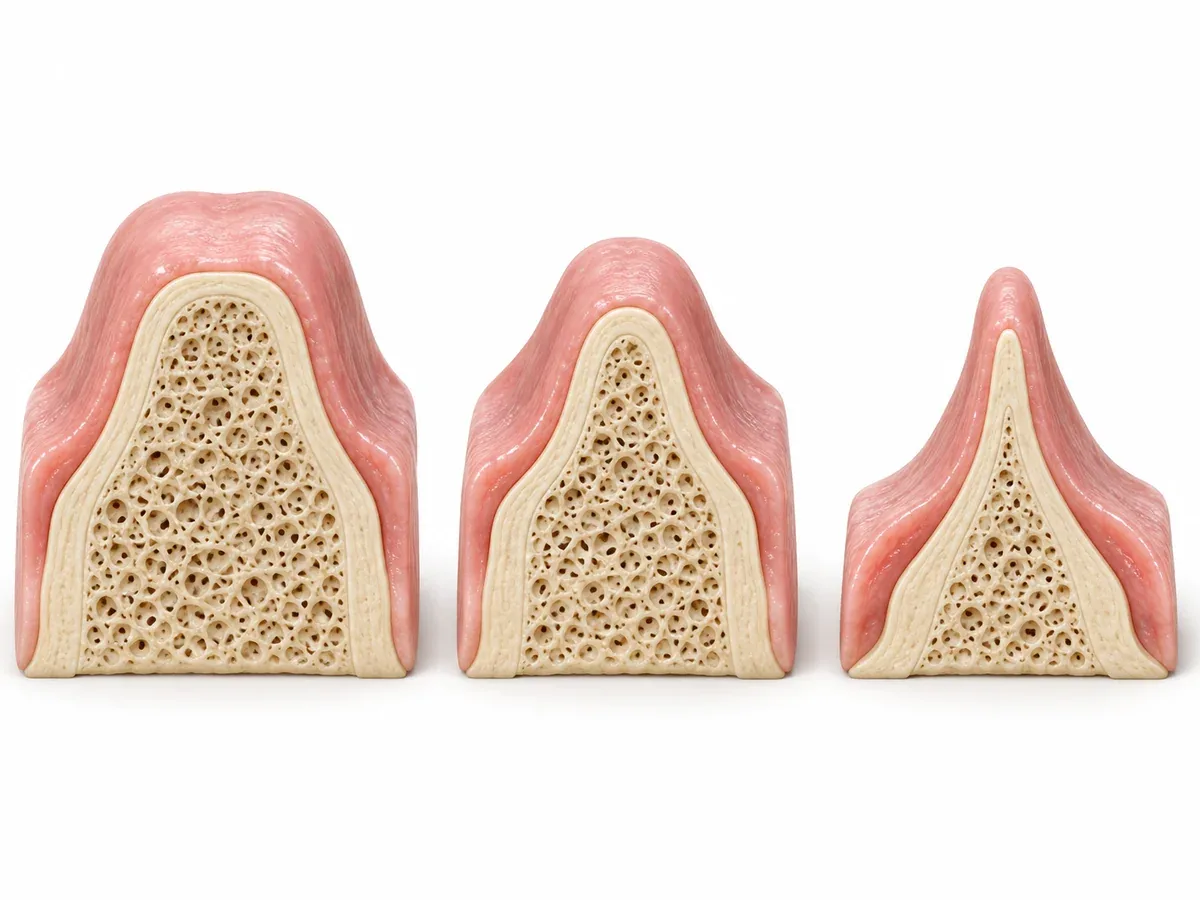
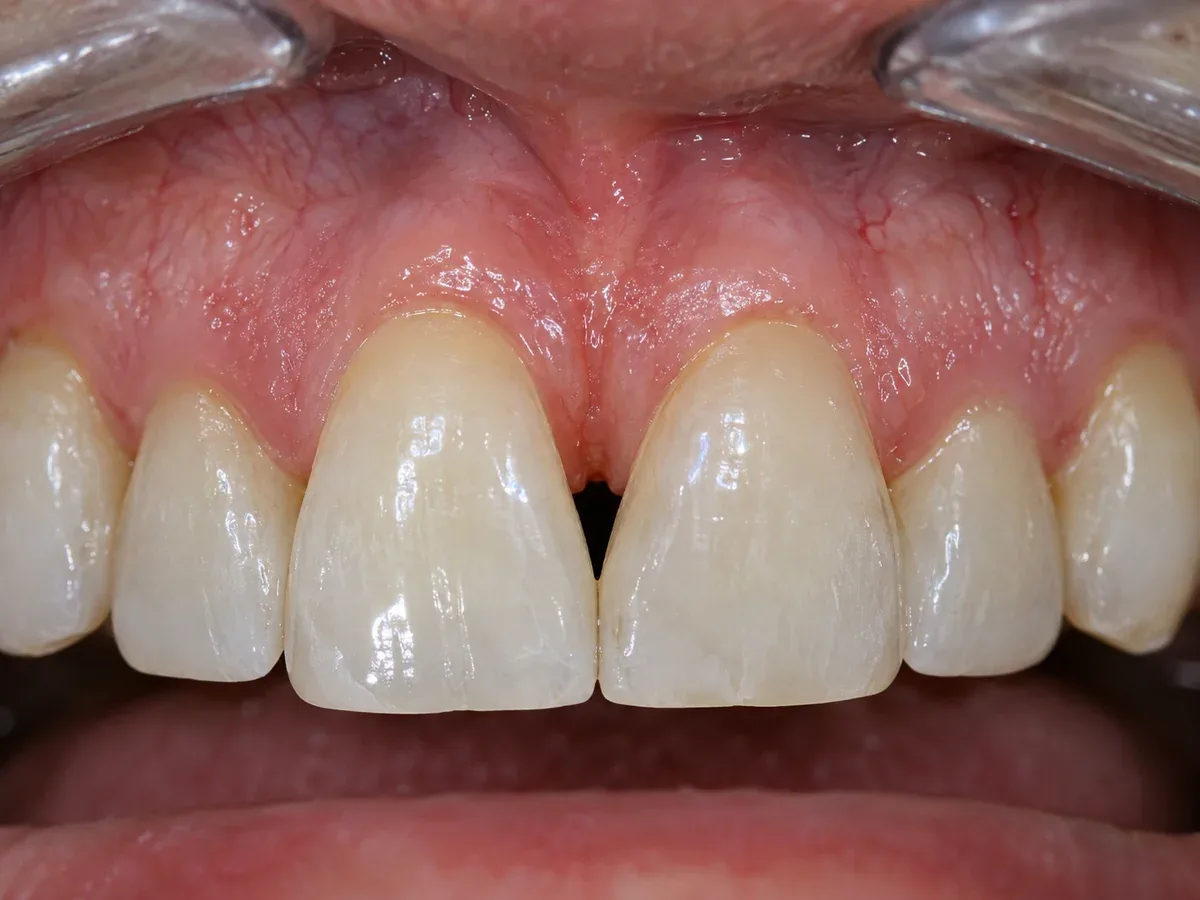
Yes. The triangular space the gum used to fill opens up, and food gets into it.
In this case, fixing the contact point alone does not solve everything.
What can be done then?
We rebuild the contact point slightly lower. The space becomes smaller, so less food catches.
We also ask you to use an interdental brush. Both steps together are what makes it comfortable.
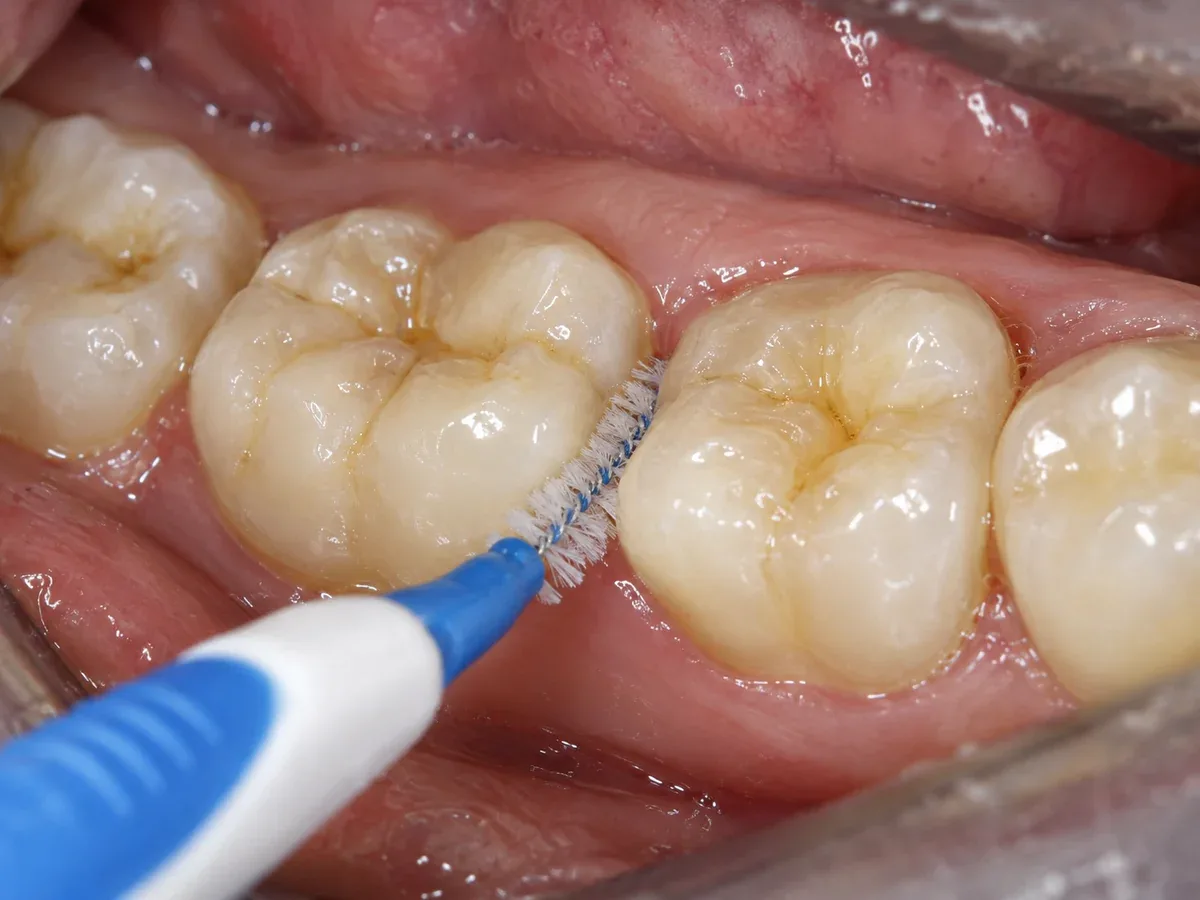
How do you choose an interdental brush?
It has to match the gap, including around a veneer. A thick brush forced in pushes the gum back and roughens the margin, while a thin one does not clean.
Where the gap is wide, the brush cleans better. Right under the contact point, floss reaches further, and we fit sizes and show you which goes where.
Does food catch more with age?
Gums slowly recede and teeth shift very slightly throughout life. Spaces open and contact points change, so spots that never caught food start to.
This happens regardless of any veneer.
Does orthodontic treatment make food catch more?
While teeth are moving, yes, because the contact points keep changing. They settle once treatment ends, and we adjust them at the finishing stage.
Some people find a triangular space after their teeth line up, because the gum shape shows. We then lower the contact point.
Which spots catch food most?
Between the back teeth, where chewing force is strongest. Crowns there act like a veneer, since they also rebuild the tooth shape. Between front teeth, gum problems are more common than food.
Implants catch food especially often, as the natural neighbour shifts over the years and the contact loosens. We check that spot at every regular visit.
How is a loose contact fixed?
How do you restore a loose contact?
We add a very small amount of tooth-coloured material at that spot. This pushes the contact point out slightly.
It is often done the same day without anaesthesia. We check it with floss right there.
Can material be added to ceramic?
It bonds if the conditions are right. We treat the surface, then add the tooth-coloured material.
It may not last long, though. If it keeps coming off, we remake that tooth.
When does the veneer need to be remade?
When the gap is too wide for a small addition, or the added material keeps falling off. We then take a new impression and correct the shape.
We always try the simpler method first.
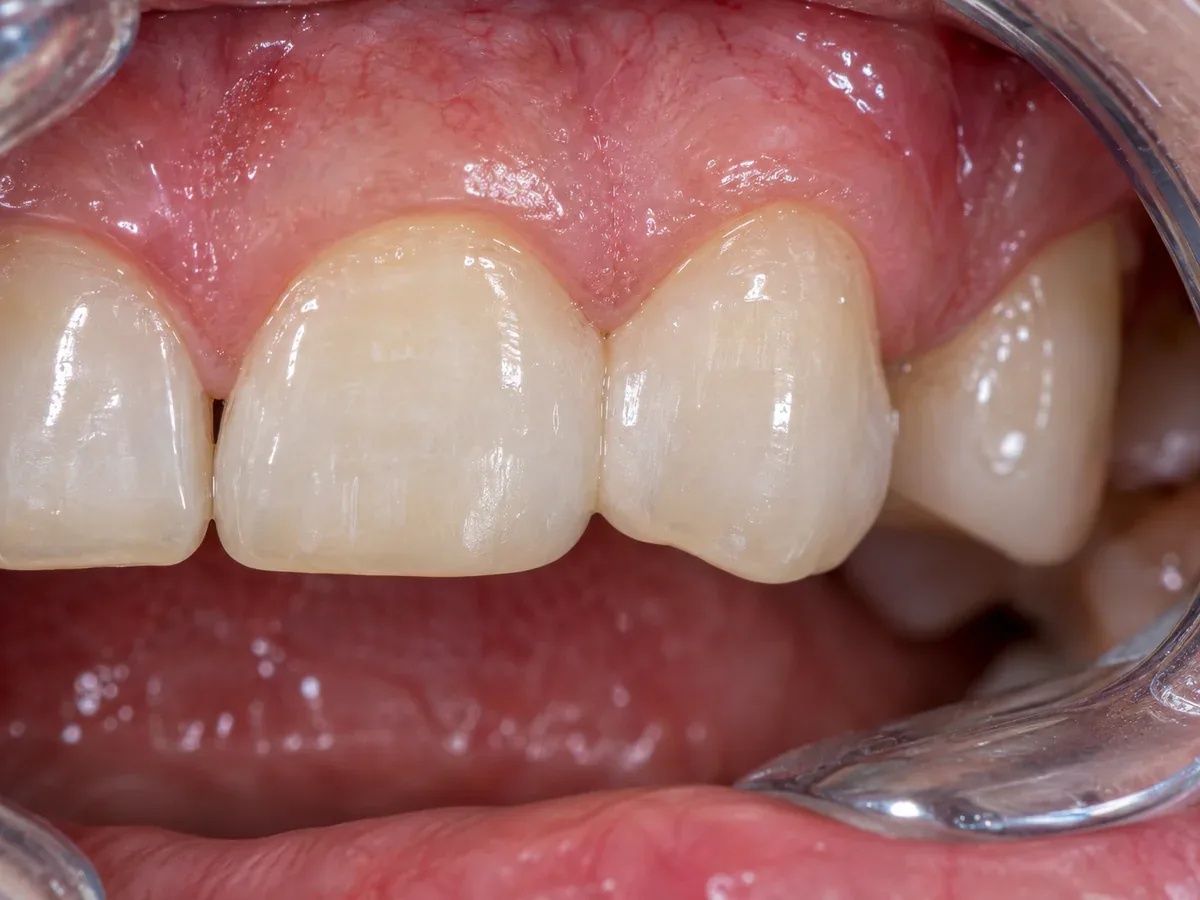
What if it loosens or catches again?
Added material can wear down, faster where chewing force is strong, and then we add more. If food still catches or it keeps recurring, we remake that veneer.
It is usually settled within two visits.
Can several spots be fixed at once?
Two or three spots per visit is possible, each checked with floss. More may take two visits, most urgent first.
What happens if you leave it?
What happens to the gum?
The gum there swells first, pressed by food. Swollen gum recedes and the space grows, so more food catches.
Can it lead to decay?
Yes. The spaces between teeth decay easily, and more so when food stays there.
These spots are hard to see, so we check them with X-rays.
Can it cause bad breath?
Yes. Floss from that one spot smells different, because food has sat there for hours and fermented.
So the smell points to the spot. Remember which space it was, and we can find it easily.
Can it lead to losing the tooth?
Some people reach that stage. Gum and bone pressed for a long time break down, and lost bone does not grow back.
So even if it seems small, please do not put it off.
Which foods catch most?
Tough, fibrous foods do.
- Meat fibres
- Leafy greens and seaweed
- Sesame seeds and mixed grains
- Tough parts of kimchi
If food catches with these alone, the contact is not very loose.
How bad is it?
We grade it like this.
| Level | What it feels like | What we do |
|---|---|---|
| Occasional | With tough food alone | Manage with floss |
| Often | One or two meals a day | Check the contact point |
| Every meal | Each time you eat | Adjust that spot |
| With pain | Gum hurts from pressure | Adjust right away |
From the third row on, it is better not to wait.
How should you clean around a veneer?
Are toothpicks or water flossers enough?
A toothpick is fine in a pinch. Used often, it pushes the gum down, the space grows and more food catches.
A water flosser removes trapped food well without pushing the gum. It cannot replace floss, though, since stuck plaque has to be rubbed off.
How do you floss properly?
The direction you insert and remove it matters.
- Snap it gently past the contact point
- Press it against one tooth surface and sweep up and down
- Do the same on the neighbouring surface
- Slide it out sideways
- Use a clean section for each space
With veneers, do not pull the floss upward. Slide it out to the side.
Will flossing pull a veneer off?
A well-bonded veneer will not come off, as long as you do not yank the floss upward hard. Skipping floss is the bigger risk, because that space decays first.
Which floss should I use?
Thin floss suits tight contacts, and slightly thicker floss cleans loose ones better. A floss holder is far better than nothing, but plain floss wraps the tooth surface and cleans more thoroughly.
The floss you will actually use is the right one.
When should I floss?
If food is caught, remove it after the meal, since the longer it stays, the more the gum is pressed. Floss at least once a day before bed, as that one time does the most work.
Keep flossing after the fix, too. Floss is a cleaning tool, not a tool to stop food catching.
When should you see a dentist in Busan?
Can it be checked on the day of bonding?
Yes. The model is mostly, but not always, the same as the mouth, so we pass floss through right there. It takes about two minutes.
If it drops through or tears, tell us then and we adjust at once. Fixed that day, it is usually done in one go.
What if I notice it later?
Many people first notice it while eating a few days later. Come in then, as it is usually done in one visit, and the longer you wait, the more the gum suffers.
Can it be prevented before bonding?
Much is decided while the veneer is being made.
- Check the contact points on the model first
- Always check with floss on the day of bonding
- Restore loose contacts on the spot
- Lower the contact point where gums have receded
These four steps prevent most cases.
What does the dentist check?
We do not look at the catching spot alone.
| Check | Method | Why |
|---|---|---|
| Contact point | Floss | Loose or tight |
| Triangular space | Visual exam | Gum recession |
| Gum condition | Bleeding check | Degree of pressure |
| Between teeth | X-ray | Decay |
| Bite contacts | Articulating paper | Force pushing food in |
All five together keep food from catching again.
When is the follow-up after bonding?
We see you once a week later and ask whether anything catches. After that, every six months is enough.
When choosing a clinic, ask about aftercare checks too.
What should I ask at the consultation?
Three questions are enough.
- Do you check the contacts with floss on the day of bonding?
- How do you restore a loose contact?
- What do you do where the gums have receded?
A clear answer to the first question is a good sign.
When should I come in?
Use this as a guide.
| Condition | When to come in |
|---|---|
| Gum at that spot swollen and sore | Within a week |
| Food catches at every meal | Within a week |
| Floss drops through freely | Within a month |
| Floss tears | Within a month |
| Tough food catches now and then | At your regular check-up |
If you are passing by, feel free to drop in then.
The one thing to remember is to try floss on the day your veneer is bonded.
Food catching after a veneer usually has a clear, fixable cause.
A floss test shows whether the contact is loose or tight,
and a small adjustment often solves it the same day.
If food keeps catching around a veneer in Busan, Reset Dental Clinic offers 1:1 English interpretation from your first consultation through the end of treatment. Call 010-8555-2854 to book a visit.
Frequently asked questions
Is it common for food to catch after a veneer?
It is not rare, and the contact point is usually the cause. Most cases are solved by adding a little material rather than remaking the veneer.
Can I check at home, and can I use toothpicks?
Pass floss through, and if it drops through freely, the contact is loose. Frequent toothpick use pushes the gum back, so food catches more.
Does it stop right after the fix?
It usually improves from that same day.
Can I get this treatment in English in Busan?
Yes, we offer 1:1 English interpretation from the first consultation to the end of treatment, near Seomyeon Station Exit 2, opposite Lotte Hotel Busan. If you live outside Busan, you can send photos first. Call 010-8555-2854, or +82-10-8555-2854 from abroad.
References
- KDCA National Health Information Portal, "Gum Disease (Periodontal Disease)" — plaque buildup causing gum inflammation, gums receding as it progresses, and the need for regular check-ups
- KDCA National Health Information Portal, "Tooth Decay" — the spaces between teeth as common sites of decay, and treatment depending on how far decay has progressed
- KDCA National Health Information Portal, "Laminate Veneer Treatment" — using a diagnostic model to estimate the shape and amount of reduction in advance
- KDCA National Health Information Portal, "Bad Breath" — food and bacteria left in the mouth as the main cause of bad breath
Written by Reset Dental Clinic Support Team
Medical review Dr. Kim Hyun-joo, Head Dentist
Last updated: October 21, 2026
This column is for general information and does not replace diagnosis or treatment for individual patients. If you have symptoms, please see a dentist.