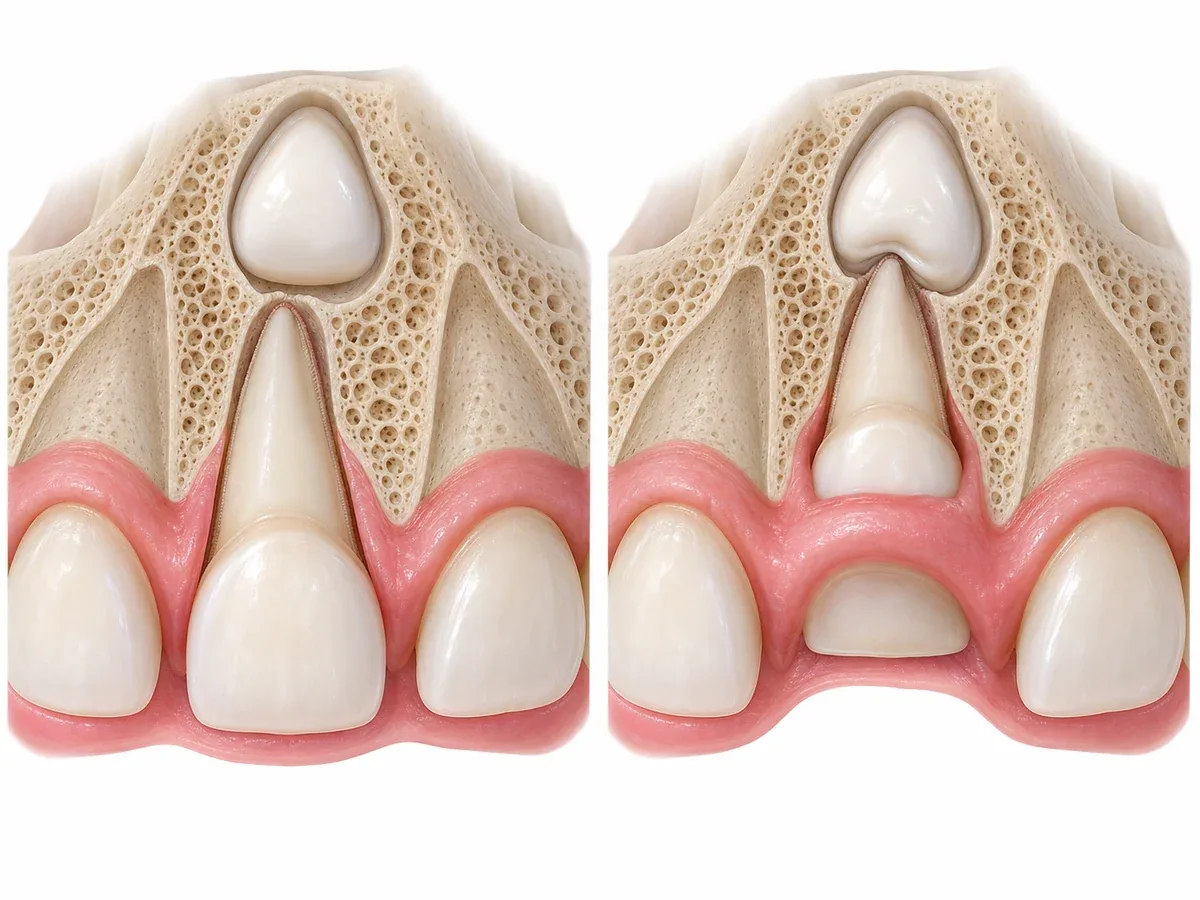
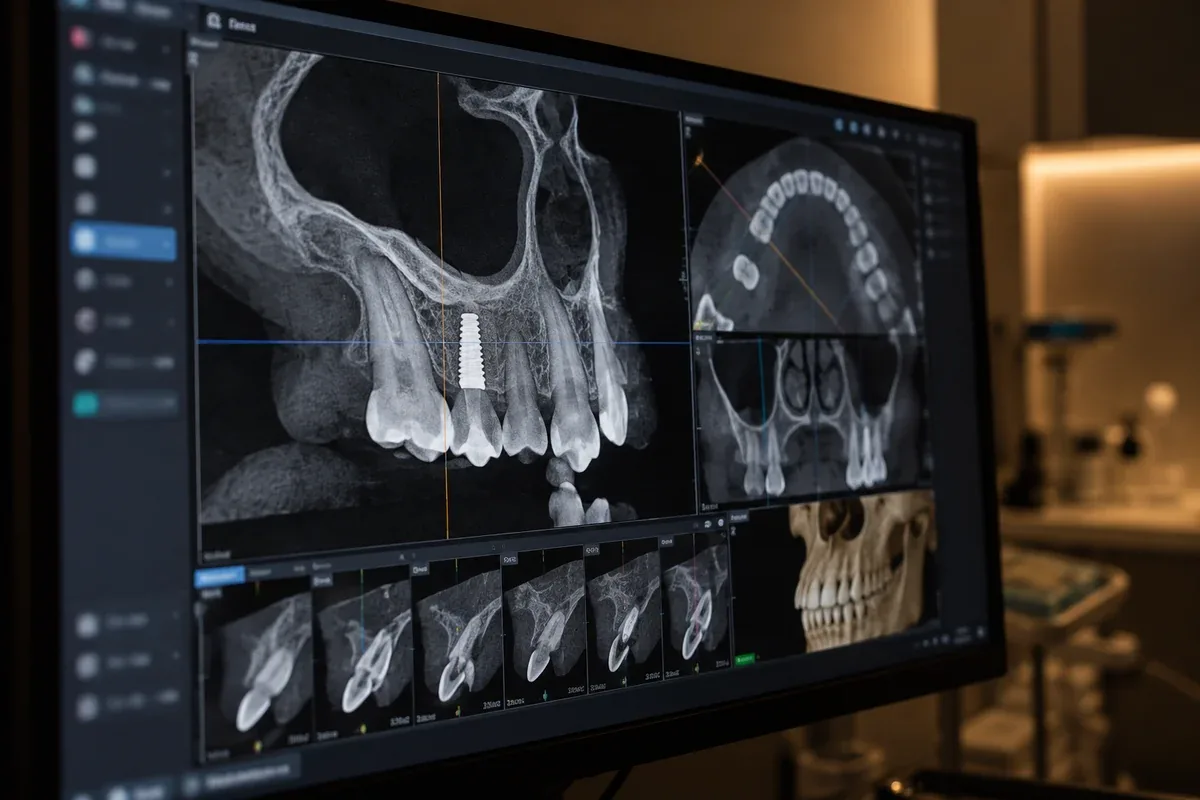
- Above the upper molars there is an air space connected to the nose.
- When a molar has been missing for a long time, that space drops lower.
- Then there is not enough bone height to place an implant.
- In that case, a sinus lift raises the floor of the space, fills it with bone and the implant goes in.
"I was told there isn't enough bone for an upper molar implant." Many people come to us in Busan after hearing this elsewhere. At Reset Dental Clinic, we first measure the height on a 3D scan. Patients living in or visiting Korea can go through a sinus lift with 1:1 English interpretation from the first consultation to the end of treatment.
Right above the roots of the upper molars is an empty space called the maxillary sinus. It is an air pocket inside the facial bone, connected to the nose.
Everyone has this space; it is not a disease. But it sets the limit for an implant.
It sounds difficult, but the sinus lift is a long-established method. One number, the height on a 3D scan, largely decides the method and timeline.
Why is an upper molar implant more demanding?
Three things overlap.
- The sinus sits right above, which limits the height.
- Upper jawbone is softer than lower jawbone, closer to a sponge.
- Molars take the most chewing force.
So an implant takes longer to bond in the upper jaw than in the lower. Demanding does not mean impossible; it means more preparation.
What is the maxillary sinus?
It is an empty space behind each cheekbone, lined with a thin membrane. During a cold, fluid can collect there.
The root tips of the upper molars sit close to it.
Why does bone height run short?
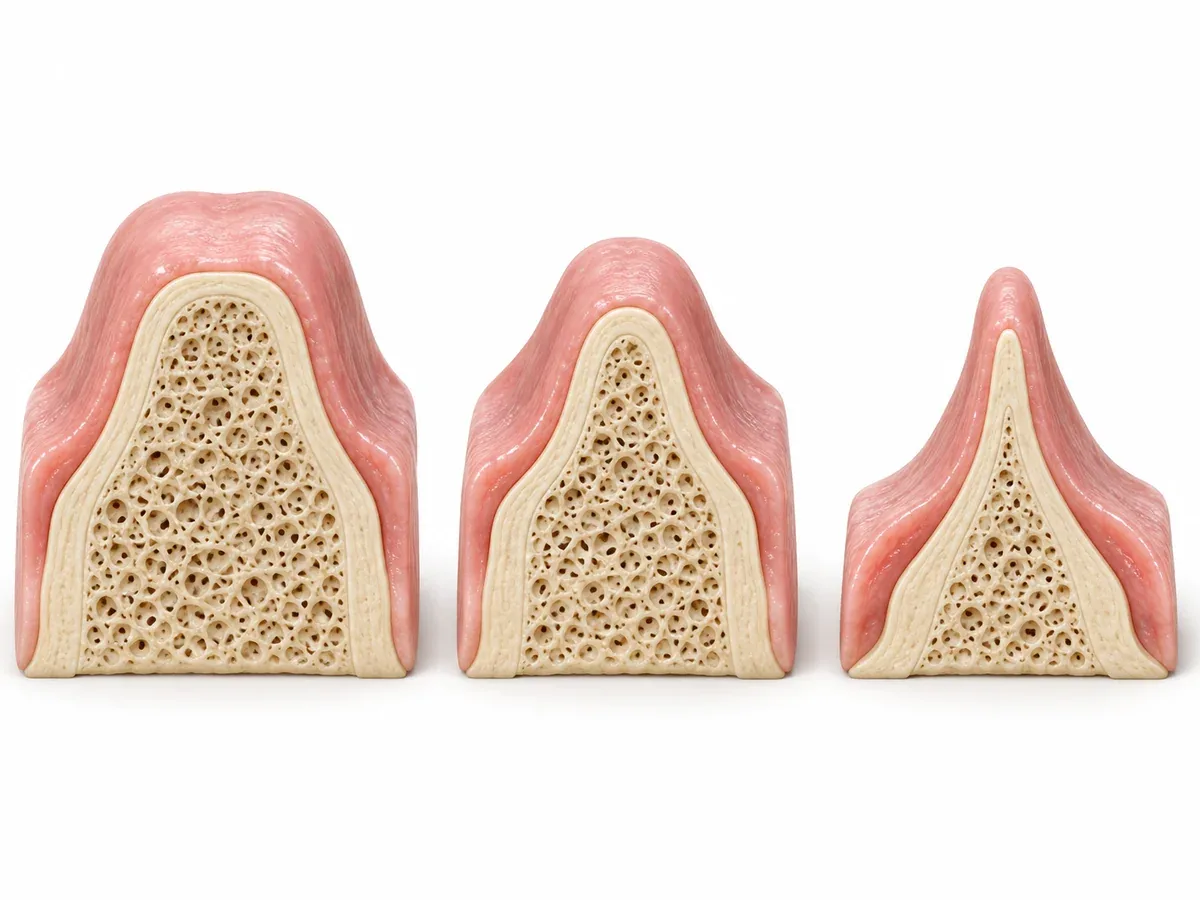
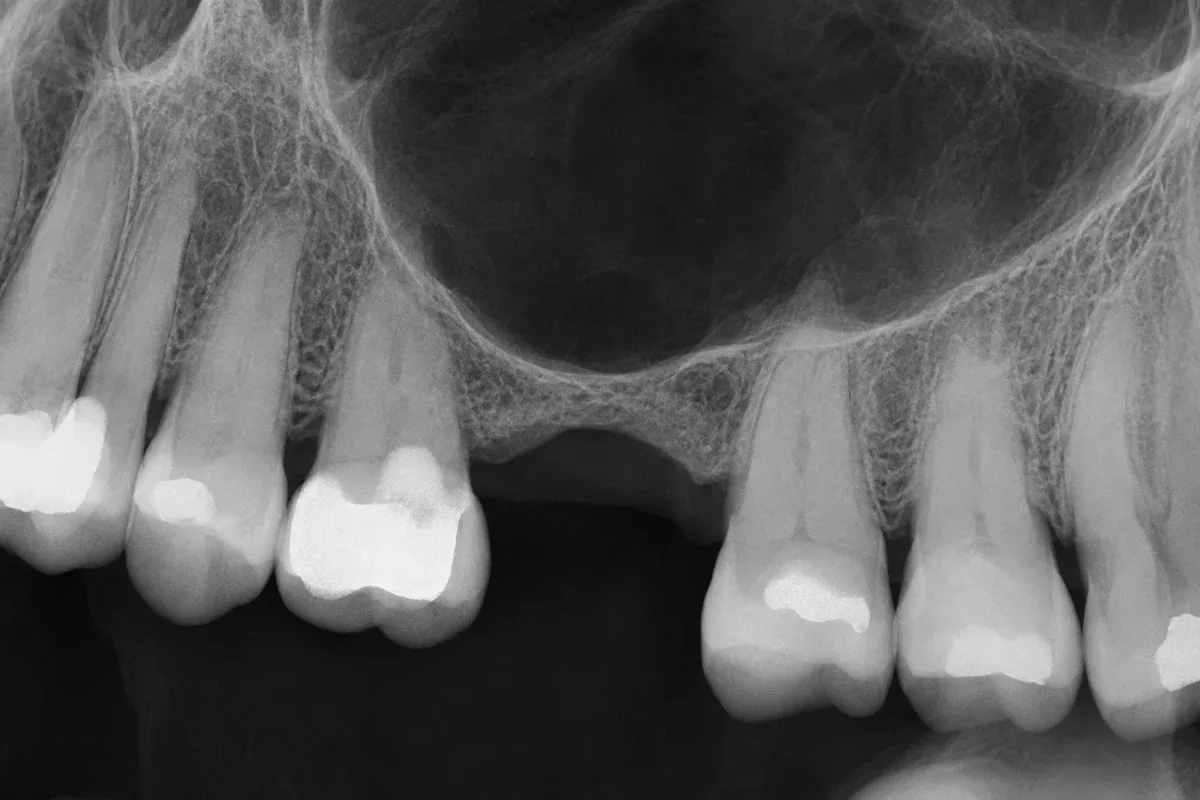
Two things happen at once: bone shrinks from below and the space drops from above.
When a tooth is lost, the gum bone there shrinks because it is no longer used. At the same time, the sinus expands downward.
Squeezed from both sides, the bone becomes thin.
How is it different from the lower molars?
The lower jaw has no sinus, but a nerve canal runs through it. So below we check the distance to the nerve, and above, the distance to the space.
Both are measured in advance on a 3D scan.
What does a sinus lift actually do?
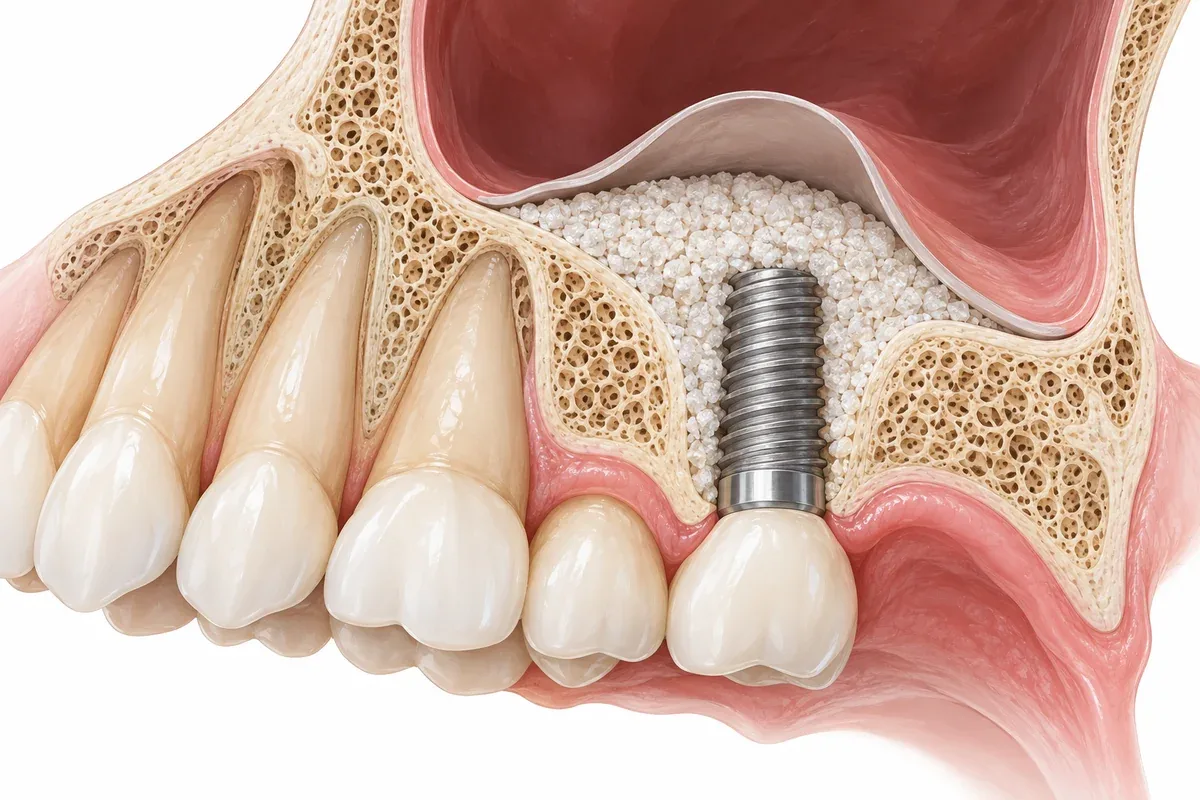
A sinus lift carefully raises the membrane on the sinus floor.
- The membrane on the sinus floor is gently lifted.
- A space is created between the membrane and the bone.
- Bone material is placed in that space.
- Over a few months, it turns into your own bone.
A sinus lift does not remove the space; it raises the floor a little.
I heard there are two methods
Yes. One lifts the floor through the implant hole from the gum side; the other opens a small window in the side wall.
Remaining height decides which.
Which one is easier on the patient?
The gum-side sinus lift is less of a burden, with less swelling. The side-window approach swells a little more, but it allows wider filling and is more reliable.
Forcing the simpler method on thin bone is actually riskier.
What if the membrane tears?
It can happen and is not rare. A small tear is covered on the spot and the work continues.
With a large tear, no bone is placed that day and the area is closed. After it heals in a few months, we try again without rushing.
What is the bone made of?
Several materials are used: your own bone, processed bovine bone and synthetic material. They are usually mixed, since each has different strengths.
After a few months the area turns into your own bone. We tell you in advance which materials we will use.
| Material | Feature | Usually used |
|---|---|---|
| Your own bone | Bonds most readily | A small amount mixed in |
| Processed animal bone | Keeps its shape a long time | For filling wide areas |
| Synthetic material | Easy to obtain | Mixed in |
| Barrier membrane | Stops gum tissue growing in | With the side-window approach |
| Mixed use | Combines the strengths | Most cases |
Most cases use a mix.
Is the bone filled on the day the implant is placed?
If enough height remains, yes. There must be enough bone to hold the implant firmly at first.
If not, the implant would wobble, so treatment is staged. The bone is filled first and the implant placed a few months later, which is often the safer path.
What should you avoid after a sinus lift?
Do not blow your nose hard. This matters most, and these five rules apply for two weeks.
- No hard nose blowing — the pressure goes straight up.
- Sneeze with your mouth open — holding it in is riskier.
- No straws — sucking creates pressure.
- No flights or diving — the air pressure changes.
- No smoking — both the sucking and the smoke are harmful.
Compared with a regular implant, a sinus lift adds one rule: do not create pressure.
If it is a season when you blow your nose a lot, tell us beforehand. We can prescribe medicine as well.
Otherwise, grafted bone can leak out.
I have a little nosebleed. Is that okay?
A little blood on the treated side is common and stops in two or three days. Wipe gently.
If it continues past a week, contact us.
My nose feels blocked
That is swelling and is common. It usually eases with the prescribed medicine, and a slightly higher pillow helps.
If it is unchanged after two weeks, it needs a check.

| Time | Usual condition | What to do |
|---|---|---|
| Same day | A little blood from the nose | No hard blowing |
| Days 1–3 | Cheek and cheekbone swell | Cold packs, do not skip medicine |
| Days 4–7 | Swelling turns the corner | Warm packs, soft food |
| Days 7–14 | Stitches removed | Still no flights or diving |
| Months 4–6 | Bone settles | Tooth is fitted |
If things go off this course, please contact us.
When should I contact you right away?
Do not wait if any of these happen.
- Granules came out when you blew your nose.
- Yellow discharge keeps coming from one nostril.
- Swelling is getting bigger after day three.
- You have a fever.
- The cheekbone area keeps throbbing.
The first one needs a visit at once. It can mean grafted bone has leaked toward the nose.
It must be covered again, which is simpler early. For the others, call first and we will make time that day.
Please do not wait it out alone.
How is a sinus lift planned in Busan?
We take a 3D CT scan, since a flat X-ray cannot show height and width accurately.
We also check for internal walls inside the sinus, which differ from person to person. The way in is planned around that shape.
How much bone is needed?
With about 10 millimeters, the implant usually goes in as it is. With five or six, the floor is lifted as the implant is placed.
If thinner, the sinus lift is done first and the implant goes in months later. The number is not the whole story, as bone density is checked too.
| Remaining height | Usual approach | Time |
|---|---|---|
| 10mm or more | Place the implant as is | 3–4 months |
| 6–9mm | Lift gently from the gum side while placing | 4–6 months |
| 4–5mm | Side window, fill and place together | 6–8 months |
| Under 4mm | Fill first, place later | 8–10 months |
| Thick membrane | ENT treatment first | Depends on condition |
The further down the table, the longer it takes.
How is implant length decided?
It follows the remaining height. Short implants are now widely used.
A short implant can sometimes mean less bone to fill, with a slightly wider body instead. The 3D scan decides which is better.
How many implants are placed?
Not always one per missing tooth. Two implants may carry a three-tooth bridge, reducing the area to fill.
Too few, though, overloads each one.
Why does it take longer, and what about a temporary?
The grafted bone needs time to settle, usually four to six months. Loading a tooth too soon can loosen it.
A removable temporary that avoids the site is available, though many go without one for back teeth.
How long is the surgery, and does it hurt?
A gum-side sinus lift with an implant takes 30 to 40 minutes. The side-window approach takes about an hour, and both sides together nearly two hours.
It is done under local anesthesia, and you can ask about sedation. You will feel pressure and hear sounds, a little louder near the sinus.
If you feel uncomfortable, raise your hand and we pause.
Who needs extra preparation before a sinus lift?
If you have sinusitis, it is treated first; it does not rule you out. Lifting an inflamed membrane can spread the inflammation.
An ENT doctor checks it before we go ahead. If the membrane looks thick on the 3D scan, we tell you.
Does smoking make it harder?
Yes, especially with a sinus lift. Smoke irritates the membrane, and the sucking motion creates pressure.
Healing slows too, so stop for at least a month.
What if I have diabetes?
If blood sugar is under control, we go ahead. The KDCA also explains that uncontrolled sugar can worsen gum disease.
We check your levels before surgery, so please bring the names of your medicines.
What if I take osteoporosis medicine?
Tell us in advance, as the type and duration matter. Some medicines affect bone healing.
Do not stop them on your own. We consult your prescribing doctor and set the timing accordingly.
What about cost?
Adding a sinus lift adds to the cost, depending on the method and how much is filled. We write it down at the consultation after reviewing the 3D scan.
According to Korea's National Health Insurance Service, insured people aged 65 or older are covered for up to two implants.
How well does it work?
It is a well-known, long-practiced procedure. However, results drop with smoking and inflammation.
So we deal with sinusitis and smoking first.
Another clinic said it can't be done
That is sometimes said from bone height alone, yet most such cases can be done with a sinus lift.
Bring your 3D scan and we will review it. Often a new scan is not needed.
How do you keep a sinus lift implant healthy for years?
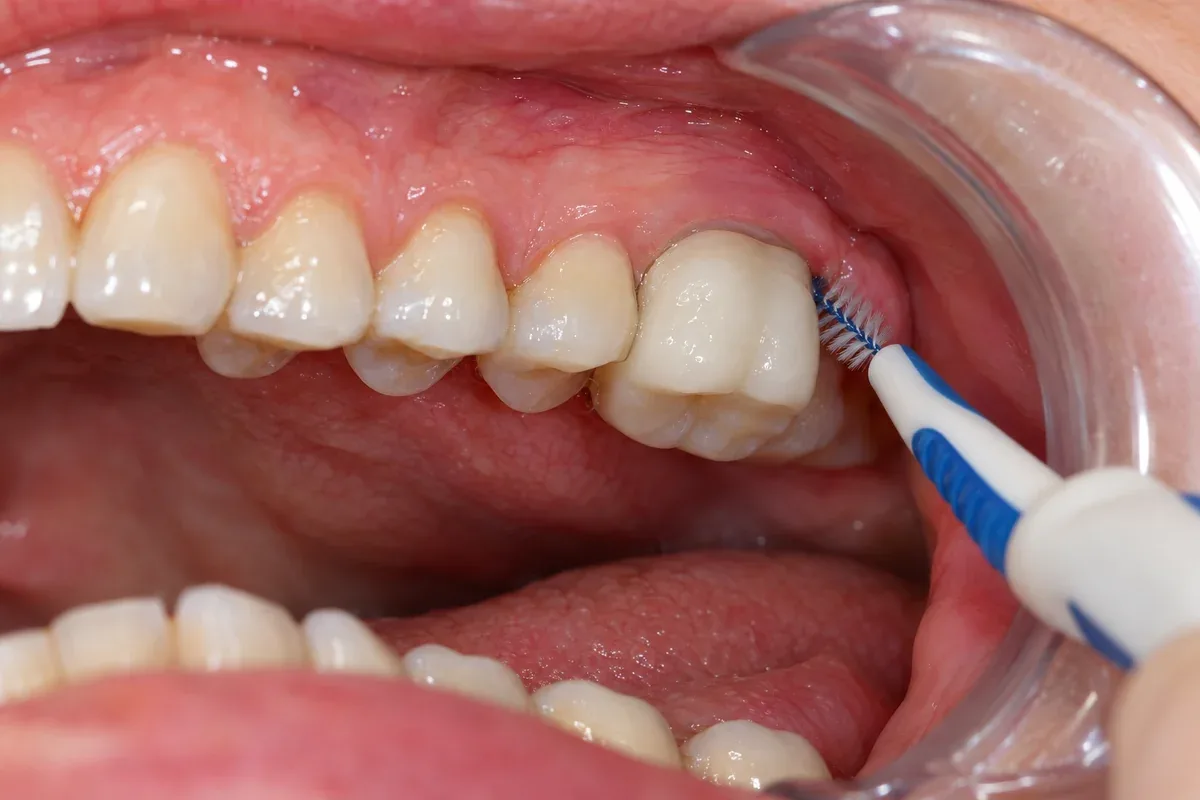
Use floss and interdental brushes, focusing on the edges. Upper molars are hard to reach, so learn the angle with a mirror.
Have a check-up every six months. Inflammation around an implant often does not hurt at first, so it is found late.
Will the bone sink back down later?
Grafted bone usually stays where it is. The implant passes chewing force into it, the opposite of unused bone shrinking.
But inflammation around it can shrink it again. Care decides how long it lasts.
Can an implant move into the sinus?
It is rare but reported, when initial stability was weak. So we check that it holds firmly when placed.
If the site is weak, we fill bone that day without placing the implant. Forcing it in is the greatest risk.
Does it affect the nose afterwards?
Usually not, because the space remains. Some feel that side is heavier during a cold.
Repeated inflammation is reviewed with an ENT doctor.
Is it easier right after extraction?
In a way, yes, because the bone has not shrunk yet. A few months after extraction, the sinus starts to drop.
So we plan the next step at extraction, deciding that day whether to place an implant or just fill bone.
How long before an empty space changes?
After six months the bone shrinks noticeably. After a year, filling is often needed, and after several years it usually is.
Even then, it is still possible; it just takes longer.
Can I just chew on the other side?
For a while, you will. But over time those teeth wear faster and the jaw shifts to one side.
So keep the empty period short.
When choosing a dentist in Busan, ask whether they measure on a 3D scan before saying yes or no to a sinus lift.
Frequently asked questions
Will a sinus lift cause problems with my nose?
The membrane is lifted, not removed, so the space itself remains.
When can I fly after a sinus lift?
Plan from two weeks onward. Tell us your travel dates and we will plan around them.
Can both sides be done at once?
Yes, though eating becomes harder for a while. Thin bone is done in stages, because rushing can lead to failure.
Can I get a sinus lift in English in Busan?
Yes, we offer 1:1 English interpretation from the first consultation through the end of treatment. The clinic is near Seomyeon Station Exit 2 (5-min walk), opposite Lotte Hotel. Call 010-8555-2854 (+82-10-8555-2854 from abroad), or send your scans first if you live farther away.
Not enough bone often means filling it first, not giving up.
Measure on a 3D scan, lift the floor and fill it,
and protect it from pressure for two weeks.
If you were told your upper molar needs a sinus lift in Busan, Reset Dental Clinic offers 1:1 English interpretation from your first consultation through the end of treatment. Call 010-8555-2854 to book a consultation.
References
- National Health Insurance Service, "Dental Implant Coverage Guide" — definition as treatment replacing missing teeth; coverage for people aged 65 or older, up to two implants per person, with a 30% co-payment
- KDCA National Health Information Portal, "Systemic Disease and Periodontal Treatment" — uncontrolled blood sugar can worsen periodontitis, and care is needed with some osteoporosis medicines
- KDCA National Health Information Portal, "Gum Disease (Periodontal Disease)" — gum inflammation that develops when plaque builds up
- KDCA National Health Information Portal, "Tooth Decay" — removing plaque with correct brushing is the most basic and important prevention
Written by Reset Dental Clinic Support Team
Medical review Dr. Kim Hyun-joo, Head Dentist
Last updated: October 21, 2026
This column is for general information and does not replace diagnosis or treatment for individual patients. If you have symptoms, please see a dentist.