- Root canal treatment does not "kill" a tooth. It removes pulp that is already infected beyond recovery, then cleans and seals the space inside.
- Pain that suddenly stops may not mean healing. The pulp can die and go quiet while the inflammation continues.
- Reported success rates are 60–90%, and about 70–80% at ten years. No clinic can promise a certain result.
- A crown afterwards is not about looks. The treated tooth breaks more easily because a lot of it has been removed.
"You need root canal treatment." Many people feel their heart sink when they hear this. At Reset Dental Clinic in Seomyeon, Busan, we often meet patients who have heard that it is long, painful and ends with a crown. For patients living in or visiting Korea, we provide 1:1 English interpretation from the first consultation through the end of treatment.
This column draws on the Korea Disease Control and Prevention Agency (KDCA) health portal. Its pages on root canal treatment, toothache, tooth decay and extraction are our main sources. We explain what the treatment does, when it is truly needed and how many visits it takes.
What does root canal treatment actually remove?
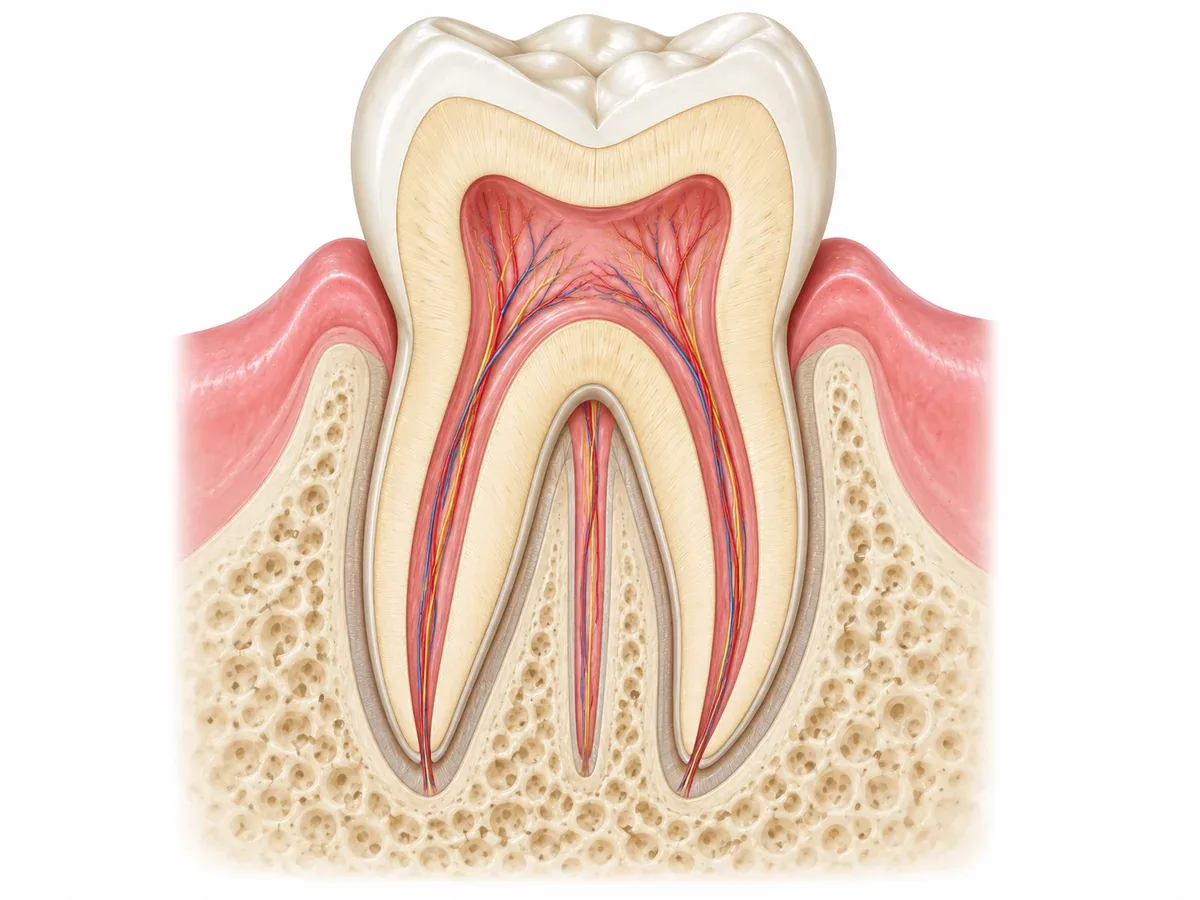
A tooth looks like a solid block, but there is a space at its very center. The KDCA material divides this space into two parts. The pulp chamber sits in the crown of the tooth, and the root canals run down through the roots.
Inside this space is the pulp. It is soft tissue that contains the tooth's nerves and blood vessels.
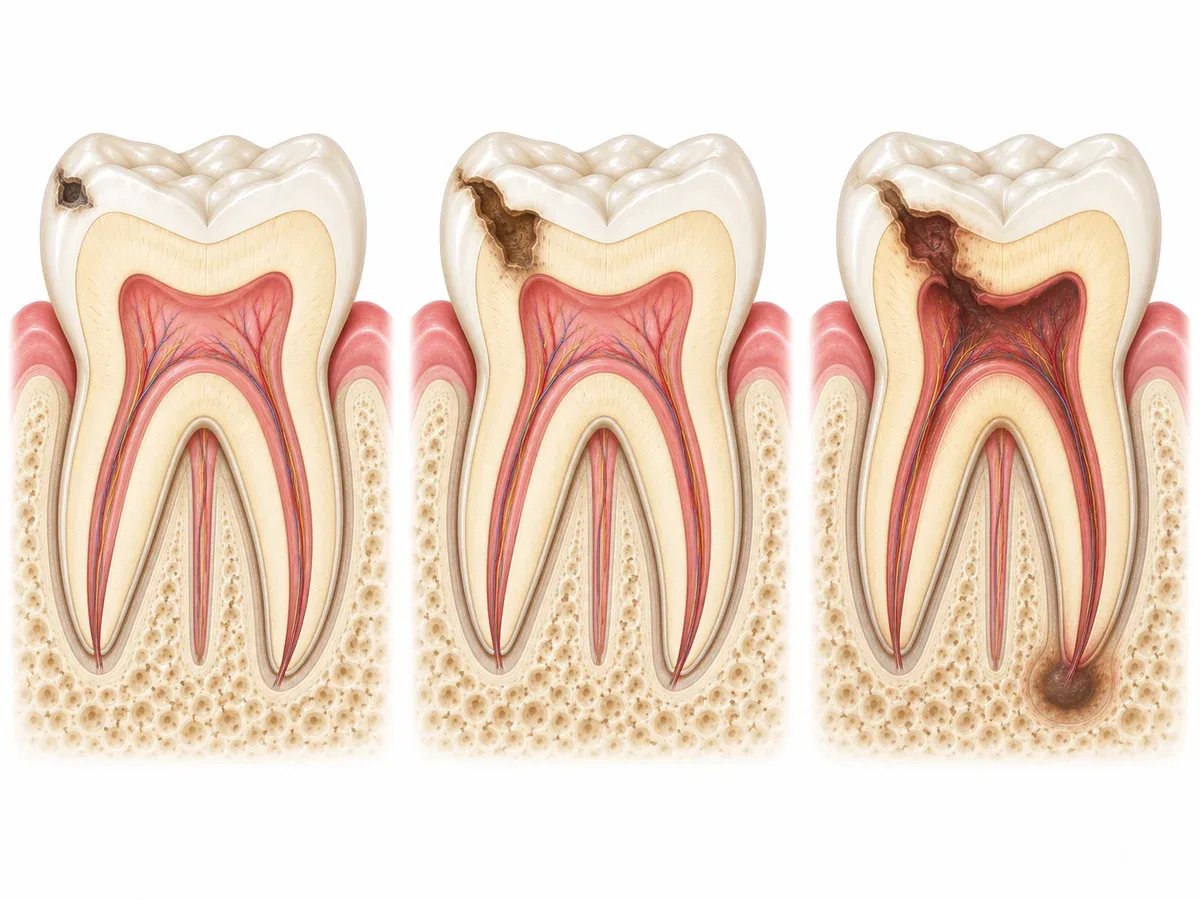
Deep decay or a fracture can put strong stress on a tooth. When the pulp reaches an infection it cannot recover from, called irreversible pulpitis, root canal treatment becomes necessary.
If it is left alone, bacteria cause pain. The inflammation can then spread through the root tip into the surrounding bone. It may progress to osteomyelitis, a bone infection, and the tooth may finally have to be extracted.
So the infected pulp is removed and the inside of the tooth is washed. The empty space is then sealed with sterilized material.
Many patients ask whether it is safe to lose the pulp. The pulp carries sensation, feeds the tooth and builds dentin to protect it. Yet once it is irreversibly damaged, removing it causes no problem for chewing, according to the KDCA material.
Is your pulp inflammation reversible or not?
Two kinds of pulpitis can look alike, yet they are treated in completely different ways. The table below follows the categories used in the KDCA toothache material.
| Type | Symptoms | Treatment |
|---|---|---|
| Reversible pulpitis | Sharp pain with cold, sweet or mechanical stimuli, but the pain stops right after the stimulus stops | Decay is removed, the pulp is protected with a dressing, and the tooth is restored a few weeks later |
| Irreversible pulpitis | Pain continues after the stimulus stops, or the tooth hurts even at rest. It can wake you at night and spread to the ear or cheek | Root canal treatment or extraction |
The material says irreversible pulpitis means the pulp is damaged and pulp necrosis is under way. Necrosis simply means the tissue is dying.
This leads to a point worth remembering. The KDCA FAQ includes a question from someone whose tooth hurt badly and then suddenly stopped hurting.
The answer is clear. The pain of acute pulpitis can fade as the pulp dies, but the inflammation has not stopped. Left untreated, it can spread below the root and even cause loss of the jawbone around the tooth.
Pain that fades is not the same as healing. Please do not read quiet as recovery.
Is the painful tooth really the one causing the pain?
The KDCA toothache material points out a feature of pulp pain. Patients often cannot say exactly where the pain is coming from.
The pain may be severe, yet the patient cannot tell which tooth it is. Sometimes they even point to the wrong tooth.
It works the other way once inflammation spreads around the root tip. Then the tooth hurts when you bite and feels tender when tapped. In that case, patients usually find the cause more easily.
Some toothaches do not come from teeth at all. The material groups these as non-dental toothache and lists several kinds:
- toothache from the muscles
- toothache from the sinuses
- toothache related to the heart
- toothache with psychological causes
- toothache caused by trigeminal neuralgia
The material even warns patients to avoid tooth treatment they do not need. That is why testing comes before treatment.
| Test | What it involves |
|---|---|
| Oral examination | The dentist examines the inside of the mouth |
| Biting test | You bite down firmly |
| Periodontal examination | The gums are checked |
| Pulp vitality test | Electric pulp testing and hot or cold stimuli show whether the pulp is alive |
| X-rays | Panoramic image, periapical X-ray or dental CT |
According to the material, X-rays also help the dentist find how many canals the tooth has and where they open.
How many visits does root canal treatment take in Busan?
The KDCA material gives a typical range. Treatment is usually done in 3–4 or more visits, 3–7 days apart. Some cases finish in a single day, and some take several months.
The number is not fixed, and the steps explain why. Each step needs the inflammation to settle before the next one can begin.
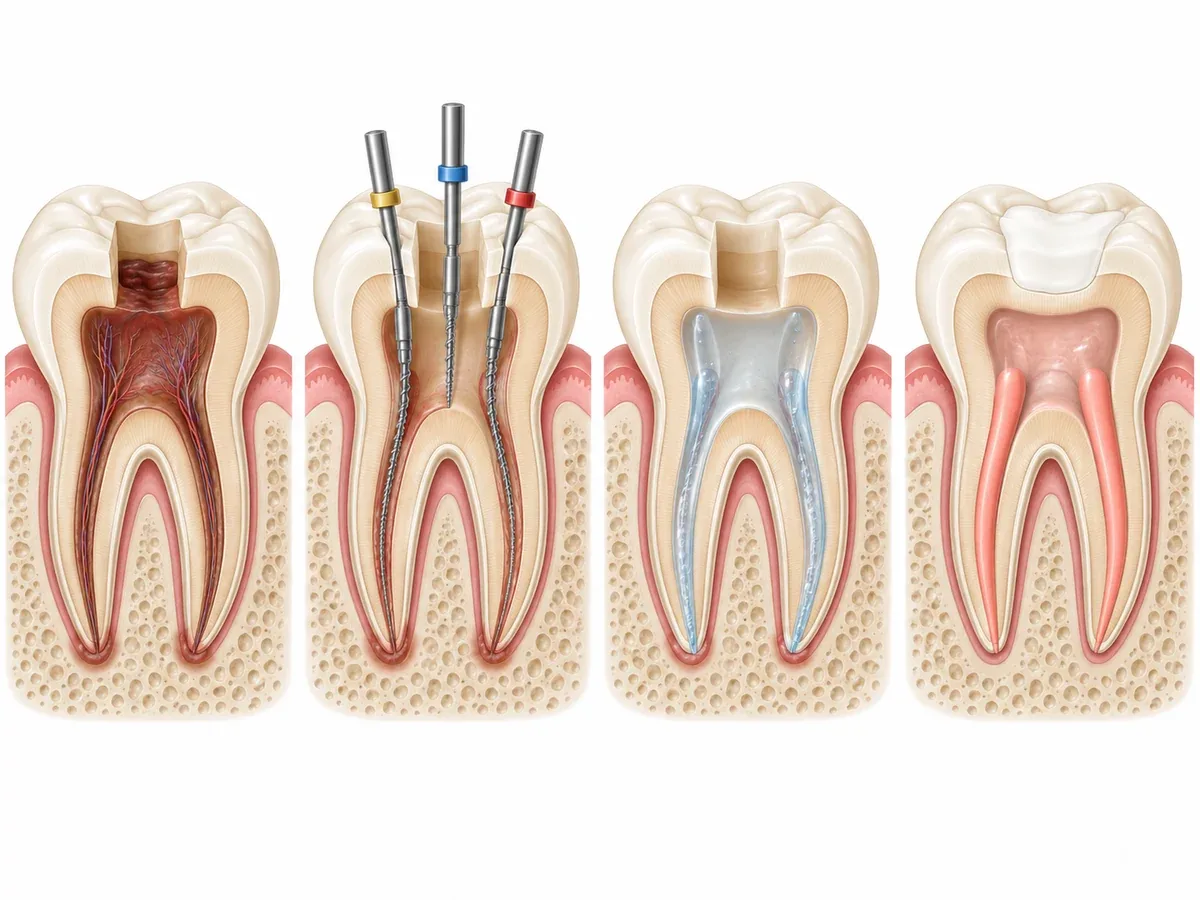
- Opening the pulp chamber. A small opening is made in the top of the tooth.
- Cleaning. Files, the instruments used in canal work, remove the infected pulp. The canals are rinsed with a disinfectant such as sodium hypochlorite.
- Shaping. The canals are smoothed and widened so they are easier to seal.
- Filling. A sealer is applied and the canals are filled with a material called gutta-percha.
The filling step is done when the pain has gone and no more inflammation appears. If inflammation does not settle at an earlier step, treatment cannot move on. That is why the number of visits differs from patient to patient.
The material adds that equipment is now used to raise success rates. Examples are rotary NiTi files, ultrasonic irrigation and dental microscopes.
The material is also clear about what patients should do during root canal treatment:
- Do not chew on the tooth. Do not push it with your finger or tongue either, because it can break easily and become sore.
- Come in right away if the temporary filling falls out. Saliva and debris can recontaminate the canal, and a contaminated canal does not heal well.
- Keep your next appointment. Leaving a temporary filling in place too long raises the risk of reinfection.
For patients visiting Korea for a limited time, it helps to plan around this schedule. Talk with your dentist about your dates before treatment begins.
How successful is root canal treatment?
The KDCA material does not hide this part. For root canal treatment to succeed, cleaning and sealing of the canals must be thorough.
But the canals are tiny, complex and different in every person. The dentist also cannot look directly inside while treating. For these reasons, success cannot be promised in every case.
| Item | Reported figure or note |
|---|---|
| Overall success rate | 60–90% |
| Ten-year success rate | About 70–80% |
| Key factor | The dentist's skill has an important effect |
| Harder cases | C-shaped canals, common in the lower second molars of Korean patients, have lower success rates |
| Follow-up | Regular check-ups, including X-rays every year |
The material notes that C-shaped canals appear often in the lower second molars of Korean people. These canals are anatomically complex, so their success rate is lower.
So checking continues after treatment ends. The material recommends regular check-ups with X-rays every year to look for reinfection.
These figures are reported ranges, not a promise of how long a tooth will last. Regular checks help catch problems early.
Why does the tooth need a crown afterwards?
It helps to reverse the question. Root canal treatment is not done in order to place a crown. Instead, the treatment leaves the tooth in a state that needs one.
To reach the pulp chamber, a lot of tooth structure has to be removed. The tooth can then break more easily, so very hard foods should be chewed with care.
The KDCA material says a crown is needed to prevent fracture in back teeth or teeth that have lost a lot of structure. The crown covers the whole tooth and holds the thin walls together.
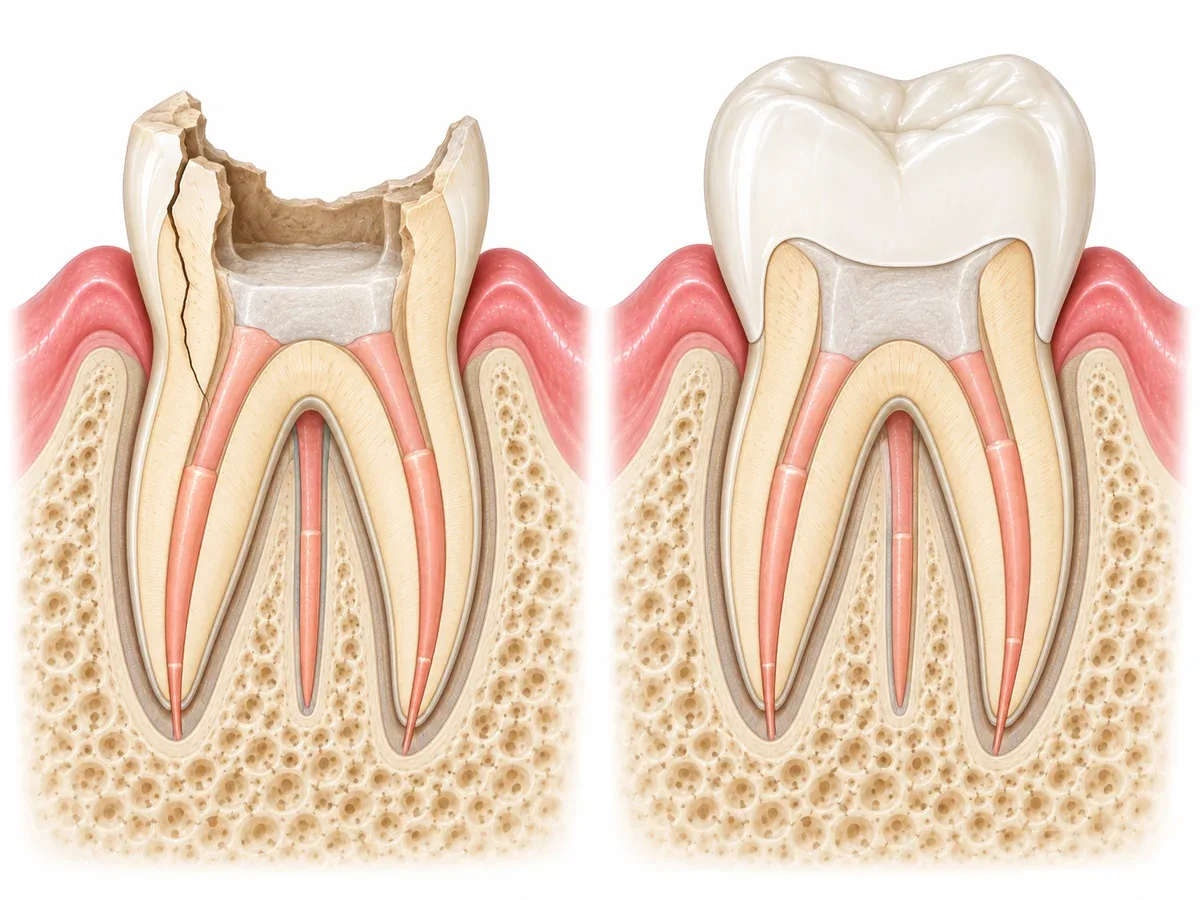
On crown materials, the material sums it up in one line. An expensive material is not automatically the right one. The choice should be made with your dentist, considering your situation, the tooth's position, your esthetic needs and your budget.
For a while after treatment, the tooth may feel different from a healthy one. If it was well cleaned and precisely filled, these unusual sensations fade within days to weeks.
Delaying the crown carries a risk. Once a treated tooth breaks, a crown may no longer fix it, and extraction can follow. It is wise to keep the timing your dentist recommends.
What comes next if root canal treatment does not work?
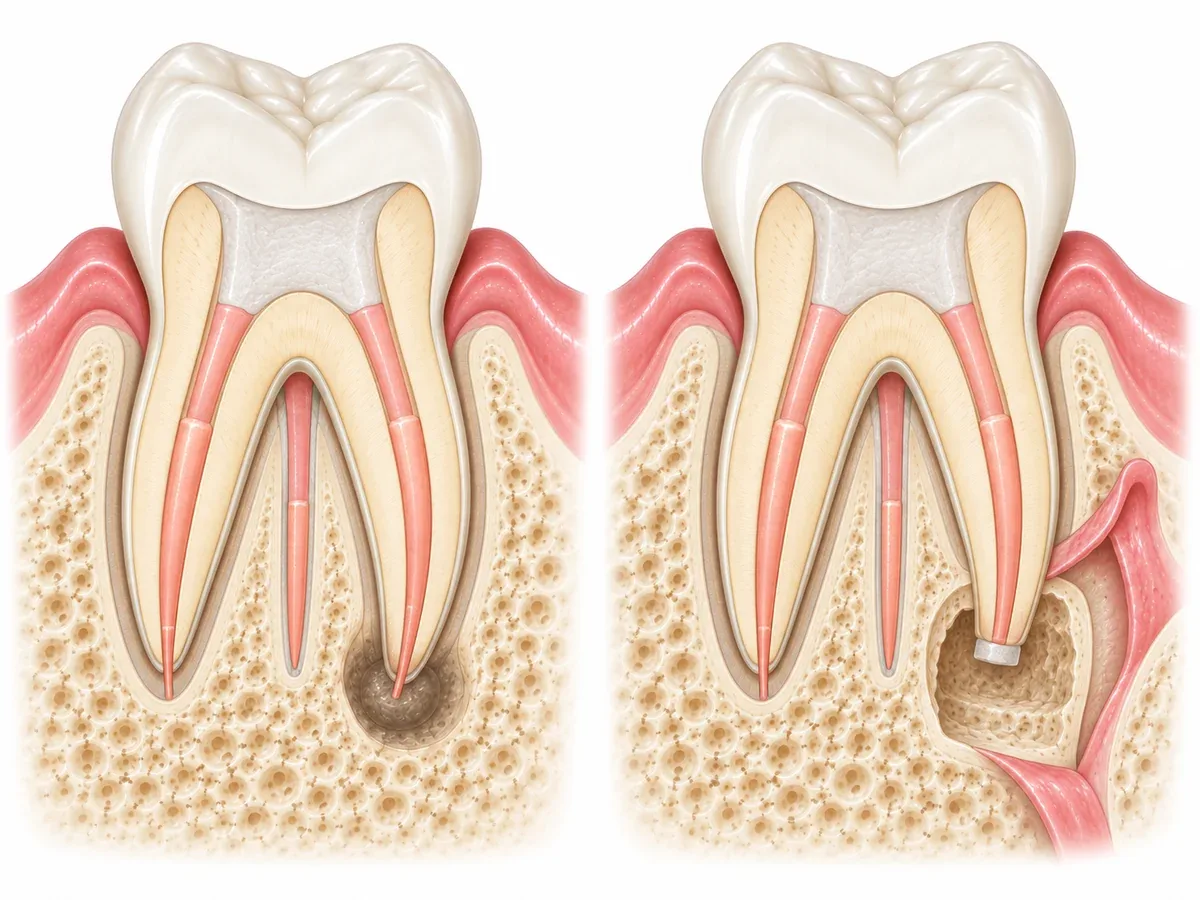
The KDCA material calls standard treatment non-surgical root canal treatment. It separately describes surgical root canal treatment for cases the standard approach cannot solve.
According to the material, the move to surgery happens in three situations:
- the canal is blocked or curved so much that it cannot be reached
- a file breaks inside the canal and is hard to remove
- a lesion at the root tip does not heal despite repeated treatment
| Option | What is done | Note from the material |
|---|---|---|
| Apicoectomy | The gum is opened, inflammation is removed, part of the root tip is cut off and the end is sealed | A biocompatible material is placed to prevent reinfection |
| Intentional replantation | The tooth is taken out, the infected root is cut and filled with a material such as MTA, then the tooth is put back | Used when thick bone or poor visibility makes root-tip surgery difficult |
| Extraction | The tooth is removed | Cannot be undone, so it should be decided carefully and when truly needed |
| Autotransplantation | After extraction, your own healthy tooth, such as a wisdom tooth, is moved into the space | Over 80% kept for about five years in clinical studies; better outlook under age 30 without gum disease |
Sometimes even these steps do not work. The KDCA extraction material lists pulp necrosis as a reason for extraction, when treatment is impossible or pain continues afterwards. Cracked teeth that stay painful despite treatment are included too.
The toothache material adds that teeth with a vertical fracture usually need extraction. Yet the same sources stress that extraction cannot be undone, so it should be a careful decision.
One lesser-known option exists after extraction, called autotransplantation. The material notes that the outlook is good for patients under 30 without gum disease. It may be worse if a long time has passed since the extraction.
Pain in a tooth that has already been treated can also have a cause. The material notes that infection in small side canals that are hard to disinfect can cause inflammation at the root tip. Surgical treatment may then be the next step, so an examination is needed.
Frequently asked questions
Does root canal treatment make the tooth "dead"?
The pulp handles sensation, nutrition and dentin formation. The KDCA material says that removing pulp that is irreversibly damaged causes no problem for chewing. The tooth does become easier to break, so it needs reinforcing.
It hurts during treatment. Is that normal?
The material lists pain and swelling as possible side effects during treatment. Pain can come from an incorrect canal length or pulp that was not fully removed. If inflammation spreads to the root tip, antibiotics and anti-inflammatory painkillers may be prescribed, so please tell your dentist rather than putting up with it.
Why not just pull the tooth instead?
The first line of the KDCA extraction material answers this. Extraction cannot be undone, so it should be chosen carefully and when truly needed. After extraction, you will need another treatment to replace the missing tooth.
Can I get root canal treatment in English in Busan?
Yes. We offer 1:1 English interpretation from the first consultation through the end of treatment. The clinic is near Seomyeon Station Exit 2 (5-min walk), opposite Lotte Hotel Busan, and you can call 010-8555-2854 (+82-10-8555-2854 from abroad).
Root canal treatment is not giving up on a tooth.
It is the last step taken to avoid losing it.
As the KDCA material says,
it is not a treatment that can promise a certain result.
That is why timing and finishing matter.
If you have been told you need root canal treatment in Busan, Reset Dental Clinic offers 1:1 English interpretation from your first consultation through the end of treatment. Please do not wait because the pain has faded; call 010-8555-2854 and have the tooth checked now.
References
- KDCA National Health Information Portal, "Root Canal Treatment" — definition and structure of the pulp chamber and canals, progression to osteomyelitis and extraction if untreated, success rates of 60–90% and about 70–80% at ten years, C-shaped canals in Korean lower second molars, 3–4 or more visits 3–7 days apart, steps from opening to gutta-percha filling, precautions during treatment, the need for a crown and choice of material, yearly X-ray check-ups, apicoectomy and intentional replantation
- KDCA National Health Information Portal, "Toothache and Chronic Pain (Toothache)" — symptoms and treatment of reversible and irreversible pulpitis, difficulty locating pulp pain, pain fading as the pulp dies, tenderness to tapping in acute apical inflammation, extraction of vertically fractured teeth, and non-dental toothache from muscles, sinuses, the heart, psychological causes and trigeminal neuralgia
- KDCA National Health Information Portal, "Tooth Decay" — symptoms by depth of decay (little pain in enamel, sensitivity in dentin, severe pain at the nerve), X-rays for lesions around the root, and temperature and electric pulp tests to decide whether root canal treatment is needed
- KDCA National Health Information Portal, "Tooth Extraction" — extraction cannot be undone and should be decided carefully; pulp necrosis (when root canal treatment is impossible or pain continues afterwards) and cracked teeth as reasons for extraction
- KDCA National Health Information Portal, "Autotransplantation of Teeth" — moving your own wisdom tooth or other healthy tooth into the space of an extracted tooth, over 80% kept for five years in clinical studies, and a better outlook under age 30 without gum disease
Written by Reset Dental Clinic Support Team
Medical review Dr. Kim Hyun-joo, Head Dentist · Esthetic Restorations
Last updated: September 19, 2026
This column is for general information and does not replace diagnosis or treatment for individual patients. If you have symptoms, please see a dentist.