

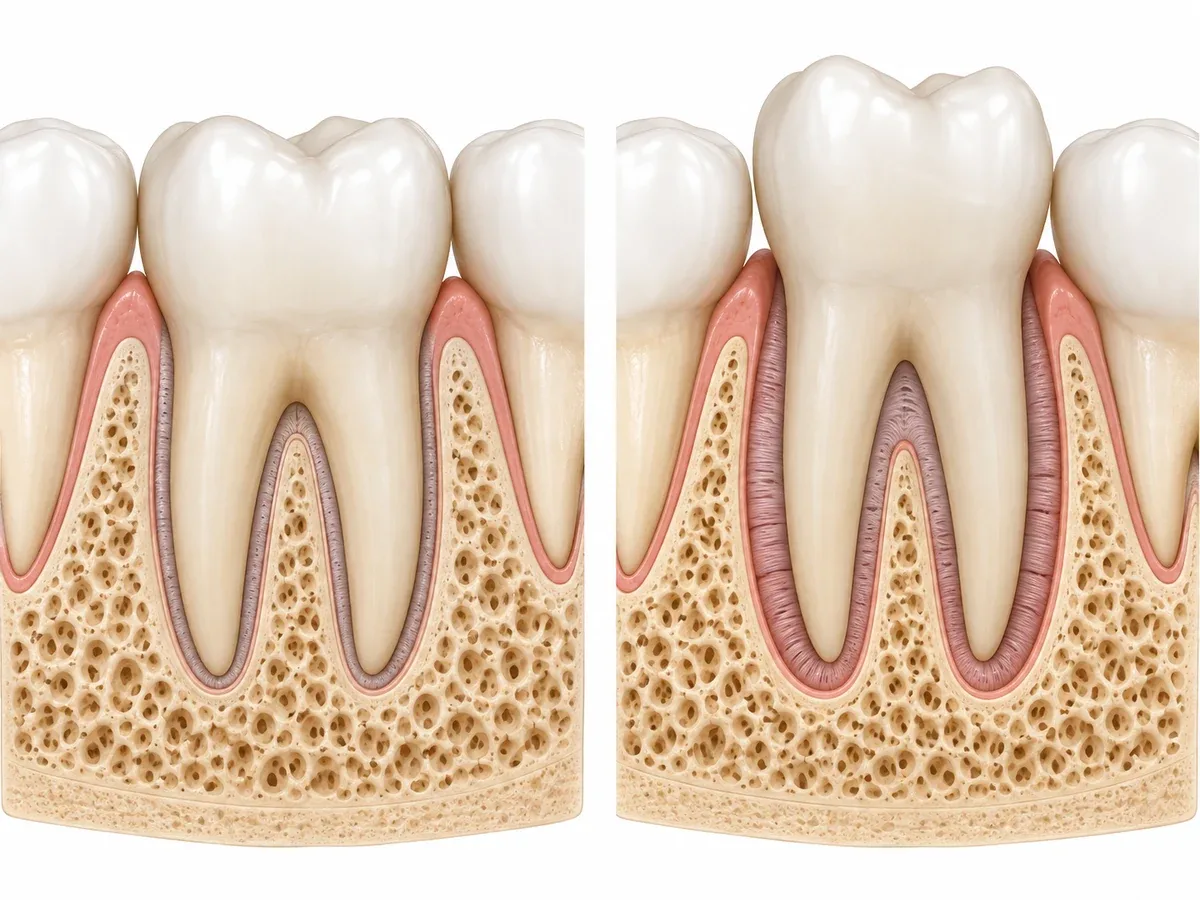
- A tooth abscess at the root tip can make the tooth feel raised, so chewing suddenly hurts.
- An acute abscess brings severe pain, swelling, fever and headache, and a light touch on the tooth can hurt.
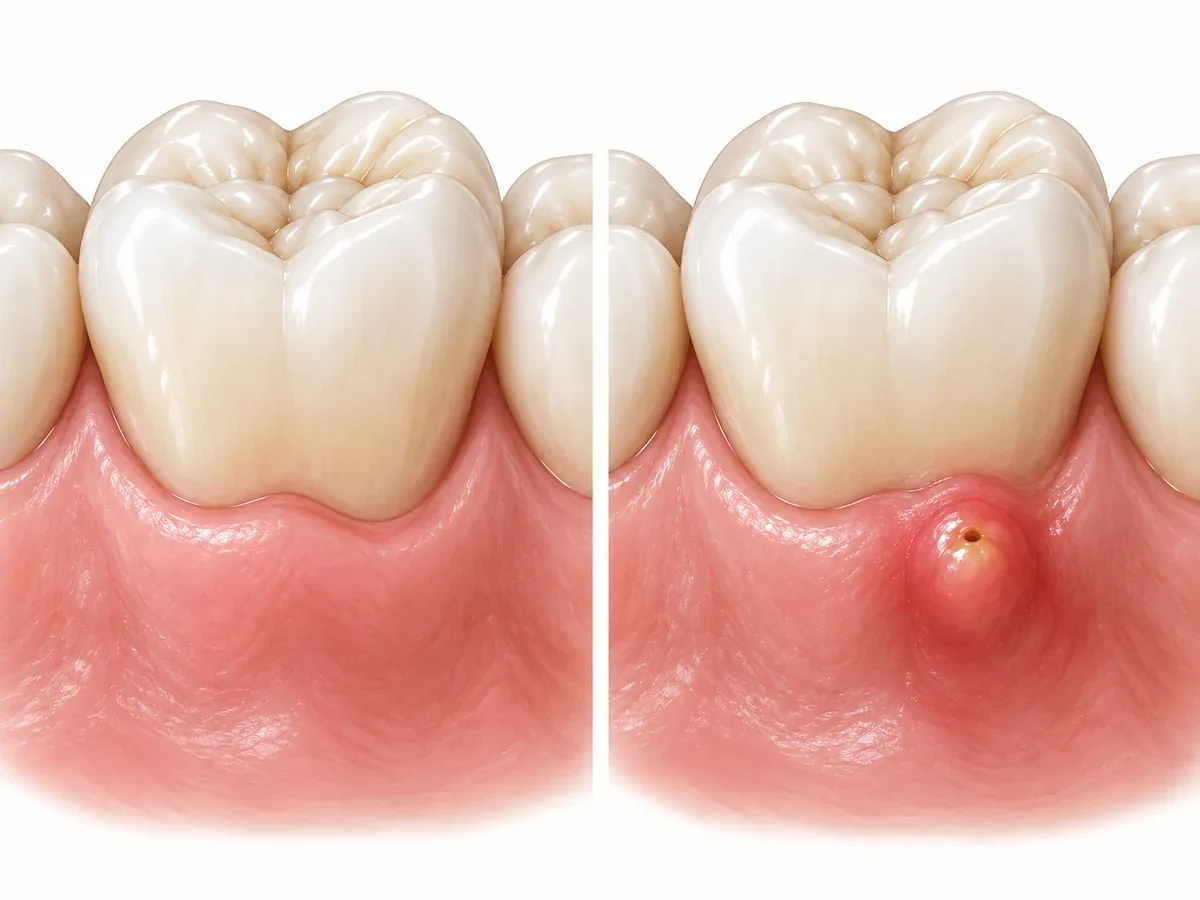
- A chronic abscess may not hurt, but it forms a fistula in the gum. This is the "pimple" that comes and goes.
- If it appears after root canal treatment, a cracked root may be the cause.
"There is something like a pimple on my gum that keeps coming and going." We hear this often from patients in Busan. Because it does not hurt, many leave it alone, yet the sources suggest a tooth abscess without pain may be the older form. For patients living in or visiting Korea, our clinic in Seomyeon provides 1:1 English interpretation from the first consultation through the end of treatment.
This column draws on Asan Medical Center's pages on periapical abscess, acute pulpitis and periodontal abscess. It also uses the KDCA page on root canal treatment.
Where does a tooth abscess start?
The medical name is periapical abscess, meaning an abscess around the tip of the root. In this column we call it a tooth abscess.
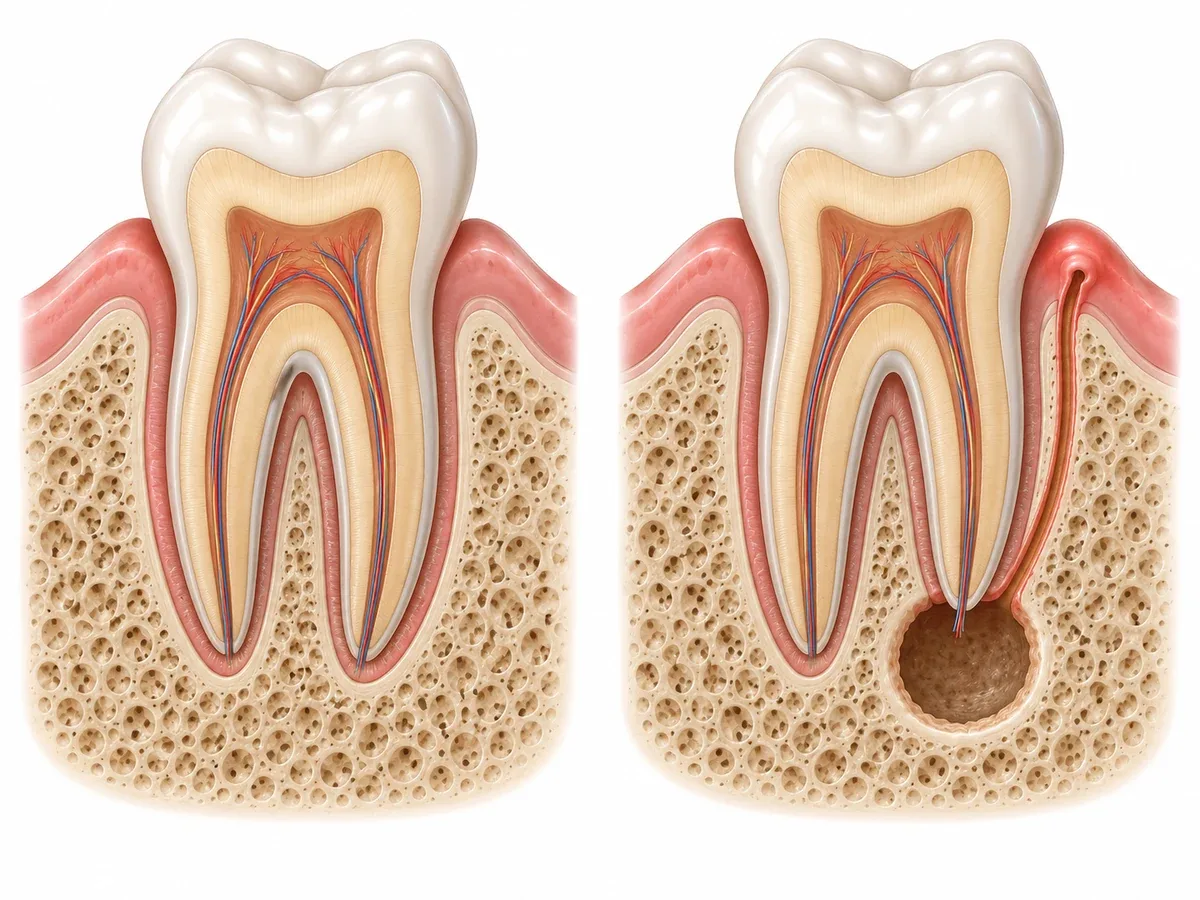
Asan Medical Center describes it as inflammation around the root of a tooth. The tooth feels as if it has risen, chewing suddenly becomes impossible, and the pain can be severe.
There are two main causes:
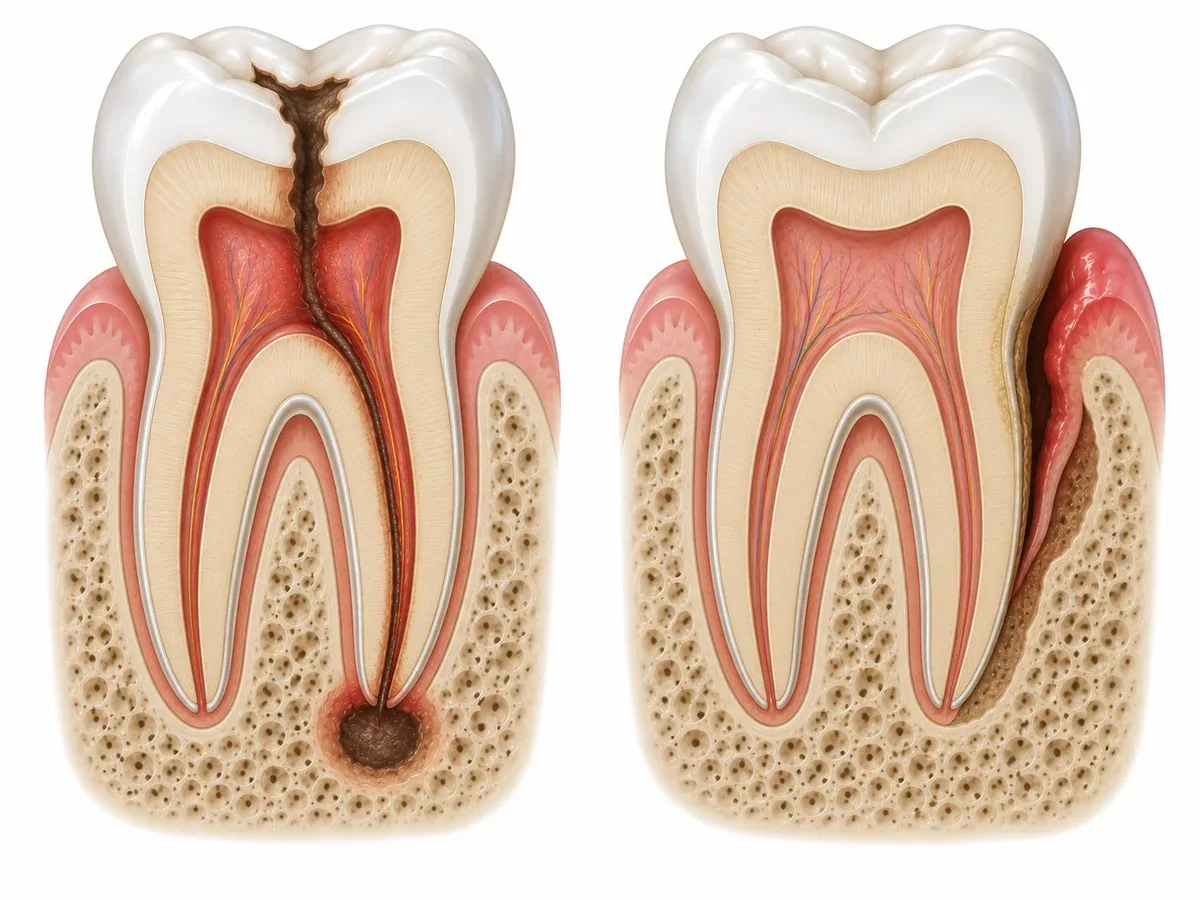
- Decay gets worse and the inflammation reaches the nerve inside the tooth.
- When the abscess appears after root canal treatment, a fractured root may be the cause.
The acute pulpitis page shows how this develops. Untreated pulpitis can spread to the periodontal ligament, the membrane around the root.
It can then lead to acute apical periodontitis, an inflammation at the root tip, and to gum disease. Treatment may take longer as a result.
The same page describes how pulpitis feels. The pain gets worse at night, with cold water and with sweet food, and it barely responds to painkillers.
In short, inflammation that begins inside the tooth moves out past the root tip. The sense that a tooth has "risen" comes from swelling in the space around the root.
How do acute and chronic tooth abscesses differ?
The source describes the two forms separately. An acute tooth abscess can bring these symptoms:
- severe pain
- swelling at the root of the tooth
- a rise in body temperature
- headache
- strong sensitivity to cold or heat
- pain so sharp that even a light touch on the tooth makes you flinch
If your face swells and you have a fever, do not wait. Fever is one of the listed signs of the acute form, so see a dentist promptly.
A chronic tooth abscess is different. It may cause no pain, but a fistula forms in the gum.
A fistula is a channel that lets pus drain out. While the channel is open, pressure does not build up, so it does not hurt.
That is why people feel it has "gotten better." Yet the inflammation inside is still there.
A pimple-like bump that keeps rising and fading can be read as this channel closing and opening again.
The difference matters for timing. The acute form pushes people to see a dentist quickly, while the chronic form is easy to ignore.
| Form | What the source says |
|---|---|
| Acute symptoms | Severe pain, swelling at the root, higher body temperature, headache |
| What patients may notice | Sensitivity to cold or heat; a light touch can cause startling pain |
| Chronic | No pain, but a fistula forms in the gum |
How is a tooth abscess told apart from a gum abscess?
"My gum is swollen" can have different starting points. Asan Medical Center defines a periodontal abscess, or gum abscess, as an infection with pus inside the gum tissue, caused by bacteria in the mouth.
The page lists these causes of a gum abscess:
- the opening of a gum pocket narrows, so pus cannot drain well
- more aggressive bacteria increase
- the body's resistance drops
- the tooth is injured, for example through orthodontics, tartar or a dental restoration
An acute gum abscess can cause spreading pain and severe pain when the gum is touched. The tooth may loosen, and rarely there is fever or weakness. A chronic gum abscess shows no severe symptoms.
A tooth abscess starts in the nerve inside the tooth and comes out at the root tip. A gum abscess starts in a gum pocket.
Both can make the gum swell, but the treatment is different. A tooth abscess needs root canal treatment. For a gum abscess, the basis is gum treatment that removes plaque and tartar, with gum surgery if bone loss has gone far.
That is why the source names X-rays for diagnosis. A tooth abscess is diagnosed with X-rays, and inflammation is usually found at the root tip.
You cannot tell the two apart by looking in a mirror. An X-ray shows whether the inflammation sits at the root tip, and that decides which treatment comes next.
| Point | Tooth abscess (periapical) | Gum abscess (periodontal) |
|---|---|---|
| Where it starts | The nerve inside the tooth, coming out at the root tip | A gum pocket |
| Causes | Worsening decay; after root canal treatment, a fractured root | Poor drainage, lower resistance, injury (orthodontics, tartar, restorations) |
| Treatment | Root canal treatment | Gum treatment removing plaque and tartar |
How is a tooth abscess treated in Busan?
The source names root canal treatment as the treatment. It removes the inflammation and the nerve inside the tooth, then fills the canal with medicine.
The source also says that if the tooth is badly damaged, it must be removed. Which path fits your tooth is decided after the X-ray and examination.
If symptoms continue despite root canal treatment, apicoectomy, surgery to remove the root tip, is carried out. The KDCA page on root canal treatment agrees.
If root canal treatment does not succeed, it moves to surgery such as apicoectomy or intentional replantation.
The KDCA page names two situations that call for root canal treatment:
- severe pain with cold or hot food and drink
- pus that keeps coming back in the gum
The second one is exactly what a recurring gum bump is. So a bump that keeps returning is one of the listed reasons to consider root canal treatment.
After treatment, the tooth is covered. As the KDCA page says, a crown is recommended to keep the tooth from cracking.
| Step | What the sources say |
|---|---|
| Diagnosis | X-rays; inflammation is usually found at the root tip |
| Main treatment | Root canal treatment removes the inflammation and nerve and fills the canal with medicine |
| Badly damaged tooth | The tooth must be removed |
| If symptoms continue | Apicoectomy, or intentional replantation |
| After treatment | A crown is recommended to prevent cracking |
What happens if a tooth abscess is left alone?
The source's section on progression is specific. Toxic products from bacteria can spread, and granulation tissue may grow at the root. In that case, apicoectomy is needed.
A pouch-like cyst can also form at the root tip. The source says a cyst destroys the surrounding bone as well as the root, so treatment should come early.
This is why an abscess that does not hurt is no reason to relax. In the chronic form, pus drains through the fistula. All the while, bone at the root tip may keep wearing away.
Some people feel better once pus comes out. Pressure drops, so the pain eases, but the inflammation has not gone.
The acute pulpitis page makes a similar point about delay. Once inflammation spreads beyond the pulp, treatment can take longer.
If the channel closes again, acute symptoms can return. The cycle of a bump rising and fading is a reason to have the tooth checked, not a sign of healing.
| Change | What the source says |
|---|---|
| Granulation tissue at the root | Toxic products from bacteria spread; apicoectomy is needed |
| Cyst at the root tip | Destroys the surrounding bone as well as the root; treat early |
| Chronic fistula | No pain, but the inflammation inside remains |

What should you keep in mind during treatment?
The source gives two cautions for patients being treated for a tooth abscess.
- A tooth abscess is hard to finish in one visit, so keep coming until treatment is complete. Do not stop halfway because the pain has settled.
- The tooth can break if you chew hard food on it during treatment. Until treatment ends, avoid chewing on that side.
A tooth whose inside has been emptied is weaker in itself. That is one reason a crown is recommended at the end.
For visitors and students with a fixed schedule in Korea, plan the number of visits early. Ask how many appointments your tooth is likely to need before you book travel.
Between visits, watch for changes. Tell the clinic if swelling, fever or pain returns before your next appointment.
| What you notice | What it may mean | What to do |
|---|---|---|
| Facial swelling with fever | Fever is a listed sign of the acute form | See a dentist promptly |
| A gum bump that rises and fades | A fistula draining pus in the chronic form | Have an X-ray taken |
| Pain again after root canal treatment | A fractured root may be the cause | Have it checked with X-rays |
| A tooth that feels raised | Swelling in the space around the root | Avoid chewing on it and get checked |
At your first visit, these details help the dentist. Note them down before you come:
- when you first noticed the bump, and how often it comes back
- whether the tooth hurts, feels raised, or is sensitive to cold or heat
- whether the tooth has had root canal treatment before
- whether you have had fever, headache or facial swelling
Frequently asked questions
It does not hurt. Do I really need treatment?
The source says a chronic tooth abscess may cause no pain but forms a fistula in the gum. It also says a cyst can form and destroy the bone around it, so treatment should come early. No pain does not mean it is healing.
The tooth already had root canal treatment, and it hurts again. Why?
The source says an abscess after root canal treatment may be caused by a fractured root. If symptoms continue despite root canal treatment, apicoectomy is carried out. X-rays show which applies.
Pus came out and now it feels better. Is it healed?
When pressure drops, pain eases, but that does not mean the inflammation has gone. This is why the source describes the chronic form as a fistula without pain. If the channel closes again, acute symptoms can come back.
Can I get tooth abscess treatment in English in Busan?
Yes. We offer 1:1 English interpretation from the first consultation through the end of treatment. The clinic is near Seomyeon Station Exit 2 (5-min walk), opposite Lotte Hotel Busan, and you can call 010-8555-2854 (+82-10-8555-2854 from abroad).
A gum bump that comes and goes is a signal, even without pain.
The channel may close and open again,
while the bone at the root tip
quietly keeps changing.
If you think you may have a tooth abscess in Busan, Reset Dental Clinic offers 1:1 English interpretation from your first consultation through the end of treatment. Call 010-8555-2854 to arrange a visit.
References
- Asan Medical Center Disease Encyclopedia, "Periapical Abscess" — definition and the feeling of a raised tooth, causes (worsening decay, and a fractured root after root canal treatment), acute symptoms such as severe pain, swelling, fever and headache, a chronic form without pain but with a gum fistula, X-ray diagnosis, root canal treatment, extraction or apicoectomy, granulation tissue and cysts that destroy surrounding bone, and cautions during treatment
- Asan Medical Center Disease Encyclopedia, "Acute Pulpitis" — definition as inflammation of the pulp that can develop when treatment is delayed, painkiller response compared with decay pain, typical symptoms, and progression to the tissue around the root, acute apical periodontitis and gum disease
- Asan Medical Center Disease Encyclopedia, "Periodontal Abscess" — definition as a pus-forming infection inside gum tissue, causes including poor drainage, more aggressive bacteria, lower resistance and injury from orthodontics, tartar or restorations, acute and chronic symptoms, and treatment by removing plaque and tartar, with gum surgery when bone loss has progressed
- KDCA National Health Information Portal, "Root Canal Treatment" — removing the infected pulp, cleaning and sealing the canal, when it is needed (severe pain with cold or heat, or pus that keeps returning in the gum), surgery such as apicoectomy and intentional replantation, and a crown afterwards to prevent cracking
Written by Reset Dental Clinic Support Team
Medical review Dr. Kim Hyun-joo, Head Dentist · Integrated Dentistry Specialist
Last updated: September 19, 2026
This column is for general information and does not replace diagnosis or treatment for individual patients. If you have symptoms, please see a dentist.


