- A Cochrane review found a water flosser may reduce gum inflammation at one month, with no evidence of less plaque.
- Just two studies compared a water flosser directly with floss, and the certainty of the evidence was low or very low.
- Gum disease usually starts between the teeth, so clean there at least once a day.
- Choose floss or an interdental brush by the size of the gap. The evidence that a water flosser can replace them is still weak.
A water flosser is one of the things patients in Seomyeon, Busan ask us about most. Many people put their floss away once they start using a water jet between their teeth. For patients living in or visiting Korea, we provide 1:1 English interpretation from the first consultation through the end of treatment.
Floss is fiddly and water feels refreshing, so the switch is understandable. But can a water flosser really take the place of floss? This column is based on a Cochrane systematic review, KDCA material and standards articles on interdental brushes and floss.
Where can a toothbrush not reach?
The answer is between the teeth. A standards series from the Korean Dental Association's materials committee says brushing alone can hardly remove all the plaque between teeth.
Plaque left between the teeth is known as a direct cause of decay and gum disease. Yet most people clean between their teeth fairly rarely.
KDCA material on gum treatment points to the same spot. Gum disease usually starts between the teeth. So it advises using floss, interdental brushes or a water flosser at least once a day.
It adds that mouthwash is a supporting measure. Notably, the material lists the water flosser on the same line as the other tools. It also advises brushing three or more times a day, in a way that suits your mouth.
Gum disease is common. According to the material, about 19.6 million people in Korea were treated for gingivitis and periodontal disease in 2024.
So the real question is not "may I use a water flosser?" but "is a water flosser enough?" To answer it, we need studies that compare the tools directly.

What does research say about a water flosser?
The Cochrane Oral Health Group compared tools for cleaning between teeth, using studies published up to January 16, 2019. It included 35 randomized studies with 3,929 adults.
Fifteen studies compared brushing plus floss with brushing alone. Five added a water flosser, also called an oral irrigator. Just two compared a water flosser directly with floss.
| Comparison | Number of studies |
|---|---|
| Brushing + floss | 15 studies against brushing alone |
| Brushing + interdental brush | 2 studies against brushing alone |
| Brushing + water flosser | 5 studies against brushing alone |
| Interdental brush against floss | 9 studies comparing the two directly |
| Water flosser against floss | 2 studies comparing the two directly |
There was evidence that adding a water flosser to brushing may reduce gingivitis at one month. However, this came from 4 studies with 380 people, and the certainty was very low. There was no such evidence at 3 or 6 months.
The review also looked at the share of bleeding sites and at plaque. There was no evidence that either fell more than with brushing alone.
In the direct comparison, there was low to very low certainty evidence that a water flosser may reduce gingivitis more at one month. For plaque, the studies did not show a difference between the two tools.
The other tools make the picture clearer. Adding floss to brushing may reduce gingivitis at 1, 3 and 6 months. Adding interdental brushes may reduce gingivitis and plaque in the short term.
The review is clear about its limits. Overall certainty was low or very low, and the effects seen may not be clinically important. Most studies were short, and many participants had mild gum inflammation to begin with.
No study looked at tooth decay. No serious side effects were reported, and there were no differences between tools in minor problems such as gum irritation.
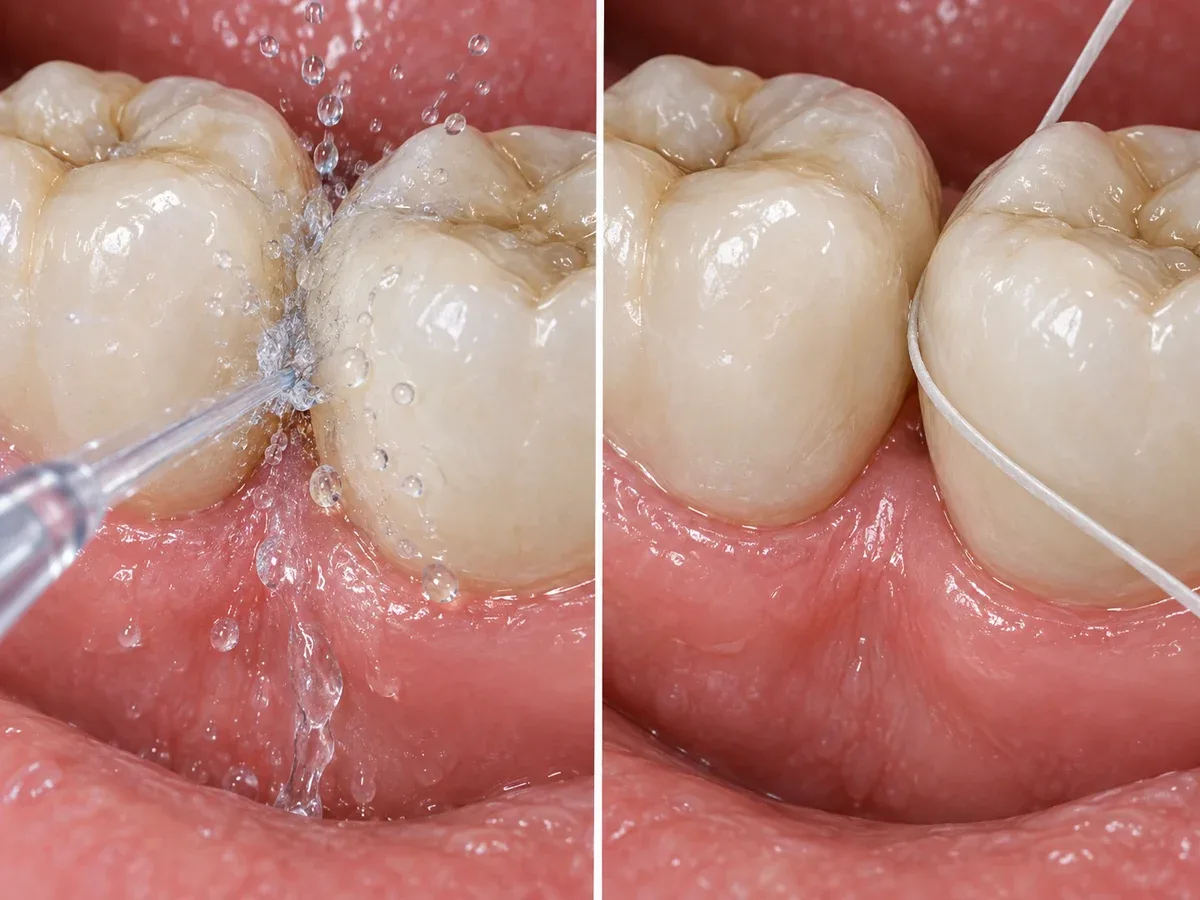
| Tool added to brushing | What the review found |
|---|---|
| Water flosser | May reduce gingivitis at one month; no evidence at 3 or 6 months, and no evidence of less plaque |
| Floss | May reduce gingivitis at 1, 3 and 6 months |
| Interdental brush | May reduce gingivitis and plaque in the short term |
| Water flosser against floss (2 studies) | May reduce gingivitis more at one month; no difference shown for plaque |
How should you use dental floss?
The KDCA material says a toothbrush removes a lot of plaque quickly. But the gaps between teeth are not cleaned well, which is why floss is used.
Floss can be used as soon as teeth come in. It does not widen the gaps between teeth. Used regularly, it helps a great deal in preventing decay and gum disease.
A standards article notes where floss is especially useful. It suits gaps where the interdental papilla, the gum between teeth, has not receded. There should also be no attachment loss exposing the root.
Put in order, the advice from the material and the articles looks like this.
- Floss before brushing.
- Do not force it in; ease it in gently with a sawing motion.
- Hold it flat against the side of the tooth and move it carefully up and down.
- Do not press so hard that you cut the gum.
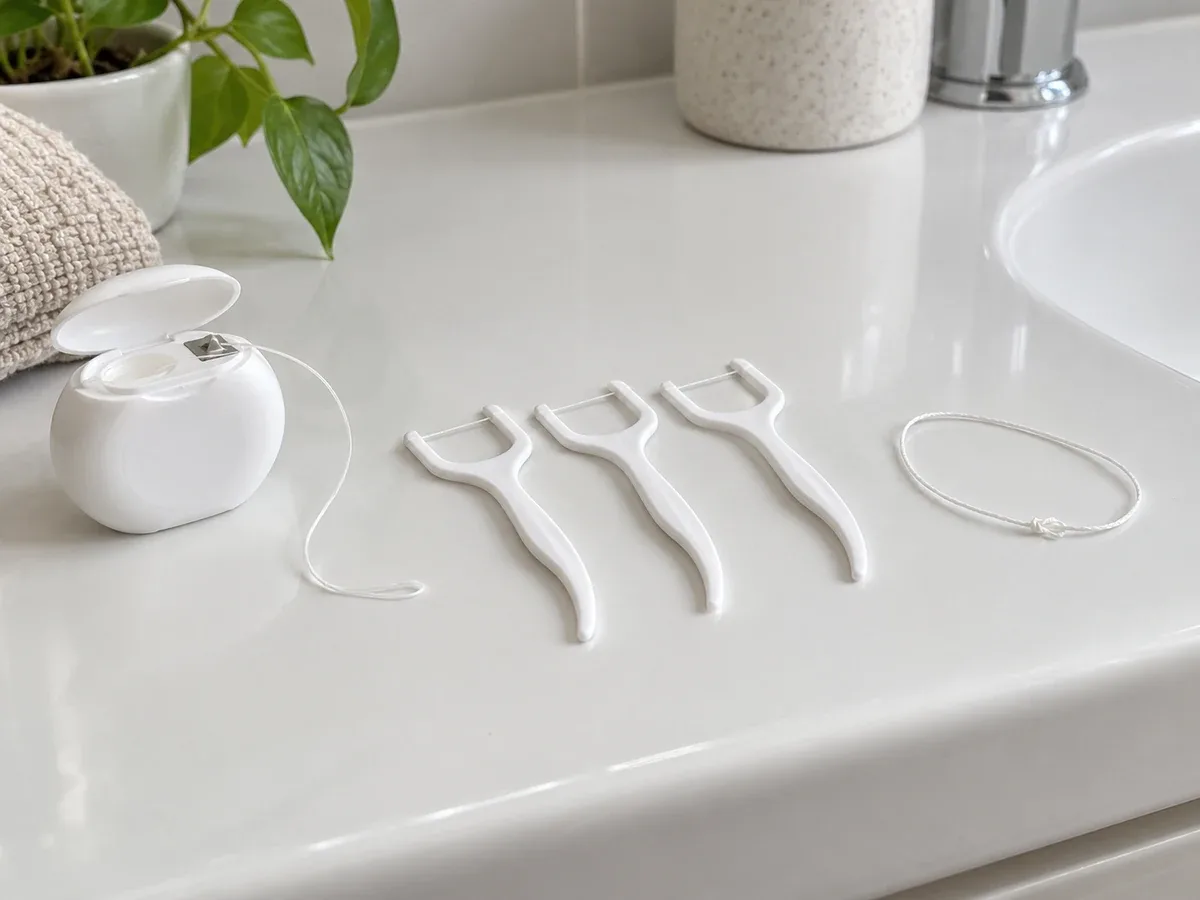
- If winding it around your fingers is hard, tie the ends into a loop.
There is a reason to floss before brushing. After brushing, the clean feeling makes it easy to forget, and flossing first lets fluoride reach the sides of the teeth.
Floss on a handle works as well as floss held in the fingers, and it helps build the habit. It suits people who find finger flossing awkward, have arthritis or cannot open their mouth wide.
Pushing floss in hard can cut the papilla or damage where the gum attaches to the tooth. The article asks for extra care with children whose teeth are still coming in.
Should you use an interdental brush if the gaps are wide?
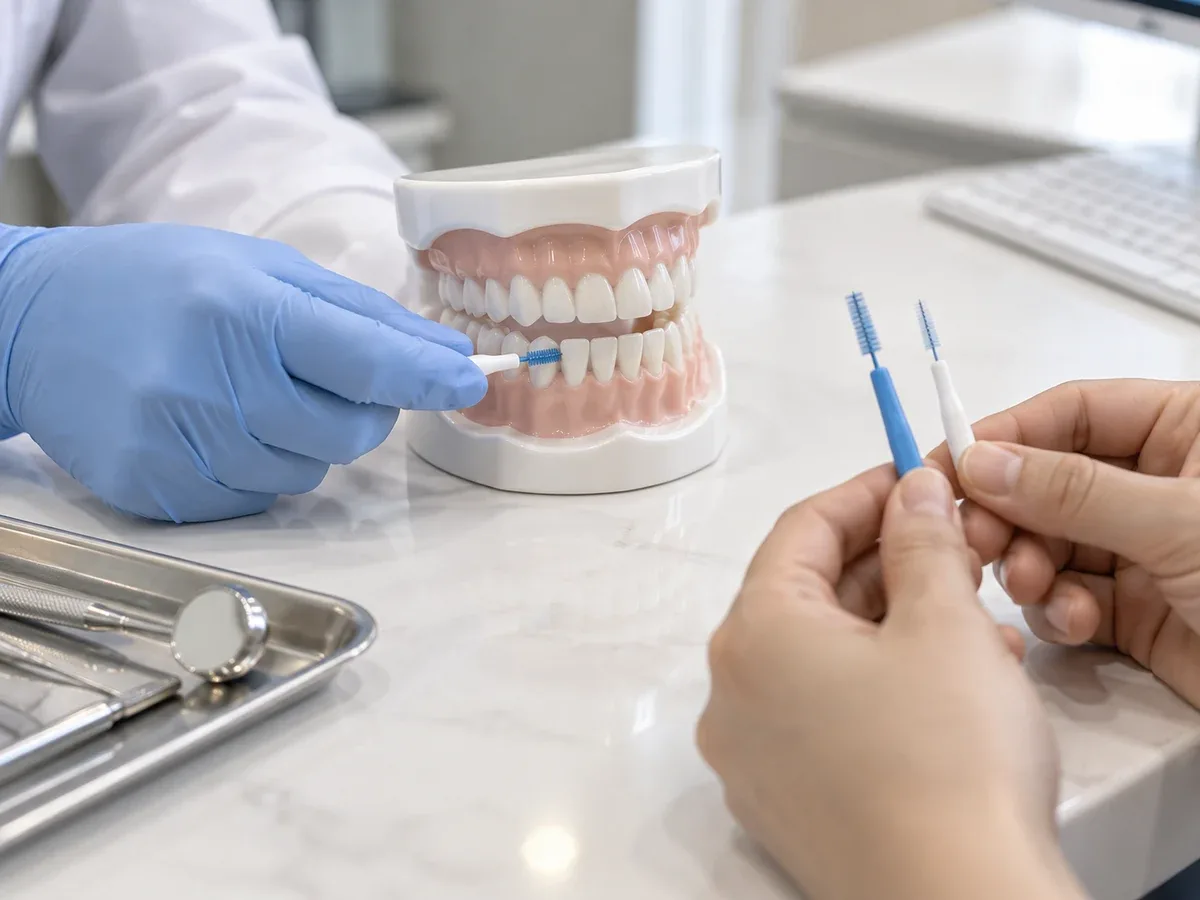
Yes, wide gaps suit an interdental brush. A standards article says it cleans both sides of the gap in a single movement. That is why it is known to clean between teeth efficiently.
The article recommends interdental brushes for people with gaps between their teeth, in a size that fits each gap. They are especially useful in these cases.
- Places where the gap between teeth is wide.
- Gum disease with a lot of gum recession, or after gum surgery.
- Around the brackets and wires of fixed braces.
- Where the furcation, the area where roots divide, is exposed.
The KDCA material also advises adding an interdental brush if bone loss has widened the gaps. The article notes it can also be used to apply fluoride or medicine for sensitive teeth.
The international standard sorts interdental brushes into nine sizes, from 0 to 8. The article advises choosing a brush slightly wider than the gap. If it does not go in easily, do not force it.
Insert the brush at an angle that follows the gum, then straighten it and move it in and out 3–4 times. Pushing it in at a sharp angle to the tooth can stab and injure the gum. Rinse it under running water as you go.
A straight brush is mainly for front teeth, and an L-shaped brush for back teeth. The KDCA says to wash and store it after use, and throw it away if the wire bends and rubs the tooth.

So how should you use a water flosser?
On the evidence alone, the case for recommending a water flosser as a replacement for floss or interdental brushes is weak. There was no evidence it removed more plaque. The benefit for gum inflammation was seen at one month, with low certainty.
That does not mean you should not use one. The KDCA lists the water flosser as one of the tools for cleaning between teeth. The review also found no serious side effects.
If you already use floss or interdental brushes, you can add a water flosser on top. If floss never feels natural, try floss on a handle or an interdental brush first. That order fits the evidence.
Check your brushing too. The KDCA recommends the modified Bass technique for people with past gum disease or deep gum pockets. Get your brushing right before adding more tools.
The sources we reviewed do not give standards for water flosser pressure or time. Follow the device instructions, and stop and get checked if your gums hurt or keep bleeding.
If you have been using a water flosser alone, you do not need to change everything at once. Start by adding another tool once a day, in one area. At the clinic, we can test which tool fits each gap.
| Tool | Where to use it | How to use it |
|---|---|---|
| Floss | Gaps where the papilla has not receded and there is no attachment loss | Hold it against the side of the tooth, move it up and down, and ease it in with a sawing motion |
| Interdental brush | Wide gaps, marked gum recession, around braces | Pick one slightly wider than the gap and move it in and out 3–4 times |
| Water flosser | Listed by the KDCA as one of the tools for cleaning between teeth | If you already use floss or interdental brushes, add it on top |
How can you spot the signs of gum disease?
The KDCA material says gum disease often causes no pain until pus builds up. By the time it hurts, it may already be severe enough to need an extraction. So it suggests checking for these signs earlier.
- Bleeding when brushing or eating.
- Loose teeth with no injury.
- Sensitive teeth because the gums have receded.
- Swollen gums.
- A change in gum color.
If you notice these signs, check your gums before changing tools. The material says swollen gums should always be treated by a dentist.
For loose teeth, the future of the tooth can be judged after the gum disease is treated. Sensitivity is not a symptom of gum disease itself, but it can come from receding gums, so it needs checking.
Scaling intervals are listed too. It is advised once a year even without gum disease, and every 3–6 months if you have had gum disease or are in maintenance after treatment.
Gum treatment starts with removing plaque and tartar from the teeth. Scaling comes first, followed if needed by cleaning tartar from below the gumline. Because the disease starts in plaque, antibiotics alone cannot treat it.
What should water flosser users in Busan remember?
In short, a water flosser is closer to an add-on than a replacement for floss. In the Cochrane review, there was no evidence of less plaque, and the gum benefit appeared weakly at one month.
Here are the basics the sources recommend.
- Clean between your teeth at least once a day.
- Use floss for narrow gaps and interdental brushes for wide ones.
- Clean between your teeth before brushing.
- Add a water flosser on top of these basic tools.
- Have scaling once a year, or every 3–6 months if you have had gum disease.
The standards series noted that cleaning between teeth is necessary but rarely done. If a water flosser gets you started on it, that has value too.
If you have bought a water flosser, just remember not to drop the basic tools. Enjoy the fresh water jet, but keep cleaning the sides of your teeth directly.
At Reset Dental Clinic, you can bring the tools you use and we will check them with you.
Frequently asked questions
Does a water flosser remove tartar?
In the Cochrane review, there was no evidence that a water flosser reduced plaque more than brushing alone. Hardened tartar is removed by scaling. If you have had gum disease, scaling every 3–6 months is advised.
My gums bleed when I floss. Is that all right?
The KDCA says bleeding when eating or brushing makes gum disease likely. Heavy bleeding does not mean the disease is severe, though. A simple treatment such as scaling may well solve it.
Will flossing widen the gaps between my teeth?
The KDCA says flossing does not widen the space between teeth. Forcing it in hard can cut the gums, so ease it in gently with a sawing motion.
Can I get advice on a water flosser and floss in English in Busan?
Yes. We offer 1:1 English interpretation from the first consultation through the end of treatment. The clinic is near Seomyeon Station Exit 2 (5-min walk), opposite Lotte Hotel Busan, and you can call 010-8555-2854 (+82-10-8555-2854 from abroad).
A water flosser is an add-on to floss, not a replacement for it.
Gum disease usually starts between the teeth.
Use floss for narrow gaps and interdental brushes for wide ones,
at least once a day, before brushing.
If you want to check whether your water flosser routine is enough, Reset Dental Clinic in Busan offers 1:1 English interpretation from your first consultation through the end of treatment. Call 010-8555-2854 and bring the tools you use.
References
- Cochrane, "Home use of devices for cleaning between the teeth (in addition to toothbrushing) to prevent and control gum diseases and tooth decay" — evidence up to January 16, 2019; 35 randomized studies with 3,929 adults; brushing plus floss (15), interdental brushes (2) or oral irrigators (5), and irrigator against floss (2); irrigators may reduce gingivitis at one month (very low certainty) with no evidence at 3 or 6 months and no evidence for bleeding sites or plaque; irrigators may reduce one-month gingivitis more than floss with no plaque difference (low to very low certainty); floss may reduce gingivitis at 1, 3 and 6 months; interdental brushes may reduce short-term gingivitis and plaque and gingivitis more than floss at 1 and 3 months; effects may not be clinically important, studies were short with mild baseline inflammation and none looked at decay; no serious side effects
- KDCA National Health Information Portal, "Systemic Disease and Periodontal Treatment" — gum disease usually starts between the teeth, so floss, interdental brushes or oral irrigators should be used at least once a day, with mouthwash a supporting measure; scaling once a year without gum disease and every 3–6 months with past gum disease or in maintenance; bleeding when brushing or eating suggests gum disease, but heavy bleeding does not mean severe disease, and simple treatment such as scaling may solve it
- KDCA National Health Information Portal, "Preventing and Managing Oral Disease" — floss is used because a toothbrush does not clean between teeth well; floss can be used once teeth come in, does not widen gaps and helps prevent decay and gum disease; holding floss flat against the tooth and moving it gently without cutting the gum, and making a loop; adding interdental brushes when bone loss widens gaps, washing them after use and discarding them when the wire bends
- Dental association newspaper, "Dental Standards (48): Interdental Brushes" (2018) — series by the Korean Dental Association materials and standards committee; brushing alone cannot remove all plaque between teeth, which directly causes decay and gum disease, yet people rarely clean there; interdental brushes clean both sides at once and are known to be more efficient than floss; use for wide gaps, marked gum recession, gum surgery, braces and exposed furcations; nine sizes from 0 to 8; choosing a brush slightly wider than the gap, inserting at an angle and moving it 3–4 times while rinsing; straight brushes for front teeth and L-shaped brushes for molars
- Dental association newspaper, "Dental Standards (62): Floss Holders" (2019) — series by the Korean Dental Association materials and standards committee; floss is useful where the papilla has not receded and there is no attachment loss; floss on a handle works like finger flossing, helps build the habit and suits people with poor dexterity, arthritis or limited mouth opening; easing floss in with a sawing motion to avoid cutting the papilla; excess force can damage gum attachment, with extra care for children with erupting teeth; cleaning between teeth before brushing is recommended because it is easy to forget afterwards
Written by Reset Dental Clinic Support Team
Medical review Dr. Kim Hyun-joo, Head Dentist · Integrated Dentistry Specialist
Last updated: September 19, 2026
This column is for general information and does not replace diagnosis or treatment for individual patients. If you have symptoms, please see a dentist.