

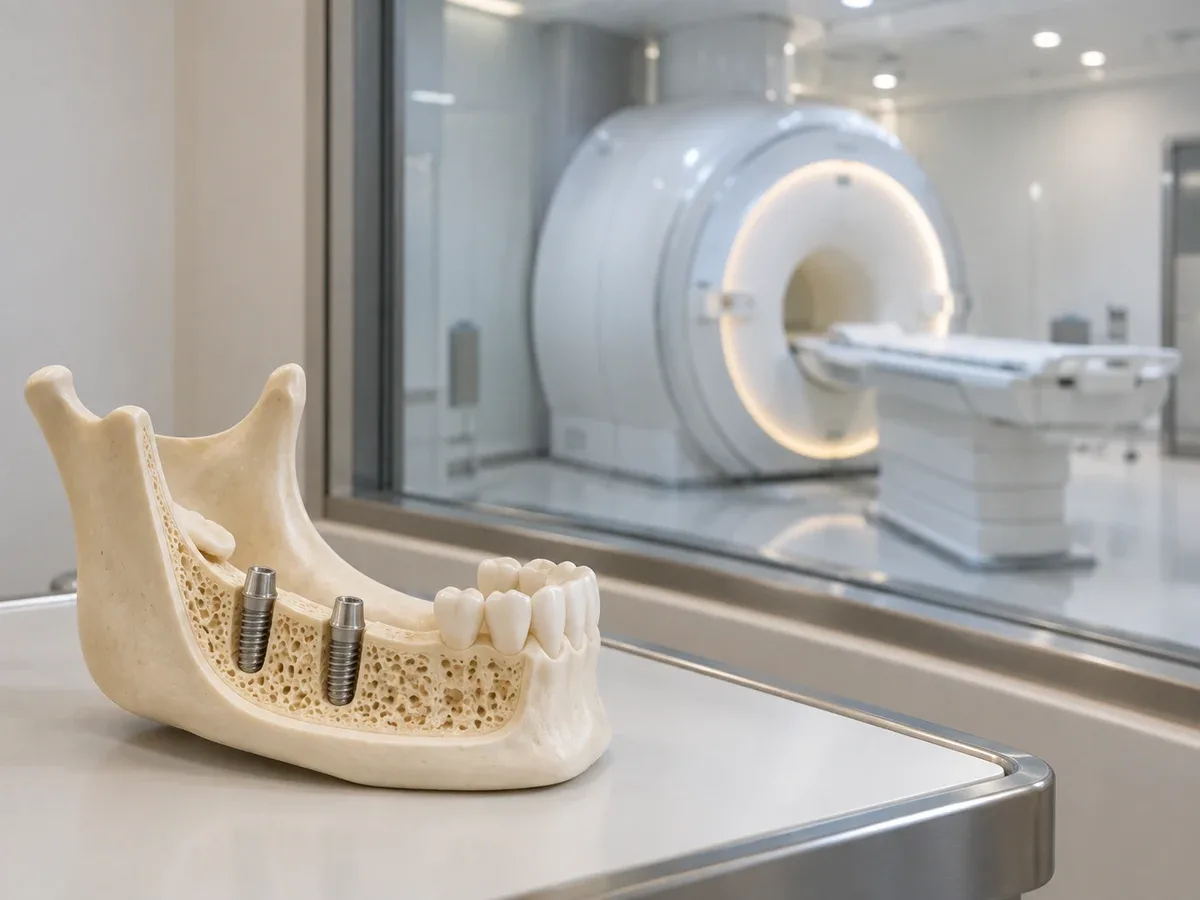
- The MSD Manual lists a typical dental implant as safe in MRI. A university hospital guide says fixed artificial teeth and crowns are fine.
- Some metals are safe and some are not, so hospitals ask you to report any metal before the scan.
- Removable dentures stay outside the scan room. If an implant-supported denture uses magnetic attachments, mention that too.
- At airport security, Incheon International Airport says to tell the officer before walking through, and another screening method can be used.
At our clinic in Seomyeon, Busan, patients with a dental implant often ask before a health check-up whether they can still have an MRI with metal in the mouth. This column sums up what public agencies and university hospitals say, and no more than what they say. For patients living in or visiting Korea, 1:1 English interpretation is available from the first consultation to the end of treatment.
Can you have an MRI if you have a dental implant?
Let us start with the sentence closest to an answer. The consumer version of the MSD Manual lists a typical dental implant as an example of a device that is safe in MRI. It appears next to artificial hips and rods used to straighten the spine.
Seoul National University Hospital (SNUH) says the same in its MRI guide. Under metal belongings, it notes that "fixed artificial teeth and crowns are fine."
It also helps to know what a dental implant is made of. The KDCA describes it as an artificial titanium root placed in the jawbone. A connecting post and an artificial tooth are attached on top.
The artificial tooth is fixed to the post with cement or a screw, the KDCA says. Many people have dental implants, so this question comes up often before scans.
Still, we should not stop at the word "safe." The same sources also ask you to report any metal in your body before a scan. The sections below explain why.
How are MRI and CT different?
Magnetic resonance imaging (MRI) uses a strong magnet to take pictures inside the body. SNUH's guide says it uses a superconducting magnet, radio waves and a computer. It shows tissues and blood vessels in two or three dimensions.
The same guide says there is almost no pain or side effect apart from the loud noise. The images are made with radio waves the body cannot feel.
The MSD Manual says a computer builds many slice-like pictures of the body. It can also create three-dimensional images.
MRI does not use X-rays, the manual explains, unlike computed tomography (CT) or PET scans. So it is generally very safe.
MRI usually gives more detailed images than CT, but it takes longer and is less comfortable. It is generally not used in emergencies that need quick results.
The manual says MRI may be used instead of CT when more detail is needed. Examples include:
- problems of the brain, spinal cord, muscles or liver
- problems of the female reproductive organs
- fractures of the hip or pelvis
- joint problems such as tears or sprains
- bleeding or infection
MRI may also be chosen after an allergic reaction to CT contrast, or during pregnancy. The specialist ordering the scan decides which test you need. Your dental implant is simply information that helps with that decision.
| Item | MRI | CT |
|---|---|---|
| What it uses | A strong magnet | X-rays (radiation) |
| Time | Longer than CT; the scan takes 20–60 minutes | Faster than MRI |
| Pregnancy | No radiation, so it may be chosen instead of CT | Uses radiation |
| Metal in the body | Type is checked because of the magnetic field | Not addressed in the sources we checked |
Dentists use CT too. The KDCA says dental CT, panoramic and intraoral X-rays are used to assess the bone when planning an implant. According to the KDA newspaper, the KDCA has set reference radiation levels for dental cone-beam CT.
These reference levels are recommended values that aim to lower patients' radiation dose. How an implant affects a CT image was not covered in the sources we checked. Before a CT scan, it is still wise to mention it.
Which metals cause problems in an MRI?
The MSD Manual says the magnetic field can be a problem if certain kinds of metal are in the body. It lists three common cases.
First, devices controlled by magnets, such as a pacemaker, a defibrillator or a cochlear implant. MRI can make them malfunction.
Second, devices that contain wires or metal that conduct electricity. These can heat up and cause burns.
Third, metals such as iron that can be pulled by a magnet. They can move inside the body.
The manual sums it up this way: because MRI uses a strong magnet, certain metals in the body can rule it out. Those "certain metals" are the three groups above.
SNUH also lists people who may not be able to have the scan.
- People with a pacemaker
- People with an aneurysm clip
- People with a nerve stimulator
- People with a cochlear implant
- People with claustrophobia
The National Police Hospital lists a wider group for advance consultation. It includes artery clips, artificial heart valves, metal contraceptive devices and artificial joints. Dental prostheses are on the same list.
SNUH's list of people who may not be scanned does not include dental implants. Its guide instead notes separately that fixed artificial teeth and crowns are fine.
| Type | What the source says |
|---|---|
| Magnet-controlled devices (pacemaker, defibrillator, cochlear implant) | MRI can make them malfunction |
| Devices with wires or metal that conduct electricity | They can heat up and cause burns |
| Metals such as iron that a magnet can pull | They can move inside the body |
| Typical dental implants, artificial hips, spinal rods | Some devices are described as safe in MRI |
Why tell the staff before the scan anyway?
The National Police Hospital explains why it gives scan instructions at all. They improve the accuracy of results and protect patient safety.
The reason to speak up, even with a "safe" device, is in the sources too. The MSD Manual says the MRI technologist will ask about all metal in your body.
Some metals are safe and some are not. So technologists check a list showing which devices are safe, and they need to know what is in your body to decide.
Hospital wording also differs a little. SNUH says fixed artificial teeth and crowns are fine.
Yet SNUH also asks people with metal implanted in the head, heart or bones to ask a doctor whether the scan is possible. The same goes for metal fragments in the body.
The National Police Hospital notes first that MRI uses strong magnetic force. It asks you to consult a radiologist in advance about surgical metal and dental prostheses.
Because the wording varies, telling the staff is more reliable than memorizing one answer. Write down your dental implant when booking and again on the day's questionnaire.
Having the details ready makes the screening quicker. Useful items for the form:
- When you had your dental implant, where in the mouth, and how many
- Any other surgical metal, such as an artificial joint
- Whether you wear a removable denture
- The type of attachment, if one holds your denture in place
What should you do with dentures and attachments?
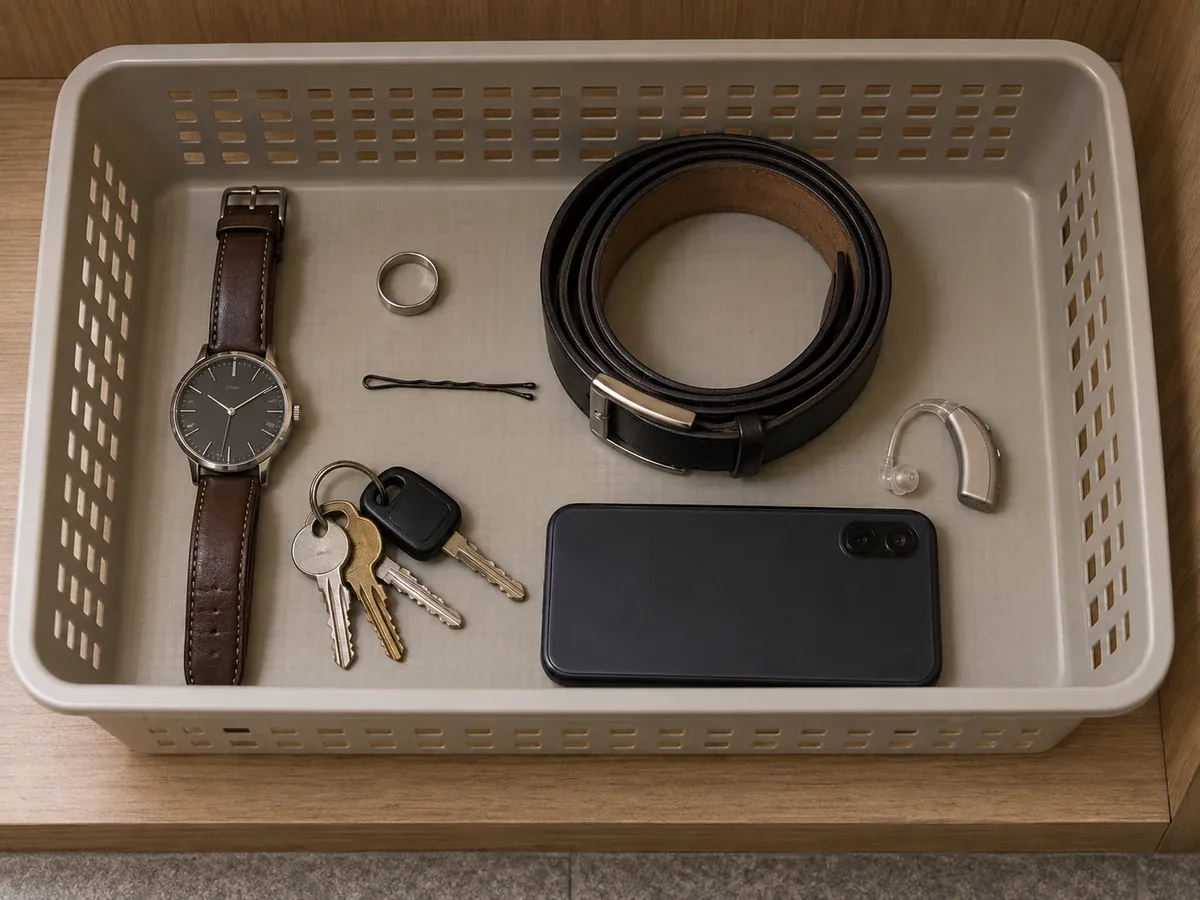
Removable dentures are handled differently from implants. SNUH's guide lists items that interfere with the scan. They are hearing aids, dentures, hairpins, belts, watches, keys, wallets, cards and mobile phones.
These must be stored in a separate place. If taken inside, cards can be erased and watches or phones can break, the guide says.
The MSD Manual also says to empty your pockets and remove jewelry, belts and other metal. The National Police Hospital asks you not to wear jewelry to the appointment.
Some people use implants to support a denture. The KDCA "Removable Prostheses" guide describes such dentures and their attachments. Magnets or similar attachments on the implants help hold and support the denture.
Compared with a regular denture, this needs extra dental implant surgery, and treatment takes longer.

How these attachments are handled in MRI was not covered in the sources we checked. So take out and store the denture. Ask your dentist what type of attachment stays in your mouth, and tell the scan team.
| Item | What the source says |
|---|---|
| Fixed artificial teeth or crowns | SNUH says they are fine |
| Metal implanted in the head, heart or bones | SNUH says to ask a doctor whether the scan is possible |
| Dental prostheses | The National Police Hospital says to consult a radiologist in advance |
| Removable dentures | They interfere with the scan, so store them separately |
| Denture attachments | Not covered in the sources; check the type with your dentist and report it |
What should you know on the day of the scan?
According to the MSD Manual, an MRI scan usually takes 20–60 minutes. You lie still on a table that slides into a tube-shaped scanner.
You can often wear your own clothes. You may be asked to hold your breath at certain points. Afterwards, you can return to normal activities.
Headphones or earplugs are often used because of the noise. The National Police Hospital says the noise is harmless. If tight spaces make you anxious, medicine can help you relax, the manual says.
SNUH describes the scan in these steps.
- You lie on the table, put on headphones and are held in position with straps.
- A sedative is given if needed, and contrast is injected for some scans.
- The table slides into the tube and scanning begins.
- Loud sounds come every few minutes, so lie still.
If something feels wrong, speak up when the machine is quiet, the guide says. If you have claustrophobia, mention it when booking.

Some scans need fasting. SNUH asks for at least 8 hours for abdominal and gynecological scans, and 4 hours for prostate scans. If your check-up includes several tests, confirm this in advance.
You may eat after the scan, SNUH says. If contrast was used, drink plenty of water to flush it out.
Contrast is a medicine that makes certain areas show up more clearly. The manual says allergic reactions to MRI contrast are less likely than with CT contrast. Headache, dizziness, an upset stomach or an odd taste can still occur.
Tell the staff if you have reacted to contrast before. SNUH advises careful discussion with a doctor if you are within 12 weeks of pregnancy. Rarely, contrast can harm the kidneys, and the risk is higher with existing kidney problems.
| Source | Advice |
|---|---|
| MSD Manual | The scan usually takes 20–60 minutes |
| MSD Manual | Headphones or earplugs may be used for the noise |
| SNUH | If uncomfortable, speak when the machine is quiet |
| SNUH | Drink plenty of water if contrast was used |
| National Police Hospital | With claustrophobia, consult your doctor in advance |
What about airport security when you fly out of Korea?
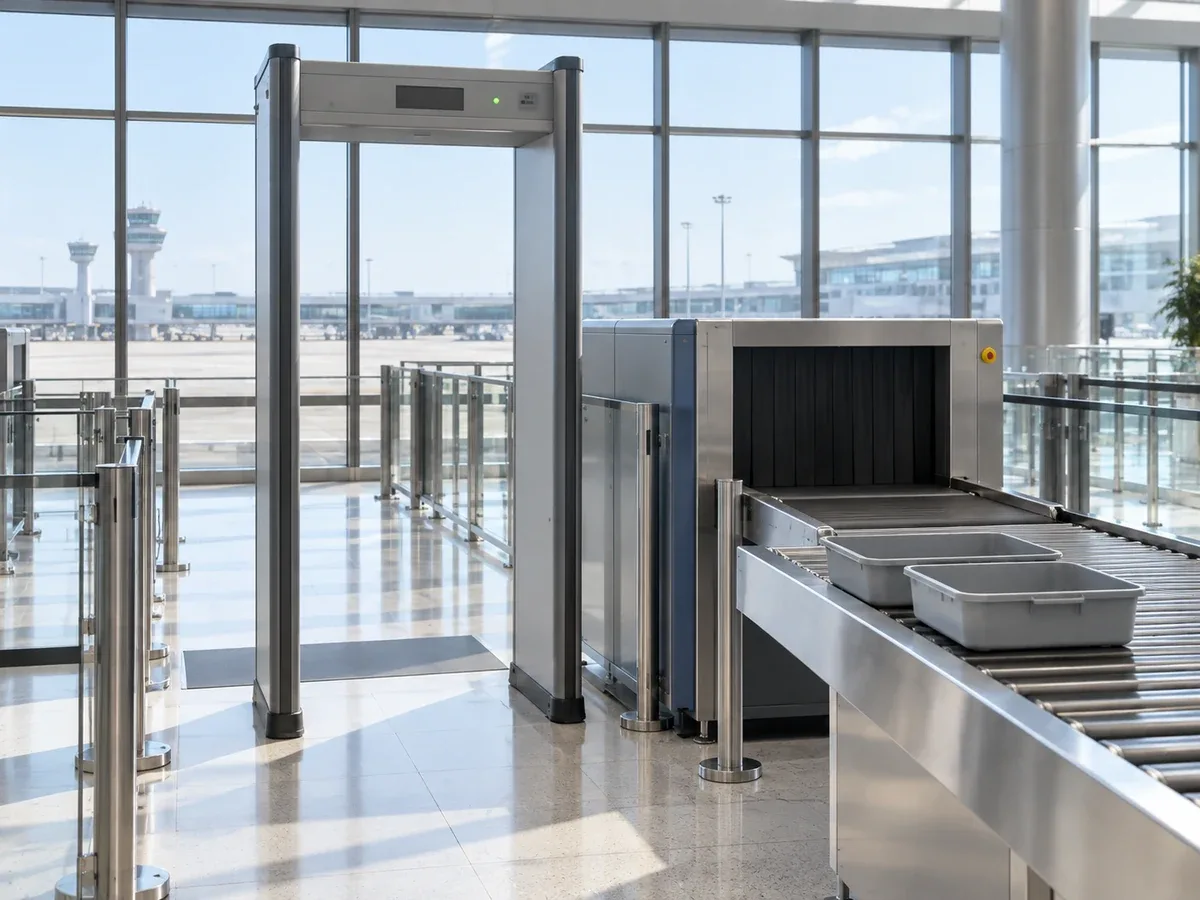
The security page of Incheon International Airport covers metal inside the body. It says metal from surgery can set off the alarm at the security gate.
In that case, tell the security officer about the surgery before walking through. Then another screening method can be used.
The same page says the magnetic field from screening equipment is tiny and harmless to the body. This covers walk-through gates, body scanners and handheld metal detectors.
Put in order, the advice looks like this.
- Tell the officer about the surgery before going through the gate.
- The officer takes this into account and uses another screening method.
- If you would rather not walk through the gate, you can also ask for other screening.
The page does not mention dental implants. The sources we checked also did not say whether a dental implant sets off the alarm. If you are worried, just mention it before going through.
If you had dental implant treatment in Busan, another hospital may ask for your records before a scan. If you were treated at Reset Dental Clinic, we can confirm when, where and how many implants were placed.
Frequently asked questions
Do I have to remove my dental implant before an MRI?
An implant placed in the bone is not removed. SNUH says fixed artificial teeth and crowns are fine. The MSD Manual lists a typical dental implant as safe, but asks you to mention it before the scan.
Do I need a letter from my dentist?
The sources do not say one is required. If the scanning hospital asks, request records such as the date, location and number of implants from the clinic that treated you.
Can I wear my implant-supported denture into the scanner?
The guides say to take dentures out and store them separately. Tell the scan team what type of attachment stays in your mouth. The clinic that treated you can confirm the type.
Can I get dental implant care in English in Busan?
Yes. We offer 1:1 English interpretation from the first consultation to the end of treatment, including help with your records. The clinic is near Seomyeon Station Exit 2 (5-min walk), opposite Lotte Hotel Busan; call 010-8555-2854 (+82-10-8555-2854 from abroad).
A typical dental implant is listed as safe for MRI, but always tell the staff first.
Remove your denture before the scan,
and note any attachment that stays in your mouth.
If you need dental implant records or treatment in Busan, Reset Dental Clinic offers 1:1 English interpretation from your first consultation to the end of treatment. Call 010-8555-2854 to ask.
References
- MSD Manual Consumer Version, "Quick Facts: Magnetic Resonance Imaging (MRI)" — how MRI uses a strong magnet and no X-rays, why technologists ask about all metal, the three kinds of metal that cause problems, typical dental implants and artificial hips as devices safe in MRI, removing metal items, when MRI is used instead of CT, scan time of 20–60 minutes, noise and anxiety, and open MRI
- Seoul National University Hospital test guide, "Magnetic Resonance Imaging (MRI)" — how the scan works, who may not be able to have it, consulting a doctor about implanted metal, storing hearing aids, dentures and other items separately, the note that fixed artificial teeth and crowns are fine, and speaking up when the machine is quiet
- National Police Hospital test guide, "MRI" — consulting a radiologist in advance about pacemakers, clips, heart valves, artificial joints and dental prostheses, and consulting a doctor about claustrophobia
- KDCA National Health Information Portal, "Removable Prostheses" — attachments such as magnets on implants that help hold and support a denture
- Incheon International Airport FAQ, "Security screening for people wearing wigs, pregnant travelers and others" — the harmless magnetic field of screening equipment, alarms from metal inside the body after surgery, and other screening methods on request
- KDCA National Health Information Portal, "Dental Implants" — definition of an implant with a titanium root, a connecting post and an artificial tooth, how the tooth is fixed, and dental CT for assessing the bone before surgery
- KDA newspaper Dailydental (Chiui Sinbo), "Check the appropriate radiation dose for key dental examinations" (March 27, 2024) — the KDCA's diagnostic reference levels for intraoral, panoramic and dental cone-beam CT imaging
Written by Reset Dental Clinic Support Team
Medical review Dr. Na In-chae, Head Dentist · Periodontics Specialist
Last updated: September 19, 2026
This article is general information and does not replace diagnosis or treatment for individual patients. If you have symptoms, please see a dentist.


