- Speech depends on where the tongue meets the teeth and palate, so a new mouth shape can change how you sound.
- Adapting to new dentures takes weeks to months, at a pace that differs by person.
- A case report traced a leaking /s/ sound to the shape of the front palate and fixed it.
- Full-arch cases used temporary teeth to check speech before the final teeth were made.
In full-arch implant consultations in Seomyeon, Busan, some people worry more about speaking than about surgery. That is especially true for people whose work depends on talking, such as teaching or sales. For patients living in or visiting Korea, we provide 1:1 English interpretation from the first consultation through the end of treatment.
This column uses public health material and case reports from prosthodontic journals. It explains why speech can change and how it is checked.
Why does speech depend on the shape of the mouth?
The Department of Prosthodontics at Yonsei University College of Dentistry published a case report in the Journal of Korean Academy of Prosthodontics. It explains the link between speech and mouth shape in detail.
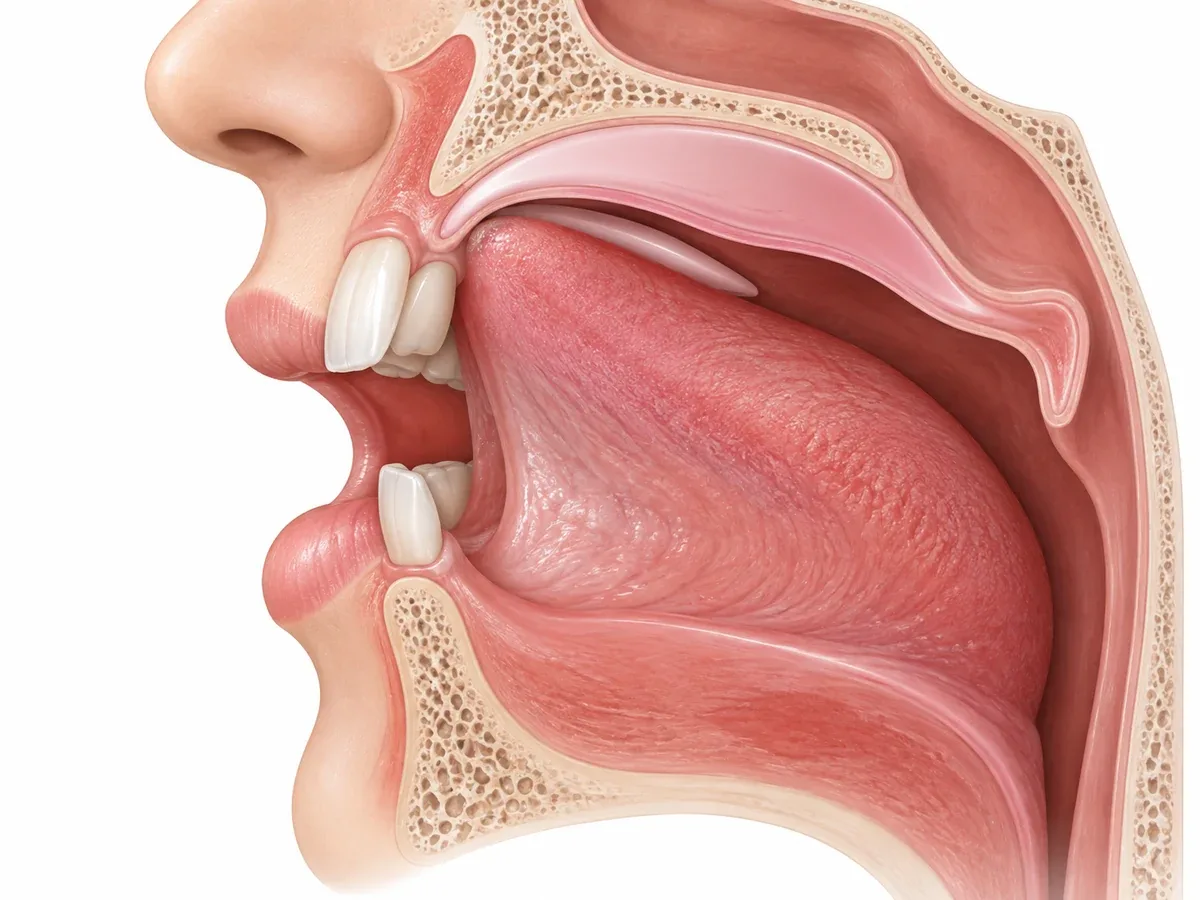
For sounds made between the tongue and palate, the shape of the palate surface matters. An /s/ sound forms when a groove appears in the middle of the tongue and an air channel opens behind the upper front teeth.
For /t/, /d/ and /n/, the tongue must press firmly against the hard palate. For /k/ and /g/, the tongue touches the soft palate at the back of the roof of the mouth.
A study cited in the paper found that people with natural teeth have a distinctive curve in the front palate. This shape is especially important for /s/ and /sh/, and the same is true for the front palate of a denture.
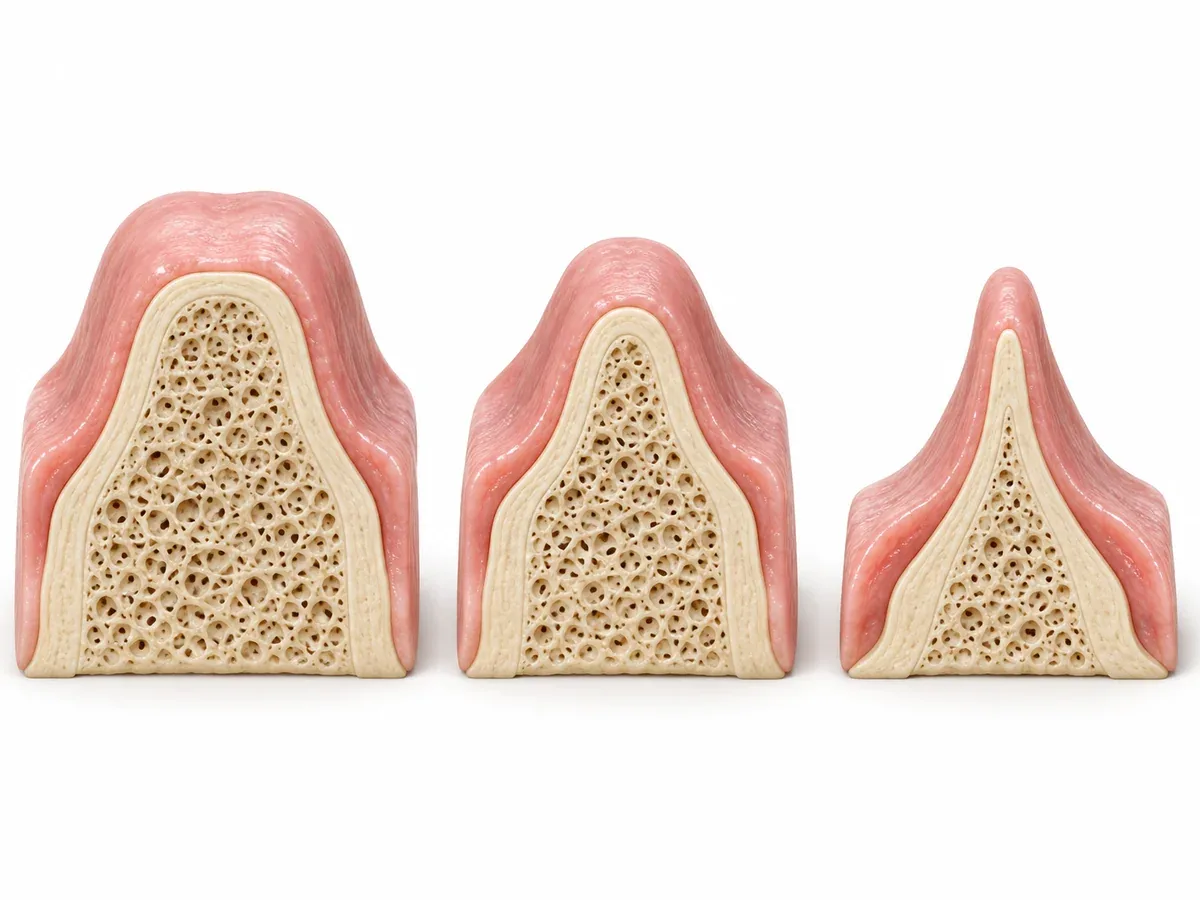
When a full-arch implant rebuilds all the upper teeth, the surface the tongue touches is new as well. So it helps to know in advance that your speech may change.
| Sound | What the paper says |
|---|---|
| /b/, /p/, /m/ | Problems can occur if the bite height is too great |
| /s/ | Made by a groove in the tongue and an air channel behind the upper front teeth |
| /t/, /d/, /n/ | The tongue must press firmly on the hard palate |
| /l/ | Contact is at the front of the palate alone |
| /k/, /g/ | Made by the tongue and the soft palate |
Which sounds do front tooth position and bite height change?
Sounds made by the two lips meeting, such as /b/, /p/ and /m/, are called bilabial sounds. The height of the bite is called the vertical dimension. The paper says bilabial sounds can suffer if this height is too great.
So it is important to check that the lips can close comfortably. Even with a suitable height, problems can arise from the position of the front teeth and the occlusal plane.
This applies to sounds made as the lower lip touches the edges of the upper front teeth, such as /f/ and /v/. If the occlusal plane is higher than the lower lip, the lip struggles to reach the teeth and the sound blurs.
The paper says most prosthodontists see the position of artificial teeth as important for speech. This is why front tooth position and height are tested first with temporary teeth in full-arch implant treatment.
Here are the speech-related factors the paper points to.
- The vertical dimension, or bite height.
- The height of the occlusal plane.
- How far forward or back the upper front teeth sit.
- The shape and thickness of the front palate surface.
- How far the prosthesis extends toward the back of the palate.
What changes when you move from dentures to a fixed full-arch implant?
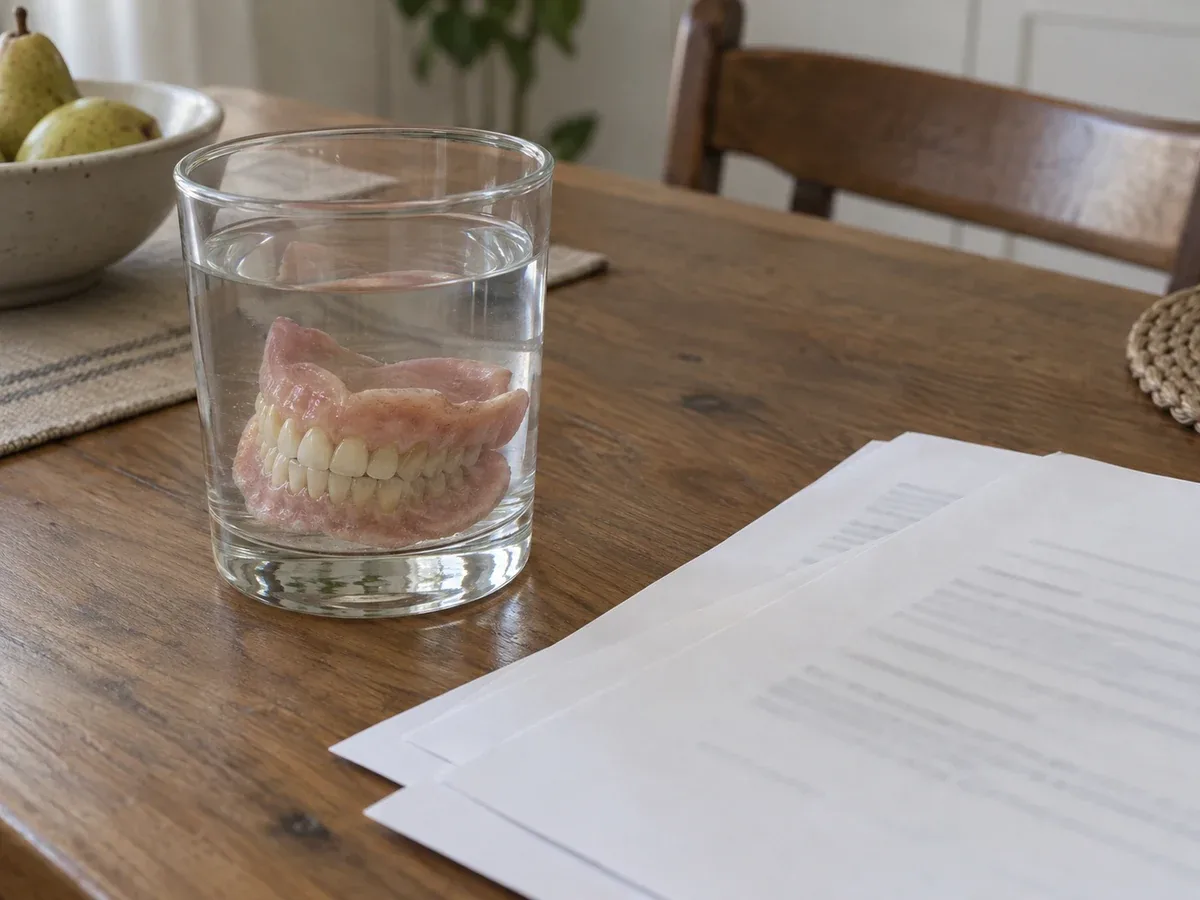
KDCA material on removable prostheses explains that most dentures rest on the gums. So it notes that they can come loose while eating or speaking.
A complete denture is held by suction, like a suction cup. Its hold is limited, so it can loosen as the mouth moves or chews. A lower denture, sitting around the tongue, has even less hold and stability.
The material lists these limits of dentures.
- They can come loose while eating or speaking.
- They feel foreign and work at about 20–30% of natural teeth.
- Biting with the front teeth of a complete denture is advised against, as it can dislodge it.
- Over time, the gums shrink, which can cause gaps or pain.
Asan Medical Center's information on implant surgery lists unclear speech as a problem implants can improve. It also names uncomfortable dentures and painful pressure on the gums.
The same source says artificial teeth are fixed on implants with screws or cement. A fixed full-arch implant is built differently from a denture when it comes to loosening during speech.
| Item | Complete denture | Fixed |
|---|---|---|
| How it is held | By suction on the gums | Fixed with screws or cement |
| When speaking | Described as able to come loose | Not designed to be taken in and out |
| At night | Removed so the gums rest 8 hours or more | Not removed by the patient |
| Adapting | Described as taking weeks to months | Checked with temporary teeth for a month or more in the cases |
This does not mean speech feels easy the moment you switch to fixed teeth. The Yonsei paper says most people find a normal speech pattern after new dentures.
Yet some take a long time to adapt to a new palate shape, and older patients may find clear speech harder. The paper is about dentures, but a new tongue contact surface is worth thinking about with a full-arch implant too.
How long does it take to adapt your speech?
The KDCA says an adjustment period is needed with a first or replacement denture. The mouth is sensitive, so even small changes can feel foreign at first.
Adapting to speech, chewing, the foreign feeling and soreness takes weeks to months. The speed and degree differ from person to person.
The material recommends the following.
- Read a newspaper aloud.
- Start with soft foods such as steamed egg.
- Raise any discomfort at regular check-ups so it can be adjusted.
Cooperating with check-ups can help you adapt faster. After a full-arch implant, it is a good idea to bring up speech first at these visits.
A study cited in the Yonsei paper found speech improves over time, but the /s/ sound is hard to improve. So it calls for special care when the prosthesis is made.
The paper also cites reports that denture wearers often do not notice their own speech problems. It links this to hearing rather than speech itself.
After a full-arch implant, it helps to set aside time to check speech on purpose. Rather than relying on feel, listen to set sentences or numbers.
How is the cause of a leaking sound found?
In the paper, a 77-year-old patient said at the first check-up after a new upper denture that sounds were leaking. The patient had gone back to the old denture.
When asked to count aloud from 30 to 40, the patient made a whistling, leaking /s/ sound. The bite height, occlusal plane and front tooth position were all normal.
The cause was that the front palate of the new denture was more hollow than the old one. A thin front section widens the air channel and creates a whistling sound, the paper explains.
If the front is too thick, the tongue and palate come too close, which can cause a lisp. So the paper warns against making it too bulky as well.
The team added a soft material to that area and shaped it while the patient counted aloud. They then replaced it with hard resin, and the patient said the leaking sound stopped right away.
They confirmed the result with a palatogram, which shows where the tongue touches the palate, and with sound analysis software. At check-ups at 1, 3 and 6 months, there were no speech complaints.
The paper lists other causes too. A leaking /s/ can come from back teeth set too far inward, leaving too little room for the tongue. Whether the bite height is comfortable should also be assessed.
It concludes that speech problems can arise if speech factors are ignored during fabrication. For a full-arch implant, this suggests speech should be part of designing the new teeth.
Telling us the following at full-arch implant check-ups helps find the cause.
- Which sounds leak or blur.
- When it started.
- Where you stumble when counting or reading aloud.
- How it sounds to people around you.
| Symptom | Cause |
|---|---|
| /s/ whistles or leaks | The front palate is thin or hollow |
| Lisp | The front palate is thick |
| Nasal sound | The back extends too far and irritates the soft palate |
| Lip sounds feel awkward | The bite height is too great |
| /s/ leaks | Back teeth set too far inward, leaving little room for the tongue |
Does tension affect speech?
The paper says the soft palate lifts for every sound except /n/, /m/ and /ng/. If it does not move, the nasal passage stays open and speech sounds nasal.
A prosthesis that extends too far back can irritate the soft palate and lead to muscle stiffness. Adjusting the length solves this fairly easily.
When the length is right but speech still feels difficult, the paper suggests psychological factors may play a part. So it says patients should be told that relaxing matters for clear speech.
If you find yourself tensing your mouth because of new teeth, feel free to mention it at a check-up. Relaxing is part of speaking clearly with a full-arch implant as well.

When is speech checked during full-arch implant treatment in Busan?
The Asan Medical Center prosthodontics team reported a full-arch implant case in the Journal of Dental Rehabilitation and Applied Science. After fixed temporary teeth were fitted, lip support and bite height were adjusted.
The second temporary set moved the upper front teeth 2 mm forward and raised the bite. The front tooth length and gum-side shape were refined several more times.
Function, appearance, speech and hygiene were then assessed over 6 months and carried into the final teeth. The patient was reported to be satisfied with lip support, chewing and speech.
In the Yonsei case of a full upper-arch implant, the patient found speaking and chewing difficult with temporary dentures and strongly wanted fixed teeth. The shape and bite of the temporary teeth were recorded with an intraoral scanner for the final design.
This patient used a fixed provisional prosthesis for about a month. After chewing and speech adaptation were confirmed, treatment moved to the final teeth. Each case follows one patient, so neither promises the same result.

| Item | What the cases describe |
|---|---|
| Speech | About a month of adaptation (Yonsei); assessed over 6 months (Asan) |
| Chewing | Adaptation confirmed with temporary teeth before the final teeth (Yonsei) |
| Lip support and bite height | Increased by 1–2 mm based on the patient's feedback (Asan) |
| Hygiene | Part of the 6-month assessment (Asan) |
In both cases, the shape was changed at the temporary stage. With a full-arch implant, this stage is also the time to listen and find what needs adjusting.
Try these during the temporary stage of a full-arch implant.
- Count aloud from 30 to 40.
- Read a long text, such as a newspaper, aloud.
- Note any sounds that leak or blur.
- Ask family or colleagues how you sound.
Since people often miss their own speech problems, the impressions of others are useful. The final shape of your teeth can then be based on these notes.

At Reset Dental Clinic, telling us what kind of speaking you do every day helps us check your speech.
Frequently asked questions
Will my speech be exactly the same as before a full-arch implant?
The sources say the speed and degree of adaptation differ by person. They do not say everyone returns to the same point at a set time. So rather than predict it, we check by speaking during the temporary stage.
What if a leaking sound remains over time?
As in the case report, the palate surface, front tooth position and bite height are checked in turn. What can be adjusted depends on the structure of the fixed prosthesis. At check-ups, tell us exactly which sounds bother you.
Will fixed teeth come loose like dentures when I talk?
The KDCA says dentures can come loose when speaking. Artificial teeth on implants are fixed with screws or cement. A fixed full-arch implant is built this way, unlike a removable denture.
Can I discuss full-arch implant treatment in English in Busan?
Yes. We offer 1:1 English interpretation from the first consultation through the end of treatment. The clinic is near Seomyeon Station Exit 2 (5-min walk), opposite Lotte Hotel Busan, and you can call 010-8555-2854 (+82-10-8555-2854 from abroad).
Speech after a full-arch implant is checked, not assumed.
A new palate surface can change how you sound.
The temporary stage is the time to count, read aloud
and find what needs adjusting.
If you are considering a full-arch implant in Busan and worry about your speech, Reset Dental Clinic offers 1:1 English interpretation from your first consultation through the end of treatment. Call 010-8555-2854 to book a consultation.
References
- Yonsei University College of Dentistry, Department of Prosthodontics, "Improving Speech by Reshaping the Anterior Palatal Area of a Maxillary Complete Denture: A Case Report," Journal of Korean Academy of Prosthodontics 60(1), 2022 — most patients regain normal speech with new dentures, but some take long to adapt to a new palate shape and older patients may struggle; excessive vertical dimension affecting bilabial sounds; the effects of the occlusal plane and front tooth position; palate contact for /s/, /t/, /d/, /n/, /l/, /k/ and /g/; reports that denture wearers often do not notice speech problems and that /s/ is hard to improve; a 77-year-old patient's leaking /s/ traced to a hollow front palate, repaired and confirmed with a palatogram and sound analysis, with no complaints at 1, 3 and 6 months; a thick front palate possibly causing a lisp; overextension irritating the soft palate and causing nasal speech; possible psychological factors and the importance of relaxing; the limit of having no matching pre-repair speech data
- KDCA National Health Information Portal, "Removable Prostheses" — complete dentures held by suction can loosen with movement or chewing, and lower dentures have less hold; dentures can come loose while eating or speaking; adapting to speech, chewing, foreign feeling and soreness takes weeks to months and varies by person; reading a newspaper aloud, starting with soft foods and discussing discomfort at check-ups
- Asan Medical Center Test, Procedure and Surgery Information, "Implant Surgery" — unclear speech and esthetic concerns listed among problems implant surgery can improve; artificial teeth fixed on implants with screws or cement
- Shin Hee-hyun et al., "Full-Mouth Rehabilitation of a Completely Edentulous Patient With Fixed Implant Prostheses," Journal of Dental Rehabilitation and Applied Science 37(3), 2021, Asan Medical Center Department of Prosthodontics — one patient's course: fixed temporaries adjusted with more lip support and 1–2 mm more vertical dimension, function, esthetics, speech and hygiene assessed over 6 months, front tooth length and gum-side shape refined and carried into the final restorations, with the patient satisfied with lip support, chewing and speech
- Yonsei University College of Dentistry, Department of Prosthodontics, "Full-Arch Fixed Implant Rehabilitation Using an Intraoral Scanning Digital Workflow in a Maxillary Edentulous Patient," Journal of Korean Academy of Prosthodontics 62(1), 2024 — one patient's course: difficulty speaking and chewing with temporary dentures and a strong wish for fixed teeth, about a month with a fixed provisional prosthesis to confirm chewing and speech adaptation before the final prosthesis
- KDCA National Health Information Portal, "Dental Implants" — using an area that had no teeth for a long time can lead to biting the tongue or cheek at first, with gradual adaptation over 1–2 months
Written by Reset Dental Clinic Support Team
Medical review Dr. Na In-chae, Head Dentist · Periodontics Specialist
Last updated: September 19, 2026
This column is for general information and does not replace diagnosis or treatment for individual patients. If you have symptoms, please see a dentist.