

- Hospital guides list slightly crooked teeth, small gaps and mild relapse as treatable.
- If the gum bone is normal and just the teeth tilt forward, orthodontics can help.
- Spreading out the front teeth alone led to an open bite in one dispute case.
- Ask for the limits, any tooth trimming and midline changes to be explained and recorded.
At consultations in Busan, many people say they do not need full braces and just want a few front teeth straightened. Partial orthodontics, which moves a few front teeth, can indeed be a good choice. For patients living in or visiting Korea, 1:1 English interpretation is available from the first consultation to the end of treatment.
Still, the front teeth you can see are not enough to decide. This column draws on Seoul National University Hospital (SNUH) guides on clear aligners and malocclusion, and Asan Medical Center's guide on protruding mouths. Two dispute cases reported in the dental press show when partial orthodontics works and when it does not.

Are crooked front teeth an alignment problem or a bite problem?
SNUH's malocclusion guide defines malocclusion in two ways. Either the teeth are not lined up evenly, or the upper and lower teeth do not meet in the normal position. Partial orthodontics mainly deals with the first: alignment.
There are several causes. When teeth are large for the jaw, there is not enough room, the guide says. The teeth then twist and overlap, which is called crowding.
When there is plenty of room but the teeth are small, gaps remain between them. This is a diastema. Losing baby teeth too early, which leaves too little room for permanent teeth, is also listed as a cause.
Malocclusion takes many forms. Even when it looks like a problem with a few front teeth, we first check which of these it is.
- Rotation, where a tooth is turned
- Displacement, where a tooth came in out of position
- Crowding from too little room, or gaps from too much
- Deep bite, where the upper teeth cover the lower teeth too much
- Open bite, where the upper and lower teeth do not meet
The aim of treatment is not just looks. The guide lists even chewing, clear speech and better oral hygiene as goals.
Uneven teeth trap food and are hard to brush, which can lead to cavities or gum disease, the guide says.
Some cases come from uneven growth of the upper and lower jaws. This is skeletal malocclusion, such as a protruding or receding chin. Even if a few front teeth look crooked, the answer depends on whether a bite or jaw problem lies behind them.
When is partial orthodontics more likely to work?
Public materials on partial orthodontics are hard to find. SNUH's clear aligner guide shows the criteria well, though. It lists three cases that aligners can treat.
- Slightly crooked teeth
- Small gaps between teeth
- Mild relapse after earlier orthodontic treatment
What the three share is the word "slightly." There is little movement needed.
Asan Medical Center draws a similar line in its guide on protruding mouths. When the gum bone is in a normal position and just the teeth tilt forward, orthodontics can help.
Partial orthodontics has a place when the problem is limited to a few teeth and the bite and bone give support. If the bite itself is unstable, it is safer to look at a wider scope.
If one or two front teeth shifted slightly after earlier treatment, that is close to the third case. But the malocclusion guide says habits like tongue thrusting keep pressing on the gum bone. If the cause remains, keeping the result also needs a plan.

Which cases are more difficult?
The same aligner guide puts large or complex tooth movement on the difficult side. Its examples are:
- severely crooked teeth
- severely prominent canines
- a severely protruding mouth
- teeth set too far outward or inward
- large gaps between the upper and lower front teeth
- severe skeletal malocclusion that needs surgery
A wish to "just pull the front teeth back a bit" also needs care. Asan Medical Center describes bimaxillary protrusion separately. When the gums protrude too, or it is severe, surgery is needed alongside orthodontics.
Trying to solve a surgical case by moving teeth alone can cause problems. The teeth tip backward, and the mouth often does not retract as much as hoped, the guide says. In such cases, moving a few front teeth is unlikely to give the change you want.
The guide recommends that a facial bone surgeon and an orthodontist treat such cases together. Since surgery shifts the teeth, orthodontics is needed before and after.
Genetics plays a large role, the guide says. Tongue thrusting, finger sucking, nail or lip biting and mouth breathing can also cause protrusion. It can affect speech and chewing, so it is more than a matter of looks.
| Case | What the guides say |
|---|---|
| Slightly crooked teeth or small gaps | The aligner guide lists them as treatable |
| Mild relapse after earlier treatment | The aligner guide lists it as treatable |
| Normal gum bone, teeth tilted forward | The protrusion guide says orthodontics can help |
| Large or complex movement, severe crowding | The aligner guide puts it on the difficult side |
| Bimaxillary protrusion with protruding gums, or severe cases | The protrusion guide says orthodontics and surgery are both needed |
What can happen if partial orthodontics moves just the front teeth?
A consumer agency case reported in the dental press is a good example. A patient treated for protrusion without extractions still had protrusion afterwards. An open bite, where the front teeth do not meet, also developed.
Before treatment, the teeth seemed about 4 mm short of space, so extractions were skipped. Stripping, trimming between the teeth, was also done. The patient said they had been told the protruding teeth would move back enough.
Expert review found that the models after treatment showed alignment back to the first premolars. The second premolars had not moved, so the teeth were simply spread out. The dentist was held responsible.
The agency team leader who wrote up the case said the initial diagnosis and plan shape the result. Where and how to move the teeth must be decided from the start.
Where the space comes from also matters. A clear aligner case shared by the national medical mediation agency centered on interproximal reduction, trimming a little enamel between teeth.
The patient felt uneasy after trimming at three spots in the first stage. Later stages went ahead without trimming. Along the way, the front teeth spread apart and the midline shifted.
The clinic said they had agreed to straighten the teeth just partly. Review found the trimming was routine and that treatment was limited without it. Still, the clinic was held responsible for not fully explaining and recording the limits, the need for trimming and the midline change.
An agency official urged full explanation and a signed consent form, since treatment takes a fairly long time.

How do you choose between clear aligners and braces?
Both can be used. SNUH's malocclusion guide describes brackets bonded to the teeth, with wires and elastics moving the teeth. This fixed method is commonly used for any type of malocclusion, the guide says.
Less visible resin or ceramic brackets are available. In some cases, lingual braces bonded behind the teeth are possible. After bonding, you usually visit about every 4 weeks for adjustment.
Clear aligners are clear resin trays you put in and take out. The aligner guide gives about a year of treatment, with visits every 2–8 weeks. They are worn 24 hours a day, except when brushing and eating.
If they are not worn enough, teeth do not move as planned, and treatment can be delayed or fail. The guide lists these steps.
- X-rays, photos and impressions of the face and teeth are taken.
- The records are analyzed, a plan is made, and pros and cons are explained.
- Needed treatment such as scaling and cavity care is done first.
- The movement is checked by simulation, and models and aligners are made for each stage.
- Check-ups follow at set intervals, with new impressions when needed.
| Item | Fixed braces | Clear aligners |
|---|---|---|
| Use | Commonly used for any type of malocclusion | Not suitable for every patient |
| Visits | Usually every 4 weeks | Every 2–8 weeks |
| What to follow | Avoid hard or sticky food | Wear 24 hours a day except meals and brushing |
| Visibility | Resin or ceramic brackets, or lingual braces | Clear resin trays |
Braces need more care after meals, since plaque builds up around them. The guide advises a soft toothbrush, floss and interdental brushes.
For partial orthodontics, the choice depends on how far and which way teeth must move, and on what fits your daily life. The aligner guide stresses a thorough consultation first.
What should you watch for with partial orthodontics?
Even with few teeth, the principle of tooth movement is the same. The aligner guide says teeth do not move in a neat line in a fixed order. So treatment proceeds by switching to new aligners.
The force comes from the aligner material, biting force and aids such as elastics. Thin trays of about 0.5 mm come first.
Side effects are listed too. As with other orthodontic treatment, the following can occur, though the reasons are not fully known.
- Root resorption
- Damage to the tooth nerve
- Tooth discoloration
- Excessive pain
Aligners cover the teeth and gums, so poor care can lead to gum disease, the guide says. Avoid sugary, sticky or hard foods, do not eat with aligners in, and keep one spot of gum from being pressed.
Come in on the scheduled dates. Each stage of partial orthodontics needs checking to confirm the teeth are moving the right way.
What should you check at a consultation in Seomyeon, Busan?
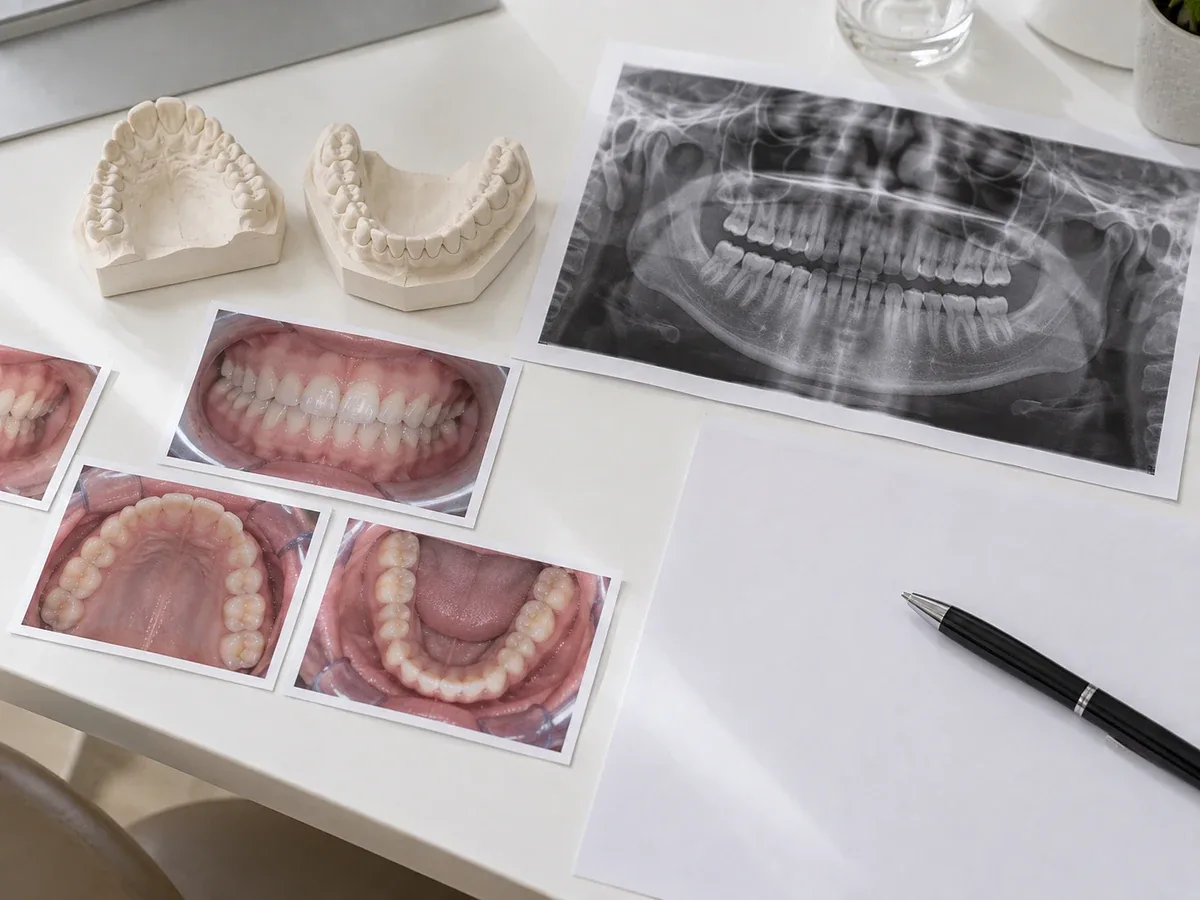
SNUH's malocclusion guide says diagnosis starts with an oral exam. The teeth, gums, alignment, bite and jaw positions are checked first. X-rays, photos and dental models then refine the diagnosis.
The same order applies to partial orthodontics. On top of that, we suggest asking these questions.
- What is the goal, and where does it become difficult?
- How will space be gained, and how much trimming is involved?
- Could the midline or bite change?
- What is the retainer plan afterwards?
The agency team leader gave similar advice after the case above. Explain the effects and limits of the method and the treatment time in advance, and sign a consent form. Keep X-rays, photos and dental models from the start and the end.
| What to check | Why |
|---|---|
| The goal and where it becomes difficult | In one case, the limits of treatment were not fully explained and recorded |
| How space is gained, and how much trimming | In one case, treatment was limited without trimming |
| Possible midline or bite changes | In one case, the front teeth spread and the midline shifted |
| Retainer plan after treatment | Relapse is a typical after-effect of all orthodontic treatment |
| Records at the start and end | Keep X-rays, photos and dental models as objective records |
Preparation is easy to skip. The aligner guide says aligners stop fitting if tooth shape changes during treatment. So it advises finishing needed dental work and scaling before starting.
It also asks you to avoid dental work that changes tooth shape during treatment. Cavities and gums come first, even in partial orthodontics.
If trimming between teeth is planned, ask for a written record of which teeth and how much. As the case above shows, what was explained can later become a point of dispute.

If you are looking into partial orthodontics in Busan, set the goal before the scope. Knowing what will change and what is difficult reduces misunderstandings about the result.
At Reset Dental Clinic, we look at the bite and jaw relationship, not just the front teeth, and explain what partial orthodontics can do. If partial orthodontics does not suit your case, we will tell you why.
Frequently asked questions
Is partial orthodontics quicker?
We could not find public materials on the length of partial treatment alone. SNUH's aligner guide gives about a year, varying with the case. The malocclusion guide gives 1–3 years for treatment in general.
Do my teeth have to be trimmed?
Not always, but when space is short, trimming between teeth may be part of the plan. Skipping it when needed can limit the result. It is important to hear why and where before starting, and keep a record.
Do I need a retainer after partial orthodontics?
Yes. SNUH says relapse is a typical after-effect of all orthodontic treatment. So a retainer and regular check-ups are advised afterwards, however few teeth were moved.
Can I get partial orthodontics in English in Busan?
Yes. We offer 1:1 English interpretation from the first consultation to the end of treatment. The clinic is near Seomyeon Station Exit 2 (5-min walk), opposite Lotte Hotel Busan; call 010-8555-2854 (+82-10-8555-2854 from abroad).
Partial orthodontics works well when little movement is needed and the bite is stable.
Know the goal and the limits before you start,
and keep records from the first day to the last.
If you are considering partial orthodontics in Busan, Reset Dental Clinic offers 1:1 English interpretation from your first consultation to the end of treatment. Call 010-8555-2854 to book a consultation.
References
- Seoul National University Hospital Medical Information, "Clear Aligners" — about a year of treatment with visits every 2–8 weeks, cases that are treatable (slightly crooked teeth, small gaps, mild relapse) and difficult (large or complex movement), the need for consultation, 24-hour wear, dental work and scaling before starting, and relapse as a typical after-effect of all orthodontic treatment
- Seoul National University Hospital Medical Information, "Malocclusion" — fixed braces commonly used for any type of malocclusion, resin, ceramic and lingual options, the definition and causes of malocclusion, skeletal malocclusion, the diagnostic process, and a usual treatment time of 1–3 years
- Asan Medical Center Disease Encyclopedia, "Protruding Mouth" — bimaxillary protrusion, when orthodontics can help and when surgery is also needed, and why orthodontics alone can fall short in surgical cases
- KDA newspaper Dailydental (Chiui Sinbo), "The limits of non-extraction orthodontics" (August 19, 2013) — a consumer agency dispute case where the front teeth were spread out and an open bite developed, the expert review, and advice on explanation, consent forms and records at the start and end of treatment
- KDA newspaper Dailydental (Chiui Sinbo), "Clear aligners: explaining and recording tooth trimming and treatment limits is essential" (July 21, 2021) — a mediation case involving interproximal reduction, spreading front teeth and a shifted midline, and the finding that explanation and records were insufficient
Written by Reset Dental Clinic Support Team
Medical review Dr. Kim Hyun-joo, Head Dentist
Last updated: September 19, 2026
This article is general information and does not replace diagnosis or treatment for individual patients. If you have symptoms, please see a dentist.


