- The oral check-up is one of the shared items in the national health screening.
- It records cavities, missing teeth, gum condition and tartar.
- It is not the visit where treatment is done.
- Bring the result sheet and we decide the next step together.
If you have seen a health screening notice in Korea, an oral check-up was probably listed on it. This column sets out what that oral check-up looks at and what it leaves out. At Reset Dental Clinic in Seomyeon, Busan we provide 1:1 English interpretation from the first consultation through the end of treatment, so the result sheet can be read with you.
The national health screening falls into two parts. There are the items everyone eligible receives, and items that depend on age and sex.
The oral check-up sits among the shared items. It is listed alongside the physical exam, body measurements, blood tests and a chest radiograph.
That placement tells you the mouth is treated as basic ground to cover. The difference is where you go for it.
It is done at a dental clinic, not at the medical centre. So the date often has to be booked separately.
Who can have the oral check-up?
Anyone eligible for the national health screening can have it at the same time. That covers local subscriber householders and workplace subscribers.
Household members aged twenty or over are included. So are dependants in that age range.
People receiving medical aid are eligible within the relevant age range. The cycle is usually once every two years.
Even and odd years are split by the last digit of your birth year. Your notice from the insurance service states whether this is your year.
| Category | Who is covered | Cycle |
|---|---|---|
| Local subscribers | The householder and members aged twenty or over | Usually once every two years |
| Workplace subscribers | The subscriber | Usually once every two years |
| Dependants | Aged twenty or over | Usually once every two years |
| Medical aid | Within the relevant age range | Usually once every two years |
| Children | Infant and school screenings are separate | By age |
The table sets out the common cases. Some occupations follow a different cycle.
So reading your own notice is the accurate route. If you miss the window, that year is gone.
Appointments pile up towards the end of the year. Going earlier is more comfortable.
Eligibility for the oral check-up is announced with the general health screening. The two are often printed on the same notice.
Keep that sheet of paper somewhere safe. It is the simplest way to know where you stand.
Where do you go, and what do you need?
You go to a dental clinic, but not to any dental clinic at all. It has to be one designated as a screening provider.
The insurance service website and its phone line both list nearby providers. You can also ask a clinic directly.
You do not have to use the same day as your general screening. Booking the dental date separately is fine.
Bring your identification card. No separate payment is needed for the oral check-up itself.
- Go to a dental clinic designated as a screening provider.
- Find one through the insurance service website or phone line.
- Book the date separately from the general screening.
- Bring your identification card.
- No separate payment is needed.
The visit takes somewhere between ten and twenty minutes. Many providers accept walk-ins.
Some patients feel awkward coming in just for an oral check-up. It is not that kind of appointment, so come without hesitation.
You can ask whatever you want to ask while you are in the chair. If something outside the set items stands out, we mention it.
Treatment is not carried out on the day, though. We book a separate date when something needs doing.
What does the oral check-up look at?
Four areas, broadly. The first is cavities, recorded by number and position.
Existing fillings and crowns are counted at the same time. The second area is missing teeth.
We note how many spaces are empty. The third is the gums.
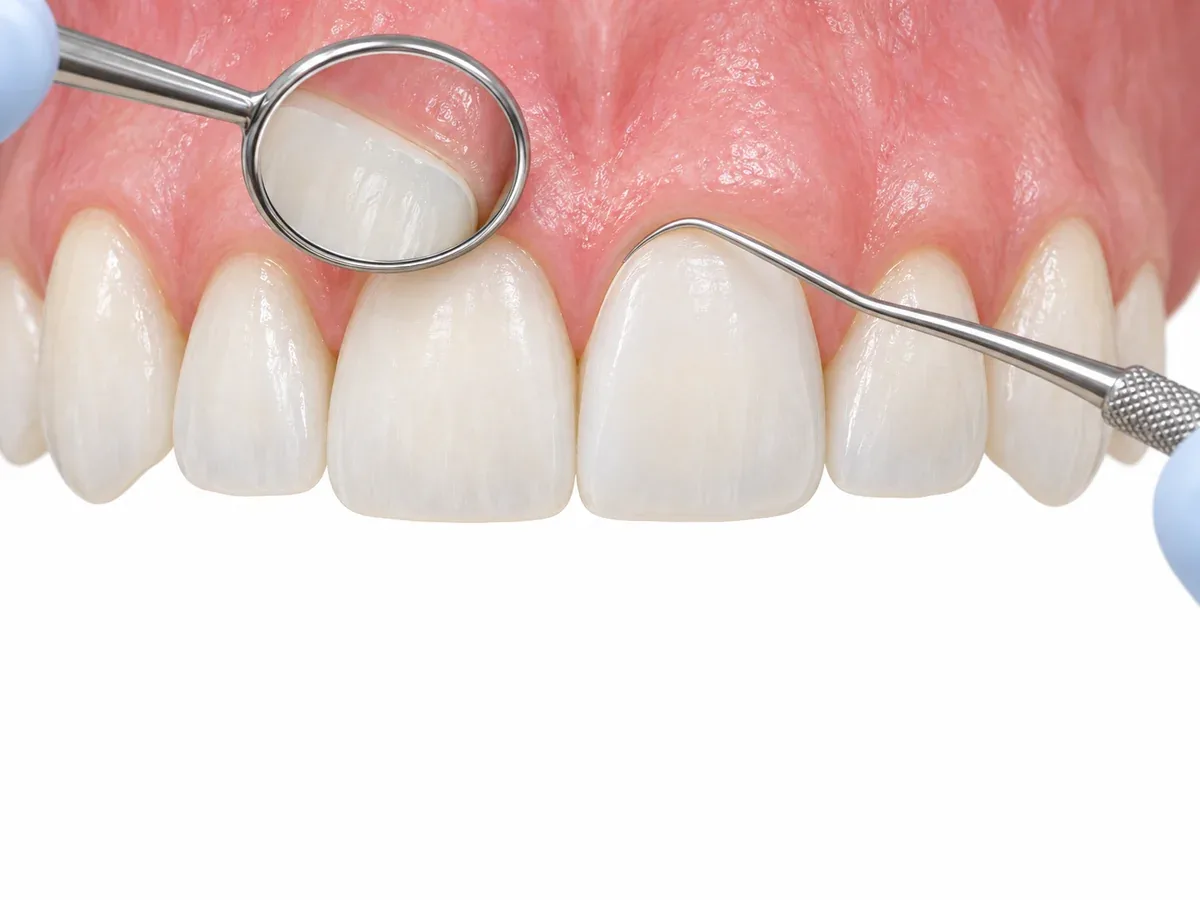
We look for swelling and bleeding, and judge how much tartar has built up.
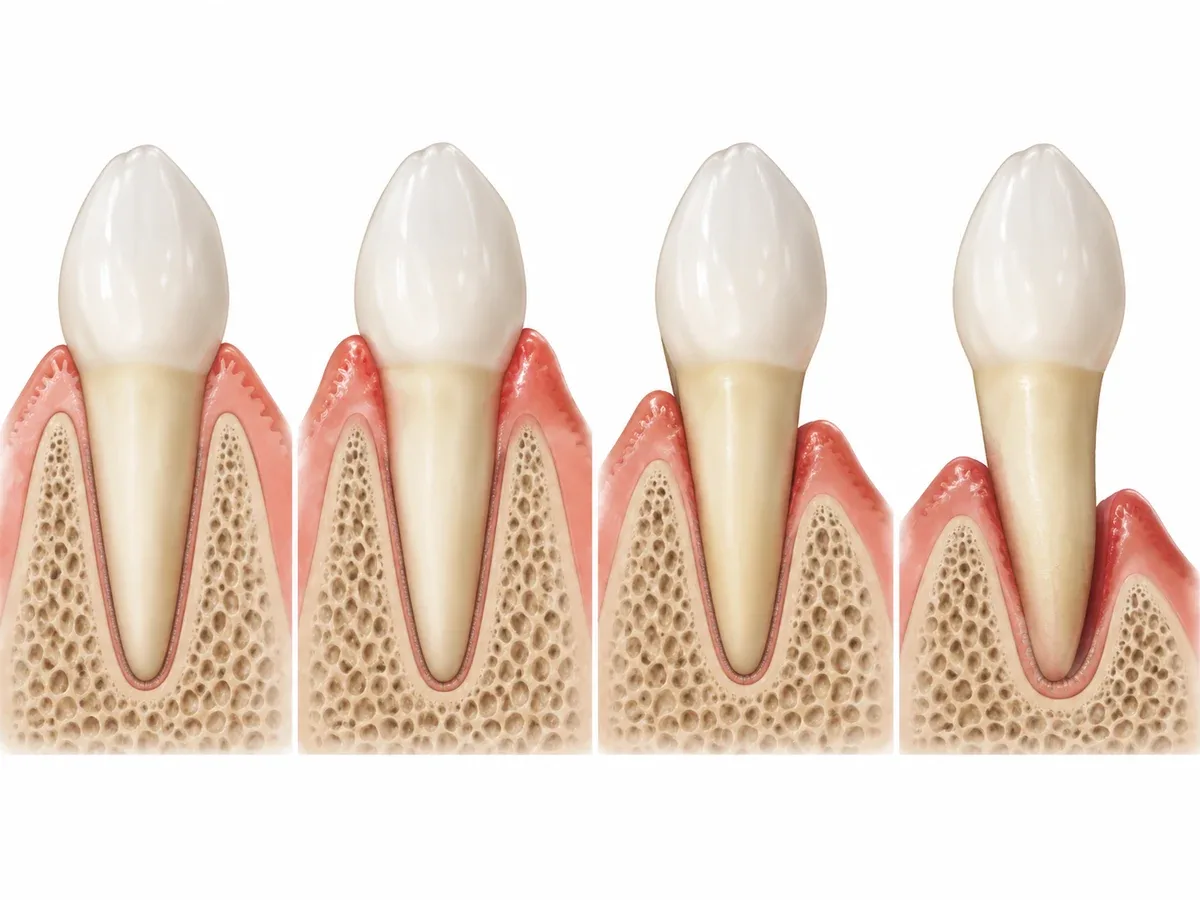
The fourth is the mouth as a whole. The mucosa, the tongue and the palate are examined.
We look for anything that stands out, such as a lump or a white patch. A short questionnaire comes with it.
- Cavities, fillings and crowns.
- The number of missing teeth.
- Gum condition and tartar.
- The mucosa, tongue and palate.
- Brushing habits, smoking and snacking.
We ask how many times a day you brush and whether you smoke. Those answers help us read the findings.
We also ask whether your jaw joint makes a noise. All of it is written down on a sheet for you.
| What is checked | In detail | How it is recorded |
|---|---|---|
| Cavities | Visible holes and dark spots | By tooth number |
| Fillings and crowns | Work already carried out | Counted |
| Missing teeth | Empty spaces | Counted |
| Gums | Swelling, bleeding, amount of tartar | By stage |
| Mucosa and tongue | White patches and lumps | Noted when present |
| Questionnaire | Brushing, smoking, snacking | As answered |
The recording form is fixed by the programme. So the same items are covered wherever you go.
What does the oral check-up miss?
No radiographs are taken, and that is the biggest limit. It means what can be seen by eye is what gets recorded.
A cavity between two teeth is not visible to the eye. Inflammation at a root tip cannot be judged without an image.
The same applies to a buried wisdom tooth. How much gum bone has been lost also needs an image.
So a normal result is not the whole picture. It is better read as a starting point.
| What the oral check-up finds | What needs a radiograph |
|---|---|
| Cavities visible on the surface | Cavities between the teeth |
| Missing teeth and crowns | Inflammation at a root tip |
| Swollen or bleeding gums | How much gum bone has been lost |
| The amount of tartar | Buried wisdom teeth |
| Visible changes in the mucosa | Cysts inside the jawbone |
The two-year interval is also long for some people. Someone prone to cavities can develop several within it.
Anyone who has had gum disease needs a shorter gap. Six months to a year is the usual range we suggest.
For gums that have been poor, three or four months is closer. Your own interval is worth setting separately.
- Nothing is imaged, so some things stay out of view.
- A two-year gap is long for some people.
- Cavity-prone mouths are seen more often.
- Past gum disease shortens the gap to a few months.
- Set an interval that suits you.
None of that is a reason to skip it. Quite a lot is picked up from surface findings alone.
The oral check-up also tells us whether an image is worth taking. That judgement is part of what it does.
How are the results written, and how do you use them?
Three wordings are used. Normal, needs attention, and disease suspected.
Normal does not mean nothing at all is there. It is closer to saying nothing needs doing right now.
Needs attention means care is required. Usually tartar has built up, or the gums are slightly swollen.
Disease suspected means you should come in for treatment. That is a cavity, or gum disease that has progressed.
- Normal — nothing needs doing right now.
- Needs attention — care is required.
- Disease suspected — come in for treatment.
- Findings are listed position by position.
- Gums are often recorded as a stage.
The sheet states which tooth holds which finding. Teeth are written as numbers, so it reads awkwardly at first.
Bring it in and we will read it through with you. We sort what is urgent from what can be watched.
Tooth numbers follow a rule. The mouth is split into four quadrants and counted from the middle outwards.
Once you know the rule, you can find any tooth on the sheet. Keep your sheets rather than throwing them away.
Two or three cycles later you have several years side by side. Read together, they show the direction of travel.
You can see whether the cavity count is rising or holding. The gum stage and the pace of tooth loss show up the same way.
- Keep the result sheets instead of discarding them.
- Read several years side by side.
- Watch how the cavity count changes.
- Follow the trend in the gum stage.
- Bring them in so we can read them together.
Past results can also be viewed on the insurance service website. If the same tooth has read needs attention for years, watch it.
Is scaling included, and do children have one too?
Scaling is not part of the oral check-up. The two are separate things.
Scaling is covered by national health insurance once a year. Anyone aged nineteen or over is eligible.
The entitlement resets when the calendar year changes. Many patients have it done on the same visit as the oral check-up.
For that, booking ahead is wise. Heavy tartar takes longer to clear.
- Scaling is covered once a year.
- Anyone aged nineteen or over is eligible.
- The entitlement resets with the new year.
- Book ahead to have it on the same day.
- Gum treatment is covered separately when needed.
Tartar that has travelled below the gum is a different matter. That is handled as gum treatment, over several visits.
Having both the oral check-up and a scaling within the year works well. Looking and clearing get finished together.
Children are screened too, under a different system. The infant health screening includes several oral examinations.
They are timed around when teeth come through. School-age children are covered by the school screening.
The notice comes home from the school. For children, cavities and the bite are looked at together.
- Infant screening includes several oral examinations.
- School-age children are covered through the school.
- Cavities and the bite are looked at together.
- The order in which baby teeth are lost is checked.
- Fluoride application or sealants may be advised.
Whether baby teeth are being lost in the right order is also checked. Fluoride application and sealants are advised when they help.
Both are preventive measures with clear benefit. Sealants are covered by national health insurance.
Eligible teeth and ages are set by the programme. Many children are nervous about the visit itself.
A check-up involves looking rather than doing, so it does not hurt. A comfortable first visit makes every later one easier.
How we read your oral check-up in Seomyeon, Busan
The examination itself follows the set items. We simply add a few things while we are looking.
If a spot is not being cleaned, we show it to you in a mirror. A staining solution can show where plaque is left behind.
If an image looks worthwhile, we say so separately. When it is not urgent, it can wait until your next visit.
An identification card is all you really need to bring. Bring the notice as well if you have it.
- We follow the set items.
- We show you the spots that are not being cleaned.
- We tell you separately if an image is worthwhile.
- We read the result sheet through with you.
- We set an interval that suits you.
Write down the names of any medicines you take. Bring your previous result sheet if you kept it.
Noting your questions in advance helps. The visit is short, and questions rarely surface on the spot.
There is no need to brush especially hard that morning. Coming as you normally are gives a truer reading.
If you smoke, say so plainly. Hiding it makes the findings harder to read.
We read the sheet through and sort out what is urgent. We do not ask you to have everything done at once.
Appointments are split and ordered by urgency. Your own oral check-up interval is agreed at the same time.
Being close to Seomyeon Station means patients drop in over a lunch break. Visitors from elsewhere in Korea manage it in a single trip.
Going through the results takes about ten minutes. Those ten minutes sometimes change the next few years.
Frequently asked questions
Is there anything to pay for the oral check-up?
No separate payment is needed. Bring your identification card and that is enough.
Can I go to any dental clinic?
It has to be a clinic designated as a screening provider. The insurance service website and phone line both list them.
Are X-rays taken during the oral check-up?
No, they are not. That is why cavities between the teeth and root-tip inflammation can stay out of view.
Can I have an oral check-up explained in English in Busan?
Yes, we provide 1:1 English interpretation from the first consultation through the end of treatment. We are near Seomyeon Station Exit 2 (5-min walk), opposite Lotte Hotel. Call 010-8555-2854 (+82-10-8555-2854 from abroad).
The oral check-up is a filter, not a full examination.
It records cavities, missing teeth, gums and tartar.
What it cannot see needs a radiograph afterwards.
If you want your oral check-up read through in Busan, Reset Dental Clinic provides 1:1 English interpretation from your first consultation through the end of treatment. Call 010-8555-2854 to book a consultation.
References
- KDCA National Health Information Portal, "Health Screening" — the shared items of the general health screening and who is eligible
- KDCA National Health Information Portal, "Health Screening (Cancer Screening)" — the purpose and limits of screening
- KDCA National Health Information Portal, "Periodontal Disease" — how gum condition is staged
- KDCA National Health Information Portal, "Fluoride Application" — the effect of preventive measures
Written by Reset Dental Clinic Support Team
Medical review Dr. Kim Hyun-joo, Head Dentist
Last updated: November 3, 2026
This column is for general information and does not replace diagnosis or treatment for individual patients. If you have symptoms, please see a dentist.