- The active ingredient is hydrogen peroxide or a source of it.
- It breaks pigment molecules into smaller pieces.
- The tooth is not ground down or covered over.
- The higher the concentration, the more sensitivity.
Patients ask whether whitening grinds the tooth down. Knowing what the gel is and how it acts takes most of that worry away, so we start with the ingredients at Reset Dental Clinic in Seomyeon, Busan. For patients from abroad, we provide 1:1 English interpretation from the first consultation through the end of treatment.
Tooth color comes from the enamel outside and the dentine beneath it. Enamel is translucent and dentine is yellowish.
So where enamel is thin, the yellow underneath shows through more. Pigment from food and tobacco is added on top of that.
That pigment does not sit on the surface alone. It travels inwards along microscopic gaps.
Brushing reaches what is stuck to the surface. Pigment that has gone inside does not come off that way, and whitening is aimed at it.
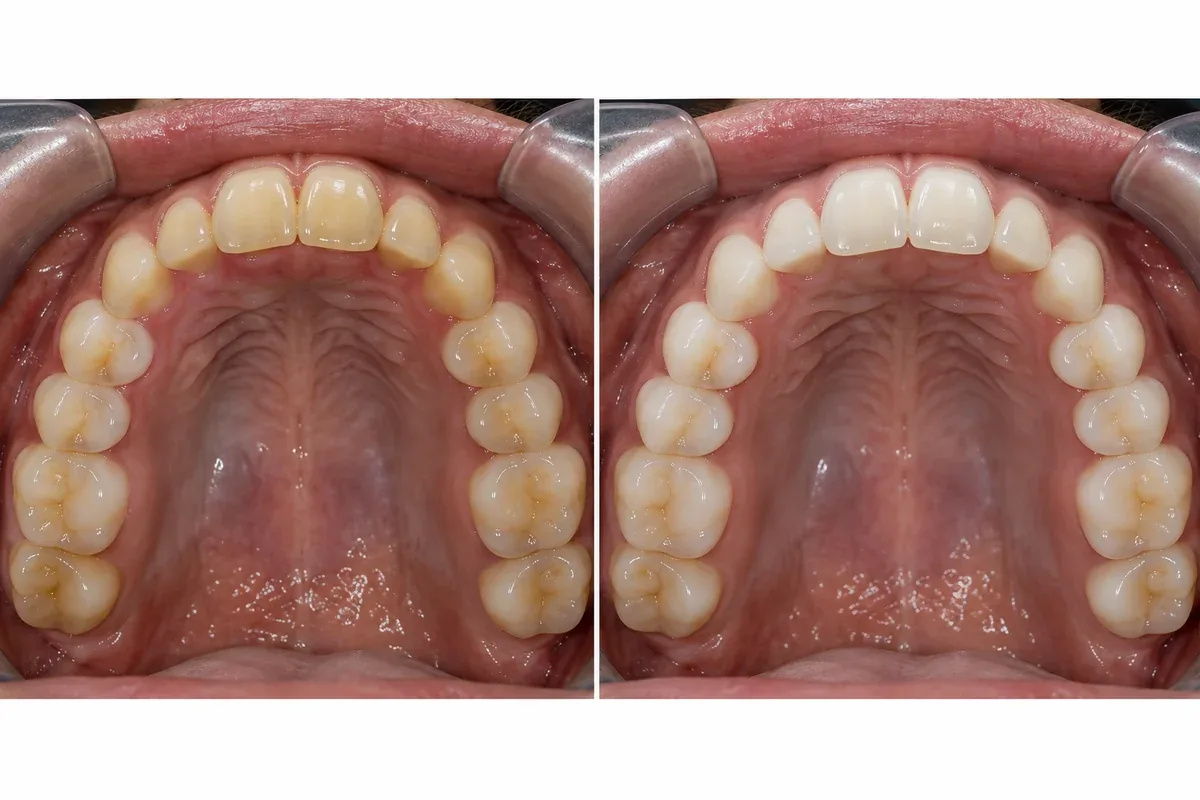
What is actually in whitening gel?
The active ingredient is hydrogen peroxide, or something that turns into hydrogen peroxide in the mouth. Carbamide peroxide is the one in common use.
Carbamide peroxide splits into hydrogen peroxide and urea on contact with water. So what acts in the end is the hydrogen peroxide.
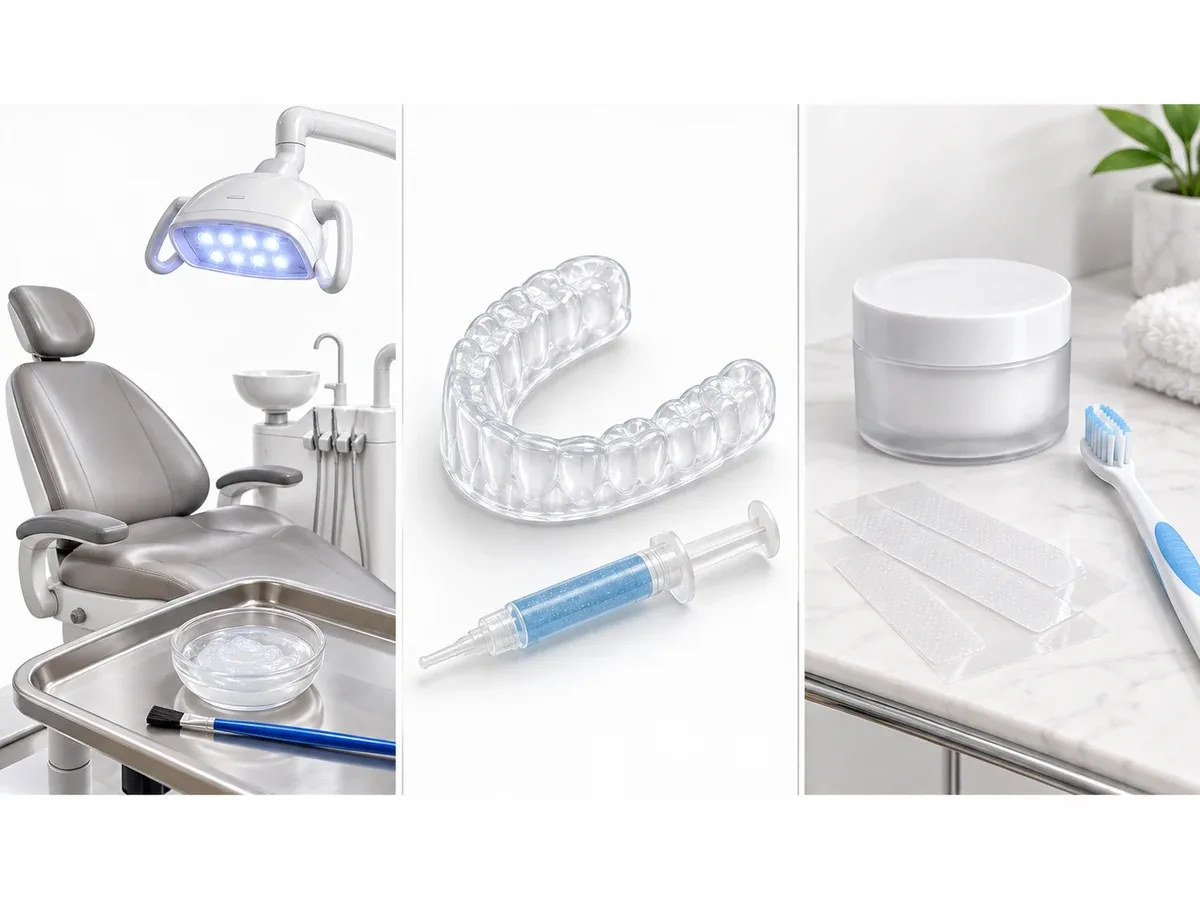
Carbamide peroxide splits slowly, so it acts over a long period. That is why it is used for gels worn at home for hours at a time.
Gels used at the clinic contain hydrogen peroxide directly. They act quickly, and the irritation is greater to match.
| Ingredient | How it acts | Mainly used in |
|---|---|---|
| Hydrogen peroxide | Acts straight away | Whitening done at the clinic |
| Carbamide peroxide | Splits slowly and acts over time | Whitening done at home |
| Abrasive | Scrubs surface pigment off | Whitening toothpaste |
| Fluoride | Settles the outer surface | Before and after treatment |
| Potassium nitrate | Makes the nerve less reactive | Reducing sensitivity |
The bottom two rows of the table do not brighten anything. They are there to reduce sensitivity.
Whitening toothpaste works by scrubbing the surface with abrasive. It barely acts on pigment inside the tooth.
So whitening toothpaste and whitening treatment are two different subjects. When you choose a product, read the ingredient list once.
Look for the words hydrogen peroxide or carbamide peroxide. Without one of those names, the product does not brighten the tooth.
How does whitening make teeth look brighter?
Pigment molecules are long chains. The longer the chain, the darker it looks.
Hydrogen peroxide breaks those chains into smaller pieces. The broken pieces are paler in color.
So the whole tooth reads as brighter. The pigment is not removed, it is cut up.
The tooth is not ground down, and nothing white is laid over it.
- Pigment chains are broken into smaller pieces
- The broken pieces are paler in color
- The tooth is not ground down
- Nothing white is laid over it
- The structure of the enamel stays as it was
While the gel acts, though, the outer surface roughens for a while. Pigment attaches more easily during that window.
That is why we ask you to avoid strongly colored things for a few days afterwards. Whitening is less about erasing pigment than about making it paler.
There is a limit to how much brighter a tooth can go. It does not go brighter than the shade you were born with.
Is whitening gel harmful to your body?
Kept to the stated amount and concentration, it causes no great problem. Hydrogen peroxide is a substance the body itself makes in very small quantities.
In the mouth, saliva and mucosa break it down quickly. A small amount swallowed is broken down in the stomach.
The trouble comes from leaving a high concentration on for a long time. The gums and mucosa can turn white and sting.
That is why we cover the gums before we start at the clinic.
- Within the stated concentration and time, it is fine
- High concentration left on too long damages the mucosa
- The gums have to be covered first
- Put it off during pregnancy and breastfeeding
- We do not whiten young children's teeth
During pregnancy and breastfeeding we suggest putting it off. Not because there is evidence of harm, but because there is little data.
We do not whiten young children's teeth. Their enamel has not finished maturing.
We generally look at fifteen or sixteen as the starting point.
| In this case | Can whitening gel be used? | What we look at instead |
|---|---|---|
| Gum disease | Treat it first | Start after gum treatment |
| Deep decay | Fill it first | The gel gets into the gap |
| Marked sensitivity | Lower the concentration | Apply fluoride beforehand |
| Pregnancy | Put it off | Discuss after the birth |
| Under fifteen | We do not do it | Enamel is still maturing |
| A filling in a front tooth | Get the order right | Refill after whitening |
As the table shows, there are things to check before whitening gel is used. If there is deep decay, the gel gets into the gap.
That makes the tooth extremely sensitive, so we fill it first. Swollen gums also raise the irritation.
How do whitening concentrations differ?
The concentration used at the clinic and the one used at home are different. The clinic version is far higher.
So one session brings a noticeable change. The home version uses a low concentration over a long time.
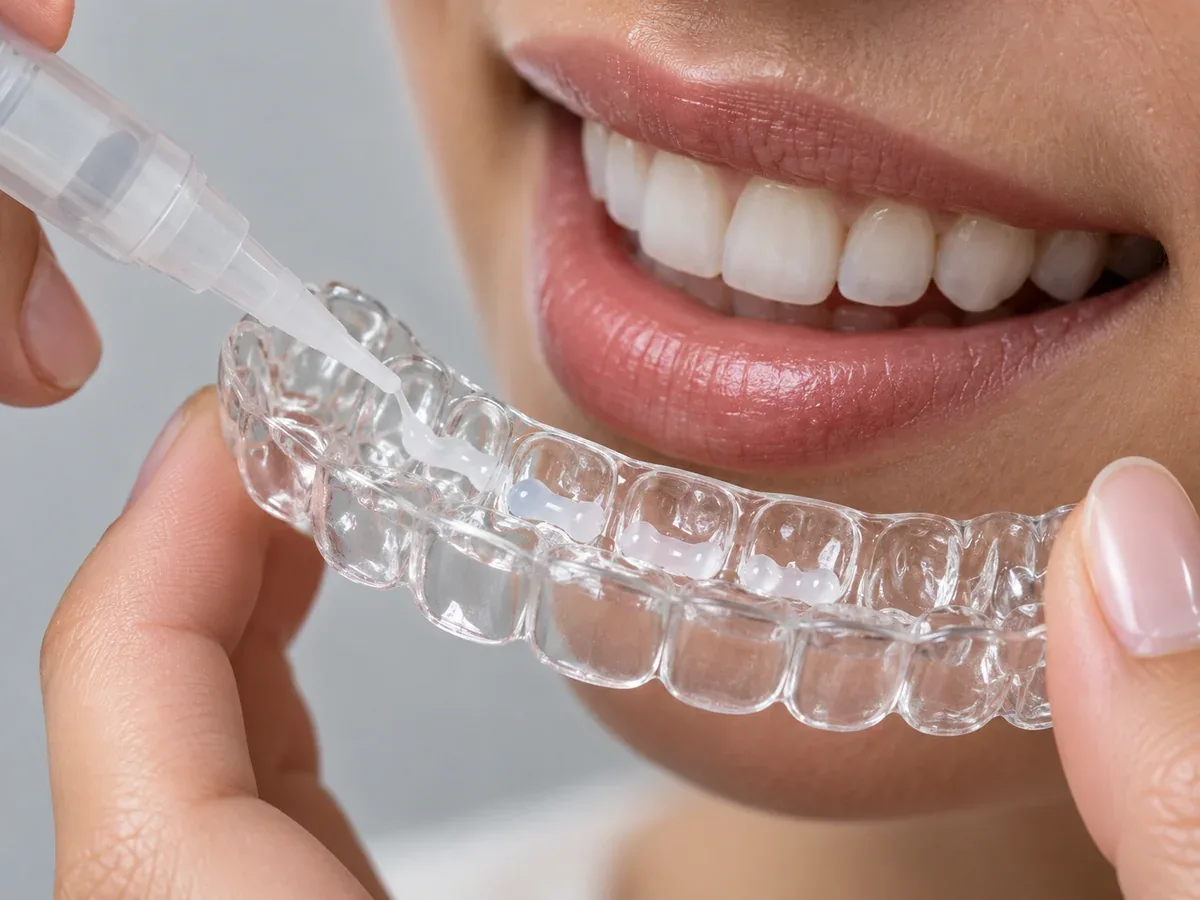
That means a few hours a day for two or three weeks. The final result of the two routes is not thought to differ greatly.
What differs is the time it takes and how uncomfortable it is. Sensitivity comes on harder the higher the concentration.
| Route | Concentration | Time it takes |
|---|---|---|
| Whitening at the clinic | High | About an hour per session |
| Whitening at home | Low | A few hours a day for two or three weeks |
| The two combined | High then low | Start at the clinic, maintain at home |
| Whitening toothpaste | Very low or none | Surface pigment alone |
| Products bought online | Unknown | We do not suggest them |
The last row of the table is the one to be careful about. Products have been found whose concentration differed from the label.
Many of the trays sold with them do not cover the gums. So we do not suggest products that no professional has looked at.
The same number means different strength depending on the ingredient. About a third of carbamide peroxide converts to hydrogen peroxide.
Why does whitening make teeth sensitive?
Hydrogen peroxide passes through the enamel and reaches the inside. The nerve becomes temporarily more reactive in the process.
So cold things give a sharp twinge, or the tooth aches for no reason. It usually settles within a few hours to a day or two.
It comes on harder with a higher concentration and a longer application. Patients who were already sensitive feel it more.
So we ask about that before we start.
- A sharp twinge from cold things
- Aching for no apparent reason
- Usually settles within a day or two
- Comes on harder at higher concentrations
- Felt more by patients already sensitive
There are ways to reduce it. Applying fluoride before and after whitening is one.
Using a toothpaste containing potassium nitrate beforehand is another. We also space the sessions out, with a day off in between.
If it is severe, we lower the concentration or lengthen the course. While the gel is in use, very cold things are easier avoided.
At the clinic we cover the gums before we start. A material that sets is painted thinly along the gum line.
That material keeps the gel off the gums, and we peel it away at the end. Home trays do not cover the gums.
- At the clinic the gums are covered first
- With a home tray, squeeze in a small amount
- Wipe off any overflow straight away
- Rest that day if a patch turns white
- It usually recovers within a day
So too much gel squeezed in overflows onto them. That spot turns white and stings.
Wipe the overflow off straight away if it happens. A whitened patch usually recovers within a day.
Call us if it does not recover or if it hurts. A well-fitting tray is what stops the overflow.
So we take an impression and make the tray to fit your mouth.
Are there colors whitening cannot change?
There are. So we look at what kind of color it is first.
Yellowish shades brighten relatively well. Greyish or bluish shades brighten less.
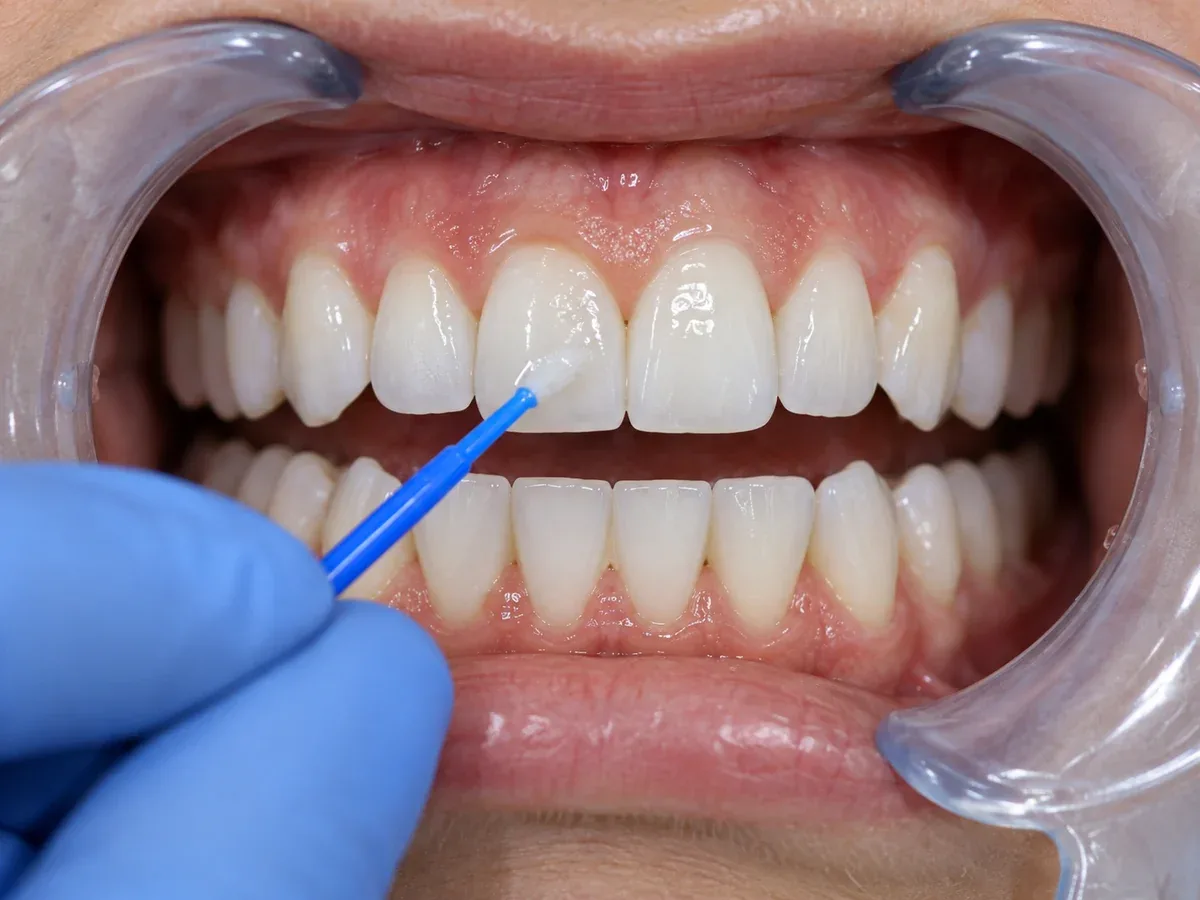
Teeth striped by medication are difficult too. White patches can even stand out more afterwards.
A single tooth darkened by a dead nerve needs a different method. In that case the gel goes inside the tooth.
- Yellowish shades — brighten relatively well
- Greyish or bluish — brighten less
- Stripes from medication — difficult
- White patches — can stand out more
- One tooth with a dead nerve — gel placed inside
Crowns and fillings do not brighten. The gel does not act on those materials.
So shades can look mismatched after whitening. If you have a filling in a front tooth, we redo it afterwards.
We explain that order before we start. Knowing the range whitening covers matters.
When a single front tooth is dark, we look for the cause first. A knock that killed the nerve is a common one.
Then we place the gel inside the tooth and brighten it from within. Applying it from the outside does not work well for that.
When a whitening course finishes, we settle the outer surface. Applying fluoride is the usual step.
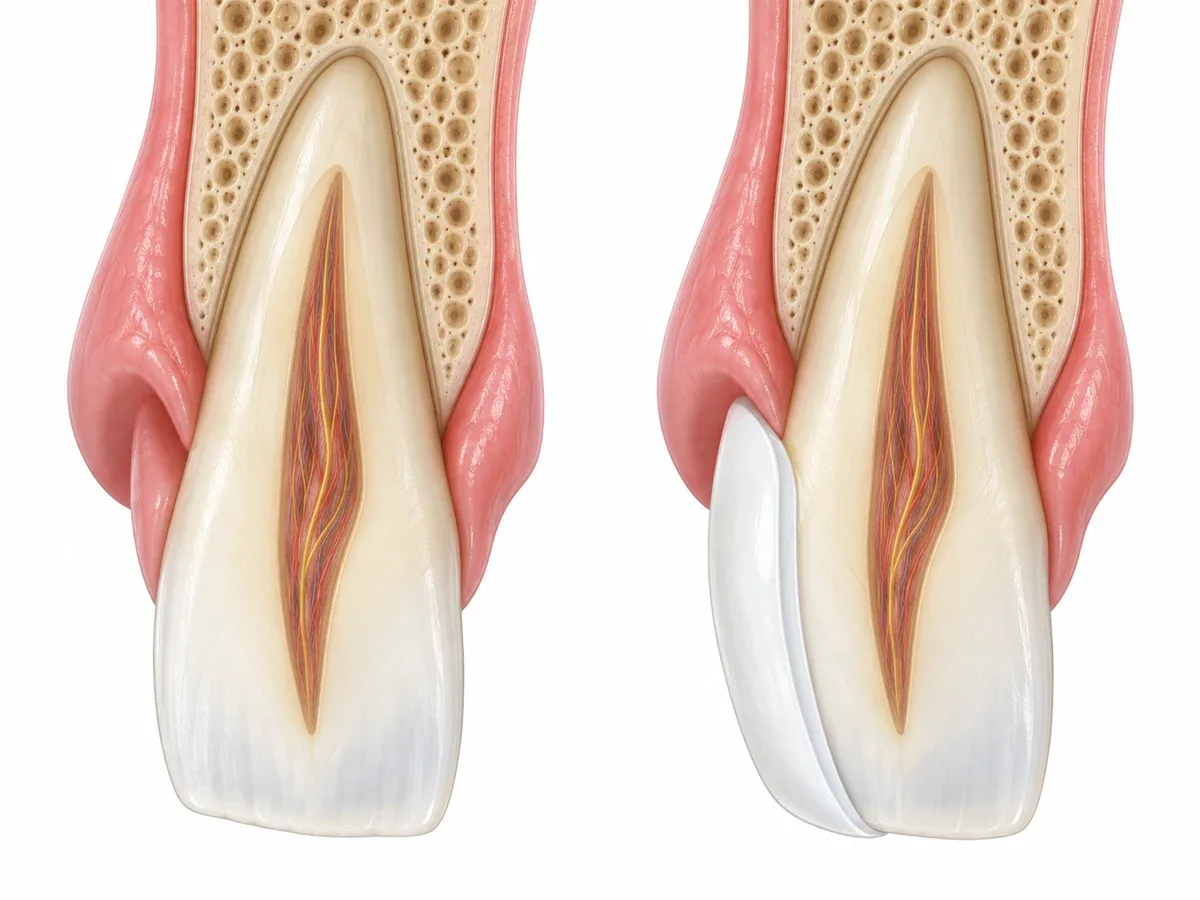
For the next few days, avoid strongly colored things. The surface firms up again during that time.
Coffee, black tea, red wine and curry are the examples. Tobacco in particular has to wait during that window.
If you do have them, rinse with water straight away.
- Fluoride applied to settle the surface
- Avoid strongly colored things for a few days
- Tobacco in particular has to wait
- Rinse with water after eating or drinking
- Leave it a while before brushing
After an acidic drink, do not brush immediately. Wait about thirty minutes.
Once those few days pass, go back to normal. Color returns a little at a time, and most patients repeat whitening every year or two.
Right after the course there are tiny openings in the surface. Those take a few days to close again, which is why those days matter most.
Patients often worry that repeated whitening thins the enamel. Kept to the stated concentration and time, the change is not of that order.
Done too often, though, sensitivity accumulates. The gums take repeated irritation as well.
So we look at about once a year as the standard. For maintenance there is a short course at home.
How do we plan teeth whitening in Seomyeon, Busan?
We start by looking at what kind of color you have, recording it against a shade guide. Whether it is yellowish or greyish changes what to expect.
We ask whether you have had sensitivity before. We check the gums and any fillings at the same time.
Then we set the concentration and the length of the course. If your schedule is tight, we mix in a session at the clinic.
- Color recorded against a shade guide
- We ask about past sensitivity
- Gums and fillings checked
- Concentration and duration set to suit you
- Color and comfort reviewed partway through
You come in once partway through so we can check color and comfort. If you are sensitive, we adjust the spacing there and then.
At the end we apply fluoride and write out the cautions for the next few days. If a filling looks mismatched, we redo it then.
The clinic is close to Seomyeon Station, so a short visit is easy. Bring any gel you have been using and we will look at the ingredient and concentration with you.
If you have a date to work towards, we count back from it. For a wedding or a photo shoot we start at least a few weeks ahead.
Teeth whitening in Busan is easier to judge when there is a record to compare, so we photograph your color at the end. Ask whatever you are unsure about, as the whitening plan can be changed partway.
Frequently asked questions
Does whitening grind the tooth down?
It does not. It works by breaking the pigment inside into smaller pieces.
Will my enamel get thinner?
Kept to the stated concentration and time, the change is not of that order. Done too often, sensitivity accumulates.
Can I buy a kit and whiten my teeth myself?
We do not suggest products whose concentration you cannot verify. The gums can be damaged.
Can I have teeth whitening in English in Busan?
Yes. We provide 1:1 English interpretation from your first consultation through the end of treatment.
The clinic is near Seomyeon Station Exit 2 (5-min walk), opposite Lotte Hotel. Call 010-8555-2854 (+82-10-8555-2854 from abroad).
Whitening makes the pigment inside paler.
The tooth is not ground down and nothing is laid over it.
The concentration and the duration are what we set to suit you.
If you are considering whitening, Reset Dental Clinic in Busan provides 1:1 English interpretation from your first consultation through the end of treatment. Call 010-8555-2854 to book a consultation.
References
- Dailydental, "Hydrogen Peroxide Concentration in Tooth Whitening Agents Exceeds the Approved Standard" — concentration standards and the range to keep to
- Dailydental, "Warning on Home Whitening Devices Used Without Professional Prescription" — the problems of using them without professional oversight
- KDCA National Health Information Portal, "Tooth Sensitivity (Dentine Hypersensitivity)" — why sensitivity arises
- KDCA National Health Information Portal, "Fluoride Application" — treatment that hardens the outer surface
Written by Reset Dental Clinic Support Team
Medical review Dr. Kim Hyun-joo, Head Dentist
Last updated: November 3, 2026
This column is for general information and does not replace diagnosis or treatment for individual patients. If you have symptoms, please see a dentist.