

- Teeth grinding and clenching mostly happen without you knowing: while you sleep, or while you concentrate on something.
- They leave marks on the teeth. The edges wear flat, the neck of the tooth gets a V-shaped notch, and teeth become sensitive.
- Care follows an order: noticing the habit, a night splint, then treatment for the muscles. Botulinum toxin is seen as a last resort.
- When worn teeth are rebuilt, bite height and force come first. If the force stays, the new part takes the same force.
Does your jaw feel stiff when you wake up? At our clinic in Seomyeon, Busan, where patients can consult with 1:1 English interpretation, we often find teeth grinding or clenching behind it. The trouble is that most people hardly know they do it.
Perhaps your front teeth also look shorter and flatter in the mirror than they used to. That can be another sign of the same habit.
This column explains what that force does to your teeth and jaw, and the order in which we manage it. It is written for anyone living in or visiting Korea.
How are teeth grinding and clenching different?
Grinding (bruxism) and clenching have one thing in common. Both put more force than needed on the upper and lower teeth. They differ in how that force is applied.
| Point | Grinding | Clenching |
|---|---|---|
| How | The upper and lower teeth rub from side to side | The teeth are pressed hard together |
| When | Mostly during sleep | During sleep, and while concentrating in the daytime |
| Sound | Can be loud enough for others to hear | Almost silent |
| What you mainly notice | The tooth edges wear down | The jaw muscles feel stiff |
Clenching makes no sound, so it is even harder to notice. Neither your family nor you may know about it.
That does not mean the strain on your teeth and jaw is any smaller.
An article in Dailydental, the Korean Dental Association's newspaper, describes grinding as a cause of tooth wear and jaw joint (TMJ) disorders. That is why the teeth and the jaw need to be checked together.
What marks does grinding leave on your teeth?
Force cannot be seen. But its marks stay on the teeth.
The edges wear flat
When the upper and lower teeth keep rubbing together, the front tooth edges and the chewing surfaces of the molars slowly wear away. This is called attrition.
Front teeth become short and straight across the edge. The bumpy chewing surfaces of the molars become flat.
The outside of a tooth is hard enamel, and inside it is dentin. According to the KDCA National Health Information Portal, a grinding habit can wear the chewing surface until the dentin is exposed.
Dentin is softer than enamel. Once it is exposed, it can wear faster.
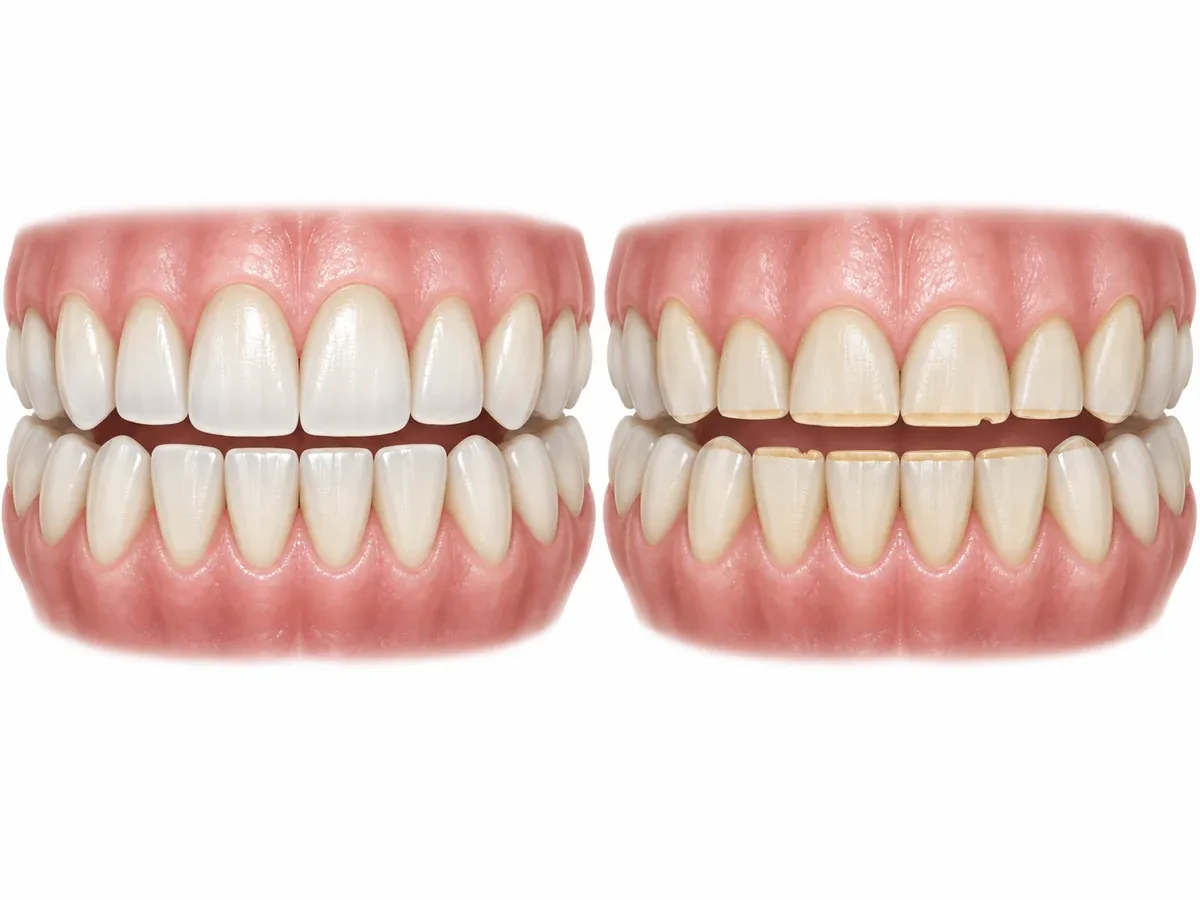
The neck of the tooth gets a V-shaped notch
The neck of the tooth near the gums is called the cervical area. According to the KDCA, repeated excessive biting force can cause tiny fractures in the enamel there.
Over time, these become a V-shaped notch at the neck of the tooth.
This does not come from brushing too hard alone. If force is the cause, changing your toothbrush may not be enough.
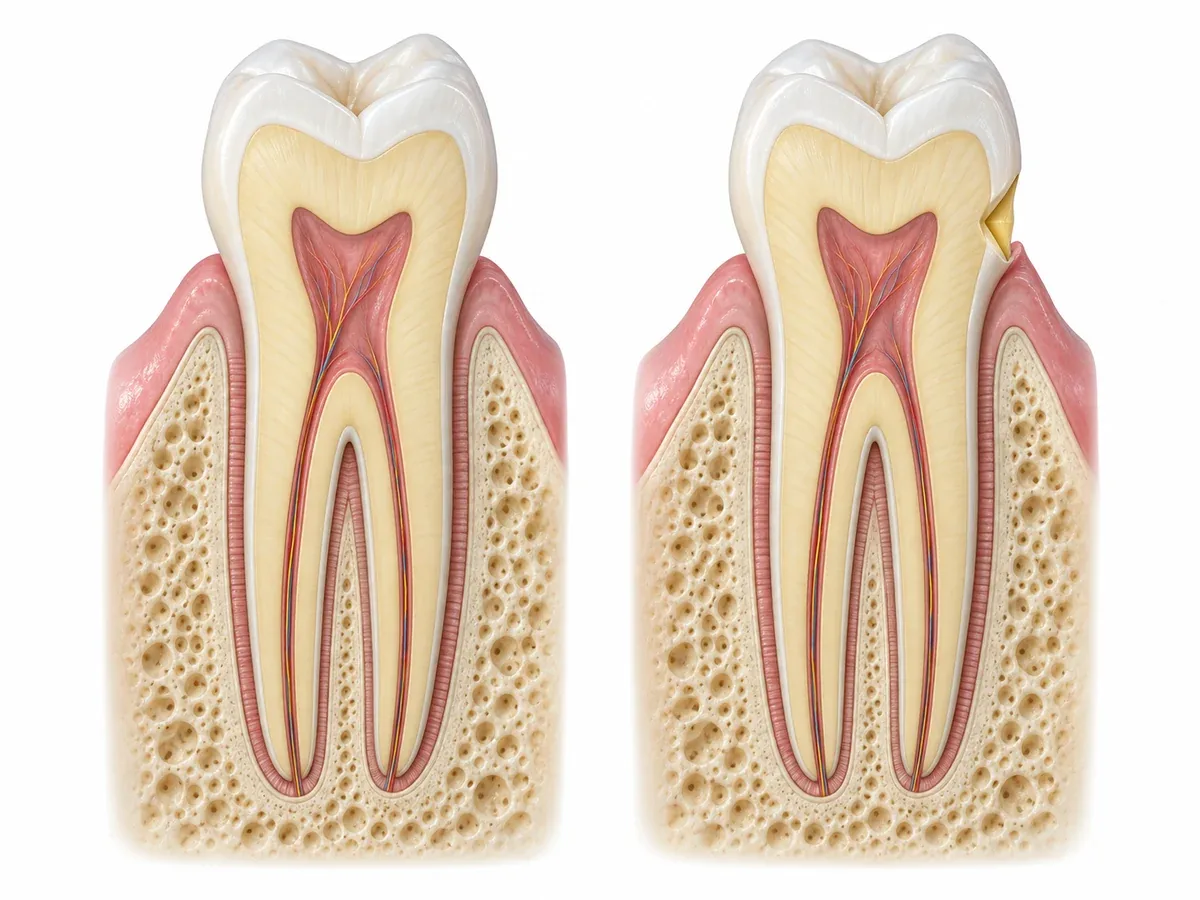
Teeth become sensitive, and edges chip
When dentin is exposed where a tooth has worn or notched, cold water or air can cause a sharp twinge.
The same KDCA source says that more than 90% of sensitive-tooth pain occurs at the cervical area. It also clearly lists correcting clenching and grinding habits as a way to prevent it.
Small chips on the edges of the front teeth are another common mark. A chipped spot can feel rough and catch on the tongue or lips.
| Mark | Where | What you may notice |
|---|---|---|
| Flat wear (attrition) | Front tooth edges and molar chewing surfaces | Shorter, straighter front teeth; flat molars |
| V-shaped notch | The neck of the tooth near the gums | A groove at the gum line |
| Sensitivity | Where dentin is exposed | A twinge with cold water or air |
| Small chips | Front tooth edges | Rough spots that catch on the tongue or lips |
Why do the jaw muscles and joint get tired too?
When you clench, the muscle doing most of the work is the masseter. It sits at the side of the cheek, above the corner of the lower jaw.
Put your hand on the side of your cheek and bite hard. You will feel a muscle bulge firmly under your fingers.
When this muscle cannot rest all night, you may notice these signs in the morning.
- a stiff jaw, and discomfort when opening your mouth wide
- heaviness or pain around the temples
- a click or catch in front of the ear when you open your mouth
- people telling you your jawline looks square
The jaw joint sits just in front of the ear and moves every time you open and close your mouth. When force keeps landing on it, strain builds up in both the muscles and the joint.
That is why we look at the jaw as well as the teeth.

How can you tell if you grind or clench your teeth?
Grinding mostly happens while you sleep, so there is no way for you to know. Many people first find out when a family member hears the sound and tells them.
Clenching happens in the daytime too. People press their teeth together without noticing while working at a computer, driving, looking at a phone or lifting something heavy.
A relaxed mouth looks like this: lips closed, upper and lower teeth slightly apart. If your back teeth are touching as you read this, try letting them part.
Grinding does not show up as a single test number. The Dailydental article notes that diagnosis has mainly relied on qualitative methods such as asking questions. Measuring it has had many limits.
For this reason, a 3D-printed splint with differently colored layers has been introduced. It lets the dentist see with the eye how much has been worn away.
At the clinic, we look at these things together.
- Asking: morning jaw stiffness, headaches, sounds your family has heard, and moments you clench during the day.
- Looking at the teeth: worn surfaces, notches at the neck, small chips and sensitive spots.
- Feeling the muscles and joint: whether the masseter is tight, and whether there is a sound or catch when you open.
- Taking photos: a record of your current condition lets us compare at the next check.
How is teeth grinding managed at our clinic in Busan?
No treatment removes the force all at once. So we go step by step, starting with the least demanding option.
| Step | What is done | Purpose |
|---|---|---|
| Noticing the habit | Practicing keeping the teeth apart during the day | Reduces force applied without knowing |
| Night splint | Wearing a custom-made device during sleep | Stops the teeth from grinding directly against each other |
| Treatment for the muscles | Physical therapy, muscle relaxants and similar | Deals with tight muscles and pain |
| Botulinum toxin | When the earlier methods do not last | Considered as a last resort |
Depending on your condition, the splint and muscle treatment may be used together. The key is not to start with the strongest option.
Noticing is the starting point
With daytime clenching, simply noticing it can help reduce it. Put a small sticker next to your monitor or on your phone screen.
Each time you see it, remind yourself: lips closed, teeth apart. This is also why the KDCA lists habit correction as a way to prevent sensitive teeth.
At night, a splint protects the teeth
Force during sleep cannot be controlled by willpower. So you sleep with a clear device made from an impression of your teeth.
It does not stop grinding itself. It is closer to a guard that keeps the teeth from grinding directly against each other.
A device that does not fit well is uncomfortable and hard to keep using. That is why it needs to be adjusted to where your teeth meet.
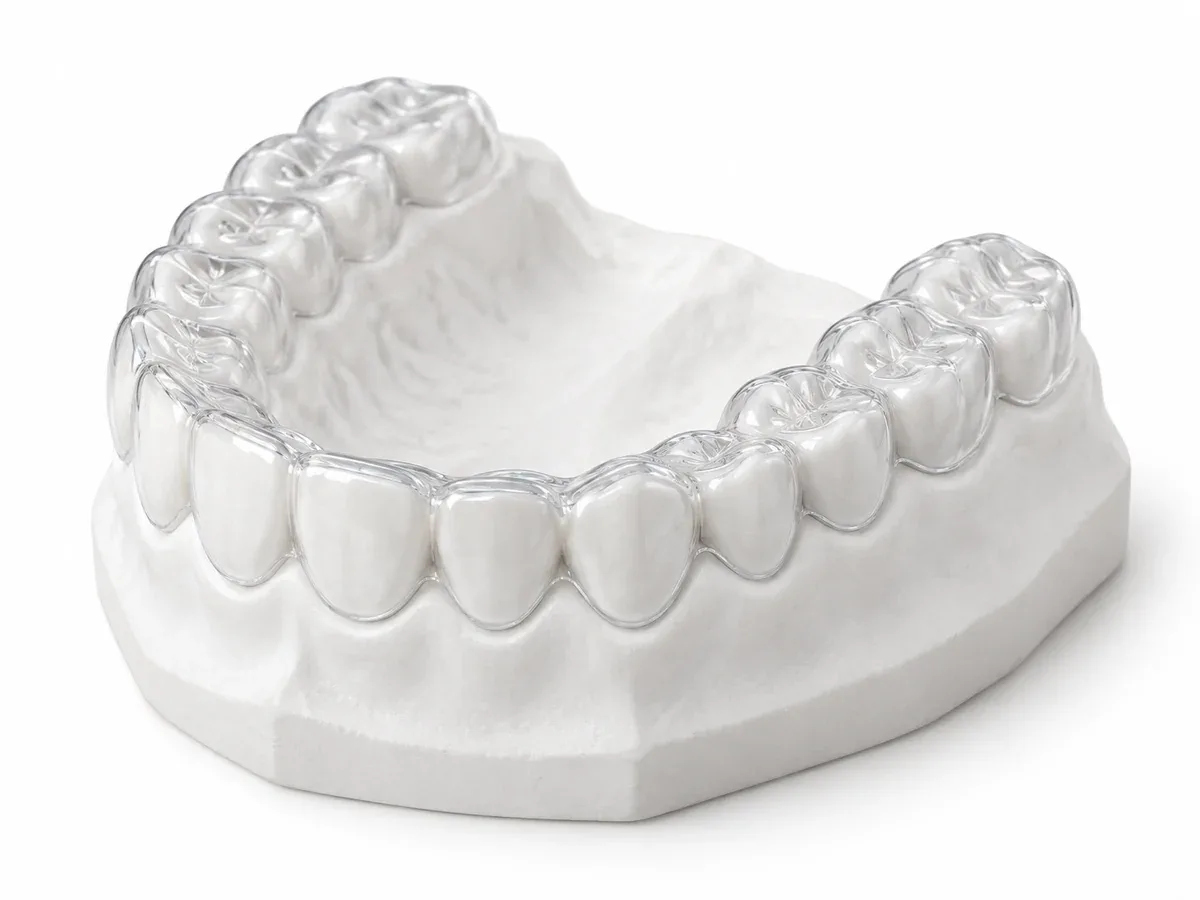
Muscle treatment, and the last option
According to a Dailydental article, dentists use botulinum toxin for grinding, jaw joint disorders and muscle pain in the head and neck. In the same article, a professor of oral medicine calls it a last resort.
The order given in the article is physical therapy and muscle relaxants, then a splint, then treatment using anesthetic injections. Botulinum toxin is considered when these do not have a lasting effect.
We follow the same principle. Less demanding methods come first, and toxin comes last.
Why check bite height before rebuilding worn teeth?
Worn and chipped teeth can get their shape back. But there is an order to follow.
When teeth wear, it is not just their length that changes. The way the upper and lower teeth meet (occlusion) and the height of the bite may also have changed.
If you fill in the visible front teeth alone, the same force lands on the new part. So before rebuilding, we first check these points.
- whether the cause of the force is still there; if the habit continues, a protective device comes first
- where and how much the teeth have worn, whether front teeth alone or molars as well
- whether the bite height has changed, and whether it needs to be restored
A tooth that has worn short has already lost structure. So in some cases, we first consider filling in what is missing with less reduction, rather than removing more and covering the tooth.
Once tooth structure is removed, it does not grow back.
Sometimes wear is severe enough that the whole tooth must be covered. The KDCA lists excessive wear and attrition among the cases for all-ceramic crowns.
It also notes that people who grind or clench in their sleep may need a device to prevent wear and fracture. Whatever the method, managing the force has to go with it.
How do you protect crowns and implants from grinding?
Crowns, bonded restorations and implants take the same force as natural teeth. If the force continues, they can chip or come loose.
The KDCA's dental implant guide also says that grinding and clenching habits should be corrected. It recommends check-ups every 3–6 months after treatment.
If you have implants and grind your teeth, let us know in advance. A protective device is used alongside them, and regular checks confirm that the restoration is not under strain.
At regular check-ups, we look at these points.
- whether small chips or wear have appeared on the edges of restorations
- whether biting force is leaning to one side
- whether the splint still fits, and whether it is worn or cracked
The marks on a splint are also a record of the force applied overnight. Bring your device to your check-up, and we will look at it together.
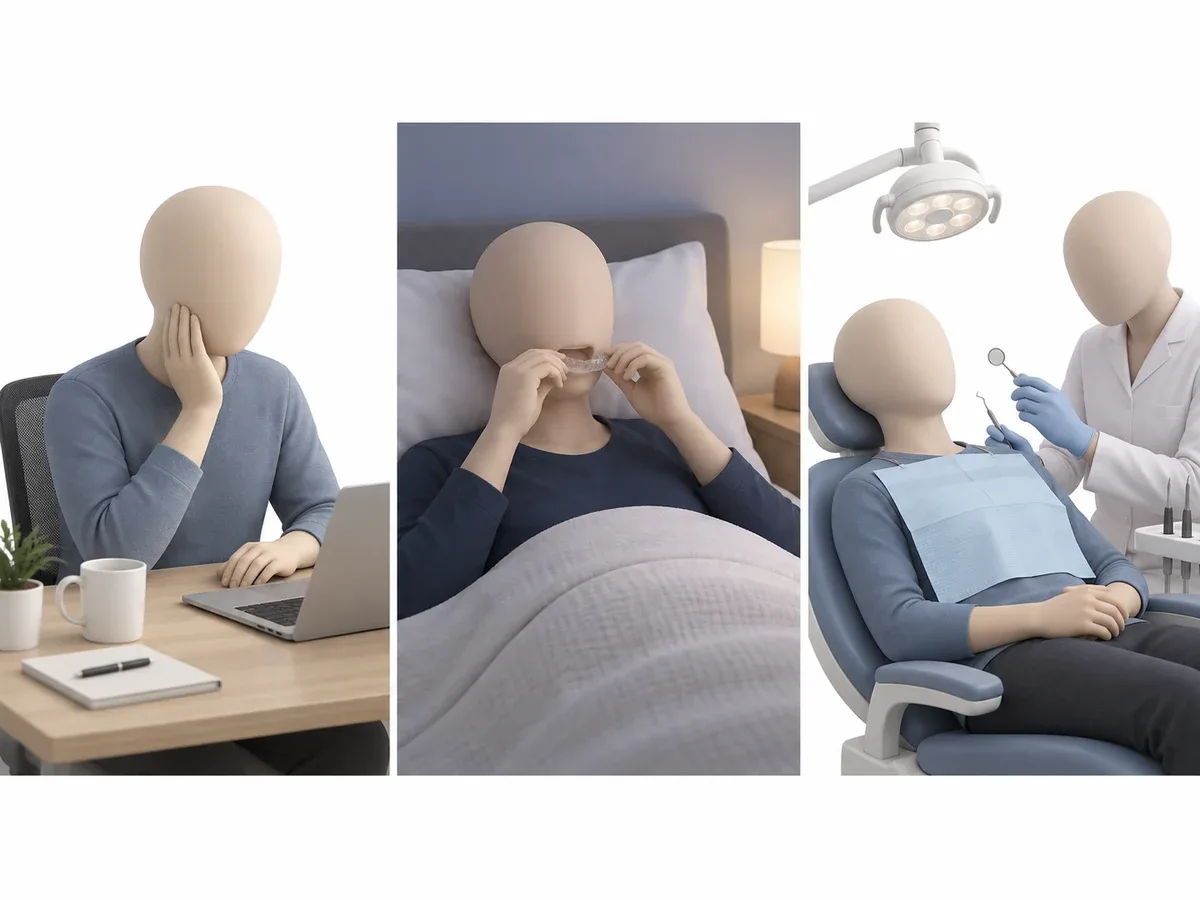
Frequently asked questions
Is teeth grinding caused by stress?
Tension and stress can play a part. In many cases, though, no single cause can be pinned down. So alongside looking for the cause, we start by protecting the teeth and jaw.
Will a splint stop me from grinding?
A splint is a device that protects the teeth; it does not stop the grinding. It keeps the teeth from grinding directly against each other while you sleep. Some people find their jaw symptoms ease too, but not everyone.
Could my sensitive teeth be caused by grinding?
They could. When a chewing surface wears or the neck of a tooth is notched, exposed dentin can become sensitive. Treating the sensitive spot while also reducing the force helps lower the chance of it coming back.
Can I get treatment for grinding in English in Busan?
Yes. We provide 1:1 English interpretation from your first consultation through the end of treatment. The clinic is near Seomyeon Station Exit 2 (5-min walk), opposite Lotte Hotel Busan; call 010-8555-2854 (+82-10-8555-2854 from abroad).
The force of grinding cannot be seen, but it leaves marks.
Left unnoticed, teeth slowly wear down.
Once you notice, you can start protecting them.
If you are concerned about grinding in Busan, Reset Dental Clinic offers 1:1 English interpretation.
We will start with the least demanding option and check what force your teeth are under.
Call 010-8555-2854 to book a consultation.
References
- KDCA National Health Information Portal, "Dentin Hypersensitivity" — V-shaped cervical lesions from excessive biting force, chewing surfaces worn to the dentin by grinding, more than 90% of pain at the cervical area, and correcting clenching and grinding habits
- KDA newspaper Dailydental (Chiui Sinbo), "Using Botox for Bruxism and TMJ Treatment" — where botulinum toxin is used in dentistry, and a treatment order that keeps it as a last resort
- KDA newspaper Dailydental (Chiui Sinbo), "Splint That Diagnoses Bruxism by Color Draws Attention" — grinding in relation to tooth wear and TMJ disorders, the limits of question-based diagnosis and a color-layered splint
- KDCA National Health Information Portal, "All-Ceramic Crowns" — excessive wear and attrition, and devices to prevent wear and fracture for people who grind or clench
- KDCA National Health Information Portal, "Dental Implants" — correcting grinding and clenching habits, and check-ups every 3–6 months after treatment
Written by Reset Dental Clinic Support Team
Medical review Dr. Kim Hyun-joo, Head Dentist · Esthetic Restorations
Last updated: September 19, 2026
This column is for general information and does not replace diagnosis or treatment for individual patients. If you have symptoms, please see a dentist.


