

- Mumps is a viral infection that swells the parotid glands in front of both ears.
- A salivary stone can feel like a lower toothache and hurts more with sour food.
- Infection spreading from a tooth under the jaw can block the airway without early warning.
- The right next step depends on which cause is behind the swollen cheek.
Many people come to our dental clinic in Seomyeon, Busan, with a swollen cheek. Sometimes a tooth is the cause, and sometimes it is a salivary gland or a virus. At Reset Dental Clinic, you can have the cause checked with 1:1 English interpretation.
A swollen cheek is a symptom, not a diagnosis. Which cause it is changes what you need to do today. This column sets out the differences using the Asan Medical Center disease encyclopedia.
We draw on its entries on mumps, sialadenitis (salivary gland inflammation), salivary stones and Ludwig's angina.
Where are the salivary glands?
The sialadenitis entry lists the places where saliva is produced. There are three main pairs of glands, and countless small glands inside the mouth.
- the parotid glands, below and in front of the ears
- the submandibular glands, under the jaw
- the sublingual glands, under the tongue
- many small salivary glands throughout the mouth
Sialadenitis is inflammation of these salivary glands. It is one of several reasons for a swollen cheek or jaw.
Where the swelling sits is the first clue. Please remember whether it is in front of the ear, under the jaw or along the gums, and tell us at your visit.
Whether one side or both sides are swollen is the second clue for any swollen cheek. It points toward quite different causes, as the sections below show.

What if both sides swell in front of the ears?
The mumps entry describes mumps as a viral infection that causes swelling of the parotid glands in front of both ears. Since vaccination became widespread, cases have dropped sharply.
It tends to occur in late winter or spring. According to the entry, once you have had it, you become immune.
The entry sets out the course in detail. After infection, there is an incubation period of about 1–2 weeks.
Early symptoms may then appear for 1–2 days. These can include fever, headache, muscle aches, loss of appetite and nausea.
The parotid glands then swell and become painful, which shows as a swollen cheek in front of the ear. Pain is worst about 1–3 days after the glands start to swell, and then it gradually settles.
The entry also gives numbers on spread. The virus can be found in saliva from about 6 days before the glands swell until 9 days after.
The contagious period runs from 3 days before to 5 days after. Also, 30–40% of infections show no symptoms, yet those people can still pass it on.
The principle of treatment is supportive care. The entry lists these steps.
- plenty of fluids and rest, which are essential
- adjusting food to keep saliva flow low
- compresses to ease pain and swelling
Can adults get mumps? The entry says cases dropped sharply with vaccination, and it does not limit mumps to any age.
It can be diagnosed clinically if contact with a patient in the 2–3 weeks before symptoms is confirmed.
| Item | What the source says |
|---|---|
| Incubation period | About 1–2 weeks |
| Early symptoms | Fever, headache, muscle aches, loss of appetite, nausea for 1–2 days |
| When pain is worst | About 1–3 days after the glands start to swell |
| Virus found in saliva | From about 6 days before the glands swell until 9 days after |
| Contagious period | From 3 days before to 5 days after |
| Infections with no symptoms | 30–40%, which can still spread to others |
What if the swelling comes at mealtimes?
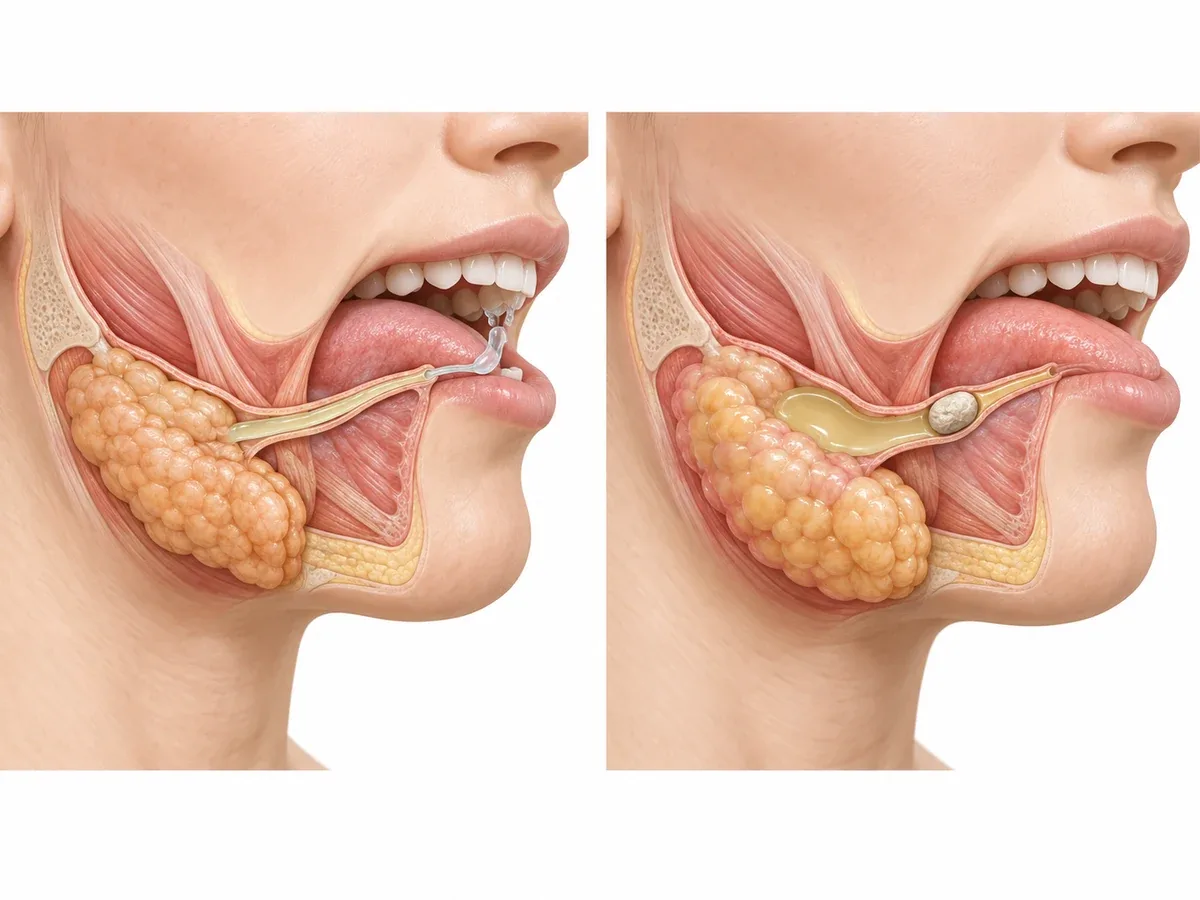
The salivary stone entry describes a condition in which calcium, foreign material and bacteria clump together and block the saliva duct. The stone forms in the gland or its duct.
The most important sentence in this column is here. A salivary stone can be mistaken for pain in the lower teeth. This is because the gland under the jaw sits close to the inner side of the lower back teeth.
There is also a telltale symptom. Pain gets worse when you eat sour food such as lemon juice.
A sour taste makes the glands produce plenty of saliva. The stone blocks the duct, so the saliva cannot flow out, and that causes pain.
A swollen cheek or jaw that grows at every meal and settles afterwards fits this pattern. A small stone may come out by itself as sour food increases saliva flow. If inflammation develops, antibiotics are given, and surgery is done if it does not improve.
The entry gives figures on where stones form. About 75% form in the submandibular gland under the jaw, and about 20% in the parotid gland below the ear.
It explains that the gland under the jaw is affected most because saliva tends to pool there and contains more mucus.
| Gland | Share | How it is found |
|---|---|---|
| Submandibular gland, under the jaw | 75% | Often felt by pressing between the tongue and gums with both hands |
| Parotid gland, below the ear | About 20% | A stone inside the gland is checked with a neck CT scan |
A stone under the jaw can often be felt when the area between the tongue and gums is pressed with both hands. A stone inside the gland itself is confirmed with a CT scan of the neck.
What if the swollen cheek spread from a tooth?
This is the most urgent case. The Ludwig's angina entry defines it as an infection from the mouth that spreads rapidly into the space just under the jaw.
It spreads very fast and can block the airway without early warning signs. For this reason, the entry says it must be treated urgently.
The main cause is bacteria from severe tooth decay or periodontitis getting into the floor of the mouth. Decay and root-tip inflammation in the lower front teeth or premolars are the usual sources.
Occasionally, inflammation around a wisdom tooth spreads and causes it. A swollen cheek that started from a painful tooth is not one to wait out.
The entry lists these symptoms.
- the tongue is pushed upward and looks like two tongues, the classic sign
- neck pain and swelling
- a swollen tongue
- difficulty swallowing
- limited neck movement
- ear pain
- drooling
- fever and tiredness
- changes in consciousness and difficulty breathing
The most serious complication is suffocation from a blocked airway. The entry adds that the inflammation can reach the mediastinum, the space in the middle of the chest.

How is a swollen cheek sorted out at a clinic in Busan?
When you arrive with a swollen cheek, we usually check a few points in order. Each one narrows down the cause.
- Is the swelling on one side or both? Mumps typically swells both sides in front of the ears, while a salivary stone swells the blocked side.
- Is it linked to meals? A salivary stone gets worse with sour food and at mealtimes.
- Is there a problem with a tooth? We check for decay and root-tip inflammation with X-rays.
- Is it hard to swallow or breathe? If so, it is an emergency.
The entries also describe how each condition is diagnosed. For Ludwig's angina, a dental panoramic X-ray is recommended to find the tooth cause.
A CT scan of the neck is recommended to see how far the inflammation has spread. For a salivary stone, a neck CT is taken if the stone cannot be felt.
Should you see a dentist or an ear, nose and throat doctor? The first step is to rule out a cause in the teeth.
Many patients come to a dentist first, since the salivary stone entry says the pain can feel like a lower toothache. After X-rays, if a salivary gland or virus is suspected, we work with the relevant department.

| Point | Mumps | Salivary stone | Infection spreading from a tooth |
|---|---|---|---|
| Where it swells | Typically in front of both ears | The blocked side | The space just under the jaw |
| Cause | A viral infection | Calcium, foreign material and bacteria blocking the saliva duct | Bacteria from severe decay or periodontitis entering the floor of the mouth |
| Key feature | Pain worst 1–3 days after swelling starts | Pain worse with sour food | Tongue looks like two tongues; trouble swallowing or breathing |
| Checks and treatment | Supportive care: fluids, rest, food changes, compresses | Feeling by hand; a neck CT if not found | Panoramic X-ray and neck CT; hospital admission and antibiotics |
What happens if you wait?
The salivary stone entry warns that, if left alone, the whole gland can become inflamed or severe pain can develop.
In some cases, the inflammation spreads and damages nearby teeth and nerves or forms an abscess. The entry says it must be treated properly.
Ludwig's angina is more urgent still. As the swelling grows, a blocked airway can be fatal.
The entry says hospital admission, antibiotics and close observation are needed. In an emergency, a breathing tube or a tracheotomy is required.
So while you wait, thinking the swelling will go down, it helps to know what may be progressing. Watch whether the swelling changes within a day.
A swollen cheek that spreads under the jaw, enough to hide the jawline, is not a reason to wait and see. A swollen cheek that makes swallowing or breathing hard needs emergency care.
Keeping a few notes helps whoever examines you. Write down when the swelling started, which side it is on, whether it changes at meals, and whether a tooth has been aching.

Frequently asked questions
Why does my swollen cheek hurt more when I eat something sour?
This is a classic sign of a salivary stone. Sour tastes make the glands release lots of saliva, but the stone blocks the duct, so the saliva cannot flow and it hurts. The entry adds that a small stone may slip out by itself as saliva flow increases.
When is it an emergency?
Among the Ludwig's angina symptoms, difficulty swallowing, drooling, difficulty breathing or changes in consciousness mean you should get emergency care without delay. A feeling that the tongue is pushed up, or trouble turning the neck, belongs in the same group.
Does a swollen cheek always mean a tooth problem?
No. A virus such as mumps or a blocked salivary gland can also cause it. That is why we first check the teeth with X-rays and then look at the glands if needed.
Can I have a swollen cheek checked in English in Busan?
Yes. We provide 1:1 English interpretation from your first consultation through the end of treatment. The clinic is near Seomyeon Station Exit 2 (5-min walk), opposite Lotte Hotel Busan, and you can call 010-8555-2854 (+82-10-8555-2854 from abroad).
A swollen cheek can come from a virus, a blocked gland or a tooth.
Both sides in front of the ears points toward mumps.
Swelling at mealtimes points toward a salivary stone.
Swelling under the jaw with trouble swallowing or breathing is an emergency.
If you have a swollen cheek in Busan, Reset Dental Clinic can check for a tooth cause with 1:1 English interpretation. Call 010-8555-2854, and seek emergency care right away if swallowing or breathing becomes hard.
References
- Asan Medical Center disease encyclopedia, "Mumps" — a viral infection that swells the parotid glands in front of both ears, now far less common due to vaccination, frequent in late winter and spring, with immunity after infection; paramyxovirus and mumps virus as the cause, spread by coughs, sneezes, saliva and contaminated objects; virus in saliva from about 6 days before to 9 days after swelling, and contagious from 3 days before to 5 days after; incubation of about 1–2 weeks, early symptoms for 1–2 days, and pain worst 1–3 days after swelling starts; 30–40% of infections without symptoms but still contagious; supportive care with fluids, rest, food changes and compresses
- Asan Medical Center disease encyclopedia, "Salivary Stones (Sialolithiasis)" — calcium, foreign material and bacteria clumping to block the saliva duct; 75% in the submandibular gland and about 20% in the parotid gland, with pooled, mucus-rich saliva explaining the higher rate under the jaw; pain that can be mistaken for lower toothache and worsens with sour food; diagnosis by feeling with both hands or by neck CT; small stones passing by themselves, antibiotics for inflammation and surgery if needed; gland inflammation, severe pain, damage to nearby teeth and nerves, and abscess if left untreated
- Asan Medical Center disease encyclopedia, "Sialadenitis" — the parotid, submandibular and sublingual glands, plus countless small salivary glands in the mouth; sialadenitis as inflammation of these glands
- Asan Medical Center disease encyclopedia, "Ludwig's Angina" — an infection from the mouth spreading rapidly into the space under the jaw that can block the airway without early warning; bacteria from severe decay or periodontitis entering the floor of the mouth, mostly from lower front teeth or premolars, sometimes wisdom teeth; the raised "double tongue" sign, neck pain and swelling, trouble swallowing, limited neck movement, ear pain, drooling, fever, changes in consciousness and difficulty breathing; panoramic X-ray and neck CT; hospital admission, antibiotics and close observation, with intubation or tracheotomy in emergencies; suffocation from airway blockage and spread to the mediastinum as complications
Written by Reset Dental Clinic Support Team
Medical review Dr. Kim Hyun-joo, Head Dentist · Integrated Dentistry Specialist
Last updated: September 19, 2026
This column is for general information and does not replace diagnosis or treatment for individual patients. If you have symptoms, please see a dentist.


