

- About 700 species of oral bacteria live in the mouth, and some of them pass through stomach acid, travel down to the gut and settle there.
- A Korean-Belgian study published in the journal Gut in March 2026 analyzed stool samples from 1,168 patients, ranging from fatty liver to liver cancer.
- As liver disease progressed, gut microbial diversity fell step by step, and bacteria of oral origin such as Veillonella took over more of the gut.
- The writer who introduced the study noted that it was cross-sectional, so more long-term research is needed to establish cause and effect. This column stays within that line.
You may have heard that oral bacteria can affect the liver. At our dental clinic in Seomyeon, Busan, we want to separate what has been observed from what still needs more research. For patients living in or visiting Korea, we provide 1:1 English interpretation from your first consultation through the end of treatment.
This column is based on four sources. The main one is a contributed article in Dailydental, the Korean Dental Association's newspaper, by Professor Lee Jung-hwan of Dankook University College of Dentistry. The others are two KDCA national health portal pages and Asan Medical Center's entry on chronic periodontitis.
How do oral bacteria travel from the mouth to the gut?
The article opens with a striking line. Right now, about 700 species of bacteria are living in your mouth.
Some of them pass through stomach acid, travel down to the gut and settle there. From the gut, they send inflammatory signals to the liver through the portal vein, the vessel that carries blood from the gut to the liver.
This framework is called the oral-gut-liver axis. It describes a route that starts in the mouth, runs through the gut and ends in the liver.
The picture used to be different. The article notes that for a long time, oral bacteria were thought to be killed by stomach acid.
As strain-level analysis improved, reports began to appear of almost genetically identical strains in the mouth and stool of the same person. The article describes this as direct evidence that oral bacteria actually moved.
It also explains how they survive. Bacteria that form a biofilm are highly resistant to acid, so they survive stomach acid. They settle especially easily in a host whose gut barrier has weakened.

Put simply, the article describes the route in four steps.
- Oral bacteria are swallowed with saliva.
- Bacteria protected in a biofilm survive stomach acid.
- They settle in the gut, especially where the gut barrier is weak.
- They send inflammatory signals to the liver through the portal vein.
What did the 2026 study find?
The study in the article is a joint Korean-Belgian project published in Gut, an international gastroenterology journal, in March 2026. It was led by Professor Suk Ki-tae's team at Hallym University and Dr. Si Ji-yeon's team at KIST.
The researchers analyzed stool samples from 1,168 patients whose liver disease ranged from fatty liver to hepatitis, cirrhosis and liver cancer. They used 16S rRNA sequencing to identify the bacteria.
They then combined their data with 2,376 public data sets and checked the results with a machine learning model.
The results are summed up like this. As the disease progressed, gut microbial diversity fell step by step.
In healthy people, Prevotella was dominant in the gut. In patients, bacteria of oral origin gradually took over, including Veillonella, Streptococcus and Ligilactobacillus.
One finding stood out. In the same patients, strains of Veillonella parvula in saliva and stool matched genetically. The article says this strongly supported real transfer from the mouth to the gut.
There was also a survival analysis. The more Veillonella in the gut, the significantly higher the death rate among patients with cirrhosis or liver cancer.
The group with the lowest microbial diversity had up to five times the risk of death compared with a normal gut profile.
| Item | What the article reports |
|---|---|
| Journal and date | Gut, an international gastroenterology journal, March 2026 |
| Research teams | A Korean-Belgian study led by teams at Hallym University and KIST |
| Patients | 1,168 patients, from fatty liver to hepatitis, cirrhosis and liver cancer |
| Methods | Stool analysis by 16S rRNA sequencing, plus 2,376 public data sets checked with machine learning |
| Main finding | Gut diversity fell as disease progressed; bacteria of oral origin took over |
| Survival analysis | More Veillonella, higher death rate; lowest-diversity group up to five times the risk |
Why might a vicious cycle form?
The article explains the mechanism as a vicious cycle. Each step makes the next one easier.
When the liver is damaged, it releases less bile acid, which weakens the gut's antibacterial defense. At the same time, gut permeability increases, so oral bacteria settle more easily.
Once settled, Veillonella and similar oral bacteria release an enzyme called collagenase. This damages the gut lining further.
Then endotoxins flow through the portal vein into the liver and worsen inflammation. The damaged liver releases even less bile acid, and the loop repeats.

| Step | What the article says |
|---|---|
| Liver damage | Less bile acid is released, weakening the gut's antibacterial defense |
| Gut | Gut permeability rises, making it easier for oral bacteria to settle |
| Bacteria of oral origin | Veillonella and others release collagenase, damaging the gut lining further |
| Portal vein | Endotoxins flow to the liver and worsen inflammation |
| Back to the liver | The damaged liver releases even less bile acid, and the loop repeats |
Where should we draw the line?
This part matters most. At the end of the article, the writer himself added a caveat. The study is cross-sectional, so more long-term research is needed to establish cause and effect.
A cross-sectional study looks at many people at a single point in time. It can show that two things appear together, but it cannot settle which came first.
In other words, this study alone cannot tell us whether oral bacteria settled in the gut because the liver got worse, or the other way around.
It also helps to look at the list confirmed by the KDCA page on systemic disease and periodontal treatment. It names the conditions that gum disease can worsen:
- cardiovascular disease
- high blood pressure
- diabetes
- low birth weight and premature birth
- rheumatoid arthritis
- chronic kidney disease
- osteoporosis
Liver disease is not on this list. To be precise, the national source covers the conditions above, while the liver story comes from an article introducing a journal study.
Either way, the practical conclusion is the same. Keeping oral bacteria under control is worth doing for your gums alone.
| Item | Details |
|---|---|
| Observed | Gut microbial diversity fell step by step as the disease progressed |
| Analysis supporting transfer | Veillonella parvula strains in saliva and stool matched genetically in the same patients |
| Survival analysis | More Veillonella was linked to a significantly higher death rate in cirrhosis and liver cancer |
| Limit of the study | Cross-sectional design; long-term research is needed to establish cause and effect |
| National source | Liver disease is not on the list of conditions gum disease can worsen |
What does the article suggest doing?
The article mentions treatment strategies that are still being studied:
- non-absorbable antibiotics
- fecal microbiota transplantation
- phage therapy
Then it makes its main point. The writer says the realistic and immediate step this research suggests is, paradoxically, a simple one: oral care.
The reason is given as well. Scaling and gum treatment directly reduce the absolute number of harmful bacteria in the mouth.
When the load of oral bacteria in the mouth falls, fewer of them travel down to the gut.
The article also cites clinical reports. Reports are building up that blood endotoxin levels and markers of body-wide inflammation fell after gum treatment.
There is also early research showing that oral hygiene care lowered gut bacteria levels in people at high risk of colorectal cancer.
The article closes by saying this gives dentists one more reason to encourage patients to take better care of their mouths.
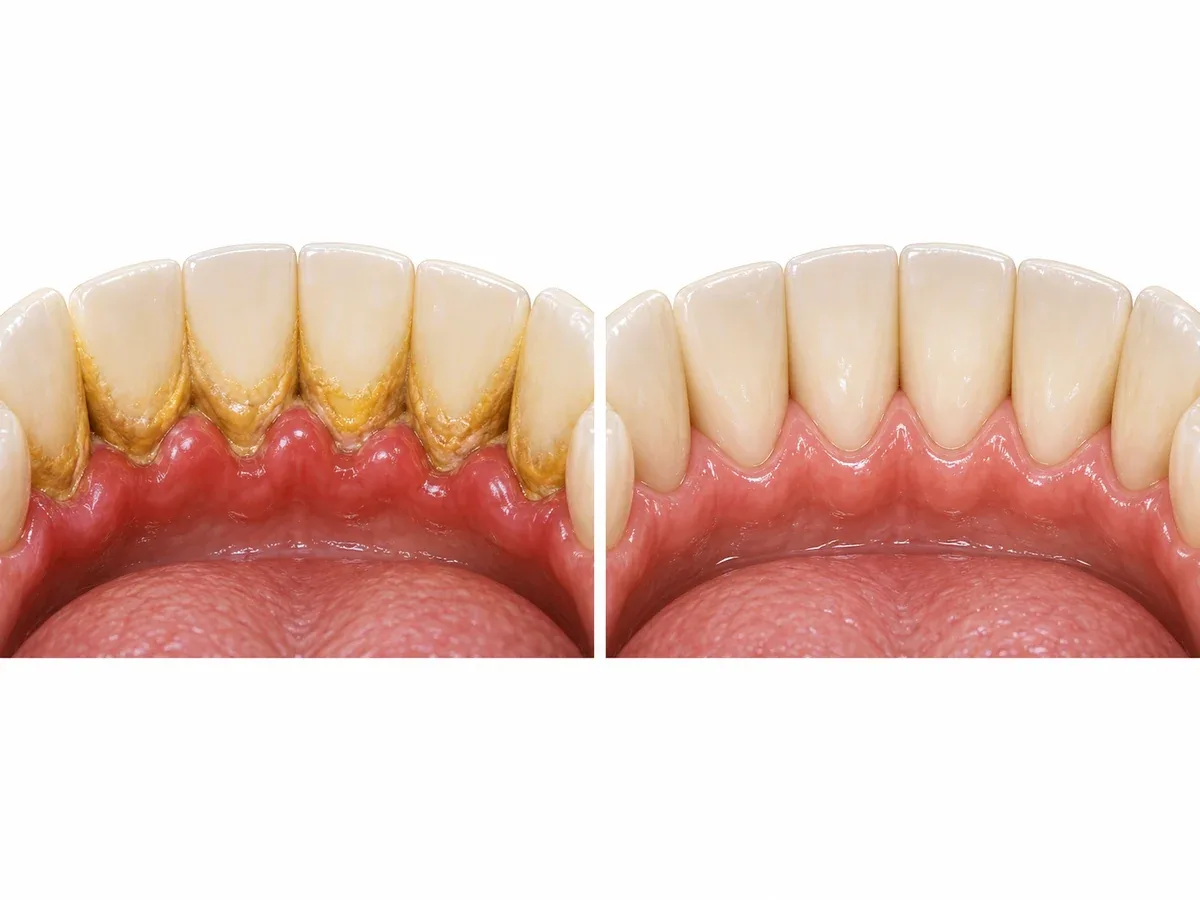
Why does gum disease go unnoticed for so long?
Asan Medical Center's entry on chronic periodontitis is a useful reminder here. It is an inflammation of the tissues around the teeth that destroys the gums and the bone holding the teeth.
Gum disease progresses quietly. In the early stage, it usually does not hurt much, and discomfort appears after the disease has progressed considerably.
Progression runs from gingivitis to early, moderate and advanced periodontitis. The gums recede and gaps start to open between teeth once it reaches the moderate stage.
The entry lists factors that affect progression, including smoking, stress, diabetes and cardiovascular disease.
That is why waiting for pain does not work well. By the time it hurts, the disease has usually gone some way.
How can patients in Busan keep oral bacteria in check?
The KDCA scaling page describes scaling as the basic treatment that removes plaque and tartar. People with gum disease should have it at least every six months.
The same page adds two practical notes. Sensitivity after scaling fades within a few weeks.
A feeling that teeth are a little loose afterwards is a natural process, as swollen gums settle down.
So the work is the same whether you are thinking of your liver, your gut or simply your gums. It comes down to three habits:
- Brush every day to disturb the biofilm on your teeth.
- Clean between your teeth, where a toothbrush does not reach.
- Have hardened deposits removed with regular scaling, at least every six months if you have gum disease.
If you have liver disease or another chronic condition, tell us your diagnosis and the medicines you take. That lets us plan treatment around them.


Frequently asked questions
Will taking care of my gums improve my liver?
That is not how to read it, as the article itself says long-term research is needed to establish cause and effect. What has been confirmed is that more oral bacteria were found in the gut of patients with advanced disease. Reports of lower inflammation markers after gum treatment are also building up.
Doesn't stomach acid kill all oral bacteria?
The article says this was believed for a long time, but bacteria that form a biofilm are highly resistant to acid and survive. Almost genetically identical strains found in the mouth and stool of the same person are given as evidence.
I have liver disease. Can I still have dental treatment?
The article does not cover this, so we will not go beyond it. The KDCA page notes that many systemic diseases affect the nature and severity of gum disease, so tell us your diagnosis and medicines in advance.
Can I have my gums checked in English in Busan?
Yes. We offer 1:1 English interpretation from the first consultation through the end of treatment. The clinic is near Seomyeon Station Exit 2 (5-min walk), opposite Lotte Hotel Busan, and you can call 010-8555-2854 (+82-10-8555-2854 from abroad).
The link between oral bacteria and the liver is still being studied.
What the research observed is worth knowing.
What it has not proven is worth saying clearly.
Either way, lowering the bacterial load in your mouth is a sound step.
To lower the oral bacteria load with scaling or gum care in Busan, talk to us. Reset Dental Clinic offers 1:1 English interpretation from your first consultation through the end of treatment. Call 010-8555-2854 to book a check-up.
References
- KDA newspaper Dailydental (Chiui Sinbo), "Oral Bacteria Harm the Gut, and Now the Liver" (contributed article by Professor Lee Jung-hwan, Dankook University College of Dentistry) — the oral-gut-liver axis, with about 700 species of oral bacteria, some reaching the gut and signaling the liver through the portal vein; strain-level evidence of nearly identical strains in mouth and stool, and biofilm bacteria surviving stomach acid; the March 2026 Korean-Belgian study in Gut of 1,168 patients from fatty liver to liver cancer, using 16S rRNA sequencing and 2,376 public data sets with machine learning; falling gut diversity and the spread of Veillonella, Streptococcus and Ligilactobacillus; matching Veillonella parvula strains in saliva and stool; higher death rates with more Veillonella and up to five times the risk in the lowest-diversity group; the vicious cycle of bile acid, gut permeability, collagenase and endotoxins; oral care, scaling and gum treatment as the practical step; reports of lower endotoxin and inflammation markers after gum treatment; the writer's note that the cross-sectional design needs long-term research to establish cause and effect
- KDCA National Health Information Portal, "Systemic Disease and Periodontal Treatment" — gum disease as a chronic bacterial infection sharing risk factors with other chronic diseases; worsening with lifestyle, diet and smoking; its possible worsening of cardiovascular disease, high blood pressure, diabetes, low birth weight and premature birth, rheumatoid arthritis, chronic kidney disease and osteoporosis; systemic diseases affecting the nature and severity of gum disease, and benefits of treatment for overall health
- KDCA National Health Information Portal, "Scaling" — scaling as the basic treatment that removes plaque and tartar; scaling at least every six months for people with gum disease; sensitivity after scaling fading within a few weeks, and a loose feeling as swollen gums settle being a natural process
- Asan Medical Center Disease Encyclopedia, "Chronic Periodontitis" — inflammation of the tissues around the teeth that destroys gums and bone; four stages from gingivitis to advanced periodontitis, with receding gums and gaps in the moderate stage; little pain early on; smoking, stress, diabetes and cardiovascular disease affecting progression
Written by Reset Dental Clinic Support Team
Medical review Dr. Kim Hyun-joo, Head Dentist · Integrated Dentistry Specialist
Last updated: September 19, 2026
This column is for general information and does not replace diagnosis or treatment for individual patients. If you have symptoms, please see a dentist.


