

- Korea's national health portal says implants leave wider gaps between teeth, so floss and interdental brushes are a must. With a full-arch implant, this matters even more.
- Seoul National University Hospital advises keeping the underside of the bridge, on the gum and bone side, clean at all times.
- Floss, interdental brushes and an oral irrigator are advised at least once a day. Mouthwash is merely a supplement.
- In a Korean Academy of Periodontology presentation, 89.4% of implant patients skipped aftercare because nothing felt wrong. Maintenance every 3 months in the first year, then about every 6 months, was suggested.
For people with a full-arch implant, the hardest part is often cleaning, not chewing. The same brush used the same way as with natural teeth leaves spots it never reaches. At Reset Dental Clinic in Seomyeon, Busan, patients can have 1:1 English interpretation from the first consultation through the end of treatment.
This column is built on public sources, including two KDCA National Health Information Portal pages on dental implants and on systemic disease and gum treatment. We also use Seoul National University Hospital's dental implant page, a Dailydental series on the interdental brush standard and a Korean Academy of Periodontology presentation.
Why can't you clean a full-arch implant like natural teeth?
The KDCA portal says implant teeth must be kept as clean as natural teeth to prevent inflammation. It then adds one important point. Because implants leave wider gaps between teeth, tools such as floss and interdental brushes are essential.
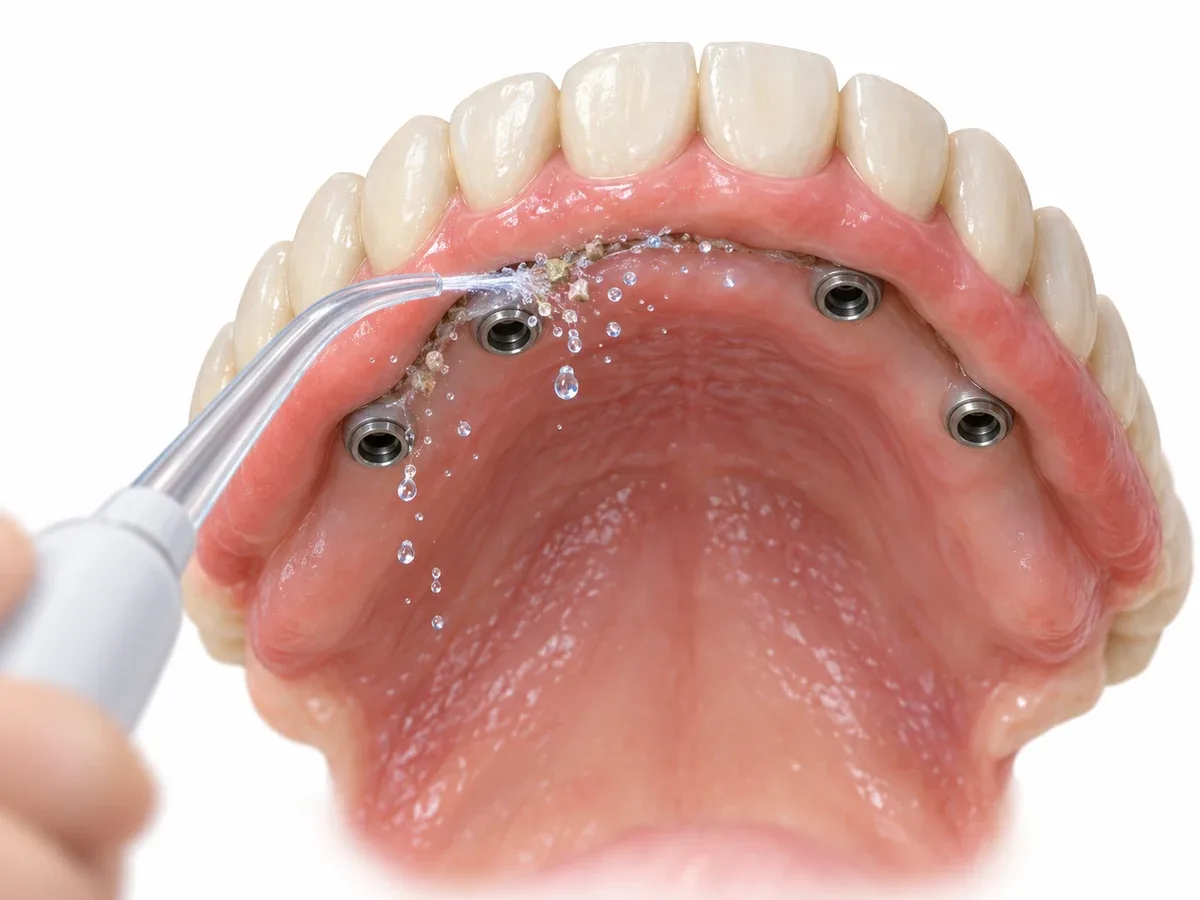
A full-arch implant adds one more area to think about. Seoul National University Hospital advises keeping the underside of the prosthesis clean at all times. This is the part below the crowns, on the gum and bone side, together with the gum tissue around the artificial teeth.
The same hospital source warns that implants and prostheses that are not kept clean may not last as long. The underside of a full-arch implant, a long connected bridge, is a place where toothbrush bristles struggle to reach.
The FAQ on the KDCA portal says the same thing in another way. No ordinary toothbrush can clean every surface of the teeth, so extra tools need to be added.
The portal also notes a common habit. Many people clean the lip side well but often neglect the side that faces the tongue. It suggests checking the inner surfaces while looking in a mirror.
Putting these sources together, a toothbrush alone tends to miss these areas on a full-arch implant.
- the underside of the bridge, where it meets the gum
- the gaps between implant teeth, which are wider than natural gaps
- the surfaces that face the tongue
- the back surface of the last tooth in the bridge

Why do full-arch implant problems go unnoticed?
Dailydental, the Korean Dental Association's newspaper, reported a presentation by the Korean Academy of Periodontology on its 17th Gum Day. According to it, 43% of implant patients experience peri-implant mucositis, and 22% experience peri-implantitis.
The presentation also explained why this matters. Bacteria in the tissue around an implant are not broken down well by immune cells. As a result, the disease can progress more destructively than periodontitis around natural teeth.
Yet 89.4% of implant patients said they did no aftercare because they felt no discomfort. The academy stressed that by the time symptoms are felt, the disease has often already progressed.
The KDCA portal explains why this happens. Peri-implantitis is limited to the gums at first. As it worsens, it can spread into the jawbone.
There is one more reason it is easy to miss. An implant can stay firm and keep working even when the bone around it is badly destroyed. For that reason, many people miss the right time for treatment.
The same presentation named the main risk factors for disease around implants. They are listed in the table below.
| Risk factor | Reported risk |
|---|---|
| Poor oral hygiene | 3.8 times |
| Smoking | 5.89 times |
| Uncontrolled diabetes | 2.75 times |
The first item on that list is the one you handle yourself every day. Cleaning between and under a full-arch implant is where that work happens.
With a full-arch implant, feeling fine is not the same as being fine. That is the main lesson of these numbers.
How do you choose the right interdental brush size?
Dailydental ran a dental standards series written by the Korean Dental Association's Materials and Standards Committee. One part covers interdental brushes in detail. It notes that brushing alone has trouble removing all the biofilm between teeth.
Biofilm is the layer of bacteria that sticks to tooth surfaces, often called plaque. An interdental brush cleans both sides of a gap in a single stroke. For this reason, it is known to clean between teeth more efficiently than floss.
Under the international standard (ISO 16409), brush sizes run from size 0 to size 8, in nine steps. Choose a brush whose bristle diameter is slightly larger than the gap you want to clean.
If the brush does not go in easily, do not force it. A straight type is mainly used for the front teeth, and an L-shaped type for the back teeth.
The series also explains how to use it. Here are the steps in order.
- Choose a size slightly larger than the gap.
- Insert it at an angle that follows the shape of the gum.
- Take care not to poke the gum as it goes in.
- Once it is through, stand the brush upright.
- Move it in and out 3 to 4 times.
- Rinse off debris under running water before moving to the next gap.
Rinsing the brush as you go keeps debris from being carried to another spot. If the brush will not pass, stop rather than pushing harder.
With a full-arch implant, each gap may need a different size. It helps to have the right size for each spot confirmed at your check-up.

| Item | What the series says |
|---|---|
| Sizes | Nine steps, from size 0 to size 8, under the international standard |
| How to choose | A bristle diameter slightly larger than the gap to be cleaned |
| Shape | Straight type mainly for front teeth, L-shaped type mainly for back teeth |
| How to insert | At an angle that follows the gum, taking care not to poke the gum |
| How to clean | Stand the brush upright and move it in and out 3 to 4 times |
| If it will not go in | Do not force it |
How far can an oral irrigator and mouthwash go?
The KDCA page on systemic disease and gum treatment recommends brushing at least three times a day. Along with brushing, it advises using floss, interdental brushes and an oral irrigator.
Gum disease usually starts between the teeth. So the portal advises using these tools at least once a day, without skipping.
The last sentence of that same paragraph is the key one. Mouthwash is merely a supplementary method.
Rinsing your mouth does not remove the biofilm stuck under a full-arch implant bridge. Flushing with a water jet and scrubbing with a brush do different jobs.
That is why we suggest using an oral irrigator and an interdental brush together. One does not replace the other.
| Tool | Its job | What the sources say |
|---|---|---|
| Regular toothbrush | Cleans the outer surfaces | Cannot clean every surface on its own |
| Interdental brush | Scrubs biofilm off both sides of a gap | Known to clean gaps more efficiently than floss |
| Floss | Cleans between teeth | Essential for implants, along with interdental brushes |
| Oral irrigator | Flushes debris out with a water jet | Advised at least once a day with the other tools |
| Small-headed brush | Reaches the tongue side and back of a full-arch implant | Special brushes or floss can help |
| Mouthwash | Rinses the mouth | A supplementary method |
How do you clean the tongue side and the back of the bridge?
This is also why Seoul National University Hospital recommends special toothbrushes or floss. On the tongue side and behind the last tooth, a regular brush head can feel too big.
Depending on the shape of your full-arch implant, we may suggest a separate brush with a small head. A small head can reach the tongue side and the very back.
Following the KDCA advice, the next step is simple. Check the inner surfaces while looking in a mirror.
Spots you have missed are hard to see on your own. It is a good idea to check them together with your dentist at each full-arch implant check-up.
Here is a simple daily routine that puts the sources together.
- Brush the outer surfaces with a regular toothbrush, at least three times a day.
- Use a small-headed brush on the tongue side and behind the last tooth, with a mirror.
- Clean each gap and the underside of the bridge with a correctly sized interdental brush.
- Flush under the bridge with an oral irrigator.
- Use mouthwash afterwards if you like, as a supplement and not a replacement.
Steps 3 and 4 are the ones the KDCA advises doing at least once a day. They take care of the areas a toothbrush misses.

What happens at a full-arch implant check-up in Busan?
Some things cannot be done at home. The KDCA portal says regular check-ups every 3 to 6 months are needed even after treatment is complete.
At those visits, inflammation around the full-arch implant is treated. The bite between the upper and lower teeth is checked and adjusted.
Depending on the implant type, the superstructure may be removed and disinfected. The superstructure is the bridge and parts that sit on top of the implants.
The Korean Academy of Periodontology suggested maintenance visits every 3 months in the first year. After that, about every 6 months was suggested, depending on each patient's risk.
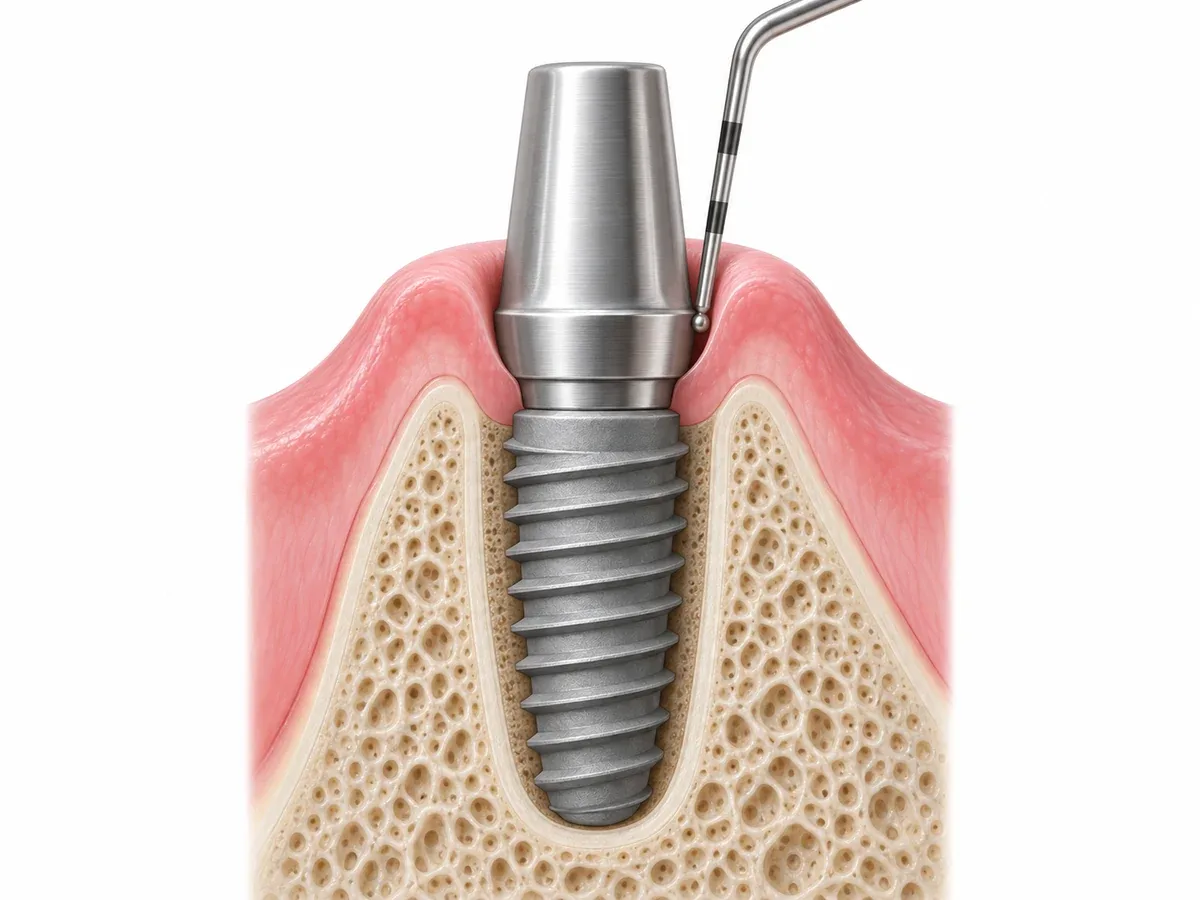
At a check-up, gum health is measured in numbers. Seoul National University Hospital describes the signs that bone around an implant has been lost.
- bleeding when the gum is gently probed
- pus around the implant
- a probing depth of 6 mm or more
- bone loss of 2.5 mm or more
When these signs appear together, the source says the implant has to be removed. Regular checks are meant to find problems well before that stage.
If you live in Busan or visit Korea often, plan your return visits around these intervals. It makes maintenance much easier to keep up.
| Item | What the sources say |
|---|---|
| Regular check-ups (KDCA) | Every 3 to 6 months, even after treatment is complete |
| Maintenance interval (Korean Academy of Periodontology) | Every 3 months in the first year, then about every 6 months depending on individual risk |
| What is done at check-ups | Treating inflammation around implants, checking and adjusting the bite, and removing and disinfecting the superstructure depending on type |
| Bone loss (Seoul National University Hospital) | Bleeding on probing, pus, probing depth of 6 mm or more, and bone loss of 2.5 mm or more |
Frequently asked questions
My gums bleed when I use an interdental brush. What should I do?
The standards series says not to force the brush if it does not go in easily, and to angle it so it does not poke the gum. First check whether the size fits the gap. If bleeding continues after changing the size, come in so we can check for inflammation.
Does the dentist ever take off a full-arch implant bridge to clean it?
The KDCA portal lists removing and disinfecting the superstructure, depending on the implant type, as part of regular check-ups. A screw-retained bridge can be taken off so the underside and the areas around the posts can be checked. The spots you cannot reach at home are taken care of then.
I still have a few natural teeth. How should I care for them?
Care for them to the same standard. The KDCA portal recommends scaling once a year even without gum disease, and every 3 to 6 months after gum disease or to maintain treatment results. Booking it on the same day as your full-arch implant check-up is convenient.
Can I get full-arch implant care in English in Busan?
Yes. We offer 1:1 English interpretation from the first consultation through the end of treatment, including check-ups. The clinic is near Seomyeon Station Exit 2 (5-min walk), opposite Lotte Hotel Busan, and you can call 010-8555-2854 (+82-10-8555-2854 from abroad).
A full-arch implant that is not kept clean may not last as long.
A toothbrush cannot reach everywhere.
Interdental brushes, floss and an oral irrigator fill that gap,
and regular check-ups catch what home care misses.
If you have a full-arch implant in Busan, Reset Dental Clinic offers 1:1 English interpretation from your first consultation through the end of treatment. Call 010-8555-2854 to book a check-up.
References
- KDCA National Health Information Portal, "Dental Implants" — implant teeth need to be kept as clean as natural teeth, and wide gaps make floss and interdental brushes essential; peri-implantitis starts in the gums and can reach the jawbone, while the implant may stay firm even with severe bone loss; check-ups every 3–6 months, including treating inflammation, adjusting the bite and removing and disinfecting the superstructure depending on type; FAQ on using extra tools and cleaning the tongue side with a mirror
- KDCA National Health Information Portal, "Systemic Disease and Periodontal Treatment" — brushing at least three times a day plus floss, interdental brushes and an oral irrigator; using these tools at least once a day because gum disease usually starts between teeth; mouthwash as a supplementary method; scaling every 3–6 months after gum disease or to maintain results
- Seoul National University Hospital Medical Information, "Dental Implants" — keeping the underside of the prosthesis and the gums around artificial teeth clean, with special brushes or floss, and the risk of a shorter lifespan without cleaning; the peri-implantitis criteria for bone loss (bleeding on probing, pus, probing depth of 6 mm or more, bone loss of 2.5 mm or more); bone loss around implants from excess force or poor hygiene
- Dailydental (Korean Dental Association newspaper), "Dental Standards (48): Interdental Brushes" — a series by the KDA Materials and Standards Committee: brushing alone has trouble removing biofilm between teeth, and interdental brushes are known to clean gaps more efficiently than floss; sizes 0–8 in nine steps under ISO 16409; choosing, inserting and using the brush; straight and L-shaped types
- Dailydental (Korean Dental Association newspaper), "65% of Implant Patients Experience Peri-Implant Disease" — the Korean Academy of Periodontology's 17th Gum Day presentation: 43% peri-implant mucositis and 22% peri-implantitis; why disease around implants progresses destructively; risk factors of poor hygiene (3.8 times), smoking (5.89 times) and uncontrolled diabetes (2.75 times); 89.4% skipping aftercare; maintenance every 3 months in the first year, then 6 months by individual risk
Written by Reset Dental Clinic Support Team
Medical review Dr. Na In-chae, Head Dentist · Periodontics Specialist
Last updated: September 19, 2026
This column is for general information and does not replace diagnosis or treatment for individual patients. If you have symptoms, please see a dentist.


