

- A fixed full-arch implant bridge is removed and reattached at the clinic. An overdenture clips onto implants, but you take it out yourself to clean it.
- A lecture in Dailydental says fixed bridges need at least 6–8 implants in the upper jaw and 4–6 in the lower jaw. For an overdenture, 4–6 upper and 2–4 lower are enough.
- For a lower full denture, the KDCA says support from at least two implants is often recommended.
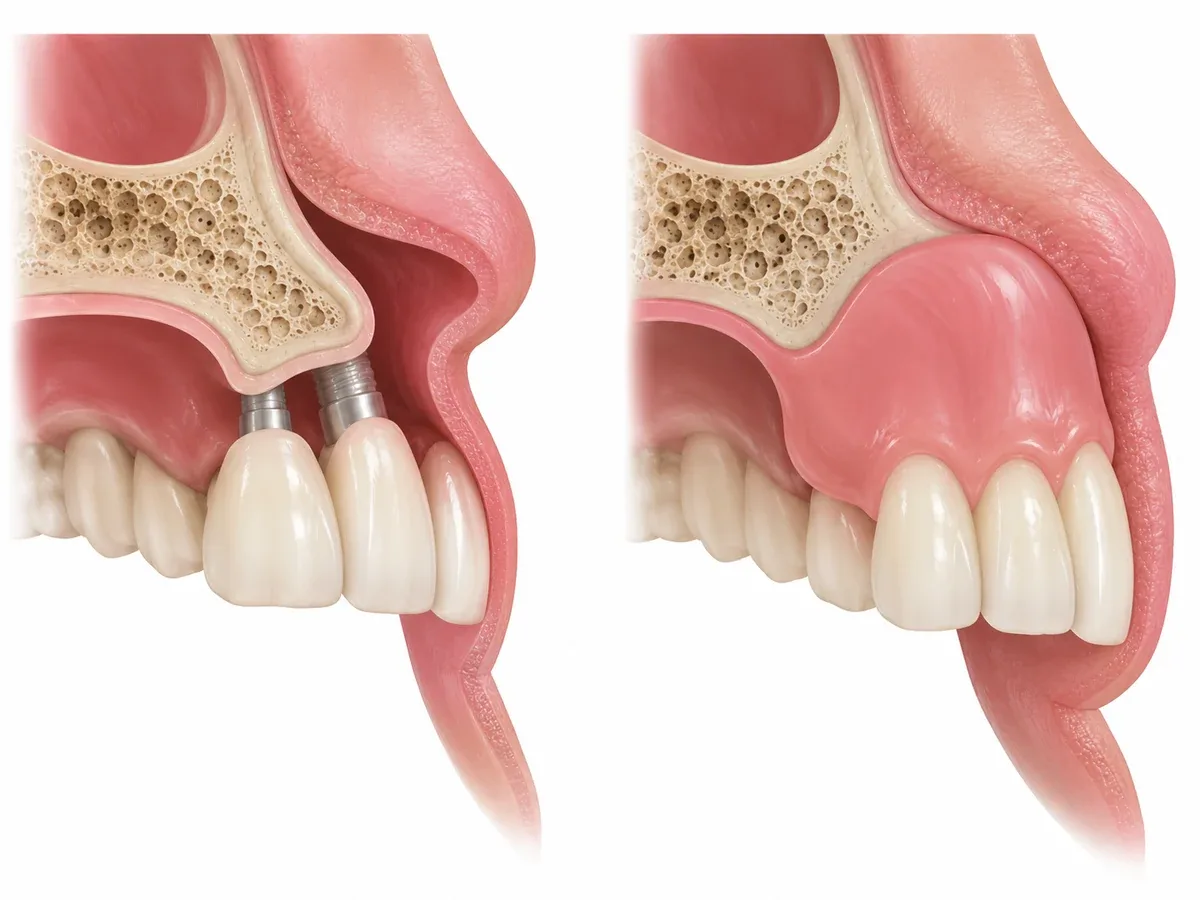
- Where a lot of jawbone has been lost, a fixed bridge may not support the lips well. The choice depends on both bone and facial support.
For patients in Seomyeon, Busan who have lost all their teeth, or will soon need them all out, the question is usually the same. Should the new teeth be fixed in place, or should a denture clip onto implants? For patients living in or visiting Korea, Reset Dental Clinic provides 1:1 English interpretation from the first consultation through the end of treatment.
This column compares the two approaches. It uses the KDCA national health portal, a lecture series on implant overdentures in Dailydental, and Seoul National University Hospital material.
What are the limits of a conventional full denture?
The starting point for comparison is the ordinary full denture. The KDCA material explains that it stays in by suction, like a suction cup.
Its hold has limits, though. It can come loose when you move your mouth or chew, and it shifts a little as it sits on soft gums.
The lower jaw is harder still. An upper denture rests on the broad palate, but a lower denture sits around the tongue, which is always moving.
As a result, the material says the lower denture has less retention and stability. For a lower full denture, it states that support from at least two implants is often recommended, even though this takes more time.
There is also a difference in function. Because a denture rests on the gums, it feels like a foreign object, and the material says it works at about 20–30% of natural teeth.
These limits are the reason implants are added. The question is how they are used: to hold fixed teeth, or to hold a denture.

How does a fixed full-arch implant bridge differ from an overdenture?
The KDCA material on dental implants lists two separate situations where implants are needed. One is when a removable denture is uncomfortable and you want to switch to a fixed restoration.
The other is keeping a full denture but using implants underneath it to improve function. The first is a fixed full-arch implant bridge; the second is an implant denture, called an overdenture.
A fixed bridge is attached to the implants with screws or dental cement, so you do not remove it yourself. An overdenture connects to the implants through attachments such as magnets or snap-in fittings, as the removable prosthetics material explains.
You click it in to wear it, and you take it out to clean it. That is the everyday difference between the two.
The number of implants also differs. A 2010 lecture by Professor Woo Yi-hyung in Dailydental gives these minimums, looking at numbers alone.
- Fixed bridge, upper jaw: at least 6–8 implants
- Fixed bridge, lower jaw: at least 4–6 implants
- Overdenture, upper jaw: 4–6 implants are enough
- Overdenture, lower jaw: 2–4 implants are enough
The lecture adds that for an overdenture, implants can be placed where there is enough bone anatomically. This gives more freedom in choosing where to place them.

What if a lot of jawbone has been lost?
The same lecture lists when an overdenture is suitable. These include severe loss of the alveolar bone, the bone that holds the teeth, and cases where placing enough implants for a fixed bridge is difficult.
It also includes cases where hygiene, speech or support for the face is a concern. Each of these points toward a removable overdenture.
- severe loss of the alveolar bone
- difficulty placing enough implants for a fixed bridge
- a need for easier oral hygiene
- concerns about speech
- a need for facial support
One sentence deserves attention. The lecture says that where bone loss is advanced, it is often hard to improve lip support enough with a fixed bridge.
When teeth are lost, it is not just the teeth that shrink. The gums and bone beneath them lose volume too, and the pink base of a denture fills that volume and supports the lips.
The KDCA material points the same way. It says a removable denture is a suitable option when bone loss makes implants hard to place.
It also fits when not just the teeth but the gums and ridge need to be restored. Even where a fixed implant bridge is difficult, a few implants and a denture can give a firm, comfortable fit, though extra surgery and time are involved.
How is an overdenture held in place?
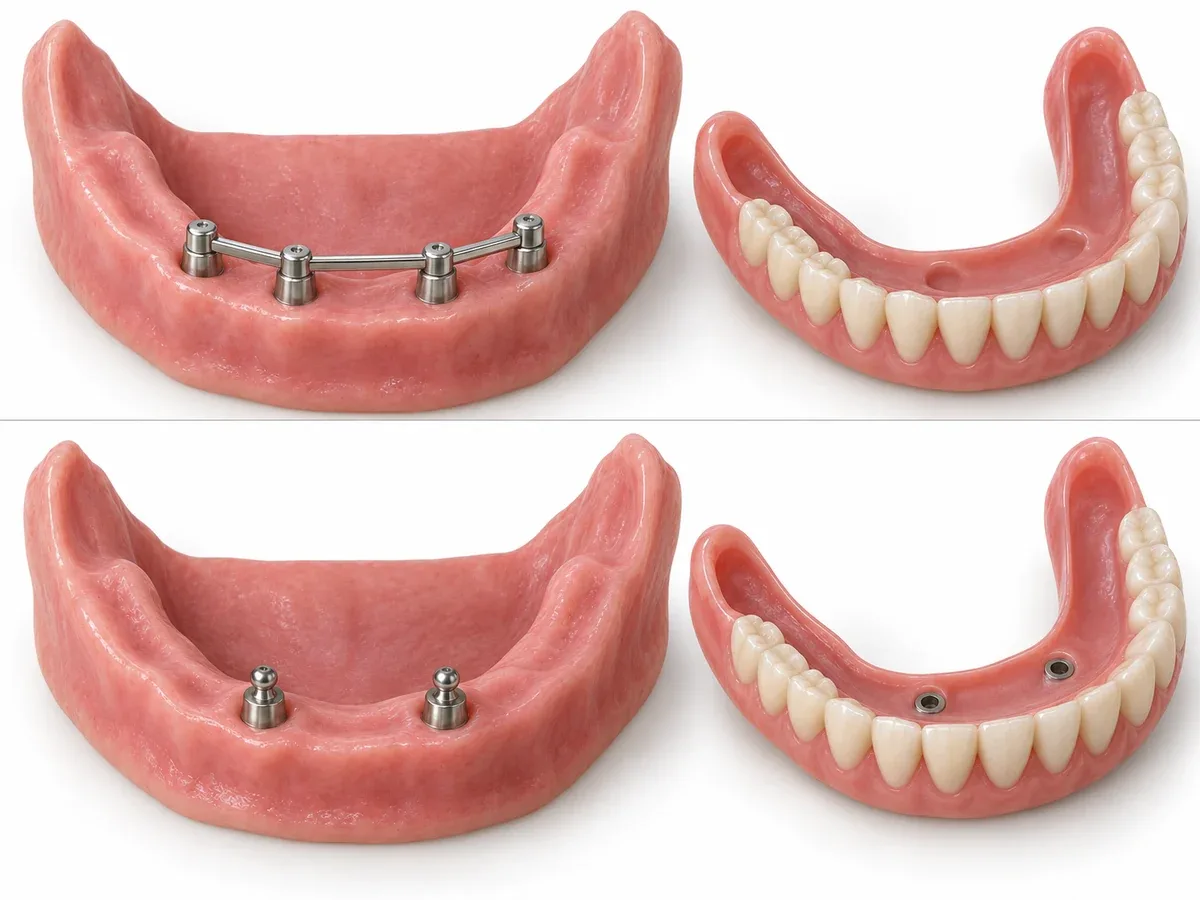
Within overdentures, there are different approaches. The lecture divides them by support: support from both implants and the gum lining, or support from implants alone.
A precisely milled bar gives support from implants alone. A button-shaped O-ring lets the gum lining and implants share the load.
The number of implants changes with this choice. According to the lecture, 4–8 implants are used when implants carry the load alone, while 2–4 can be enough with gum support as well.
The lecture lists general health conditions and severe bone loss among the reasons to choose gum-shared support. After a while, it says, patients feel no particular difference in function from a fixed bridge, and a natural look is easier to restore.
Whether to join the implants together is another choice. The second part of the lecture says recent reports show no particular difference between joined and separate attachments.
Separate attachments were reported to be easier to make and easier to keep clean. The first part also notes that with a bar, the gum under the bar can overgrow.
| Implants alone | Implants and gum lining together | |
|---|---|---|
| Attachment | A precisely milled bar | Button-shaped O-rings |
| Number of implants | 4–8 | 2–4 can be enough |
| Also noted | Enough implants are needed, so a fixed bridge is often possible with a little more planning | Suited to general health conditions or severe bone loss |
Why does the upper jaw need more careful planning?
The second part of the lecture deals with the upper jaw separately. Conditions there are less favorable than in the lower jaw, and overdentures show a higher failure rate.
The lecture cites a report of a failure rate about nine times higher. It therefore advises placing more implants where possible, with at least four to lower the failure rate.
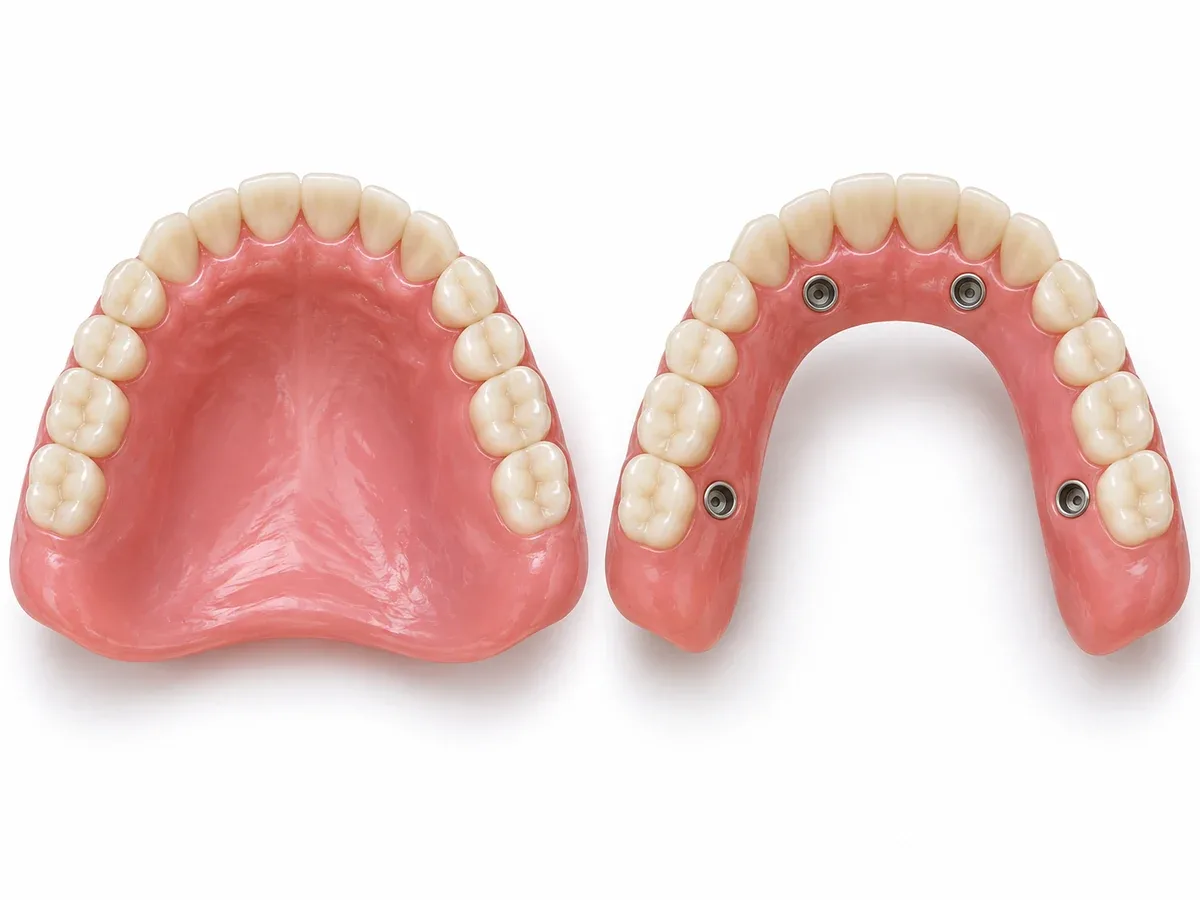
There is also the palate to think about. According to the lecture, at least four implants are needed for the denture to leave the roof of the mouth uncovered.
If fewer than four can be placed, the palate must be covered. The lecture calls this a very important factor from the patient's point of view.
That is why it is one of the first things we ask about at consultation. Some people mind a covered palate a great deal, and others do not.
| Point | What the lecture says |
|---|---|
| Failure rate | Higher than in the lower jaw; one report found it about nine times higher |
| Number of implants | More where possible; at least four to lower the failure rate |
| Palate | At least four implants to leave it uncovered; with fewer, it must be covered |
| For the patient | Whether the palate is covered is a very important factor |
How do care and repairs differ between the two?
The weak point of a fixed bridge comes from being one piece. The lecture notes that without a precise fit, the connecting screws often come loose.
It also describes a difficult situation. If one or two implants fail, the existing fixed bridge can fail completely.
With an overdenture, parts wear. The lecture says the main issues are attachment-related: retention clips breaking or losing grip, or magnets coming off, which means return visits.
It stresses that patients should hear about this clearly beforehand. We explain it at the first consultation for that reason.
For daily care, the KDCA material advises taking a denture out after meals to clean it. Unless there is a special reason such as grinding, take it out at night and let the gums rest for at least 8 hours.
Ordinary toothpaste can wear down denture material. The material advises brushing gently with soap or dish detergent, over a sink or basin filled with water so it is not damaged if dropped.
The Seoul National University Hospital material adds to keep the area under the restoration and the surrounding gums clean at all times. This applies to both options.
- Take the overdenture out after meals.
- Brush it gently with soap or dish detergent, not toothpaste.
- Wash it over a basin of water.
- Clean the gums around each attachment while it is out.
- Leave it out at night for at least 8 hours, unless told otherwise.
| Fixed full-arch implant bridge | Overdenture | |
|---|---|---|
| How it attaches | Screws or cement; you do not remove it | Attachments such as magnets or snap-in fittings; taken out for cleaning |
| Upper jaw implants | At least 6–8 | 4–6 are enough |
| Lower jaw implants | At least 4–6 | 2–4 are enough |
| With severe bone loss | Often hard to improve lip support enough | Listed as a suitable case |
| Common problems | Screws loosen often without a precise fit | Clip breakage or lost grip, magnets coming off |
Which lasts longer, and how do patients in Busan decide?
The sources do not compare the lifespan of the two options directly. What they do record is each option's weak point.
With a fixed bridge, the failure of one or two implants can affect the whole restoration. With an overdenture, the attachments need regular servicing.
The lecture also comments on satisfaction. Many follow-up studies report that fixed bridges score well on psychological satisfaction at first.
Over time, however, the difference in preference between the two tends to disappear. This is why it is hard to say one option suits everyone.
So the decision comes from your own mouth. These are the points that shape it:
- how much bone remains, and where
- how much lip and facial support is needed
- how many implants the upper jaw can take, and whether the palate can stay open
- whether you prefer teeth you never remove, or a denture you take out to clean
A CT scan and a look at your facial support come first. After that, the number and position of implants can be planned for the option that fits.
Frequently asked questions
Do I need to take an overdenture out at night?
The KDCA material says a denture presses on the gums. Unless there is a special reason such as grinding, leave it out at night for at least 8 hours so the gums can recover. While it is out, clean the gums around the attachments too.
Are two implants enough for the lower jaw?
The KDCA material says support from at least two implants is often recommended for the lower jaw. The lecture says 2–4 can be enough when the gum lining shares the support, and the number depends on bone position and chewing force.
Can I start with an overdenture and switch to a fixed bridge later?
The lecture says an overdenture supported by implants alone needs enough implants, so a fixed bridge is often possible with a little more planning. We consider this when deciding where to place the implants.
Can I get an overdenture or fixed bridge planned in English in Busan?
Yes. We offer 1:1 English interpretation from the first consultation through the end of treatment. The clinic is near Seomyeon Station Exit 2 (5-min walk), opposite Lotte Hotel Busan, and you can call 010-8555-2854 (+82-10-8555-2854 from abroad).
Fixed or removable is not a question of which is better for everyone.
Bone, lip support and the palate
decide which one fits your mouth.
Each has its own care and its own weak point.
If you are weighing a fixed bridge against an overdenture in Busan, Reset Dental Clinic offers 1:1 English interpretation from your first consultation through the end of treatment. Call 010-8555-2854 to book a consultation.
References
- KDCA National Health Information Portal, "Removable Prosthetics" — full dentures held by suction with limited retention; lower dentures around the tongue being less stable, with support from at least two implants often recommended; attachments such as magnets on implants to improve retention, including where bone loss makes fixed implant bridges difficult; removable dentures as an option for severe bone loss or restoring gums and ridge; dentures working at about 20–30% of natural teeth; leaving dentures out at night for at least 8 hours; cleaning with soap or dish detergent over a basin of water
- KDCA National Health Information Portal, "Dental Implants" — implants for switching from a removable denture to a fixed restoration, or for supporting a full denture from underneath; artificial teeth fixed with cement or screws
- Korean Dental Association newspaper Dailydental, "Professor Woo Yi-hyung's Lecture: Easy Solutions With Implant Overdentures" (2010) — minimum implant numbers for fixed bridges (6–8 upper, 4–6 lower) and overdentures (4–6 upper, 2–4 lower); limited lip support from fixed bridges with advanced bone loss; loose screws and complete failure after one or two implant failures; satisfaction differences fading over time; indications for overdentures; clip, retention and magnet problems and the importance of explaining them; milled bar versus O-ring support and implant numbers for each; gum overgrowth under bars
- Korean Dental Association newspaper Dailydental, "Professor Woo Yi-hyung's Lecture: Easy Solutions With Implant Overdentures, Part 2" (2010) — higher overdenture failure in the upper jaw, with one report of about nine times higher; the palate as a very important factor for patients; at least four implants to lower failure and leave the palate uncovered; no particular difference between splinted and unsplinted attachments, with unsplinted ones easier to make and clean
- Seoul National University Hospital Medical Information, "Dental Implants" — implants placed to make artificial teeth or to improve denture retention; keeping the area under the restoration and the surrounding gums clean
Written by Reset Dental Clinic Support Team
Medical review Dr. Na In-chae, Head Dentist · Periodontics Specialist
Last updated: September 19, 2026
This column is for general information and does not replace diagnosis or treatment for individual patients. If you have symptoms, please see a dentist.


