

- Korean pediatric dentistry textbooks and the American Academy of Pediatric Dentistry guideline recommend a dental visit before 12 months of age or when the first tooth appears.
- The Korean Academy of Pediatric Dentistry also names 12 months as the time for the first dental check-up.
- Korea's national infant oral check-ups take place four times, at 18–29, 30–41, 42–53 and 54–65 months.
- A first dental visit is less about treatment and more about checking teething, brushing, feeding habits and fluoride use.
"My baby has barely any teeth. Is a first dental visit really needed already?" Parents in Seomyeon, Busan ask us this often, and many first bring a child in when something hurts. For families living in or visiting Korea, we provide 1:1 English interpretation from the first consultation through the end of treatment.
The sources recommend an earlier first dental visit than most parents expect. This column draws on a Korean Dental Association journal paper, pediatric dentistry guidance for parents, and government material on check-ups and fluoride.
When should a child's first dental visit be?
The first tooth matters more than age. A pediatric dentistry paper from Kyung Hee University notes that dental clinics have long been seen as places that treat teeth. So babies with no teeth rarely come to a dentist.
The paper then introduces Korean pediatric dentistry textbooks and the American Academy of Pediatric Dentistry guideline. Both recommend a first dental visit before 12 months of age or when the first tooth comes in.
The Korean Academy of Pediatric Dentistry gives the same answer in its material for parents. Asked when regular check-ups should begin, it recommends 12 months as the time for the first check-up. Another answer says that, in principle, the first dental visit is from 12 months.
It also explains why. By the time a parent can see a problem, the disease has often progressed quite far from a dentist's point of view. So it advises having a professional look at a baby's teeth regularly.
The material adds that regular check-ups with one professional are an easy way to protect a baby's teeth. An early first dental visit simply means starting that routine of check-ups early.

When do baby teeth come in, and what if they are late?
The Academy's material first notes that the timing of primary teeth (baby teeth) differs from baby to baby. Roughly, two lower front teeth come in at 7–9 months, and four upper teeth arrive around the first birthday.
Next come the lower side teeth, and by 15–18 months there are about 16 teeth. The primary molars arrive around 24 months, and the set of baby teeth is complete at about 30 months.
The material also gives the normal range. At ages one to two, a difference of up to six months either way is considered normal. If you can feel a firm bump on the gum, a tooth is likely on its way.
However, if no tooth has appeared after 12 months, the material advises seeing a dentist. If an 18-month-old has two upper and two lower teeth and no more, that is very late and should be checked with an X-ray.
Sometimes teeth come in very early instead. Rarely, a baby is born with a tooth or one appears within the first week, called a natal tooth. The Academy advises against removing it automatically, and to remove it just when it causes a problem.
Teeth that come in early tend to decay more easily. So the material advises wiping them clean with gauze after each feed.
So there is no need to calculate the exact date of a first dental visit. The sources point to the same window: from when the lower front teeth start to appear until around the first birthday.
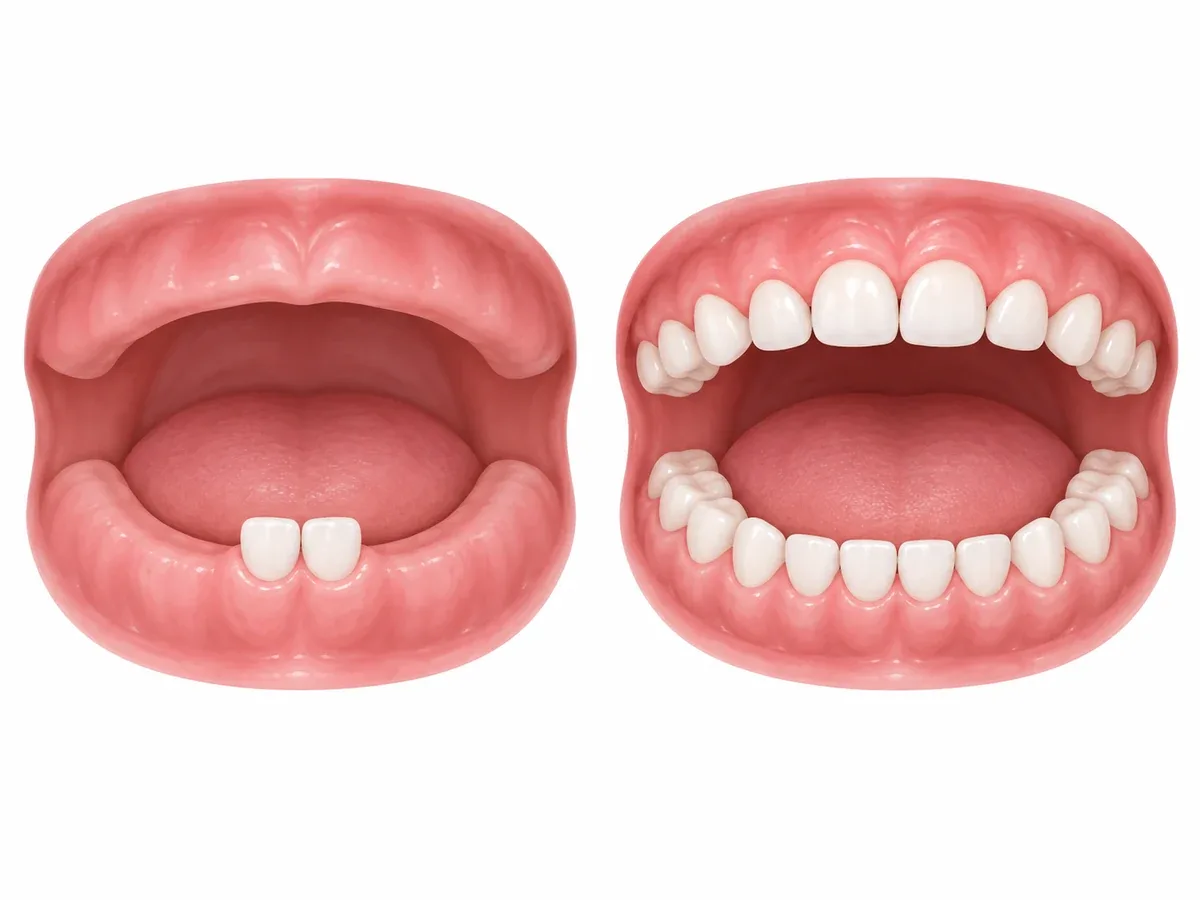
| Age | Teeth that come in |
|---|---|
| About 7–9 months | Two lower front teeth |
| Around the first birthday | Four upper teeth |
| 15–18 months | Lower side teeth, then about 16 baby teeth in total |
| Around 24 months | Primary molars |
| About 30 months | The set of baby teeth is complete |
What happens at a first dental visit?
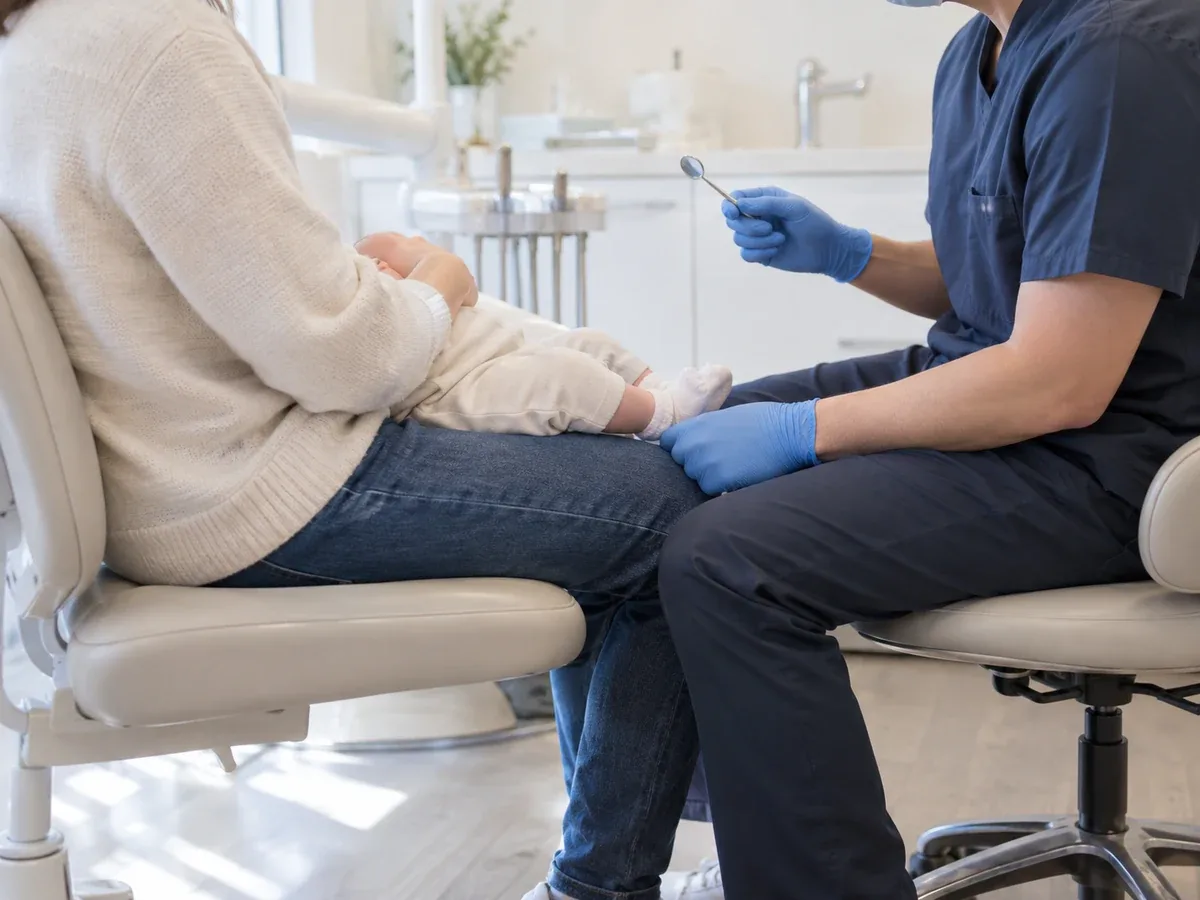
A first dental visit does not usually mean treatment. The Academy's material says a visit at around 12 months includes the following check-up and advice.
- Checking how the teeth are coming in.
- Reviewing how to brush and how clean the mouth is at night.
- Advice on weaning, night feeding, drinks and eating habits, and how they affect teeth.
- Finding and treating any early decay.
- Guidance on using fluoride to prevent decay.
The dental association paper goes a step further. A baby's mouth keeps changing shape from birth. So it says dentists should help the child learn to eat, speak and breathe well.
The paper introduces an approach it calls infant dentistry, which covers the period from birth to about 18 months. Its aim is to care for babies from the newborn stage so that healthy structure and function can develop.
The paper's stages of eating development are also useful. It stresses that these ages are averages and that children vary a great deal.
| Age | Description |
|---|---|
| 5–6 months | Learns the simple movement of swallowing soft, paste-like food. |
| 7–8 months | Moves the tongue up and down to press soft food against the palate and mash it. |
| 9–11 months | Chews food the tongue cannot mash, using the jaw, tongue and cheeks together. |
It helps to think about a few things before the first dental visit. How do you feed your baby, and do you feed at night? Which toothpaste do you use, and how do you clean the teeth?
What if my baby is fussy or the gums bleed while teething?
The Academy's material calls the range of symptoms around new teeth "teething." Common signs include the following.
- Drooling a lot.
- Wanting to chew on anything because the area feels hot and itchy.
- Crying and pointing to the sore spot.
- Sometimes, a fever.
Teething is a normal stage that every baby goes through, not an illness. Keeping the mouth clean and giving a rubber teething toy can ease it a little.
Fever is explained separately. Fever often appears during teething, but studies report no scientific link between the two. The overlap is explained by the drop in antibodies received from the mother at the same age.
Still, neglecting oral hygiene during this time can make symptoms worse. So the material advises cleaning the mouth even more carefully when it hurts.
Gums where a tooth is coming through may bleed during brushing. Local inflammation is common in these gums. Avoiding the area can make the inflammation worse, so keep brushing it.
The same applies when a child complains of sore gums as molars come in. Some swelling is natural, but a secondary infection often makes it worse. Brushing less because it hurts can make things worse.
Parents also ask about the small folds under the lip and tongue. A baby's labial frenum often reaches the gum and looks tight. It usually moves upward as the jaw grows, so there is no need to rush to cut it.
A tongue tie also looks short at this age, which is expected. Whether it is a real problem is diagnosed at age four to five, when certain clinical signs are present.
When should night feeding and cleaning habits change?
Feeding habits come up often in the Academy's case answers. For a 14-month-old with four decayed upper teeth, the answer is that removing the cause of decay comes first.
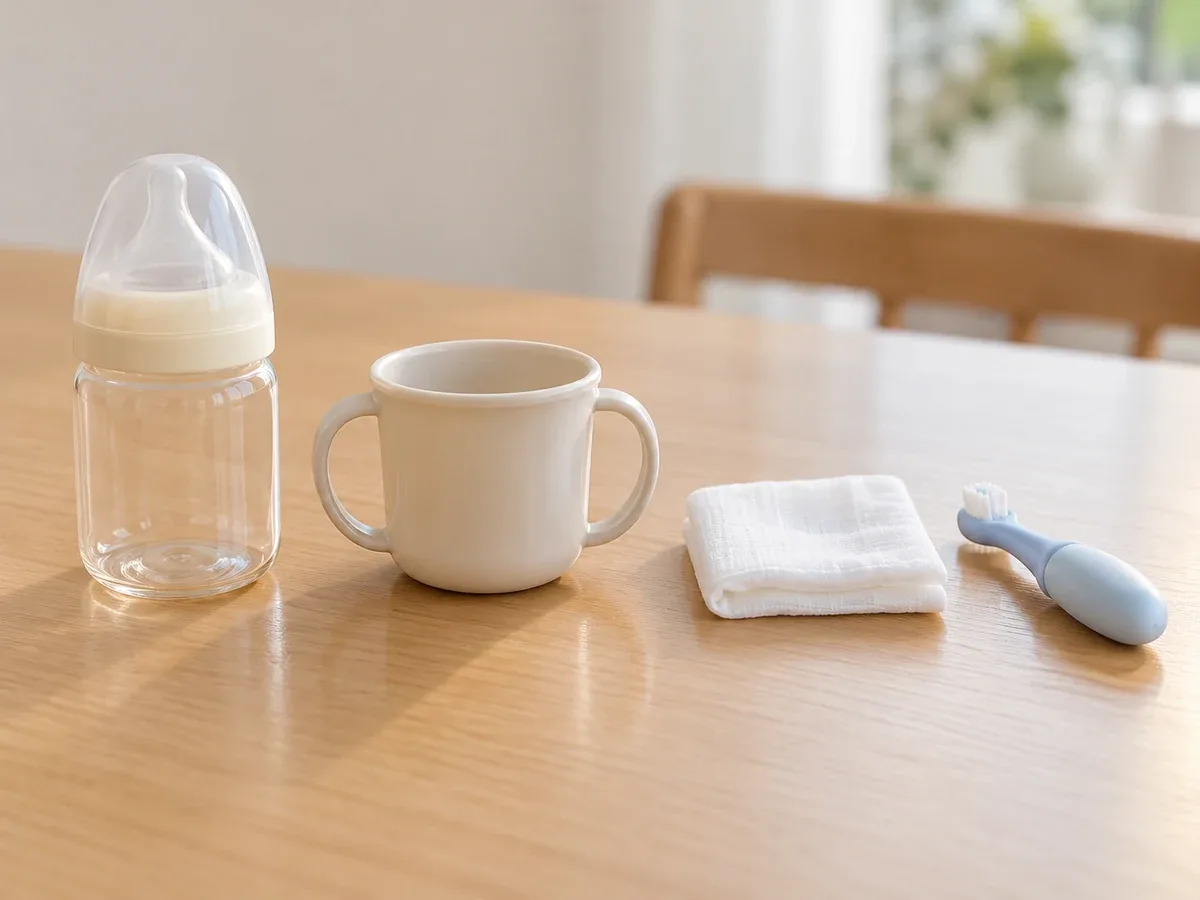
At that age, weaning time has passed and night feeding should stop completely. After eating or drinking anything, milk included, brush the teeth or wipe the teeth and tongue with gauze. It is also time to brush with a toothbrush and fluoride toothpaste.
The answer for a 16-month-old is similar. Night feeding should no longer happen, and the gauze stage has passed. This is why a first dental visit checks feeding and cleaning together.
Many parents worry because their baby dislikes brushing. The Academy honestly says there is no easy trick. It takes steady effort and patience from parents to make brushing a pleasant part of daily life.
Put in order, the answers look like this.
- Stop night feeding.
- After eating or drinking anything, milk included, clean the teeth and tongue.
- Switch from gauze to a toothbrush by about 16 months at the latest.
- Use fluoride toothpaste in the right amount for the child's age.
How much toothpaste and fluoride should a child use?
The KDCA fluoride material lists toothpaste amounts by age. Under age three, use a smear the size of a grain of rice; from three to six, a pea-sized amount. After six, use a pea-sized amount or a little more.
It recommends fluoride toothpaste even for children under two. If a child aged six or under cannot spit well, parents should watch the amount.
Strength is covered too. The material cites evidence-based oral care guidelines from the Korean Academy of Dental Science. They recommend fluoride toothpaste of 1,000–1,500 ppm for all ages.
The dental association paper describes a similar standard. In 2020, the International Association of Paediatric Dentistry advised brushing children's teeth twice a day with 1,000 ppm fluoride toothpaste. The aim is to prevent early childhood caries.
If a child aged six or under keeps swallowing fluoride, spots can form on the teeth. This is called dental fluorosis. So the right amount and parental supervision are needed.
Fluoride can also be applied at the dental clinic. Professional fluoride application, such as fluoride varnish, is recommended every 3–6 months. The paper notes that fluoride is widely used in varnish and mouth rinse as well as toothpaste.
Fluoride varnish forms a thin film on the teeth that stays and releases fluoride. On the day it is applied, follow these steps from the material.
- Do not rinse with water for one hour after application.
- Do not eat or drink anything, water included, for one hour.
- Brush gently after four hours.
- Use an old or disposable toothbrush, as the varnish can damage the bristles.

How does Korea's national check-up fit with a first dental visit in Busan?
According to the Ministry of Health and Welfare, children under six receive eight health check-ups in total. The oral check-ups take place at 18–29, 30–41, 42–53 and 54–65 months.
The target disease is dental caries (tooth decay). The check-up includes an exam and consultation, an oral hygiene test, and oral health education for parent and child.
The paper also cites figures showing that decay in children is falling. The share of children with decay experience in permanent teeth fell from 77.1% in 2000 to 56.4% in 2018. The share with untreated decay in permanent teeth fell from 42.0% to 6.9% over the same period.
The first national oral check-up starts at 18 months. So the check-up at around the first birthday comes earlier. Do not miss the national check-ups, but plan a first dental visit when the first tooth appears.
| Item | What the sources say |
|---|---|
| First dental visit (textbooks, American Academy of Pediatric Dentistry) | Before 12 months of age or when the first tooth comes in |
| First dental check-up (Korean Academy of Pediatric Dentistry) | 12 months |
| National infant oral check-ups | 18–29, 30–41, 42–53 and 54–65 months |
| Toothpaste amount | Rice-grain size under three, pea size from three to six, pea size or more after six |
| Professional fluoride application | Recommended every 3–6 months |
If you are thinking about a first dental visit for your child, please stop by once the first tooth appears. Check-ups and consultations are available at Reset Dental Clinic near Seomyeon Station.
Frequently asked questions
Can my baby have a first dental visit before any teeth come in?
The dental association paper gives before 12 months or when the first tooth appears as the time for a first dental visit. The Academy advises seeing a dentist if no tooth has appeared after 12 months. If your child is past the first birthday, a check is worthwhile even with no teeth.
Is it a problem if my child swallows fluoride toothpaste?
The KDCA recommends fluoride toothpaste even for children under two. At an age when a child cannot spit well, keep to a rice-grain amount and watch closely. Swallowing large amounts again and again can cause dental fluorosis.
What if my child cries a lot at the dentist?
The Academy says it is entirely normal for children this age to dislike dental treatment. So it advises focusing first on daily hygiene and good eating habits. Any decay that has already formed should be checked for its cause and treated promptly.
Can we have our child's first dental visit in English in Busan?
Yes. We offer 1:1 English interpretation from the first consultation through the end of treatment. The clinic is near Seomyeon Station Exit 2 (5-min walk), opposite Lotte Hotel Busan, and you can call 010-8555-2854 (+82-10-8555-2854 from abroad).
A first dental visit is about the first tooth, not about pain.
The sources point to the time the first tooth appears,
up to around the first birthday.
The national check-ups start later, at 18 months.
If you are planning your child's first dental visit in Busan, Reset Dental Clinic offers 1:1 English interpretation from the first consultation through the end of treatment. Call 010-8555-2854 to book a check-up.
References
- Journal of the Korean Dental Association, "Oral Care for Infants (Infant Dentistry)" (Lee Hyo-seol, 2022) — why babies without teeth rarely visit a dentist; Korean pediatric dentistry textbooks and the American Academy of Pediatric Dentistry guideline recommending a dental visit before 12 months or when the first tooth erupts; why dentists should support oral function from birth; the national infant oral check-ups rising from three to four from June 30, 2022; the International Association of Paediatric Dentistry's 2020 advice to brush twice a day with 1,000 ppm fluoride toothpaste to prevent early childhood caries; the aims of infant dentistry from birth to about 18 months
- Korean Academy of Pediatric Dentistry, "Dental Treatment for Children" parent Q&A — 12 months as the recommended time for the first dental check-up, covering tooth eruption, oral hygiene (brushing and night-time care), feeding advice (weaning, night feeding, drinks, diet), early decay and fluoride use; why problems parents notice are often advanced; advice for a 14-month-old with decay (remove the cause, stop night feeding, clean teeth and tongue after eating, use fluoride toothpaste and a toothbrush); the gauze stage having passed at 16 months; bleeding from inflamed gums around erupting teeth and why brushing should continue; the labial frenum usually moving upward with jaw growth; a short-looking tongue tie being expected at this age, with diagnosis at age four to five
- Korean Academy of Pediatric Dentistry, "Educational Materials and Guidelines" parent Q&A (tooth eruption) — eruption timing varies, but roughly two lower front teeth at 7–9 months, four upper teeth around the first birthday, about 16 teeth at 15–18 months, primary molars around 24 months and a complete set at about 30 months; advice to see a dentist if no tooth appears after 12 months; two upper and two lower teeth at 18 months being very late and needing an X-ray
- Ministry of Health and Welfare, "Health Check-ups" infant check-up guide — eight check-ups for children under six; oral check-ups at 18–29, 30–41, 42–53 and 54–65 months; dental caries as the target disease; exam and consultation, oral hygiene test and oral health education for parent and child
- KDCA National Health Information Portal, "Fluoride Application" — toothpaste amounts of rice-grain size under three, pea size from three to six and pea size or more after six; fluoride toothpaste recommended under two with care for children who cannot spit; 1,000–1,500 ppm fluoride toothpaste for all ages under the Korean Academy of Dental Science guideline; dental fluorosis risk and the need for supervision; professional fluoride application (gel or varnish) every 3–6 months
Written by Reset Dental Clinic Support Team
Medical review Dr. Kim Hyun-joo, Head Dentist · Integrated Dentistry Specialist
Last updated: September 19, 2026
This column is for general information and does not replace diagnosis or treatment for individual patients. If you have symptoms, please see a dentist.


