

- A cracked tooth typically gives a sharp pain on biting that fades as soon as you let go.
- A crack within the enamel causes no symptoms, but one that reaches the pulp can cause toothache.
- Early cracks are not open, so they are hard to see on X-rays, and there is still no way to measure their depth.
- Prevention means reducing heavy force: chewing on one side, biting ice, pens or nails, and grinding.
"It's fine at rest, but now and then I get a sharp twinge when I chew." We often hear this in Seomyeon, Busan. The next bite feels fine, so many people let it go.
For patients living in or visiting Korea, we provide 1:1 English interpretation from the first consultation through the end of treatment.
This column draws on national health portal guides and two cracked tooth papers from the Journal of the Korean Dental Association.
Is a sharp pain on biting a sign of a cracked tooth?
The national health portal's toothache guide gives the cracked tooth its own section. Biting something hard, a blow to the jaw, or heavy wear with age can cause a fine crack.
In such cases, people often do not notice it themselves.
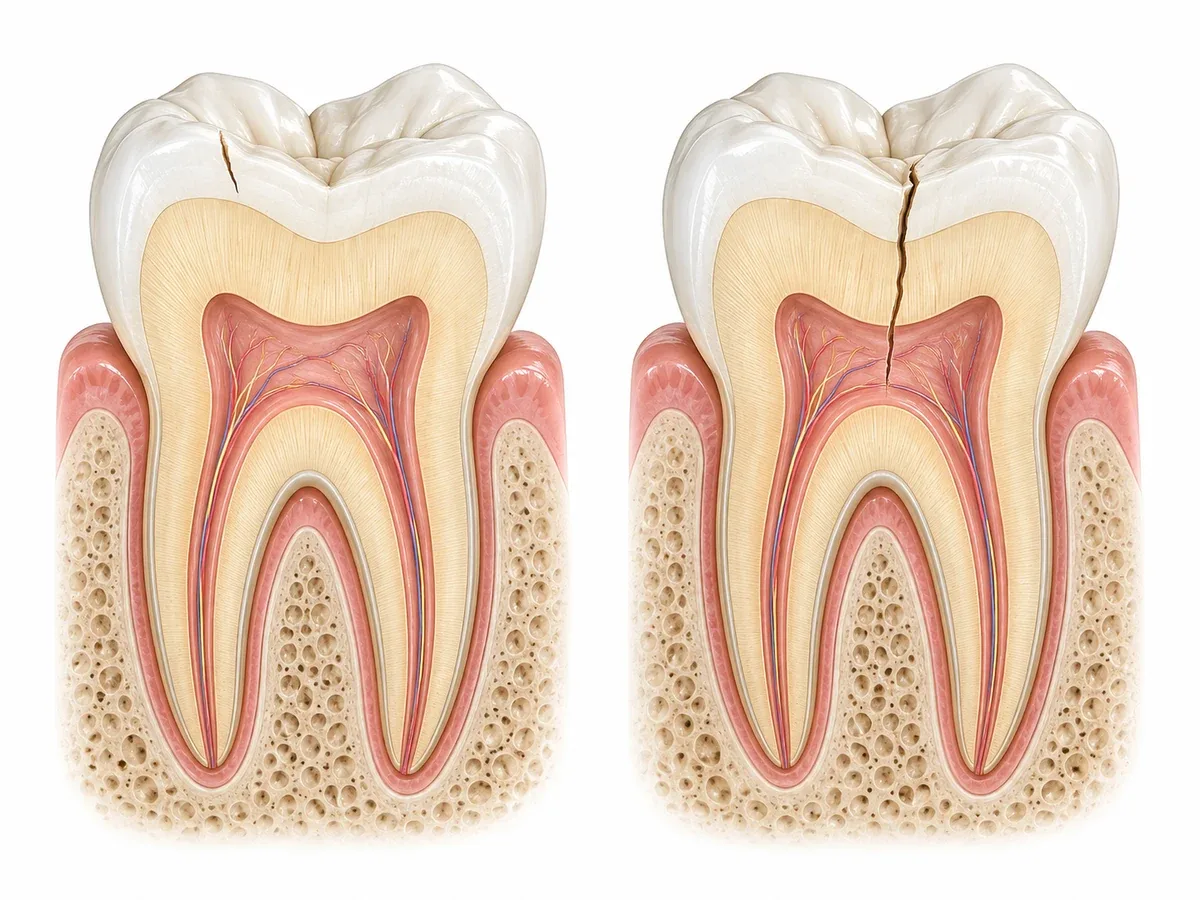
The guide explains when symptoms appear. A crack that stays in the outer layer, the enamel, causes no symptoms. If it reaches the pulp, where the nerves and blood vessels are, it can cause toothache.
The pain has a typical pattern. It is usually sharp, appears when you bite, and fades as soon as you let go. It can seem like gum pain, but it comes from biting force irritating the pulp.
Sometimes it hurts more when you release the bite than when you bite. This is called rebound pain. The guide says it is thought to come from the cracked dentin surfaces rubbing together.
Papers call this cracked tooth syndrome, a name first used by Cameron in 1964. Discomfort on chewing, sensitivity to cold and pain on release are the usual signs.

Is every line on a tooth a crack?
Many people see fine lines on their front teeth or molars in the mirror. The national health portal separates these lines from a cracked tooth.
A fine crack that stays within the enamel is called a craze line. It may not look nice, but without symptoms such as pain it does not have to be treated.
A crack beyond the enamel, by contrast, needs treatment. A Yonsei University paper defines a cracked tooth as an incompletely fractured tooth with a vertical crack running from the chewing surface toward the gum.
The paper also cites a guideline from the Korean and American associations of endodontists. It sorts vertical fractures into five groups by severity: craze line, fractured cusp, cracked tooth, split tooth and vertical root fracture.
The guideline suggests planning treatment by the location and extent of the crack.
| Type | What the sources say |
|---|---|
| Craze line (fine crack within enamel) | Does not have to be treated if there are no symptoms such as pain |
| Crack reaching the pulp | Can cause toothache |
| Cracked tooth (crack beyond enamel) | Seen as needing treatment |
| Vertically fractured tooth | Usually has to be removed |
Does pain on biting always mean a cracked tooth?
No. The Yonsei paper says pain on chewing can come from many causes, and lists these:
- A cavity can hurt when you chew.
- A loose filling, such as an inlay, can cause it too.
- Heavy wear that exposes the dentin makes chewing feel sore.
- Gum disease shows up as trouble biting with force.
- Muscle pain in the chewing muscles can also feel like pain on biting.
The way people describe it also differs. Patients with a crack often say, "It hurt so suddenly that I haven't chewed on that side for months." They add that it seems fine when they try again.
Patients with a cavity more often say food gets stuck or cold water hurts. Not being able to eat hard or chewy food suggests a crack.
The toothache guide adds that sensitivity can arise as a crack or cavity progresses, so it advises a professional check rather than self-diagnosis.
That is why we follow steps in the clinic. The paper says causes that are clear on exams and X-rays, such as cavities or gum inflammation, are ruled out first. If a crack line is visible and the symptom can be reproduced on that tooth, a crack is diagnosed.
If symptoms do not repeat clearly on one tooth, finding the cause is harder.
Why is a cracked tooth hard to find?
The paper cites a 2016 statement from the Korean Academy of Conservative Dentistry: public awareness of cracks is far lower than of cavities or gum disease.
The paper gives four reasons why diagnosis is difficult:
- Patients often cannot say exactly where the discomfort is.
- Early cracks are not open, so they are hard to see on X-rays.
- Crack lines often appear on neighboring, opposing or opposite-side teeth too.
- There is currently no way to tell how deep a visible line goes.
Take the first reason. People rarely confuse left and right, but they often mix up premolars and molars. Upper and lower get confused too, and discomfort usually occurs just two or three times a month.
X-rays do not help much either. Cracks usually run front to back. Early on there is no gap, so they are hard to see even on regular X-rays or CBCT.
When lines appear in many places, it is hard to tell which one is the cause.
Depth is the hardest part. Without extracting the tooth for micro-CT or tissue samples, no one can tell how far a crack has gone. During treatment, a line that looked faint can turn out to reach the pulp.
In one case in the paper, the line was hard to see under the microscope until stained, and the deep crack turned out to be elsewhere.
How do dentists check for a cracked tooth?
The paper names reproducing the pain as a reliable method. The patient bites on a cotton swab, a wooden tongue depressor or a rolled piece of rubber placed on the suspect spot. This is the bite test.
Biting opens the tooth along the crack, which shows whether the same pain appears. The national health portal's root canal guide also says fractures are diagnosed by having the patient bite with force.
The paper notes the limits too. Depending on where you bite, the crack may not open, so the pain may not be reproduced. Upper and lower teeth are pressed at once, so it can be hard to tell which one is the cause.
Some researchers warn that the bite test could worsen a crack. In past studies, most people with a cracked tooth had their discomfort reproduced by the bite test. About 20–30% reported sensitivity on a cold test.
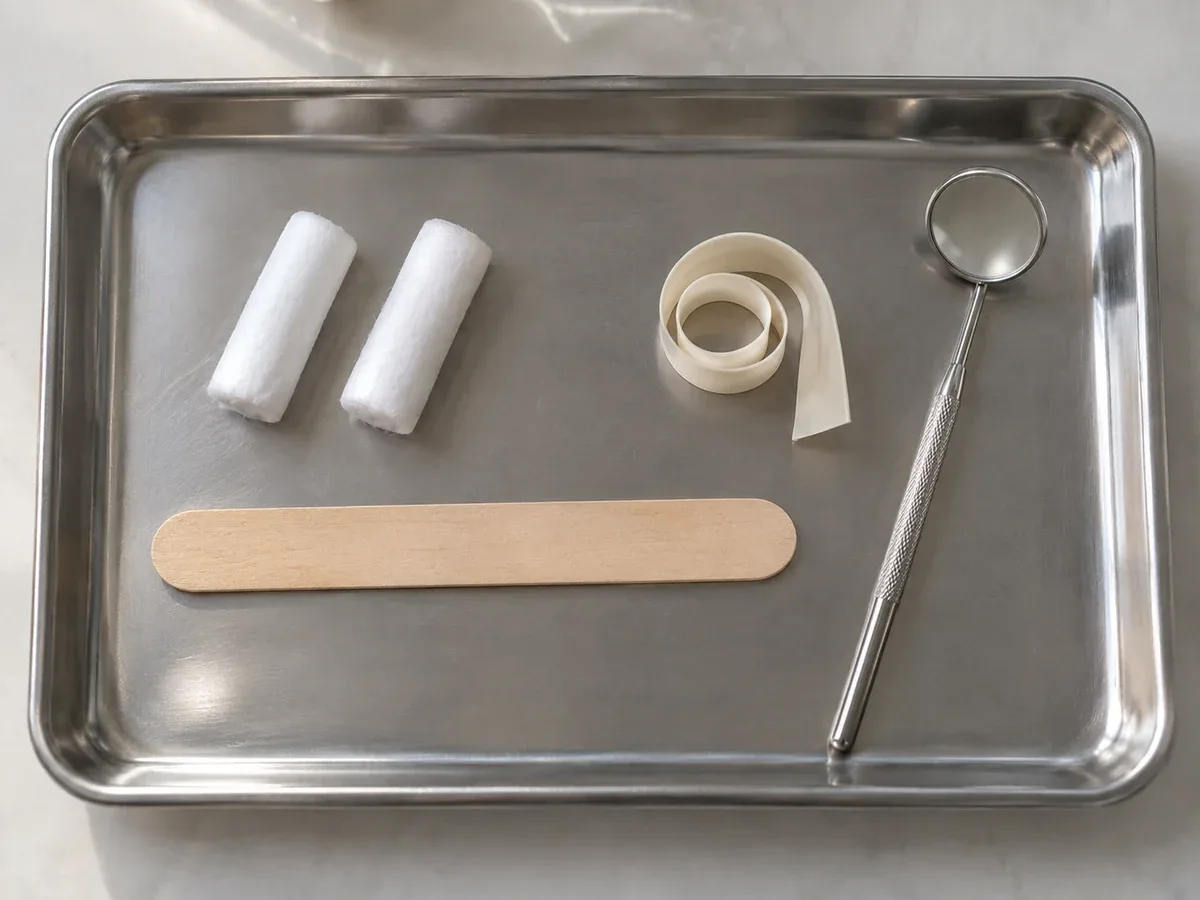
A Chosun University case report shows the process. A 43-year-old man had sharp pain in an upper right molar for months. Biting on a cotton roll reproduced his usual pain, the X-ray showed nothing unusual, and a cracked tooth was diagnosed.
A dye can be applied so it seeps into the crack, but it can also hide the crack or leave a stain. Inexperienced examiners may mistake craze lines or grooves for cracks.
A dental microscope at 14–20 times makes lines easier to find than the naked eye or 2–4 times loupes. It also does not change the tooth at all.
Fiber-optic light also helps, because it bends at the crack.
The paper concludes that all these methods show where a crack is, but not how deep it goes.
| Test | What the paper says |
|---|---|
| Bite test | Tries to reproduce the pain, but may not, depending on where you bite |
| Cold test | 20–30% of patients with a cracked tooth reported sensitivity |
| Dye, dental microscope (14–20x) | Show the location but not the depth |
| X-ray, CBCT | Early cracks are not open, so they are hard to see |
How is a cracked tooth treated?
The Chosun University case report explains the basic strategy. Hold together the crown of the tooth, where the crack is spreading, to ease symptoms and slow progress.
An orthodontic band, a cap over the chewing surface or a full crown can be used.
The next steps are set out as well. If symptoms settle after the tooth is held together, it is simply watched. If symptoms continue or worsen, root canal treatment follows.
In one study cited, cracked molars with reversible pulpitis were given full crowns. Within 6 months, 21% needed root canal treatment. The crown then had to be remade.
A temporary crown may be tried first. If biting causes no pain and there are no pulpitis symptoms, a full crown follows. However, pain often returns after the final crown, so root canal treatment is sometimes done first.
Another study looked at 72 cracked teeth. Before final crowns, 60 of them (83.3%) had root canal treatment, and 12 kept a living pulp.
The case report says root canal treatment does not hold the tooth together; it removes symptoms. So the decision on root canal treatment must follow the symptoms.
After root canal treatment of a cracked tooth, 2-year survival is reported at 85.5–90%.
For an early cracked tooth without pulpitis, the report concludes that resin can be used to cover the cusps. This may delay root canal treatment and a crown.
Direct resin coverage takes less treatment time and can be repaired if it chips, but recreating the cusp shape is hard.
A study by Opdam, cited in the paper, points the same way. Teeth with resin covering the cusps had no failures over 7 years. Teeth without cusp coverage failed at 6% a year.
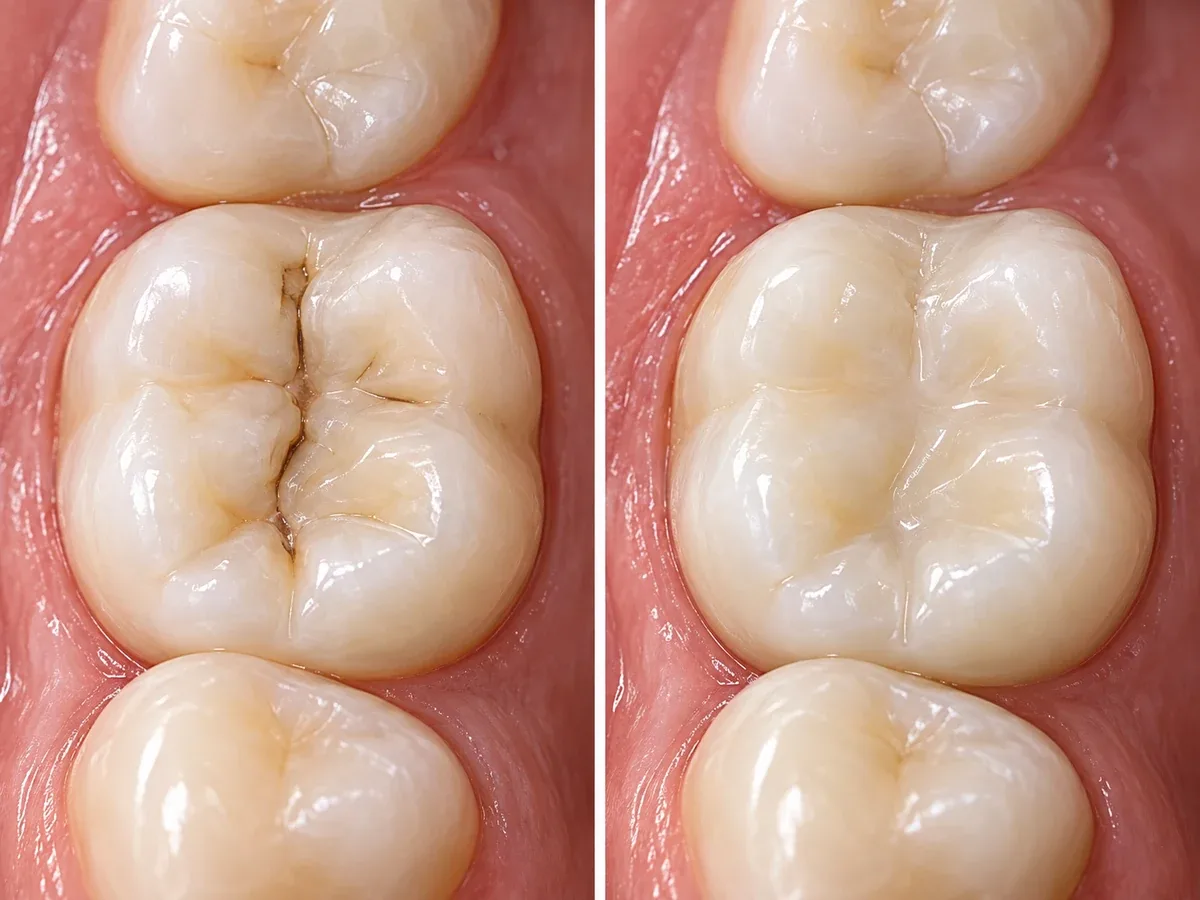
Still, this case report followed one person for one year. The symptoms were gone after a year, but part of the resin had chipped. The same result cannot be expected in every case.
| Option | What the sources say |
|---|---|
| Band or cap | Holds the crown together to ease symptoms and slow progress |
| Full crown | In one study, 21% needed root canal treatment within 6 months |
| Resin cusp coverage | Can be used for early cracks without pulpitis |
| Root canal treatment | Done if symptoms continue or worsen after the tooth is held |
| Extraction | Usually needed for a vertical fracture |
As a crack deepens, options narrow. The toothache guide says a vertically fractured tooth usually has to be removed. Bonding and crowning is possible, but its success rate is not high.
The extraction guide also lists a cracked or broken tooth that stays painful despite treatment as a reason for extraction.
How can patients in Busan prevent a cracked tooth?
The national health portal's advice is to reduce repeated heavy force. The journal paper also links eating habits and clenching to cracks. The portal recommends these habits:
- Stop chewing on one side.
- Stop biting hard things such as ice, pens or fingernails.
- Control grinding or clenching.
- Wear a night guard if needed.

Teeth with root canal treatment need extra care. The root canal guide says heavily drilled teeth break easily. Molars and heavily drilled teeth need a crown to prevent fracture, and very hard food should be chewed with care.
If a sharp pain on biting keeps coming back, have it checked for a crack. The depth of a cracked tooth is hard to know in advance, so treatment is decided from symptoms and test results together.
Patients often cannot say exactly where the discomfort is, so note these points before your visit.
- Left or right, upper or lower.
- How many times a month it hurts.
- Which foods caused the pain.
- Whether it hurts more on biting or on letting go.
- Whether cold hurts, and whether you grind or clench.
At Reset Dental Clinic in Seomyeon, we decide on treatment by looking at these notes together with the test results.
Frequently asked questions
I can see a line on my tooth, but it doesn't hurt. Is that okay?
The portal says a craze line within the enamel does not have to be treated if there are no symptoms. But its depth cannot be seen from outside. If biting starts to hurt or feel sensitive, have it checked.
It hurts just a few times a month. Can I wait?
The paper says discomfort from a cracked tooth usually occurs two or three times a month. Rare pain does not mean a mild problem. A tooth that splits vertically usually has to be removed, so do not put it off if it recurs.
Will a crown stop a cracked tooth from hurting?
A crown can ease symptoms, but root canal treatment is sometimes needed afterwards. This is because the depth of the crack cannot be known in advance. We explain this possibility before treatment.
Can I get cracked tooth treatment in English in Busan?
Yes. We offer 1:1 English interpretation from the first consultation through the end of treatment. The clinic is near Seomyeon Station Exit 2 (5-min walk), opposite Lotte Hotel, and you can call 010-8555-2854 (+82-10-8555-2854 from abroad).
A sharp pain that comes and goes on biting is worth checking.
Cracks are hard to see on X-rays,
and their depth cannot be measured in advance.
Symptoms and tests together guide the treatment.
If you suspect a cracked tooth in Busan, Reset Dental Clinic offers 1:1 English interpretation from your first consultation through the end of treatment. Call 010-8555-2854 to book a consultation.
References
- KDCA National Health Information Portal, "Toothache and Chronic Pain (Toothache)" — fine cracks from biting hard objects, trauma, wear or aging, often unnoticed; no symptoms when limited to enamel, toothache when reaching the pulp; sharp pain on biting that fades on release, and rebound pain; vertically fractured teeth usually extracted, with a low success rate for bonding and crowning; prevention by stopping one-sided chewing, biting ice, pens or nails, and controlling grinding with a night guard; craze lines not needing treatment without symptoms
- Journal of the Korean Dental Association, "Diagnostic Methods and Limitations for Cracked Teeth" (Kim Sun-il, Shin Su-jung, 2024) — five categories of longitudinal tooth fracture; patients often unsure of the location, with discomfort two or three times a month; early cracks hard to see on X-rays and CBCT; crack lines on other teeth and no way to measure depth; other causes of pain on chewing; the bite test and its limits; most patients reproducing discomfort on the bite test and 20–30% reporting cold sensitivity; dye and microscopes not showing depth; eating habits and clenching as factors
- Journal of the Korean Dental Association, "Treatment of Cracked Tooth Syndrome Using Composite Resin and an Occlusal Index: A Case Report" (Park Tae-young et al., 2021) — holding the crown together to ease symptoms and slow crack progress; bands, overlays and full crowns; watching if symptoms settle and root canal treatment if they persist or worsen; 21% of crowned cracked molars with reversible pulpitis needing root canal treatment within 6 months; resin cusp coverage for early cracks without pulpitis possibly delaying root canal treatment and crowns (one case, one-year follow-up)
- KDCA National Health Information Portal, "Root Canal Treatment" — diagnosing fractures with a bite test; teeth breaking more easily after being drilled for root canal treatment; crowns for molars and heavily drilled teeth to prevent fracture
- KDCA National Health Information Portal, "Tooth Extraction" — extraction when a cracked or broken tooth stays painful despite treatment
Written by Reset Dental Clinic Support Team
Medical review Dr. Kim Hyun-joo, Head Dentist · Integrated Dentistry Specialist
Last updated: September 19, 2026
This column is for general information and does not replace diagnosis or treatment for individual patients. If you have symptoms, please see a dentist.


