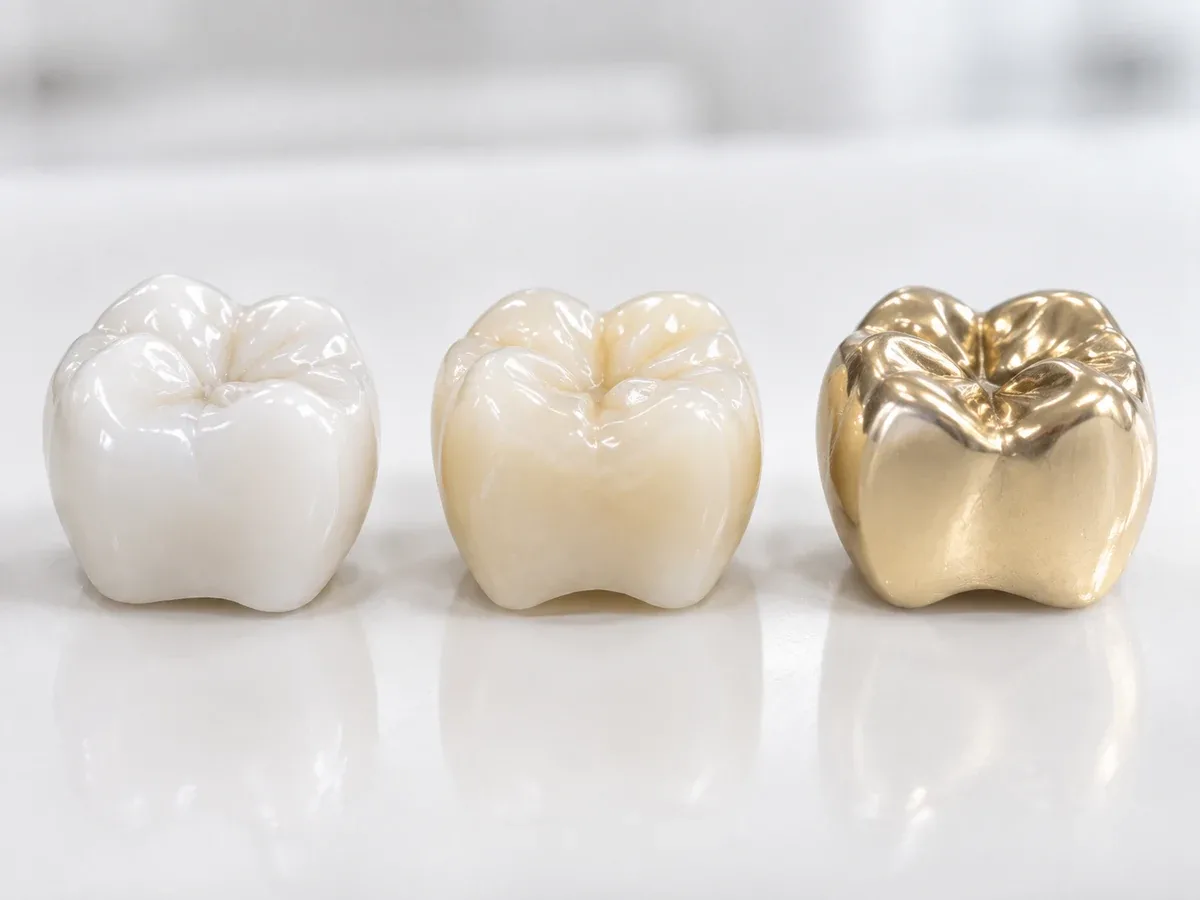
- The teeth on top of a full-arch implant, the implant prosthesis, can be made of porcelain fused to metal, zirconia, gold alloy or resin. Each has different features in the published sources.
- A prosthodontic case report notes that zirconia and porcelain fused to metal are the materials widely used today for fixed implant teeth.
- A Korean study of back-tooth implant crowns found no statistically significant difference in survival or success by material. Complications were common whatever the material, so regular checkups matter.
- For full-arch fixed teeth made of monolithic zirconia, long-term studies are still lacking compared with porcelain fused to metal, so the choice calls for care.
At full-arch implant consultations in Seomyeon, Busan, we are often asked, "Is zirconia better?" The published sources do not name one material that suits everyone. This column goes through what public health information and Korean prosthodontic journals say about each material. For patients living in or visiting Korea, we provide 1:1 English interpretation from your first consultation through the end of treatment.
What makes up the top part of a full-arch implant?
The KDCA, Korea's public health agency, explains that an implant has three parts.
- An artificial root placed in the bone (the fixture).
- A connecting post that joins the root to the tooth (the abutment).
- The artificial tooth you see in the mouth (the prosthesis).
The artificial tooth on top is fixed to the post with cement or a screw. The materials in this column are the materials of this artificial tooth part.
The KDCA notes that when you chew hard or tough food, the force passes through the prosthesis into the implant. As a result, the implant or the prosthesis can break.
A damaged prosthesis must be repaired or remade. A loose screw is tightened again or replaced with a new one. That is why chipping, wear and repair always come up when materials are discussed.
As the cases below show, a full-arch implant joins many teeth into a few sections. So along with the material, the number of sections and the way they are fixed are decided together.
What is porcelain fused to metal?
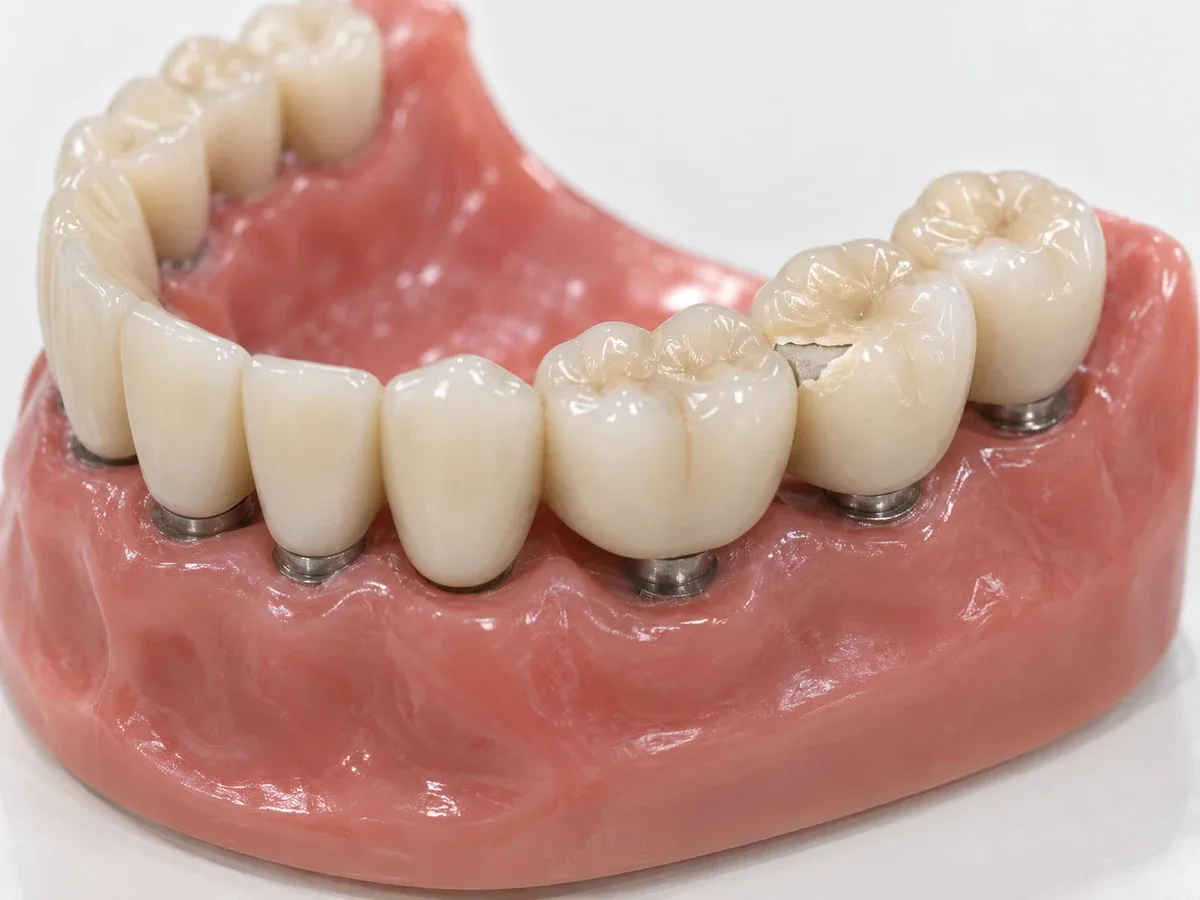
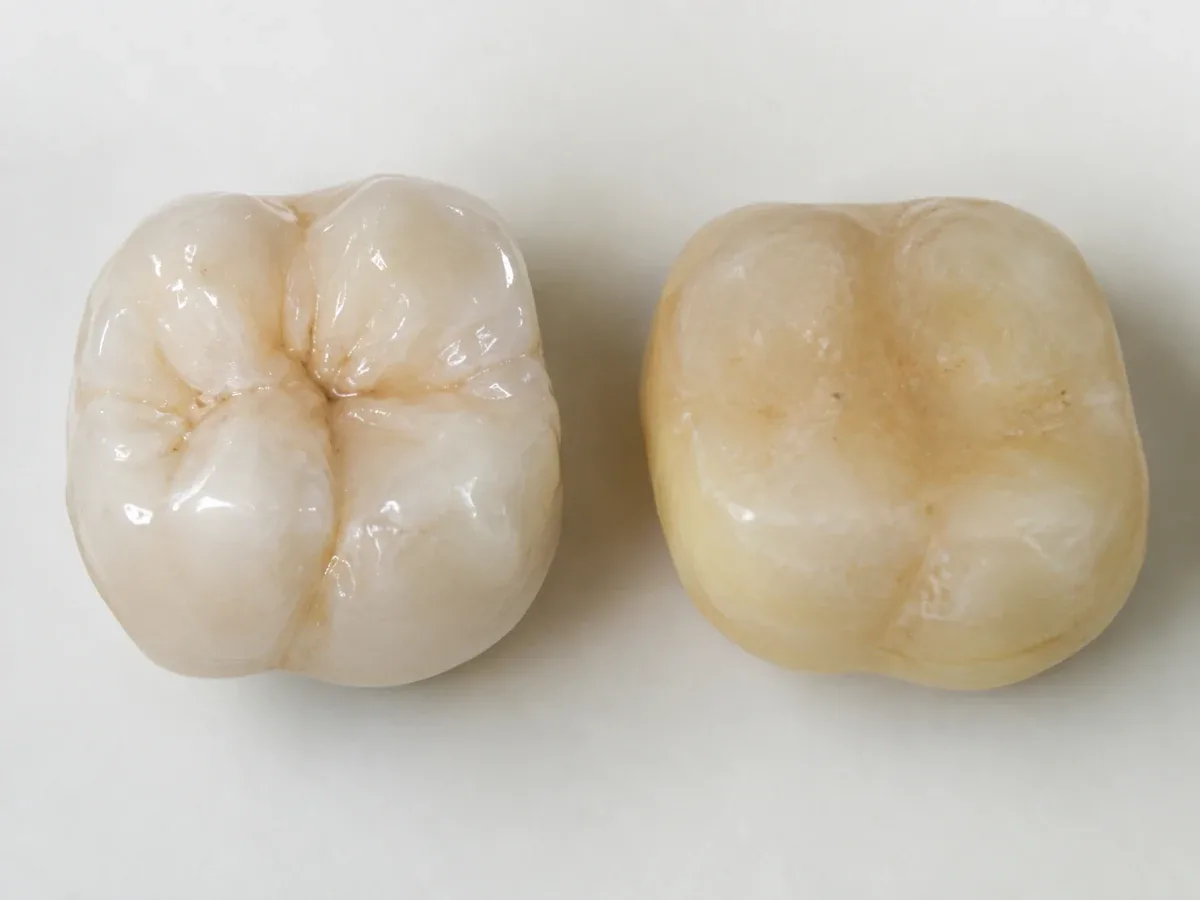
Porcelain fused to metal combines the look of porcelain with the strength of metal. A retrospective study from the prosthodontics department of Jeonbuk National University Dental Hospital introduces this material first.
A 2009 lecture article by Professor Lee Sung-bok in the Korean Dental Association's newspaper also covers it. He writes that it has been widely used for bridges joining several back teeth. With implants, however, cushioning through the periodontal ligament cannot be expected.
So he writes that porcelain chipping happens often where chewing force is strong or the porcelain thickness is not right. The worry grows if the opposing teeth are implants too.
The lecture adds that a cemented porcelain prosthesis is not easy to repair once it chips. Repair takes time and effort, and patients may be unhappy.
In the Jeonbuk study, not a single porcelain chip occurred. The researchers put this down to most of the metal-ceramic crowns having a metal chewing surface on the back teeth. A metal chewing surface may reduce chipping, they suggest.
A full-arch implant case from Asan Medical Center's prosthodontics department made a similar choice. Because many teeth were joined, the team chose porcelain fused to metal with metal chewing surfaces, weighing chipping risk and maintenance. No chipping or similar problems were seen over six months.
How are zirconia and monolithic zirconia different?
The KDCA's page on all-ceramic crowns describes zirconia as a leading metal-free, reinforced ceramic. With no metal, the gum edge does not show a dark line.
Using high-strength ceramic alone lowers the risk of small pieces chipping off compared with older porcelain. However, strong ceramic is less translucent, and highly translucent ceramic is weaker.
The KDCA lists these weak points of reinforced ceramic.
- High-strength ceramic lacks translucency.
- Highly translucent ceramic is less strong.
- A sudden hard bite with a strong impact can break it.
- With long use, strength can drop and cracks can form.
It says lifespan varies widely by material but is generally shorter than metal-ceramic crowns, around ten years in the literature. This page covers crowns on natural teeth, though, so it cannot be applied directly to a full-arch implant.
The Jeonbuk study saw monolithic zirconia as a good alternative to metal-ceramic or gold alloy for back teeth. This should be read alongside the Asan report's note that long-term full-arch studies are lacking.
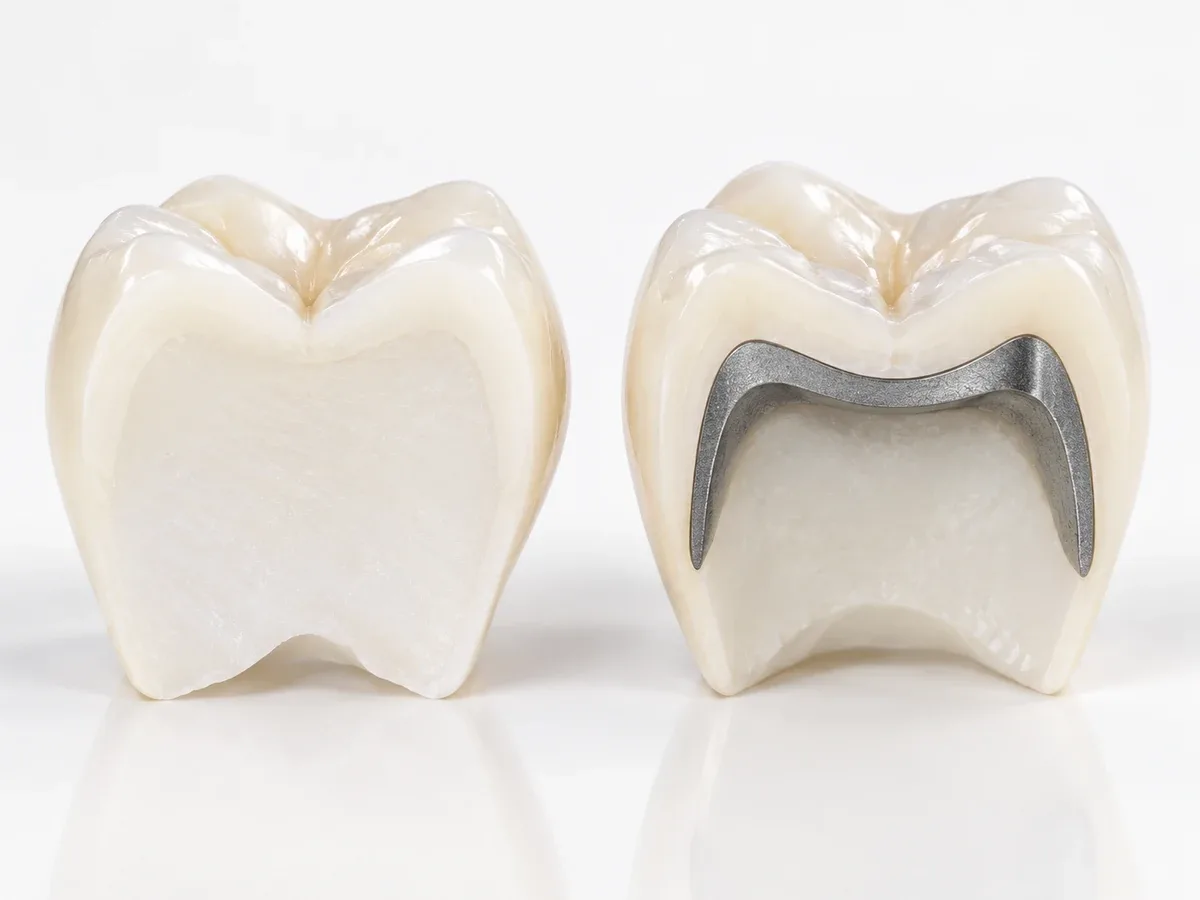
Monolithic zirconia is milled from one solid block, with no porcelain layered on top. The Asan report says it is used as an alternative that avoids porcelain chipping.
Its listed strengths are better wear resistance and less biofilm build-up. Repair or remaking with CAD/CAM is also easier.
However, the report says long-term studies are lacking for full-arch fixed restorations in monolithic zirconia compared with metal-ceramic. The material should therefore be chosen with care.
The studies cited in that report disagree. For single teeth, there was no significant difference between the two materials in chipping, screw fracture or loss of retention.
For implant bridges joining several teeth, one report found lower success for zirconia than metal-ceramic. Another found more chipping that needed polishing. Conditions and material designs differed, so the findings do not point one way.
| Material | What the sources say |
|---|---|
| Porcelain fused to metal | Look of porcelain with strength of metal; porcelain can chip on implants in some conditions |
| Monolithic zirconia | Wear resistance and easier repair; long-term full-arch studies lacking |
| High-strength ceramic in general | Less translucent; more translucent means less strong (natural-tooth crown data) |
| Gold alloy | No significant difference in cumulative success from other materials in the back-tooth study |
| Composite resin | Older types needed frequent repair for wear, staining and fracture; reinforced types developed (2009 lecture) |
What about resin?
The 2009 lecture by Professor Lee names composite resin as a tooth-colored option for back teeth besides porcelain. He writes that older resin chewing surfaces were weak and wore down quickly.
Opposing teeth could over-erupt, and the material could break or stain, so frequent repair or replacement was needed. This limited its clinical use.
From the late 1990s, reinforced composite resins were developed to address these weaknesses. Their strength and look were improving, and they were said to soften the impact passed to implants.
The lecture notes that, unlike porcelain, a resin chewing surface is easy to repair when it breaks. There is also no distortion of the metal frame, which can happen when porcelain is fired.
However, he writes that there is still no clear fix for weak bonding between metal and resin. Metal and porcelain, by contrast, also bond chemically, so their bond is far stronger.
The lecture is more than 15 years old, so materials, including those used for a full-arch implant, may have changed since then.
Does the material change the outcome?
The Jeonbuk study looked at back-tooth implant crowns made by one prosthodontist between 2011 and 2018. There were 364 crowns in 245 patients, made of monolithic zirconia, metal-ceramic or gold alloy.
The three- and five-year cumulative survival rates were 97.5% and 91.0%. Material, sex, age, location and type did not affect cumulative success. The average follow-up was 17.1 months, which is fairly short.
| Item | Result |
|---|---|
| Sample | 245 patients, 364 crowns. |
| Cumulative survival | 97.5% at 3 years, 91.0% at 5 years. |
| Cumulative success | 61.1% at 3 years, 32.9% at 5 years. |
| Difference by material | Not statistically significant. |
| Porcelain chipping | None. |
The researchers explained why five-year survival was lower than in other studies. With a short average follow-up, few crowns had been watched for five years or more.
The low success rate also has a reason. The team counted any complication, even once, as a failure, including crowns that were repaired and kept in use.
Five crowns were removed and remade during follow-up. Two were for a lowered bite, and one each for loss of bone bonding, mucositis and a broken post and screw.
The most common complications were as follows.
- Loss of contact with the neighboring tooth: 53 cases.
- Loss of retention, where a cemented crown comes loose: 17 cases.
- Inflammation of the gum around the implant: 12 cases.
- A lowered bite: 4 cases.
When contact with a neighboring tooth opens, food gets trapped, which is uncomfortable and can harm the gums. The researchers say regular checkups help find this early. Making the crown removable so the contact can be restored also helps.
The researchers concluded that complications are common whatever the material. So regular checkups and timely repair or adjustment are very important. They also noted that patients tend to skip checkups when nothing feels wrong.
Monolithic zirconia had more complications in number. The researchers say sample size and follow-up differed, so the counts alone cannot be interpreted. The study looked at back-tooth crowns, which limits how far it applies to a full-arch implant.
Why do fixation and design matter as much as material?
All 17 cases of lost retention in the Jeonbuk study happened with one type of implant cement. That cement is designed so a dentist can remove the crown if a problem arises.
The researchers therefore say patients should be told in advance that a crown may come loose over time. Checking retention at regular visits also matters.
The KDCA advises checkups every three to six months after implant treatment. Depending on the implant type, the upper parts are removed and cleaned at checkups. That is why being able to remove the top of a full-arch implant is linked to its care.
The Asan case chose the option that makes complications easier to handle. Back teeth were fixed with screws, and front teeth used both screws and cement. The screw holes allow the prosthesis to be taken off.
A Yonsei University upper full-arch implant case made the final teeth from monolithic zirconia. The front teeth were cemented because their screw holes would face the lip. The back teeth used both screws and cement so they could be removed easily.
| Method | What the sources say |
|---|---|
| Screw-retained | Can be removed through the screw hole, making complications easier to handle. |
| Cement-retained | Patients are told that implant cement may loosen over time. |
| Front teeth | Cement was used where screw holes would face the lip. |
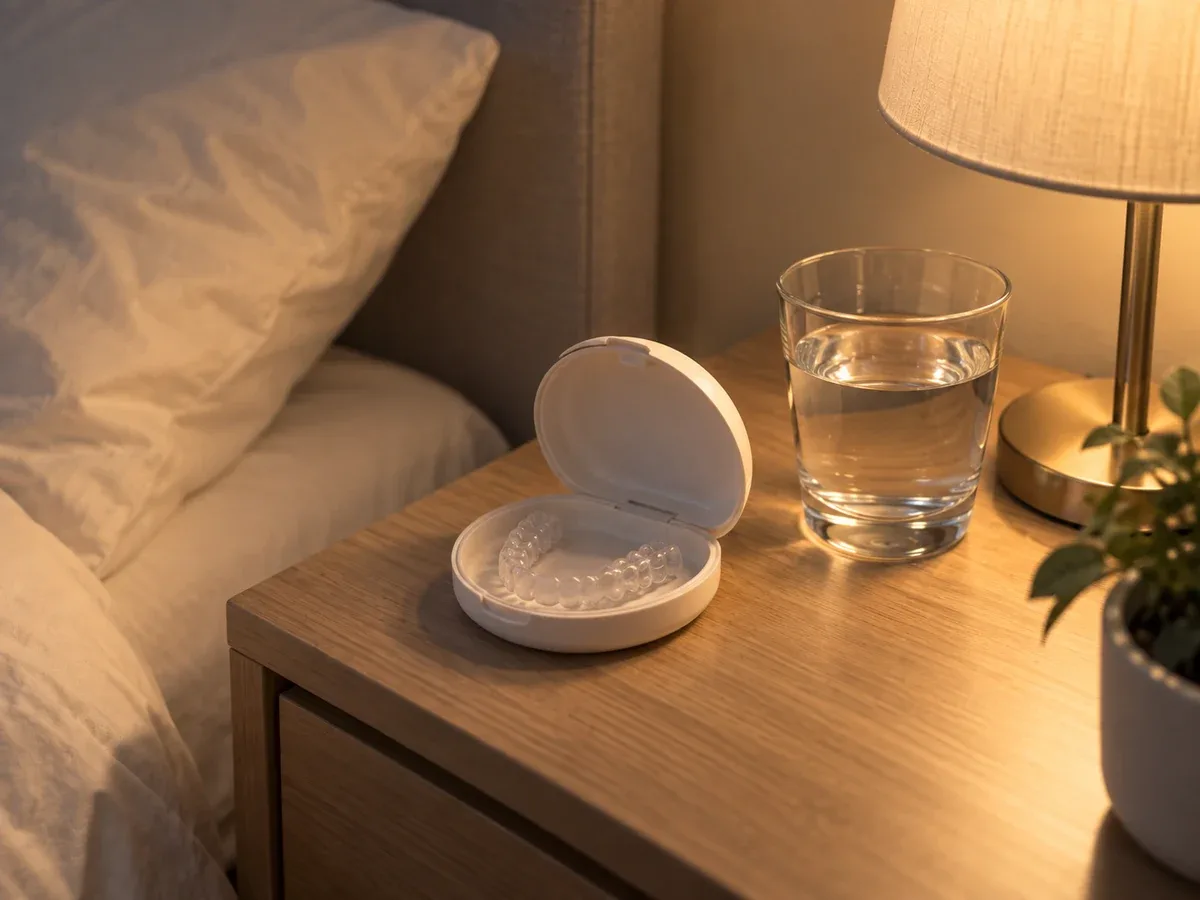
The KDCA notes that too much force on hard food can break a prosthesis. If you grind or clench your teeth in your sleep, a device to protect against wear and breakage may be needed.
Ceramic used for a long time loses strength and can crack, making it easier to break. In the Asan full-arch implant case, the patient was taught to wear a night guard during sleep after the final teeth.
Design also includes shapes that are easy to clean. The Asan team shaped the spaces between teeth for good hygiene, since cleaning between teeth and under the prosthesis is a daily task.
What should you ask when choosing full-arch implant materials in Busan?
When planning a full-arch implant, several factors are weighed together rather than a material name alone. The Asan case also chose its material because the teeth were joined and would need maintenance.
If both jaws get a full-arch implant, the opposing teeth are implants too. That is the condition Professor Lee says raises the risk of porcelain chipping.
Asking these questions at your consultation will help you understand the choice.
- Are the opposing teeth natural teeth or implants?
- What material will the chewing surfaces be?
- How many sections will the arch be divided into?
- Will it be screwed in or cemented?
- How is it repaired if it chips or comes loose?
- If I grind my teeth, do I need a protective device?
When you hear about materials, ask about weak points and repair as well as strengths. The sources all stress this.
If you are looking into a full-arch implant in Busan, you can ask for the whole design to be explained, not just a material name. What the sources share is that every material needs regular checkups.
Before planning a full-arch implant, please also tell us about your chewing habits and whether you grind your teeth.
Frequently asked questions
Can zirconia break?
The KDCA says even high-strength ceramic can break under a strong impact, and it can weaken and crack with long use. No source describes the top of a full-arch implant as unbreakable.
I grind my teeth. Which material suits a full-arch implant?
The sources do not name one right material. We consider the lecture's note that porcelain chips more where bite force is strong, and the KDCA's advice to discuss a protective device if you grind.
If it breaks, does the whole thing have to be remade?
The KDCA says a damaged prosthesis is repaired or remade. The Asan report notes monolithic zirconia is easier to repair or remake with CAD/CAM. It depends on the extent of the damage and the design.
Can I get full-arch implant treatment in English in Busan?
Yes. We offer 1:1 English interpretation from the first consultation through the end of treatment. The clinic is near Seomyeon Station Exit 2 (5-min walk), opposite Lotte Hotel Busan, and you can call 010-8555-2854 (+82-10-8555-2854 from abroad).
No single material suits every full-arch implant.
The opposing teeth, your bite habits,
how the arch is divided and how it is fixed
are weighed together with the material.
At Reset Dental Clinic in Seomyeon, the material is decided after tests and design, and we explain the weak points and repair options too. We offer 1:1 English interpretation from your first consultation through the end of treatment. Call 010-8555-2854 to book a consultation.
References
- Shin HH et al., "Full-mouth rehabilitation of a completely edentulous patient with fixed implant prostheses," Journal of Dental Rehabilitation and Applied Science 37(3), 2021, Asan Medical Center Department of Prosthodontics — zirconia and metal-ceramic are widely used for fixed implant prostheses; cited studies disagree for multi-unit restorations; monolithic zirconia offers wear resistance, less biofilm and CAD/CAM repair but lacks long-term full-arch data; one patient treated with metal-ceramic with metal chewing surfaces and no chipping over six months
- Chae HS, Wang WG, Lee JJ, Song KY, Seo JM, "A retrospective study on survival rate, success rate and complications of posterior implant-supported fixed prostheses by material," Journal of Korean Academy of Prosthodontics 57(4), 2019, Jeonbuk National University — 364 prostheses in 245 patients (2011–2018); 3- and 5-year cumulative survival 97.5% and 91.0%, success 61.1% and 32.9%; material did not affect success; contact loss, retention loss and mucositis as main complications; regular checkups matter whatever the material
- KDCA National Health Information Portal, "All-Ceramic Crowns" — features of reinforced ceramics such as zirconia for natural-tooth crowns; strength versus translucency; breakage under impact and with long use; protective devices for grinding; repair or remaking
- KDCA National Health Information Portal, "Dental Implants" — the three parts of an implant and how the tooth is fixed; implants or prostheses can break with hard or tough food and must be repaired or remade
- KDA newspaper Dailydental, "Professor Lee Sung-bok's lecture IV: full-arch implant prostheses" (November 12, 2009) — porcelain chipping on implants where bite force is strong or porcelain thickness is wrong, especially against implant teeth; history and limits of composite resin chewing surfaces, including weak metal-resin bonding (product-specific parts not cited)
- Yonsei University College of Dentistry, Department of Prosthodontics, "Full-arch fixed implant restoration using an intraoral scanning digital workflow in a maxillary edentulous patient," Journal of Korean Academy of Prosthodontics 62(1), 2024 — final teeth in monolithic zirconia; front teeth cemented because screw holes faced the lip, back teeth screw-and-cement retained for easy removal
Written by Reset Dental Clinic Support Team
Medical review Dr. Na In-chae, Head Dentist · Periodontics Specialist
Last updated: September 19, 2026
This column is for general information and does not replace diagnosis or treatment for individual patients. If you have symptoms, please see a dentist.