

- In Korea, a full-arch implant is mostly not covered by national health insurance, so there is no single set fee. For a fully toothless jaw, the whole procedure is currently uncovered.
- A national survey of uncovered dental items found wide gaps even for items with the same name. Difficulty, extent and the number of teeth were given as the reasons.
- Quotes differ because they combine the number of implants, bone-building surgery, the temporary-teeth stage and the final prosthesis design.
- Limited insurance coverage for fully toothless older patients has been approved from January 2027. Implant overdentures remain uncovered.
At our clinic in Seomyeon, Busan, patients often ask why full-arch implant quotes differ so much. This column lists no fees but explains what a quote is made of and what to line up before comparing. For patients living in or visiting Korea, we provide 1:1 English interpretation from your first consultation through the end of treatment.
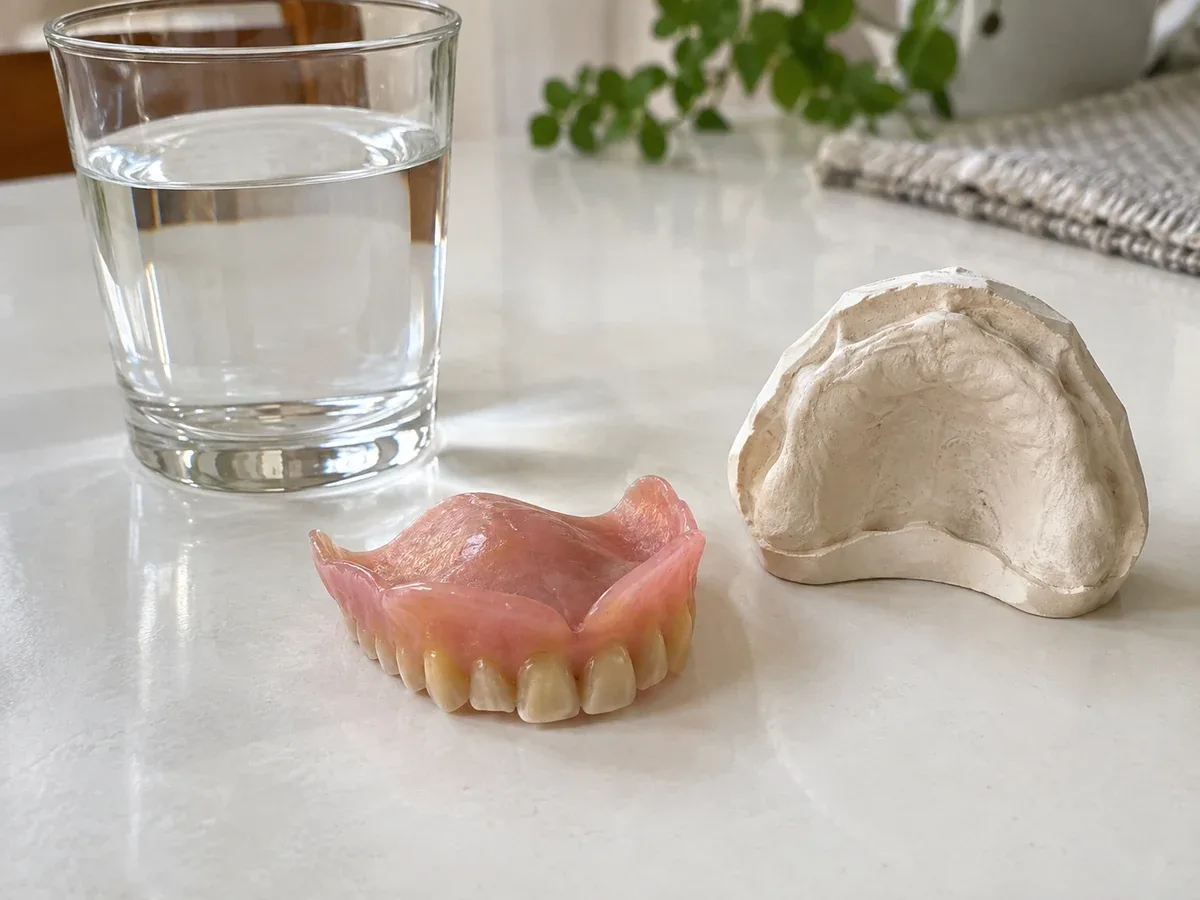
Why is there no single fee for a full-arch implant?
Care covered by national health insurance has a set fee. Dental prostheses and implants, however, are generally not covered.
The Health Insurance Review and Assessment Service (HIRA) explains this in its online Q&A. Under the insurance benefit rules, prostheses and extra surgery done for implants are not covered.
The exception is older patients. For those aged 65 and over who are partly toothless, a limited number of implants per person is covered. This applies when certain implant types and crown materials are used.
HIRA states that the whole procedure is uncovered in cases like these.
- Implants for a patient with no teeth at all (fully edentulous).
- Implants placed through the upper jaw into the cheekbone.
- One-piece implants.
- Crowns made from materials outside the covered types.
Most full-arch implant patients fall into the first group, so each clinic currently sets its own fee.
The system is changing. According to Dailydental, Korea's health insurance policy committee decided on September 8, 2026 to extend coverage to implants for fully toothless patients aged 65 and over.
It takes effect from January 2027 and also covers a limited number of implants.
The Korean Dental Association (KDA) added one caution. Even after the rules change, implant overdentures will remain uncovered at every stage.
| Situation | What the sources say |
|---|---|
| General rule | Prostheses and extra surgery for implants are not covered |
| Aged 65+, partly toothless | A limited number of implants covered, with set implant and crown types |
| Fully toothless (now) | The whole procedure is uncovered |
| Aged 65+, fully toothless (from January 2027) | Limited coverage approved |
| Implant overdenture | Remains uncovered at every stage, according to the KDA |
In short, even with coverage, it applies to a small part of treatment. The remaining implants, extra surgery and prosthesis for a full-arch implant are uncovered. That is where the differences between quotes begin.
Can the same item really vary so widely?
In 2019, Dailydental reported the results of a sample survey of uncovered fees at dental clinics.
The survey covered dozens of items, including dental implants, gold crowns and resin fillings. Most of the sampled clinics submitted data.
Even for items with the same name, the average and the upper end were far apart. The article linked these gaps to conditions of the treatment itself.
For resin fillings, the reasons given were the extent of the cavity, the tooth's location and condition, and difficulty. For gum-reshaping surgery, the number of teeth treated was named.
This survey looked at single-unit items, not full-arch implant treatment. Still, it shows clearly that extent, difficulty and number change the fee even for the same item name. A full-arch implant is a treatment where all three grow at once.
What goes into the fee for a full-arch implant?
In a 2010 lecture article for Dailydental, Professor Woo Yi-hyung, then head of Kyung Hee University Dental Hospital, described the demands of a fixed full arch. It needs precise diagnosis and careful surgery, and the burden on the patient grows considerably.
He writes that a fixed arch needs at least six to eight upper and four to six lower implants. An overdenture can work with four to six upper and two to four lower.
With a fixed arch, the implants must be parallel and evenly spread. So a sinus lift is almost always needed. An overdenture can use areas where bone is already sufficient, so difficult extra surgery is not needed.
Please read these numbers as the author's view in 2010.

The KDCA's dental implant page also describes how the number is decided. Bone is assessed with CT and panoramic X-rays, and impressions show how the teeth meet. Needs, expectations and cost are then weighed to decide on bone grafting and the number of implants.
HIRA also names bone-building surgery separately: extra surgery for implants is uncovered. Even in covered cases, a custom abutment is classed as uncovered.
The KDCA's page on removable prostheses covers the same issue from the denture side. Even with severe bone loss, a denture can be supported by a few implants. But extra surgery is needed, and cost and treatment time go up.
Taken together, three things raise the fee for a full-arch implant.
- Number: the approach decides how many implants are needed.
- Extra surgery: bone grafting or sinus work may be added.
- Prosthesis work: many units must fit precisely as one piece.
Each quote lists extra surgery and parts differently. First check whether an item appears on one quote but is missing from the other.
Why do hidden steps affect the fee?
The prosthesis side also involves a long process. Professor Woo writes that passive fit is hard to achieve with a fixed full arch. This means the prosthesis sits exactly on many implants without being forced.
Natural teeth can absorb small errors thanks to the periodontal ligament. A full-arch implant cannot. So the front and both back sections are made separately, and each fit is checked closely.
A case of a fully toothless patient in a 2021 dental journal shows this process step by step. First, a surgical guide was made with the final prosthesis in mind. The implants were then placed in the planned positions through that guide.
Next came the provisional restoration stage, with changes and remakes. Function and appearance were assessed here, and the final prosthesis was based on the result.
The design had reasons too. The back sections were screw-retained to prepare for loose screws and chipped porcelain. The final teeth were metal-ceramic, and the front section used both screws and cement.
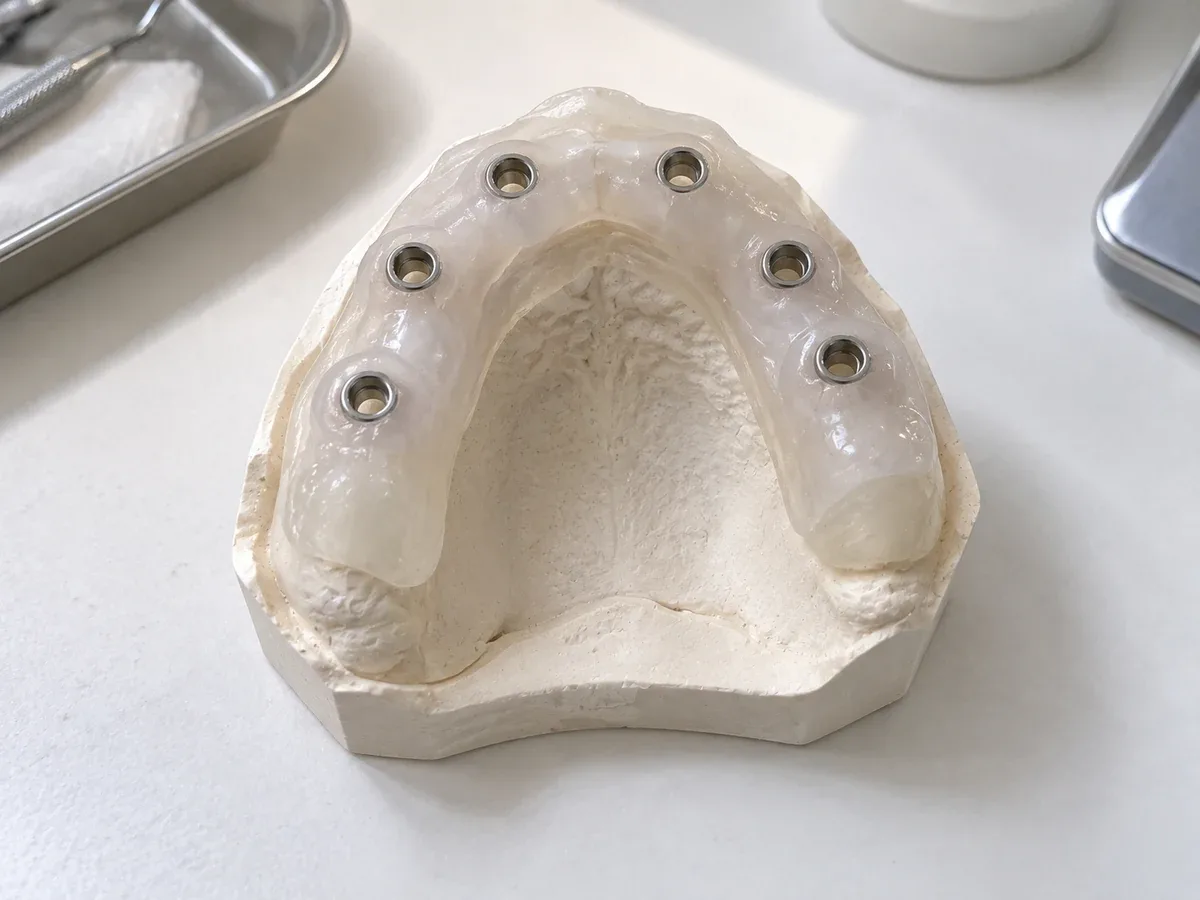
A surgical guide, revised temporary teeth and a removable screw design are hard to see from the outside. Two full-arch implant quotes can contain very different work depending on whether these steps are included.
With a full-arch implant, time is linked to the fee as well. The KDCA says treatment takes at least several months, sometimes over a year. Extraction sites need months to heal, and bonding to bone takes several more.
Meanwhile, an extra temporary denture is often made so you can eat and go about daily life. It also takes time to make, so the KDCA advises allowing plenty of time. Check whether this temporary denture is in your quote.
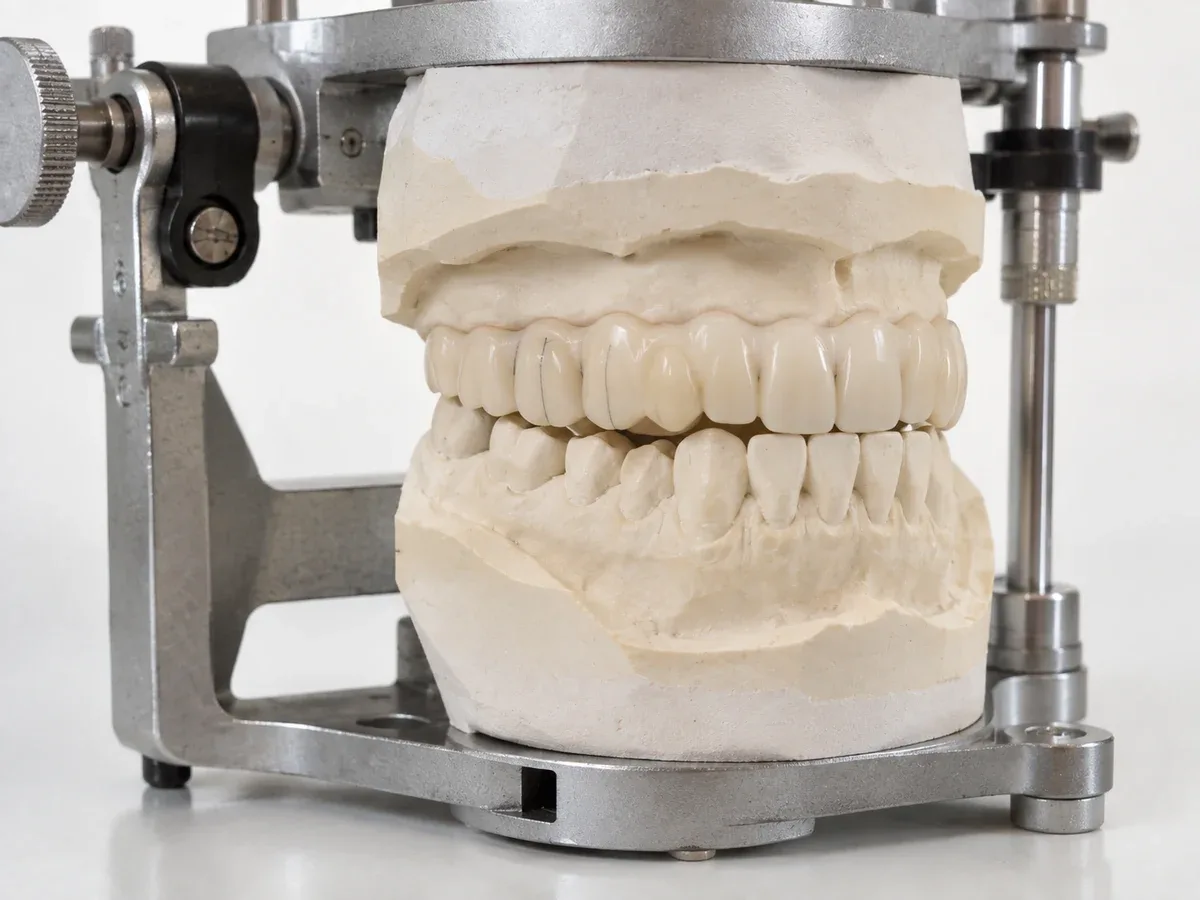
| Item | What to check |
|---|---|
| Approach | Fixed, or an overdenture |
| Number | How many implants in the upper and lower jaw |
| Extra surgery | Whether bone building or a sinus lift is included |
| Planning | Whether a surgical guide and diagnostic work are included |
| Temporary teeth | Whether fixed temporaries and their revisions are included |
| Final prosthesis | Material, number of sections, and whether it can be unscrewed |
Does the quote include care after treatment?
The KDCA's implant page says plainly that implants do not last indefinitely without care. Thorough oral hygiene and regular checkups are essential for long use.
It advises checkups every three to six months after treatment. At a checkup, inflammation around implants is treated, and the bite is checked and adjusted. Depending on the type, upper parts may be removed and cleaned.
Repairs may also be needed over time. The same page lists the following cases.
- A damaged prosthesis is repaired or remade.
- A loose screw is tightened again or replaced.
- If the implant in the bone breaks, it has to be removed.
Putting off care can lead to more treatment. Dailydental reported a 2025 presentation by the Korean Academy of Periodontology. It said 43% of implant patients had mucositis around the implant, and 22% had peri-implantitis.
In the same presentation, 89.4% of implant patients said they skipped aftercare because they felt no discomfort. The society stressed regular checkups, noting that by the time symptoms appear, the problem has often progressed.
It suggested maintenance visits every three months in the first year, then every six months depending on risk. A full-arch implant means caring for many implants together, so plan for these visits in advance.
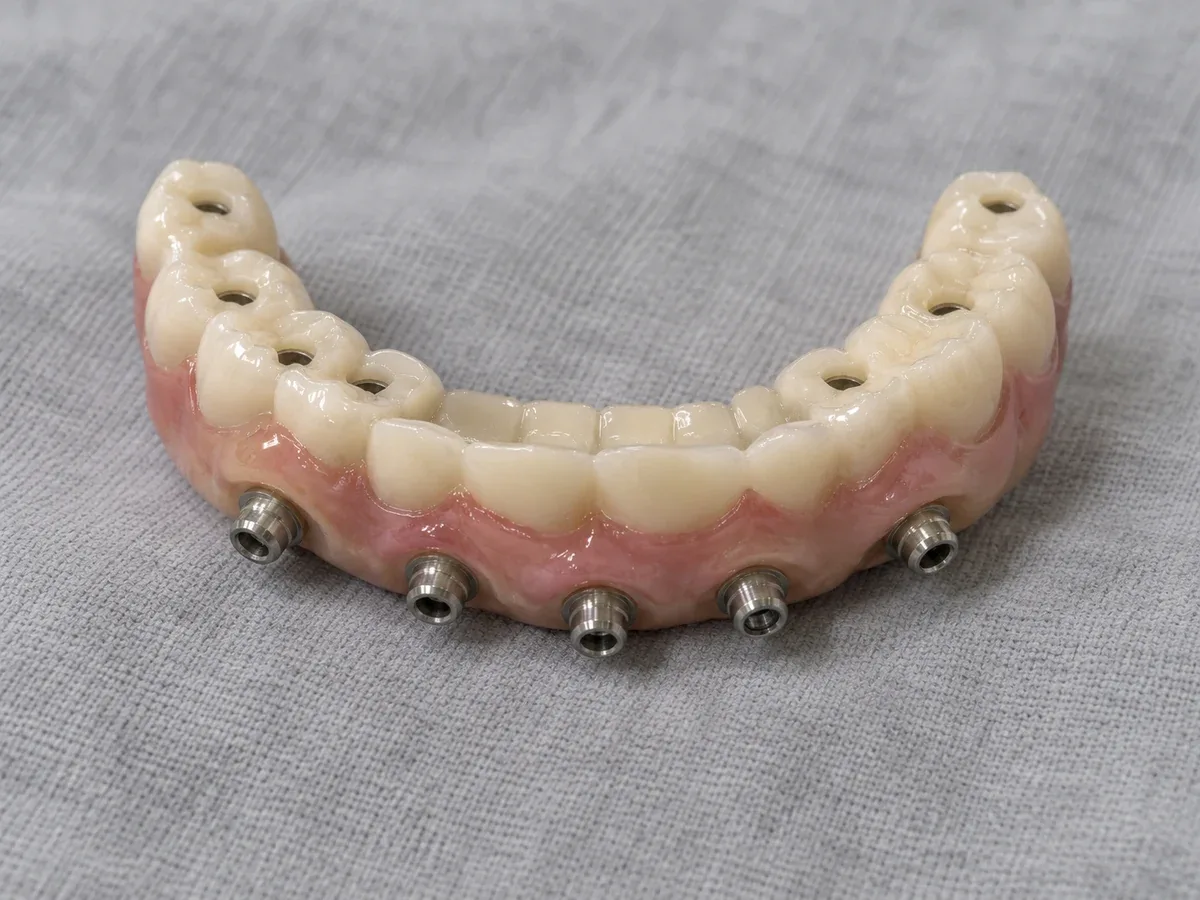
The screw-retained back sections in the case above were designed with such repairs in mind. Whether it can be unscrewed later affects the effort and cost of care after treatment.
How much checkups and repairs are included in a full-arch implant quote varies. Comparing totals alone hides these differences. At your consultation, ask separately about checkup intervals and how repairs are handled.
If an overdenture needs fewer implants, is it the better choice?
By number alone, an overdenture needs fewer implants than a fixed full-arch implant. But choosing an approach on fee alone is hard. The two feel different and need different care.
The KDCA's removable prosthesis page notes a weakness of the lower complete denture. Because of the tongue, it is less stable and less retentive than an upper one.
It also says a denture worn for a long time can come loose or feel foreign. It may end up working at about 20–30% of natural teeth.
For these reasons, an implant overdenture is often advised even though it takes more cost and time. At least two implants are placed to support the denture.
Sometimes an overdenture is the better fit. Professor Woo writes that with advanced bone loss, a fixed arch may not support the lips well. He lists severe bone loss, too little bone for enough implants, and hygiene and speech as reasons for an overdenture.
An overdenture has its own upkeep. He mentions broken clips, weaker retention and loose magnets, and says patients should be told about these in advance.
| Item | Fixed | Overdenture |
|---|---|---|
| Minimum implants | Six to eight upper, four to six lower. | Four to six upper, two to four lower. |
| Extra surgery | Sinus work almost always needed. | Difficult extra surgery not needed. |
| Severe bone loss | May not support the lips well. | Listed as a reason to choose it. |
| Upkeep | Designed for loose screws and chipped porcelain. | Broken clips, weaker retention, loose magnets. |
For a full-arch implant, the lower-cost option is not always the better one. Bone, lip support and care all need to be weighed together.
What should you ask when comparing full-arch implant quotes in Busan?
These questions come straight from the sources above. You can ask them at any clinic.
First, the approach and the number. With a full-arch implant, the number of implants depends on whether it is fixed or an overdenture. If two quotes differ in number, line that up before comparing totals.
Second, extra surgery. Ask whether bone-building surgery is needed and, if so, whether it is in the quote. HIRA also classifies it separately.
Third, the steps up to the final prosthesis. In the cases above, temporaries were revised and remade to check function. Asking how far this stage is included makes comparison easier.
Fourth, checkups and repairs after treatment. Confirm the checkup interval and how screw changes or prosthesis repairs are handled.
Fifth, insurance, if you are enrolled in national health insurance and aged 65 or over. Check whether you are partly or fully toothless, and whether the rules from January 2027 apply to you.
If you have two quotes, writing them out in this order makes comparison easier.
- Write the approach and the upper and lower implant numbers side by side.
- Mark whether extra surgery and custom parts are included.
- Copy over the temporary teeth and final prosthesis stages.
- Note the checkup and repair terms after treatment.
- Compare totals after the items match.
A single headline figure does not show these items. At Reset Dental Clinic, you are welcome to ask about each of them one by one.
Frequently asked questions
What makes one quote higher than another?
This column does not compare specific fees. In the HIRA survey, gaps came from conditions such as difficulty, extent and number. For a full-arch implant, first line up the approach, number, extra surgery and prosthesis steps on the same basis.
Will an implant overdenture be covered by insurance?
The KDA has cautioned that implant overdentures remain uncovered at every stage, even after the rules change. Please confirm this at your consultation.
Can I discuss a full-arch implant in English in Busan?
Yes. We offer 1:1 English interpretation from the first consultation through the end of treatment. The clinic is near Seomyeon Station Exit 2 (5-min walk), opposite Lotte Hotel Busan, and you can call 010-8555-2854 (+82-10-8555-2854 from abroad).
A full-arch implant quote is the sum of many steps.
The approach, the number of implants, extra surgery,
temporary teeth, the final design and aftercare
should be lined up before totals are compared.
In Seomyeon, we will go through each of these items with you. We offer 1:1 English interpretation from your first consultation through the end of treatment. Call 010-8555-2854 to book a consultation.
References
- Health Insurance Review and Assessment Service FAQ, "Insurance criteria for dental implants for people aged 65 and over" — prostheses and extra surgery for implants are uncovered; limited coverage for partly toothless older patients; custom abutments uncovered; fully toothless, zygomatic and one-piece cases uncovered
- KDA newspaper Dailydental, "After a decade of KDA effort, insurance coverage opens for implants in toothless patients" (September 9, 2026) — approval of coverage for fully toothless patients aged 65 and over from January 2027; waiting period for previous complete denture recipients; implant overdentures remain uncovered
- KDA newspaper Dailydental, "HIRA releases fee data for crowns and implants" (September 6, 2019) — sample survey of uncovered items at dental clinics; wide gaps for the same item explained by extent, tooth condition, difficulty and number of teeth; differences by region and by clinic size
- KDA newspaper Dailydental, "Professor Woo Yi-hyung's lecture: easy solutions with implant overdentures" (December 13, 2010) — a fixed full arch needs precise diagnosis and careful surgery and places a heavy burden on the patient; minimum implant numbers for fixed and overdenture options; sinus work for fixed arches; passive fit and sectioned fabrication
- Shin HH et al., "Full-mouth rehabilitation of a completely edentulous patient with fixed implant prostheses," Journal of Dental Rehabilitation and Applied Science 37(3), 2021 — surgical guide based on the final prosthesis; revised and remade fixed temporaries; screw-retained back sections and screw-cement front section
- KDCA National Health Information Portal, "Dental Implants" — number of implants and grafting decided from tests, needs, expectations and cost; implants need care to last; checkups every 3–6 months; repairs and screw replacement; insurance limits on later prosthesis care
- KDCA National Health Information Portal, "Removable Prostheses" — implants can support a denture even with severe bone loss, with extra surgery and more cost and time; treatment takes months to over a year; temporary dentures; long-used dentures work at about 20–30% of natural teeth
- Kim TH, Oh KC, Moon HS, "Full-mouth rehabilitation with implant-supported fixed prostheses in a patient with an edentulous maxilla and partially edentulous mandible," Journal of Korean Academy of Prosthodontics 57(4), 2019 — the prosthesis was made in three parts for fit, ease of cleaning and removability
- KDA newspaper Dailydental, "65% of implant patients experience peri-implant disease" (March 26, 2025) — Korean Academy of Periodontology presentation: mucositis 43%, peri-implantitis 22%, 89.4% skipping aftercare when comfortable; maintenance every 3 months in the first year, then about every 6 months by risk
Written by Reset Dental Clinic Support Team
Medical review Dr. Na In-chae, Head Dentist · Periodontics Specialist
Last updated: September 19, 2026
This column is for general information and does not replace diagnosis or treatment for individual patients. If you have symptoms, please see a dentist.


