

- For a front tooth implant, bonding to the bone is not enough. The gum line and the gum between teeth must look natural too.
- Gum follows the bone, so lip-side bone thickness and height largely set the gum line.
- The gum between teeth depends on the neighboring tooth's bone, which is very hard to restore once lost.
- Bone grafts or gum shaping may be needed, so it can take longer than a back tooth.
Losing one front tooth makes you think about it every time you smile. At our clinic in Seomyeon, Busan, the question we hear most at front tooth consultations is whether people will be able to tell. For patients living in or visiting Korea, we offer 1:1 English interpretation from the first consultation through the end of treatment.
This column sums up what makes a front tooth implant look natural, based on Korean dental journal papers and public health sources.
Why are the standards higher for a front tooth implant?
The KDCA describes the core principle of an implant as osseointegration. This is when the bone and the artificial root bond firmly and act as one. For a back tooth, this is the central goal of treatment.
A front tooth needs one more thing. A case report in the Journal of Korean Academy of Prosthodontics states that for upper front teeth, osseointegration alone is not enough. Restoring the surrounding gum and bone in an esthetic way matters just as much.
A literature review by researchers at Jeonbuk National University makes the same point. Patients see their front teeth directly and compare them with the natural teeth beside them. So the standard is higher than for back teeth.

Shape also differs. The neck of a natural upper front tooth is oval, 4.5–7 mm across. An implant is round and 5 mm or less, which makes the gum outline harder to match.
Even so, there is a reason to consider a front tooth implant when just one tooth is missing. The KDCA lists, as one indication, wanting to treat the missing tooth without grinding the natural teeth beside it. A single missing front tooth can fit this case.
Why does the gum line follow the bone?
The review describes gum as the outer image of the bone beneath it. It varies by person, but gum height usually forms about 3–4 mm above the top of the bone on the lip side.
So if a front tooth implant is placed at the level of bone that has already sunk, a problem follows. The tooth on top will look longer than the tooth beside it.
The direction of bone loss matters too. After a tooth is lost, bone is lost first in thickness, toward the lip and the palate. To place an implant of the right width, more bone building is then needed.
According to the KDCA, bone is assessed before surgery with dental CT, panoramic and intraoral X-rays. If bone is lacking, guided bone regeneration is used to encourage new bone growth.

Seoul National University Hospital lists related treatments, including bone grafting and socket preservation. It also mentions connective tissue grafts and papilla regeneration, which means bone and gum each have their own methods.
Where, and at what angle, should the implant be placed?
The review gives position standards for a front tooth implant to keep the gum from sinking. At the level of the top of the implant, at least 1.8 mm of bone should remain on the lip side.
There is also a standard seen from above. Picture a line joining the lip-side surfaces of the neighboring teeth. The outer surface of the front tooth implant should sit at least 2 mm inside that line.
Angle matters as well. The review names placement that does not tilt toward the lip as key. In thin bone, a lip-side tilt can make the gum line sit higher than on the neighboring tooth.
| Item | What the review says |
|---|---|
| Bone left on the lip side | At least 1.8 mm at the level of the top of the implant |
| Position seen from above | At least 2 mm inside the line joining the lip-side surfaces of the neighboring teeth |
| Angle | Placed without tilting toward the lip |
| Bone that cannot meet the standards | Build bone up first, or preserve the site and place the implant later |
| Placing on the day of extraction | Recommended for cases that meet conditions such as lip-side bone at least 1 mm thick |
A front tooth implant can also be placed on the same day the tooth is taken out. Seoul National University Hospital divides placement timing into three types.
| Type | When the implant is placed |
|---|---|
| Immediate placement | On the day of extraction |
| Early delayed placement | 6–10 weeks after extraction |
| Late placement | 3–6 months after extraction |
The review's author recommends immediate placement when conditions are met, such as lip-side bone at least 1 mm thick. Bone and gum height should also match the neighboring teeth.
In practice, the author adds, many cases need bone grafting or socket preservation. So we first ask whether the bone can hold it, and then how soon it can go in.
Why do dark gaps appear between teeth, and how are they prevented?
The pointed gum that fills the space between two teeth is called the interdental papilla. When this gum is lacking, a dark gap shows between the teeth.
Take the case of a single front tooth implant. The review states that the papilla height is set by the bone height on the neighboring natural tooth.
If the neighboring tooth is healthy, that bone is not easily lost. But once it is lost for any reason, it is very hard to restore.

The review also cites a study on distance. When the distance from the crown's contact point to that bone was 5 mm or less, the papilla filled the space in every case.
Placing several implants side by side changes things. The gum between two implants forms lower, at an average height of 3.5 mm.
| What | What the review says |
|---|---|
| Gum line height | Usually forms about 3–4 mm above the top of the lip-side bone |
| Papilla next to a single implant | Set by the bone height on the neighboring natural tooth |
| Contact point to bone 5 mm or less | A study found the papilla filled the space in every case |
| Between two implants | Gum forms lowest, at an average of 3.5 mm |
What are the steps for a front tooth implant in Busan?
A front tooth implant sits in the upper jaw. Seoul National University Hospital gives a healing time of at least 4–6 months for the upper jaw, and at least 2–3 months for the lower jaw.
After a bone graft, healing usually takes 6–9 months. The KDCA gives a general healing time of 3–4 months, and notes that it is longer when a bone graft is needed.
Before placement, your general health is checked first. The KDCA lists these points.
- Medicines: some heart and circulation drugs may be paused because of bleeding risk.
- Diabetes: it slows wound healing, so blood sugar control is needed.
- Osteoporosis drugs: they can interfere with bone bonding, so they may be paused or changed.
- Smoking: it is directly linked to failure, so quitting is essential.
- Decay and gum disease: these are treated before surgery.
Following the sources, the process runs roughly in this order.
- Exam: general health and medicines are checked, and bone is assessed with dental CT.
- Bone building: if bone is lacking, guided bone regeneration is done first or with placement.
- Placement: the gum is opened and the artificial root is placed, usually in about an hour.
- Healing: the bone and the artificial root are given time to bond.
- Temporary crown: the gum shape is refined while progress is watched.
- Final crown: the crown is fixed on the abutment and the bite is adjusted.
A case report in the Journal of Korean Academy of Prosthodontics shows the temporary crown stage in detail. A 47-year-old man had lost an upper front tooth to gum disease, and much of the lip-side bone was gone. The team used CT analysis and a surgical guide.
A bridge on the teeth on either side was expected to leave the left and right gum lines uneven. So the implant was placed together with bone building.
Over the next 4 months, the gum-side shape of the temporary crown was enlarged slightly, twice. The aim was to raise the papilla.
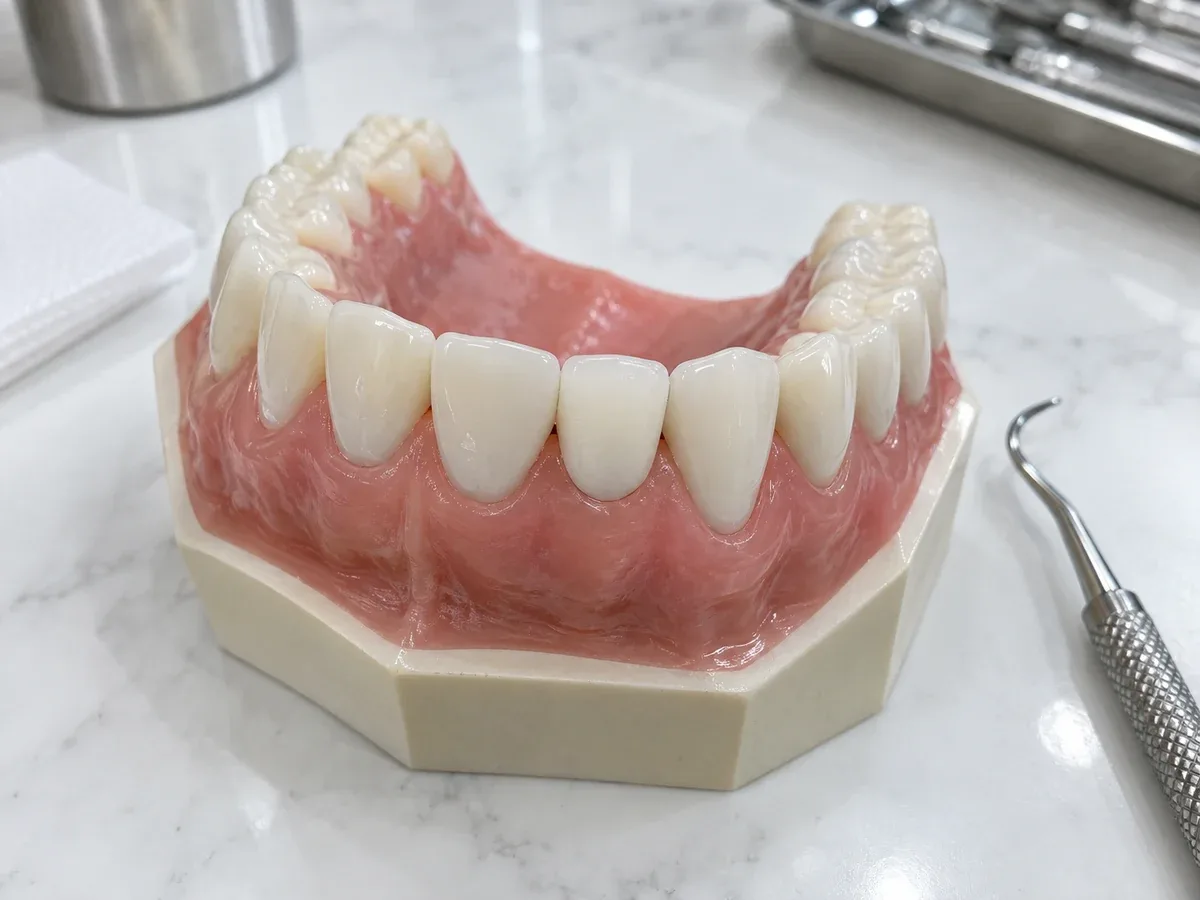
On the side with severe bone loss, however, the gum did not fully recover. The final crown's contact area was made longer to make up for it. Even in a good case, not everything returns to how it was.
The review also names adjusting a temporary crown while watching progress as a key step. But removing and replacing the abutment too often can damage gum attachment. So adjustments are kept to a minimum.
| Source | What it says |
|---|---|
| KDCA | Usually 3–4 months, longer if a bone graft is needed |
| Seoul National University Hospital | At least 4–6 months for the upper jaw, at least 2–3 months for the lower jaw |
| Seoul National University Hospital (bone graft) | Usually 6–9 months after a bone graft |
| Prosthodontics case report | The gum was reshaped twice with a temporary crown over 4 months |
How are the bite and abutment material chosen for a front tooth?
First, there is a difference in shock absorption. A paper by Jeonbuk National University researchers in the journal Implantology explains it. An implant has no periodontal ligament, so it absorbs shock less well than a natural tooth.
So for a single upper front tooth implant, the bite is made differently. It touches lightly when you bite down fully. It is better if it does not touch when you move your jaw forward or sideways.
This is because the upper front teeth overlap the lower front teeth. In this position, upper front teeth are bound to take sideways force.
The paper stresses that the bite can change over time, as neighboring and opposing teeth may shift. So the bite should be checked at regular visits and readjusted if needed.
For a front tooth implant, the abutment material also needs thought. The prosthodontics case report noted that the gum was thin enough for metal to show through. So a zirconia abutment was used.
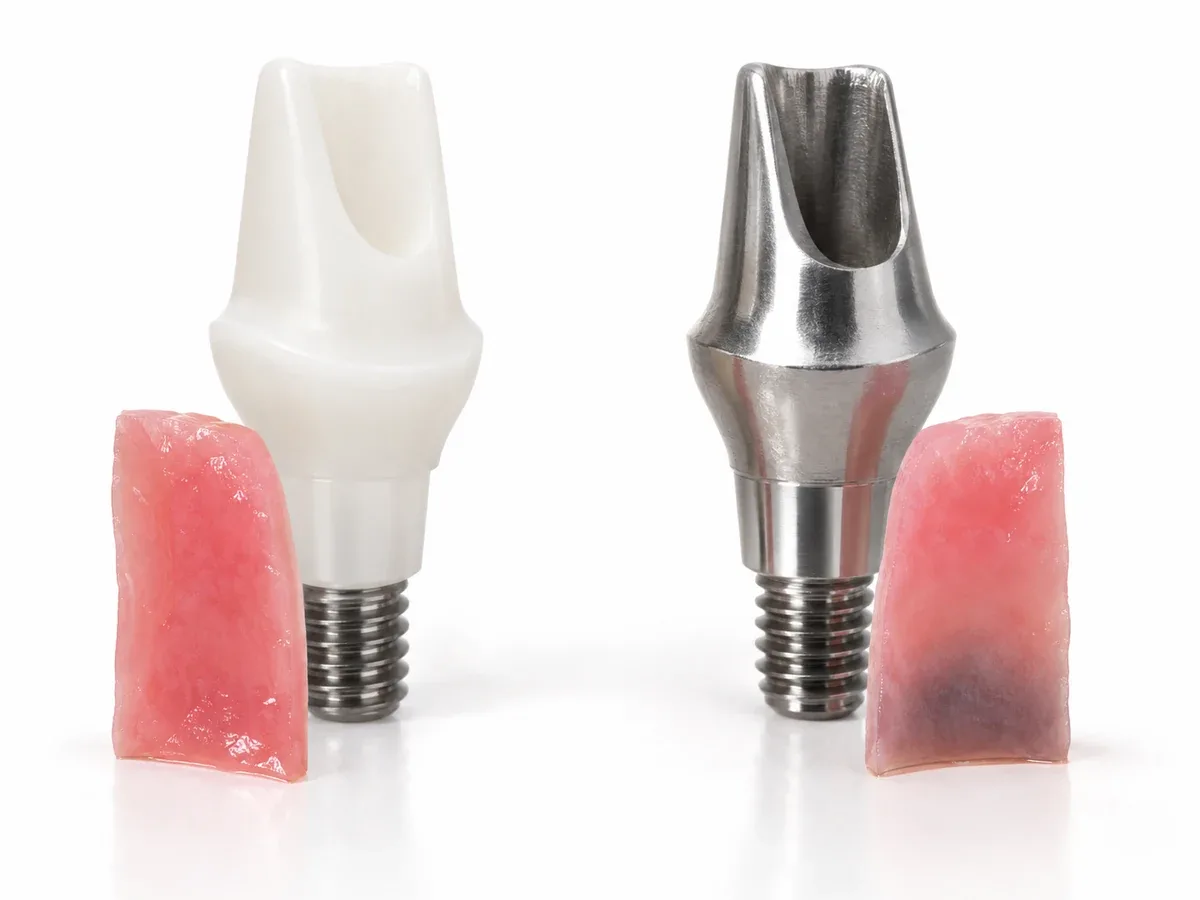
The KDCA lists crown fracture as a complication. Biting hard or tough food sends force down into the implant in the bone, and the crown or implant can break. So the KDCA gives this advice:
- The first year is when the bone stabilizes, so start with soft foods.
- Avoid hard or tough foods where possible.
- Chew evenly on both sides rather than on one side.
- If you grind or clench your teeth, talk to your dentist.
Do the gums need watching after the crown is placed?
The natural look of a front tooth implant does not end on the day the crown goes in. The review notes that bone building can reduce blood flow to the gum. In that case, the gum can shrink regardless of the bone beneath.
A gum graft can then be considered. It is expected to add up to about 1.5 mm of thickness and raise the gum line by up to about 1 mm. But if the cause is lack of bone, the plan should focus on building bone instead.
The KDCA states that implants do not last forever. It advises a check-up every 3–6 months after treatment. Because the gaps between teeth are wider, floss and interdental brushes are essential.
There is also a warning about peri-implantitis. Even when bone is badly damaged, the implant may not move, so treatment is often delayed. If you notice any of these changes, please have them checked without delay.
- The front tooth looks slightly longer than the one next to it.
- The gum seems to have pulled back, a sign of gingival recession.
- The tooth or abutment feels loose.
- The surrounding gum stays swollen or shows pus.
Frequently asked questions
Will people be able to tell I have a front tooth implant?
The papers explain that results depend on bone and gum condition, position and the temporary crown stage. The process and result can differ between enough bone and gum and bone that has already shrunk a lot. That is why we check with an exam first.
What if a dark gap shows beside my front tooth implant?
If bone height remains on the neighboring tooth, the gum is shaped with a temporary crown, and the contact area may be adjusted. If that bone is already gone, we plan knowing it is hard to restore fully.
Can I get this treatment in English in Busan?
Yes. We provide 1:1 English interpretation from the first consultation through the end of treatment. The clinic is near Seomyeon Station Exit 2 (5-min walk), opposite Lotte Hotel Busan, and you can call 010-8555-2854 (+82-10-8555-2854 from abroad).
A natural-looking front tooth implant starts with the bone and gum beneath it.
We look at the bone and gum first,
then decide together whether to build bone
and when to place the implant.
If you are considering a front tooth implant in Busan, Reset Dental Clinic offers 1:1 English interpretation from your first consultation through the end of treatment. Call 010-8555-2854 to book a consultation.
References
- Park Yeon-hee, Ahn Seung-geun, Kim Kyung-a, Seo Jae-min, "Surgical and Prosthetic Considerations for Soft Tissue Esthetics of Anterior Implants," Journal of Dental Rehabilitation and Applied Science 37(4), 2021 — higher standards for front implants because they are compared directly with natural teeth; oval natural tooth necks versus round implants; bone lost first in thickness; gum height about 3–4 mm above the lip-side bone; the 1.8 mm and 2 mm position standards and avoiding a lip-side tilt; conditions for immediate placement; papilla height set by the neighboring tooth's bone; the 5 mm contact-point study and 3.5 mm between implants; temporary crowns and the effect of frequent abutment removal; gum grafts versus bone building; retightening loose screws and keeping crown edges from sitting too deep
- Kang Hyun et al., "Esthetic Restoration of a Single Implant in the Maxillary Anterior Region: A Case Report," Journal of Korean Academy of Prosthodontics 56(4), 2018 — why osseointegration alone is not enough for an upper front implant; a case of a 47-year-old man with bone building, CT analysis and a surgical guide; gum reshaping twice with a temporary crown over 4 months; a longer contact area where the papilla did not fully recover; a zirconia abutment for thin gum
- Jeon Bo-seul et al., "Possibilities and Limits of Natural-Tooth-Like Occlusion in Implant Fixed Prostheses," Implantology, 2018 — weaker shock absorption without a periodontal ligament; a light contact in full bite and no contact in forward and side movements for a single upper front implant; regular check-ups and bite adjustment as neighboring teeth shift
- KDCA National Health Information Portal, "Dental Implants" — osseointegration as the core principle; healing usually 3–4 months and longer with bone grafts; dental CT, panoramic and intraoral X-rays; guided bone regeneration; implants do not last forever; check-ups every 3–6 months; floss and interdental brushes as essential
- Seoul National University Hospital, "Dental Implants" — placement timing (immediate, 6–10 weeks and 3–6 months after extraction); related treatments such as bone grafting, socket preservation, connective tissue grafts and papilla regeneration
Written by Reset Dental Clinic Support Team
Medical review Dr. Na In-chae, Head Dentist · Periodontics Specialist
Last updated: September 19, 2026
This column is for general information and does not replace diagnosis or treatment for individual patients. If you have symptoms, please see a dentist.


