

- Jawbone where teeth are missing shrinks over time, notes Korea's national health portal. When the loss is severe, planning a full-arch implant can become complicated or limited.
- If bone is lacking, it can be rebuilt with a bone graft first. Seoul National University Hospital also lists distraction osteogenesis, ridge split and sinus floor elevation.
- A lecture in Dailydental notes that sinus lifts and short, wide implants made the back of the upper jaw easier to treat.
- Even when bone loss rules out fixed teeth, a denture supported by a few implants remains an option. A CT scan of the bone comes first.
Many patients come to us after being told they do not have enough bone for a full-arch implant. This is more common among people who wore dentures for years or lost teeth to gum disease. At Reset Dental Clinic in Seomyeon, Busan, patients can have 1:1 English interpretation from the first consultation through the end of treatment.
This column sets out the options when bone is short, using public sources. We draw on KDCA National Health Information Portal pages on dental implants and on removable prostheses. We also use implant pages from Seoul National University Hospital and Asan Medical Center, plus a Dailydental lecture on implants for toothless jaws.
Why does jawbone shrink after teeth are lost?
The KDCA page on removable prostheses explains that the alveolar bone in areas without teeth shrinks over time. The alveolar bone is the part of the jaw that holds the teeth.
For that reason, a denture that fit well at first can gradually stop fitting a few years later. Many long-term denture wearers know this change well.
Asan Medical Center gives a similar warning. If a gap left by a lost tooth is not treated, ongoing bone loss can cause esthetic and functional problems.
The same KDCA page notes that implants made fixed teeth possible for people without teeth. However, when bone loss is severe, the treatment plan can become complicated or limited.
In other words, the longer the bone shrinks, the more planning a full-arch implant needs. That is why the first step is to see how much bone is left.

How is bone measured before a full-arch implant in Busan?
The KDCA dental implant page describes three kinds of images. They are a dental CT scan, which shows the bone in 3D, a panoramic X-ray and intraoral X-rays.
These images give information about the bone. Based on the results, the following decisions are made.
- whether a bone graft is needed
- which type of implant to use
- the size and length of each implant
- how many implants to place for the full-arch implant
Bone quantity is not the whole story. The same page lists low bone density as one cause of failed fusion between bone and implant. Infection right after surgery, poor oral hygiene and smoking are also on that list.
Medication matters too. Osteoporosis drugs or injections that interfere with this fusion should be stopped or replaced. Diabetes slows wound healing, so blood sugar needs to be under control.
Asan Medical Center adds that surgery may not be possible with uncontrolled diabetes or during chemotherapy or radiation therapy. Yet it also notes that when a condition is mild or well controlled, treatment may be possible after careful diagnosis.
This is why we ask you to tell us about every medicine you take. For patients visiting Korea from abroad, bringing the names of your medicines and recent blood sugar results makes this step smoother.
| Factor | What the sources say |
|---|---|
| Low bone density | Listed as a cause of failed fusion between bone and implant (KDCA) |
| Osteoporosis drugs or injections | Should be stopped or replaced if they interfere with fusion (KDCA) |
| Diabetes | Blood sugar control is needed because diabetes slows healing (KDCA) |
| Uncontrolled diabetes, chemotherapy or radiation therapy | Surgery may not be possible, but may be possible after careful diagnosis if mild or well controlled (Asan Medical Center) |
| Smoking, poor hygiene, infection | Listed as causes of failed fusion (KDCA) |
How can bone be rebuilt for a full-arch implant?
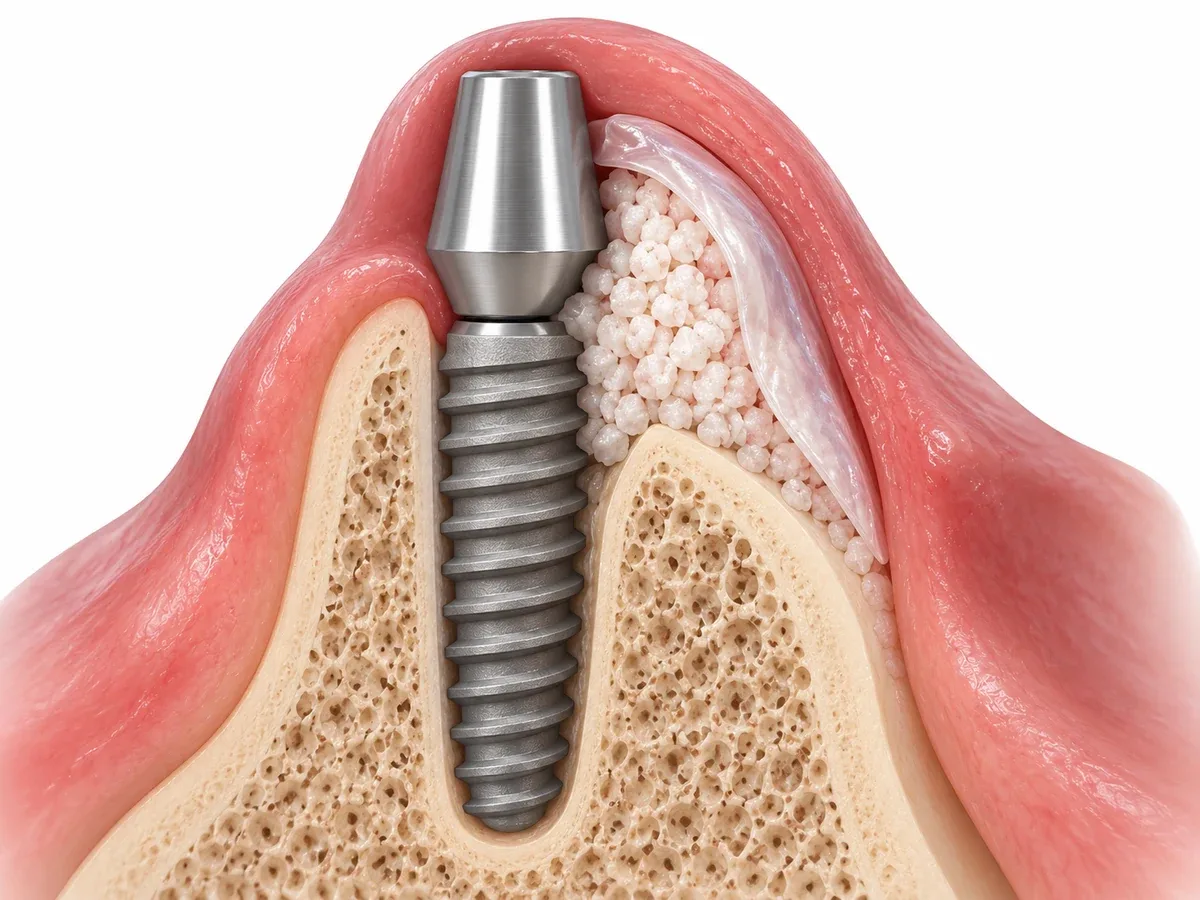
When there is not enough bone to hold an implant, the KDCA page describes guided bone regeneration (GBR). This technique guides new bone to grow where it is missing.
Graft material acts as a scaffold while the bone regrows. The page lists four kinds of graft material.
- autogenous bone, taken from your own body
- allograft, bone from a human donor
- xenograft, bone from another species
- synthetic bone
In the procedure, the gum is opened, the graft is placed in the defect and the gum is stitched closed. It is usually done before the implant is placed, but sometimes at the same time, depending on the case.
Seoul National University Hospital describes implant treatment as placing implants in jawbone that can fully surround them. When needed, the bone is first enlarged with extra surgery such as bone grafting or distraction osteogenesis.
The hospital lists these related treatments.
- bone grafting
- guided bone regeneration
- distraction osteogenesis
- ridge split
- alveolar ridge expansion
- socket preservation after extraction
- sinus floor elevation
The long list has a reason. The method is chosen according to the shape of the bone loss.
For a full-arch implant, the trade-off is time. According to Seoul National University Hospital, healing usually takes 6 to 9 months after a bone graft. If the bone is weak, it can take 1 to 2 months longer.
| Item | What the sources say |
|---|---|
| Guided bone regeneration (GBR) | The gum is opened, graft material is placed in the defect and the gum is stitched; usually done before placement |
| Graft materials | Autogenous bone, allograft, xenograft and synthetic bone |
| Related treatments (Seoul National University Hospital) | Distraction osteogenesis, ridge split, alveolar ridge expansion, socket preservation, sinus floor elevation and others |
| Healing time | Usually 6 to 9 months after a bone graft, and 1 to 2 months more if the bone is weak |
Why is the upper back jaw harder for a full-arch implant?
Above the upper back teeth sits the maxillary sinus, an air-filled space connected to the nose. As the bone shrinks, the bone between this space and the mouth grows thinner.
In 2010, Professor Woo Yi-hyung wrote a lecture published in Dailydental. He noted that early implants for toothless jaws were placed mostly in front of the sinus, with short bridges on top.
He also wrote that the back teeth later became easier to reach. This came from advances in surgery such as the sinus lift and the development of short, wide implants.
Complications of upper jaw work for a full-arch implant need to be explained as well. The KDCA page notes that upper jaw treatment can cause new sinusitis or make existing sinusitis worse.
If sinusitis develops, antibiotics are taken. In severe cases, the implant is removed.
Seoul National University Hospital adds one more point. If the sinus and the mouth become connected during a sinus graft or drilling, pain may occur, but it is usually temporary.

| Complication | When it can happen | What the sources say |
|---|---|---|
| New or worse sinusitis | Treatment in the upper jaw | Antibiotics; removal of the implant in severe cases (KDCA) |
| Pain | When the sinus and mouth connect during grafting or drilling | Usually temporary (Seoul National University Hospital) |
| Jaw fracture | Placement in a thin lower jaw | Very rare; avoid hard foods until healing is complete (Seoul National University Hospital) |
Can a full-arch implant use the bone you already have?
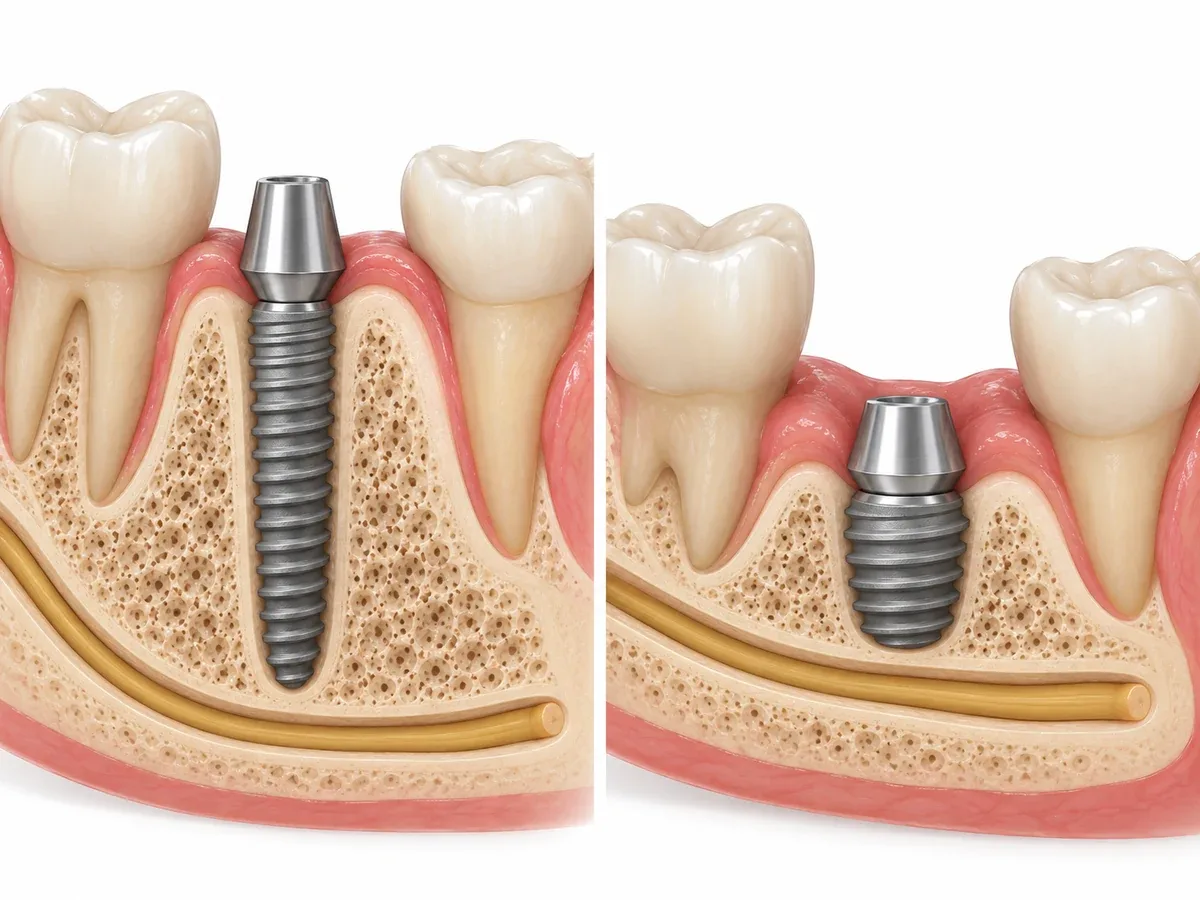
Not every full-arch implant case requires building new bone. The same lecture notes that short, wide implants were developed for sites without enough length inside the bone.
Where bone height is short, an implant that is wider instead of longer may be considered. The aim is to work with the bone that is already there.
Seoul National University Hospital also mentions a method used less often. Among implants that pass through bone, some in the upper jaw are placed in the cheekbone.
Subperiosteal implants are a different story. They place a metal frame on top of the bone when jaw volume is small, but the source says long-term results were poor, so they are rarely used today.
The weight of evidence differs from method to method. We explain this openly when we go through the options for a full-arch implant.
Placing implants in thin bone also needs care. The same source says that, though very rare, a jaw fracture can occur when implants are placed in the lower jaw, especially when the bone is thin.
For that reason, we ask patients to avoid hard foods until healing is complete. This keeps unnecessary strain off the jaw.
What if a fixed full-arch implant is not possible?
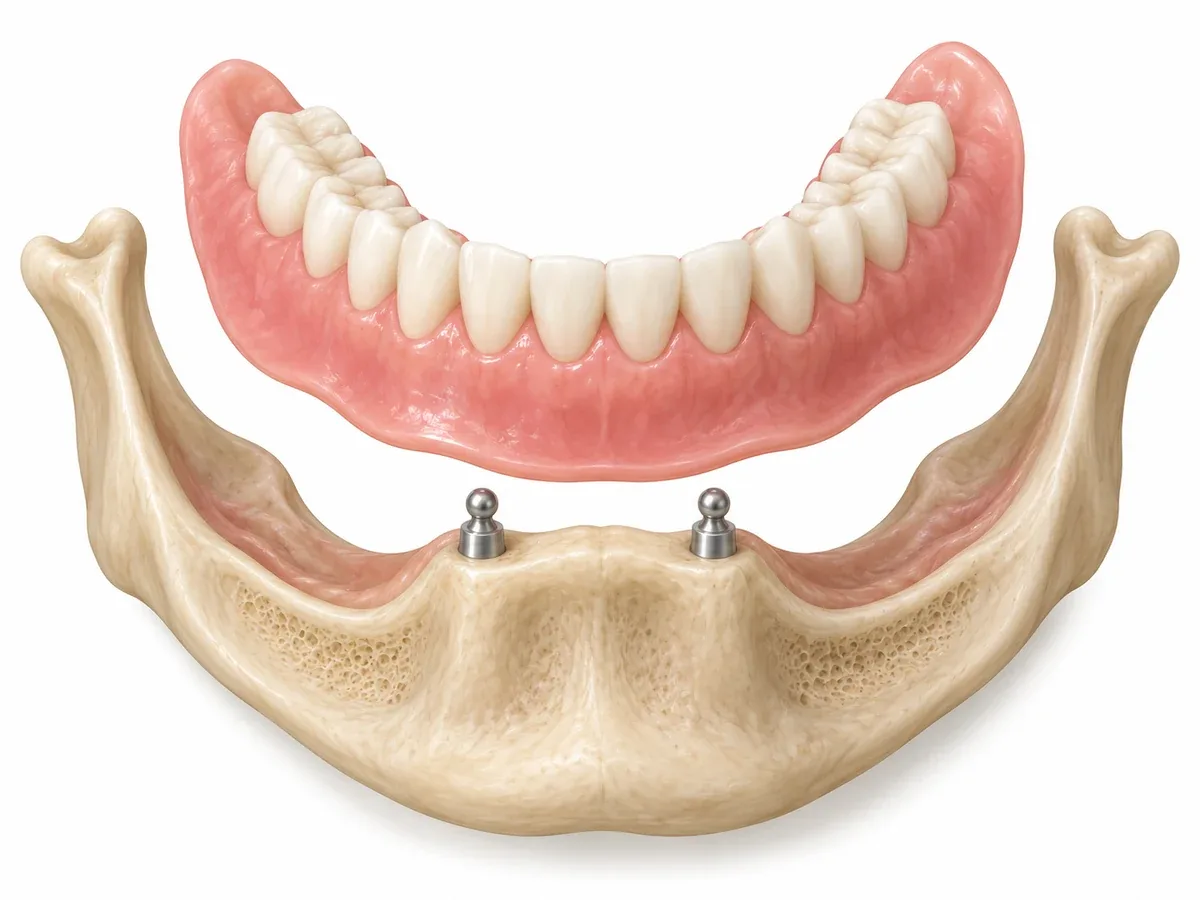
When bone loss is severe, insisting on fixed teeth can make things harder. The lecture lists severe bone loss as a reason to consider an overdenture, a denture held in place by implants.
It is also suited to cases where placing enough implants for fixed teeth is difficult. The lecture gives several reasons for this approach.
- Implants need to go into areas with enough bone, and nowhere else.
- The implants do not have to be parallel to each other.
- Difficult extra surgery is usually not needed.
- With advanced bone loss, fixed teeth often struggle to support the lips.
The KDCA page points in the same direction. Even when fixed implant teeth are hard to achieve, a denture on a few implants can feel secure and comfortable.
It also lists a downside. Extra surgery is needed, and treatment takes longer.
The same page lists a removable denture as another alternative when bone loss makes implants hard to place. Whether a fixed full-arch implant or an overdenture fits you is decided after a CT scan.
| Option | What the sources say |
|---|---|
| Sinus lift | Advances in surgery made the back teeth easier to reach (2010 lecture) |
| Short, wide implant | Developed for sites without enough length inside the bone |
| Placement in the cheekbone | Listed for the upper jaw among implants that pass through bone |
| Subperiosteal implant | Rarely used today because long-term results were poor |
| Implant overdenture instead of a fixed full-arch implant | Placement in areas with enough bone is sufficient (lecture); needs extra surgery and more time (KDCA) |
Frequently asked questions
I was told I do not have enough bone for a full-arch implant. Is there still a way?
The sources list several methods for low bone, such as guided bone regeneration, distraction osteogenesis, ridge split and sinus floor elevation. They also describe dentures supported by a few implants. Which option fits you can be discussed after a CT scan checks the height, width and density of your bone.
Can I be sedated for larger surgery?
Seoul National University Hospital says sedatives before surgery, laughing gas or sedation can help patients relax. For extensive surgery, such as when bone grafting or jaw reshaping is combined, general anesthesia may be used. In that case, you must not eat for 6 hours before surgery.
I take osteoporosis medication. What should I do?
The KDCA page says osteoporosis drugs or injections that interfere with fusion should be stopped or replaced. Please do not stop them on your own. Bring the names of your medicines so they can be discussed with the doctor who prescribed them.
Can I get full-arch implant treatment in English in Busan?
Yes. We offer 1:1 English interpretation from the first consultation through the end of treatment. The clinic is near Seomyeon Station Exit 2 (5-min walk), opposite Lotte Hotel Busan, and you can call 010-8555-2854 (+82-10-8555-2854 from abroad).
Less bone does not always rule out a full-arch implant.
Bone can sometimes be rebuilt,
the bone that remains can sometimes be used,
and a denture on a few implants is another path.
If you are considering a full-arch implant in Busan, Reset Dental Clinic offers 1:1 English interpretation from your first consultation through the end of treatment. Call 010-8555-2854 to book a consultation, and bring a list of your medicines.
References
- KDCA National Health Information Portal, "Dental Implants" — dental CT, panoramic and intraoral X-rays used to decide on bone grafting and on implant type, size, length and number; guided bone regeneration with autogenous bone, allograft, xenograft or synthetic bone, usually before placement; longer healing when grafting is needed; stopping or replacing osteoporosis drugs and controlling blood sugar; causes of failed fusion; sinusitis after upper jaw treatment and how it is managed
- KDCA National Health Information Portal, "Removable Prostheses" — alveolar bone in toothless areas shrinks over time so dentures loosen; severe bone loss can complicate or limit implant plans; removable dentures as an alternative when implants are hard to place; dentures on a few implants can feel secure even when fixed implant teeth are difficult, with extra surgery and a longer treatment period
- Seoul National University Hospital Medical Information, "Dental Implants" — implants placed in jawbone enlarged by grafting or distraction osteogenesis; related treatments including ridge split, ridge expansion, socket preservation and sinus floor elevation; subperiosteal implants now rarely used; cheekbone placement in the upper jaw; healing of 6–9 months after grafting; temporary pain from sinus connection; rare jaw fracture in thin lower jaws; sedation and general anesthesia with 6 hours of fasting
- Asan Medical Center, "Implant Surgery" — ongoing bone loss when missing teeth are left untreated; longer surgery time with bone grafts or sinus lifts; surgery may not be possible with uncontrolled diabetes or during chemotherapy or radiation therapy, but may be possible after careful diagnosis when the condition is mild or well controlled
- Dailydental (Korean Dental Association newspaper), Professor Woo Yi-hyung's lecture, "Simple Solutions for Implant Overdentures" (2010) — early implants for toothless jaws were placed in front of the sinus, and sinus lifts and short, wide implants made the back teeth easier to reach; overdentures for severe bone loss, placed where bone is sufficient without the need for parallel implants or difficult extra surgery; limits of fixed teeth in supporting the lips after advanced bone loss
Written by Reset Dental Clinic Support Team
Medical review Dr. Na In-chae, Head Dentist · Periodontics Specialist
Last updated: September 19, 2026
This column is for general information and does not replace diagnosis or treatment for individual patients. If you have symptoms, please see a dentist.


