

- For patients in Busan considering a full-arch implant: the jawbone where teeth are missing shrinks over time. The KDCA notes that a well-fitting denture can stop fitting a few years later.
- Lip support, how well the lips are held out, depends on the shape of the remaining bone and the gum-side contour of the front teeth, according to a published case report.
- A prosthodontics professor has written that when bone loss is advanced, a fixed bridge alone may not restore lip support well enough.
- In the published full-arch cases, lip support and bite height were checked and adjusted with temporary teeth before the final teeth were made.
At consultations in Seomyeon, Busan, patients often ask whether a full-arch implant will change the way their mouth and face look. It can, and the direction differs from person to person, so this column uses published cases to explain what shapes your lips. For patients living in or visiting Korea, we provide 1:1 English interpretation from your first consultation through the end of treatment.
Why does the mouth area change after teeth are lost?
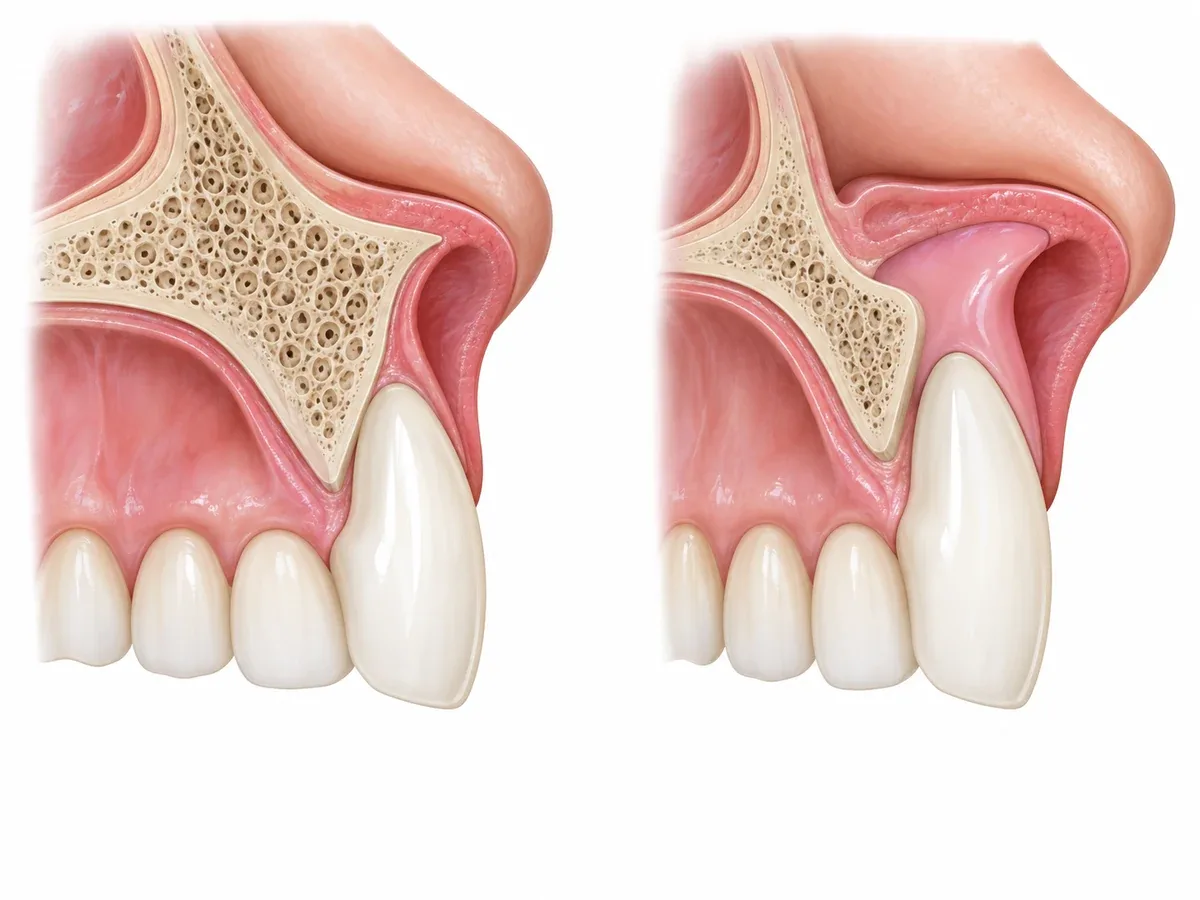
The jawbone that holds the teeth is called the alveolar bone. The Korea Disease Control and Prevention Agency (KDCA) explains on its health portal that where teeth are missing, this bone is gradually absorbed over time. That is why a denture that fitted well at first can stop fitting a few years later.
The bone keeps changing shape even if the denture itself is not worn or broken. For this reason, the KDCA says dentures need regular checkups, adjustment and, at some point, replacement.

Asan Medical Center in Seoul also describes what happens after tooth loss. If nothing is done, bone keeps shrinking and problems with appearance and function can follow. The KDCA adds that delaying treatment can let the remaining teeth drift, which makes treatment more complex.
The KDCA lists these changes as bone shrinks.
- A denture that once fitted well stops fitting after a few years.
- The gums recede, and a gap can open between the denture and the gums.
- Irritation can cause soreness.
- If bone loss is severe, implant planning can become more complex or limited.
People who have worn dentures for a long time sometimes say their mouth looks more sunken than before. In that case, we first check whether the foundation under the teeth has changed, not just the teeth.
This change is also the starting point for planning a full-arch implant. How much bone has been lost decides how the lips can be supported.
What actually supports the lips?
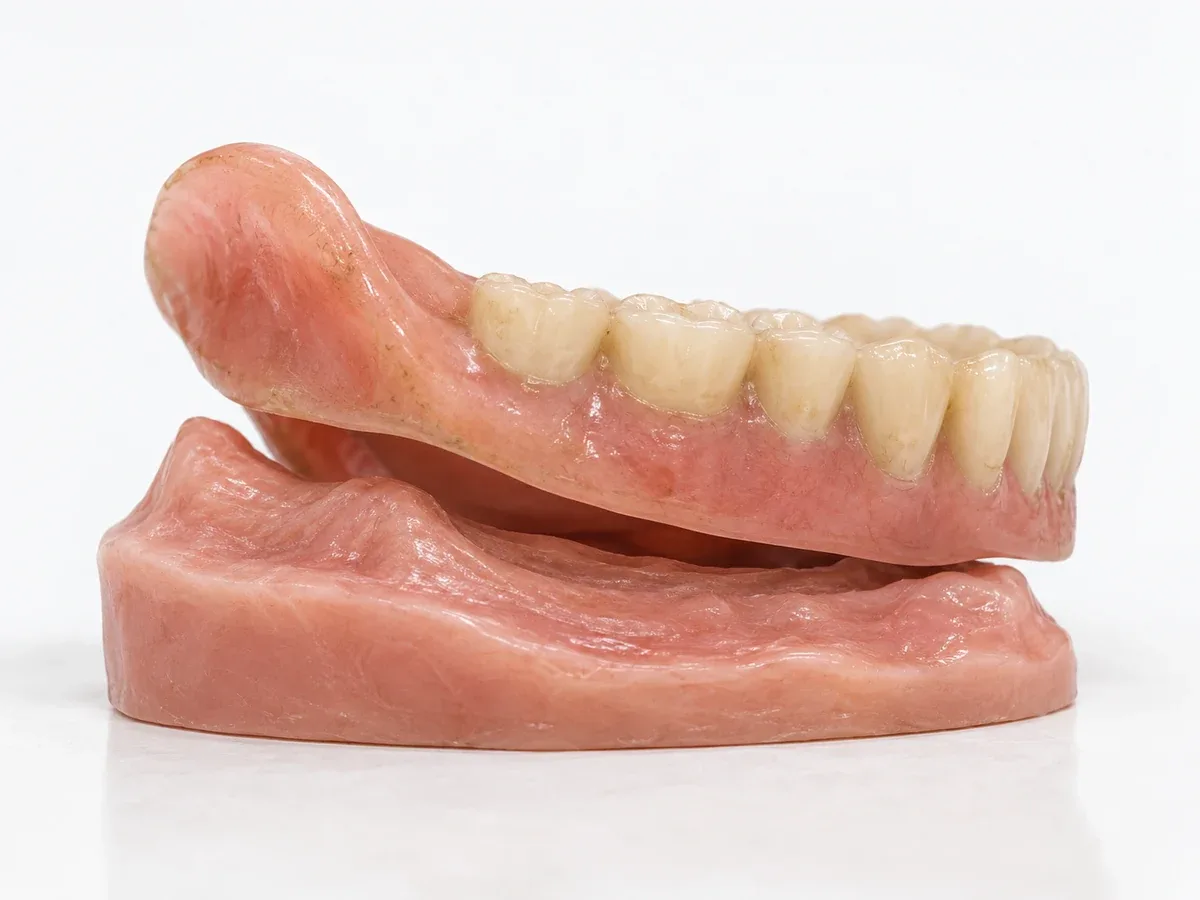
The prosthodontics department of Asan Medical Center published a full-arch implant case report in a Korean dental journal. The degree to which the lips are held out is called lip support. The report explains that it is set by the shape of the remaining bone and the gum-side contour of the front teeth.
Moving the front teeth forward, or making their gum-side contour fuller, can restore lost lip support to some degree.
Things change when there is a large gap between where the front teeth should sit and where the bone is. The authors write that proper lip support may then be possible solely with a removable prosthesis that has a gum-side flange.
The authors stress that bone quantity, bone quality and lip support all need to be assessed. The lip line, the height of the lips when smiling or speaking, is checked as well.
| Factor | What the report says |
|---|---|
| Shape of the remaining bone | One of the factors that decide lip support |
| Gum-side contour of the front teeth | Making it fuller can restore lost support to some degree |
| Position of the front teeth | Moving them forward can increase lip support |
| Large gap between tooth position and bone | Support may be possible solely with a removable prosthesis with a flange |
So in this case, planning started with the lips. The steps were as follows:
- After the extractions, artificial teeth were set up and tried in to assess lip support.
- Four months after extraction, lip support and bite height were decided first.
- The artificial teeth were arranged to match that height.
- That arrangement was used to make a surgical guide, and a CT scan was taken.
- The CT scan set the position and number of implants, which were placed through the guide.
The final plan was nine implants in the upper jaw and eight in the lower jaw. Bone grafting was also done at a few sites near the front teeth.
In a full-arch implant plan, the implant positions follow the planned smile, not the other way round.
If much bone is lost, is a fixed full-arch implant enough?
In 2010, Professor Woo Yi-hyung, then head of Kyung Hee University Dental Hospital, wrote a lecture article for the Korean Dental Association's newspaper. It looks closely at cases with advanced bone loss. He wrote that he often sees cases where a fixed prosthesis cannot improve lip support enough.
A fixed full arch needs precise diagnosis and careful surgery, and it is a bigger commitment overall. In his view, insisting on a fixed option often leads to poorer results.
He also summarizes earlier follow-up studies. At first, fixed prostheses are rated highly, partly for psychological reasons. Over time, many reports find the preference gap between the two types disappears.
A denture held in place by implants is called an overdenture. The article lists conditions where an overdenture may have the advantage.
- Severe loss of jawbone.
- Too little bone to place enough implants.
- Hygiene and speech need to be considered.
- The face needs support from the outside of the gums (facial support).
- A high lip line, where the lip rises high when smiling.
Where the jaw relationship and overall soft-tissue support are a concern, he adds, an overdenture can also look better. The actual choice is made by looking at your current bone and the type of treatment you want.
He writes that an overdenture that also rests on the gums can work with two to four implants. In his view, after a while it becomes hard to feel a difference in function from a fixed option, and the appearance is easier to restore.
| Item | Fixed | Overdenture |
|---|---|---|
| Minimum number of implants | Six to eight upper, four to six lower. | Four to six upper, two to four lower. |
| Lip support | Often hard to improve when bone loss is advanced. | Helpful when the face needs outer support. |
| Implant layout | Parallel and evenly spread implants matter. | Parallel placement is less critical. |
| Satisfaction | Rated highly at first, partly for psychological reasons. | Many reports say preference evens out over time. |
How does bite height change the lower face?
In the Asan case, a 50-year-old patient had artificial teeth tried in after extraction. The result was assessed as moderate loss of lip support. The team decided to test with temporary teeth whether a fixed prosthesis could restore that support.
After a month with the first fixed temporaries, the patient said the front teeth looked sunken and the face looked short. The patient's feeling about their mouth had become a clear, specific comment.
The team moved the upper front teeth 2 mm forward to add lip support. They also raised the bite height, called the vertical dimension, slightly and made a second set of temporaries.
The shape the patient was happy with was copied into the final teeth. After the final teeth, the patient was reported to be satisfied with lip support, chewing and speech.
Higher is not always better. A Yonsei University case report on speech notes that a bite height set too high in a denture can cause problems with lip sounds. The authors say it is important to check that the patient can close their lips comfortably.
That is why form and function are adjusted together. With a full-arch implant, the length of the lower face affects appearance, speech and chewing all at once.

How are the teeth lined up with the face?
The prosthodontics department at Yonsei University College of Dentistry reported an upper full-arch implant case. For about two months after extraction, the patient wore a temporary denture while lip support was reassessed.
With a denture-style flange at the front, the lip was pushed out too far. This was listed as one reason a fixed option was chosen. It shows that bone loss does not always lead to sunken lips.
A 3D face scan was used to design the final teeth. The midline of the upper front teeth was set using the groove above the upper lip and the smile line. The front teeth were then designed to suit that smile line.
With full-arch implant treatment, the look of the mouth is not decided by the teeth alone. Bone, lips, bite height and the reference lines of the face are all looked at together.
The cases in this column each describe one patient. Read them as examples of what gets checked, not as a reason to expect the same result.
Will the shape of the mouth stay the same after treatment?
The KDCA notes that the bone keeps changing shape while a denture is worn. That is why dentures need regular checkups, adjustment and replacement.
A fixed full-arch implant also needs ongoing care after it is fitted. The KDCA's dental implant page advises checkups every three to six months even after treatment is finished.
According to the same page, a checkup includes the following:
- Checking how the upper and lower teeth meet, and adjusting if anything has changed.
- Treating any inflammation around the implants.
- Depending on the implant type, removing and cleaning the upper parts.
In the Asan case, the patient came back every three months for hygiene care after the final teeth. The patient was taught to wear a night guard during sleep. No porcelain chipping was seen during six months of follow-up.
The shape of your mouth is not fixed once and for all on the day the teeth go in. Watching the bite, gums and prosthesis over time helps keep the look of a full-arch implant.
How is the mouth area checked when planning a full-arch implant in Busan?
Taken together, these sources point to three main steps. See how much bone has been lost, decide what will support the lips, and then check it in person with temporary teeth.
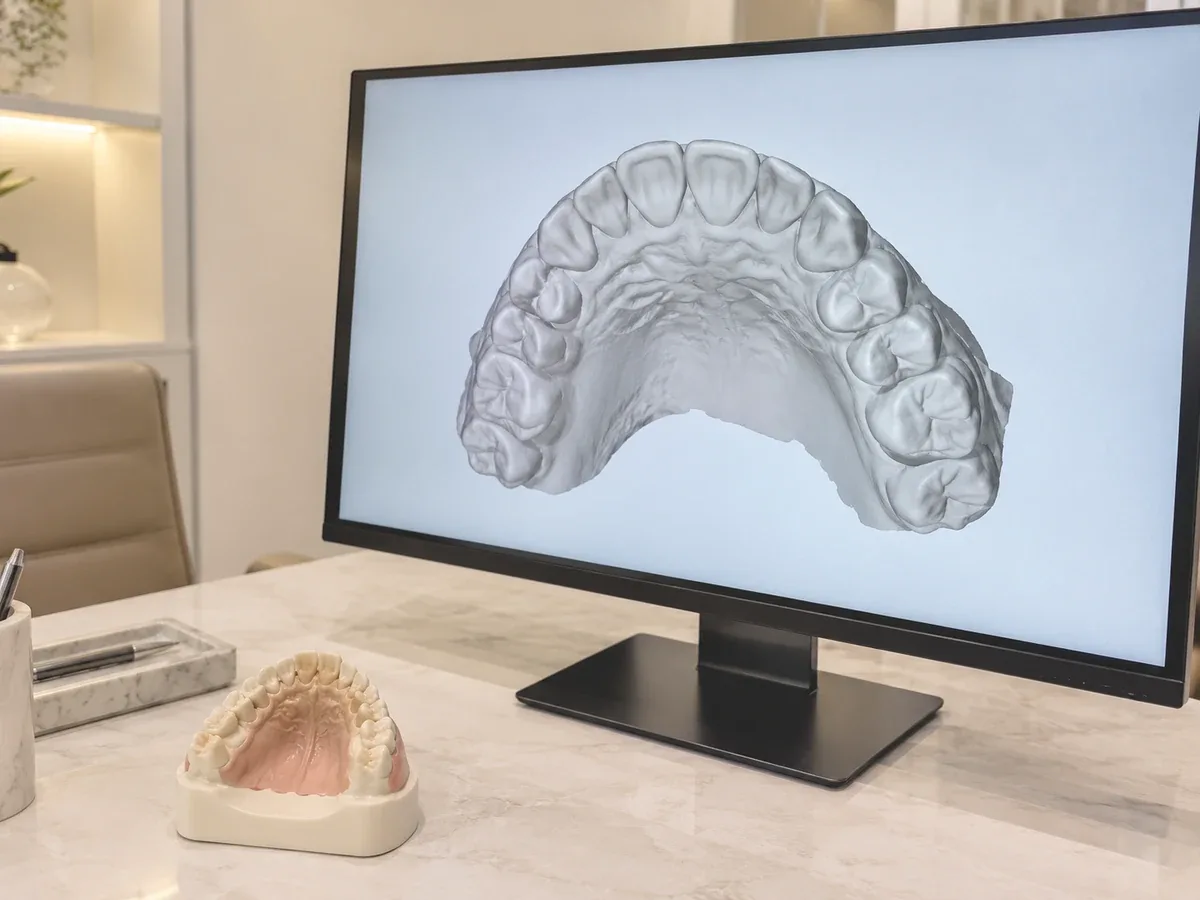
The first step of full-arch implant planning is a CT scan and study models. These show the gap between where the front teeth should be and where the bone is. If the gap is large, fixed and overdenture options are weighed side by side.
The second step is setting up artificial teeth. As in the Asan case, lip support and bite height are decided first, and the full-arch implant positions are planned from that setup.
| Step | What is checked | Source |
|---|---|---|
| CT and study models | The gap between tooth position and remaining bone. | Asan case. |
| Artificial tooth setup | Lip support and bite height are decided. | Asan case. |
| Temporary teeth | Worn for a month or more while the shape is refined. | Both cases. |
| Final teeth | Designed to match reference lines on the face. | Yonsei case. |
The third step is temporary teeth. Here is what to look for in the mirror.
- Does the upper lip look sunken from the side?
- Can you close your lips comfortably?
- When you smile, does the midline of the front teeth match the center of your face?
- Does the lower face look too short or too long?
- Does speaking feel natural?
If you are looking into full-arch implant treatment in Busan and worry about how your mouth will look, please mention it first at your consultation. Old photos can help you show the look you want.
If you wear a denture now, bring it along. In the Yonsei case, lip support was also reassessed with a temporary denture.
Frequently asked questions
Will a full-arch implant smooth out my wrinkles?
The sources in this column do not cover wrinkles. They describe lip support and bite height, and even those changes depend on bone and prosthesis design. We cannot promise changes in wrinkles or facial appearance.
My mouth has sunk after years of dentures. Can that be reversed?
The case report says front tooth position and gum-side contour can restore lost lip support to some degree. If the gap between tooth position and bone is large, a prosthesis with a flange may be needed. Before a full-arch implant, that gap is checked first with CT and study models.
What if my mouth ends up looking too full?
As in the Yonsei case, a prosthesis edge can sometimes push the lip out too far. This is checked and adjusted at the temporary stage. Please tell us what you notice in the mirror.
Can I get full-arch implant treatment in English in Busan?
Yes. We offer 1:1 English interpretation from the first consultation through the end of treatment. The clinic is near Seomyeon Station Exit 2 (5-min walk), opposite Lotte Hotel Busan, and you can call 010-8555-2854 (+82-10-8555-2854 from abroad).
With a full-arch implant, the look of your mouth is planned before the implants go in.
Bone, lips, bite height and the lines of your face
are checked together,
and temporary teeth let you see the result first.
At Reset Dental Clinic in Seomyeon, we review your test results with you and go through the options for your smile. We offer 1:1 English interpretation from your first consultation through the end of treatment. Call 010-8555-2854 to book a consultation.
References
- KDCA National Health Information Portal, "Removable Prostheses" — bone where teeth are missing is absorbed over time so a well-fitting denture stops fitting; dentures need checkups, adjustment and replacement; a complete denture makes up for teeth and shrunken gums; gums can recede and leave a gap under the denture
- Shin HH et al., "Full-mouth rehabilitation of a completely edentulous patient with fixed implant prostheses," Journal of Dental Rehabilitation and Applied Science 37(3), 2021, Asan Medical Center Department of Prosthodontics — lip support is set by the remaining ridge and the cervical contour of the front teeth; a large mismatch may need a removable prosthesis with a flange; a 50-year-old patient's temporaries were revised (front teeth moved 2 mm forward, bite height raised) before the final teeth
- Korean Dental Association newspaper Dailydental, "Professor Woo Yi-hyung's lecture: easy solutions with implant overdentures" (December 13, 2010) — with advanced bone loss a fixed prosthesis often cannot improve lip support; indications for overdentures include severe bone loss, hygiene and speech, facial support and a high lip line; preference between fixed and overdenture evens out over time (the author was then head of Kyung Hee University Dental Hospital)
- Yonsei University College of Dentistry, Department of Prosthodontics, "Full-arch fixed implant restoration using an intraoral scanning digital workflow in a maxillary edentulous patient," Journal of Korean Academy of Prosthodontics 62(1), 2024 — lip support reassessed with a temporary denture for about two months; a front flange gave excessive lip support; a 3D face scan guided the midline and front tooth design
- Yonsei University College of Dentistry, Department of Prosthodontics, "Speech improvement by modifying the anterior palatal contour of a maxillary complete denture," Journal of Korean Academy of Prosthodontics 60(1), 2022 — a bite height set too high in a denture can affect lip sounds, so comfortable lip closure should be checked
- KDCA National Health Information Portal, "Dental Implants" — checkups every 3–6 months after treatment, with treatment of inflammation around implants, bite checks and adjustment, and cleaning of the upper parts depending on implant type
- Asan Medical Center, "Implant Surgery" — X-rays, face photos and intraoral photos before surgery, and planning with impressions and models; untreated tooth loss can lead to ongoing bone loss with esthetic and functional problems
Written by Reset Dental Clinic Support Team
Medical review Dr. Na In-chae, Head Dentist · Periodontics Specialist
Last updated: September 19, 2026
This column is for general information and does not replace diagnosis or treatment for individual patients. If you have symptoms, please see a dentist.


