

- Food impaction beside an implant is the most common complaint after an implant crown is placed.
- An implant does not move, but its neighbors shift, so the contact can loosen over time.
- Crown shape, a drifting opposing tooth or a loose neighbor can be the cause, so we first find where the gap formed.
- Trapped food can inflame the gums, so floss, interdental brushes and check-ups matter.
"My implant feels fine, but meat gets stuck next to it every time I eat." We hear this often at our clinic in Seomyeon, Busan. For patients living in or visiting Korea, we offer 1:1 English interpretation from the first consultation through the end of treatment.
Food impaction can appear right away, or it can start several years after the implant was placed. This column draws mainly on a review in the Journal of the Korean Dental Association.
Below, we explain why food impaction happens, what is checked, and how to care for the area.
How common is food impaction around a dental implant?
In 2014, Professor Cho Lee-ra of the Department of Prosthodontics at Gangneung-Wonju National University published a review in the Journal of the Korean Dental Association. It names food impaction as the most common complaint from patients after an implant crown is placed.
The studies cited in the review report sizable numbers. In an overseas study that followed 186 patients, 43% lost contact with the neighboring tooth over 5.5 years. A study of 93 Korean patients observed for about 30 months on average found food impaction in over 30%.
The author noted that in the overseas study, the rate did not fall over time. She wrote that after about ten years, contact loss might appear in almost every patient.
The numbers vary widely between studies. The first study to report this problem followed single implants for 15 years. It found the issue in 4 of 28 patients and treated it as a minor problem, more common in people with longer faces.
| Study | Result |
|---|---|
| 15-year follow-up study | Seen in 4 of 28 patients |
| Pilot study of 55 patients | Contact lost in close to 60% of restorations |
| 93 Korean patients | Over 30% after about 30 months on average |
| Follow-up of 186 patients | 43% of patients over 5.5 years |
The patients and follow-up times differ, so no single number fits. Still, it is clear that food impaction around implants is not rare, and it often builds up over time.
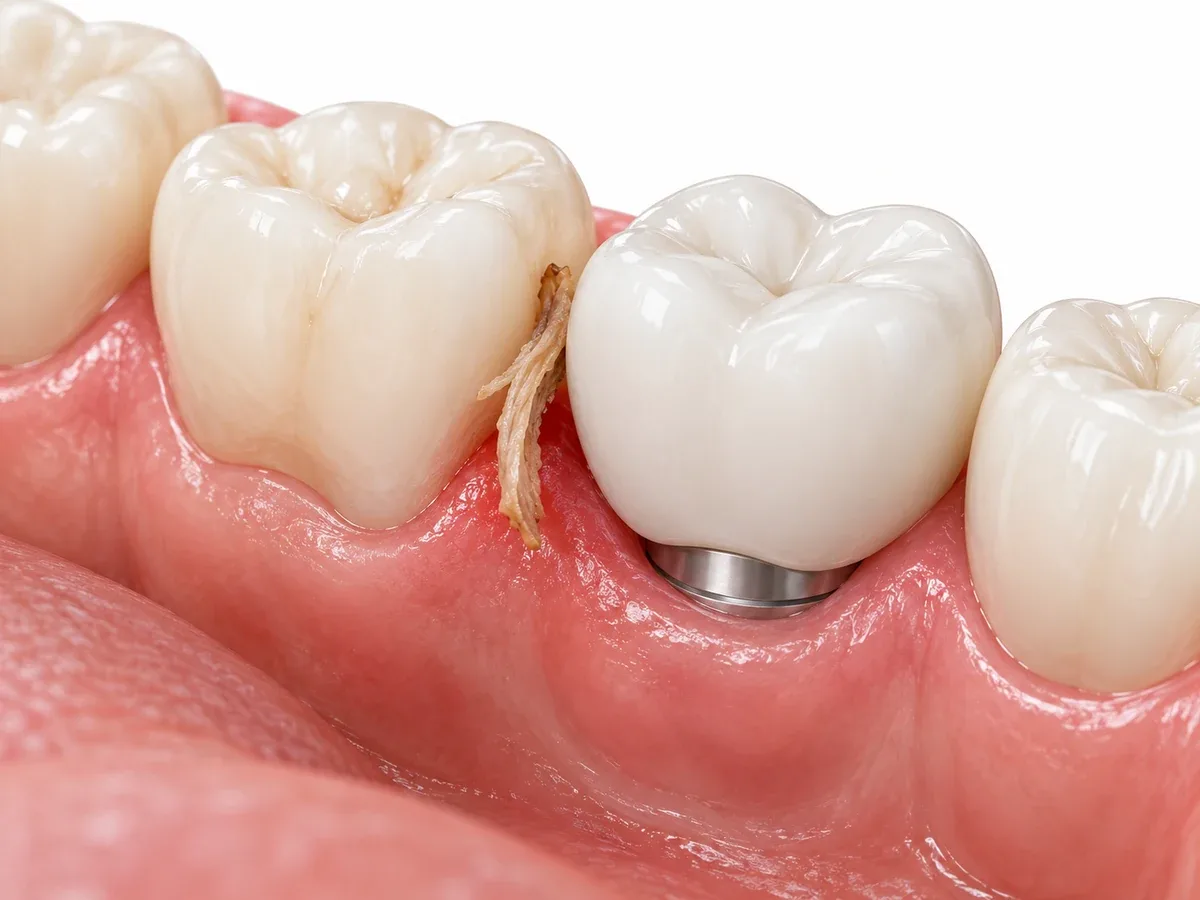
Why does a gap form next to an implant?
The review compares two studies by the same authors. In food impaction around natural teeth, the contact between teeth was tight in over 70% of cases. Around implant crowns, it was tight in just 7%.
So with implants, the likely cause is proximal contact loss. The surfaces that used to touch the neighboring tooth separate, and a gap opens.
The author traces this to the neighboring teeth, not the implant. Neighboring teeth sit about 3–21 μm apart. They move very slightly when you chew, touching and supporting each other.
An implant is fused directly to the bone and does not make this natural movement. So even when the gap is filled, the contact can loosen as time passes. The author considered this hard to avoid with implant crowns.
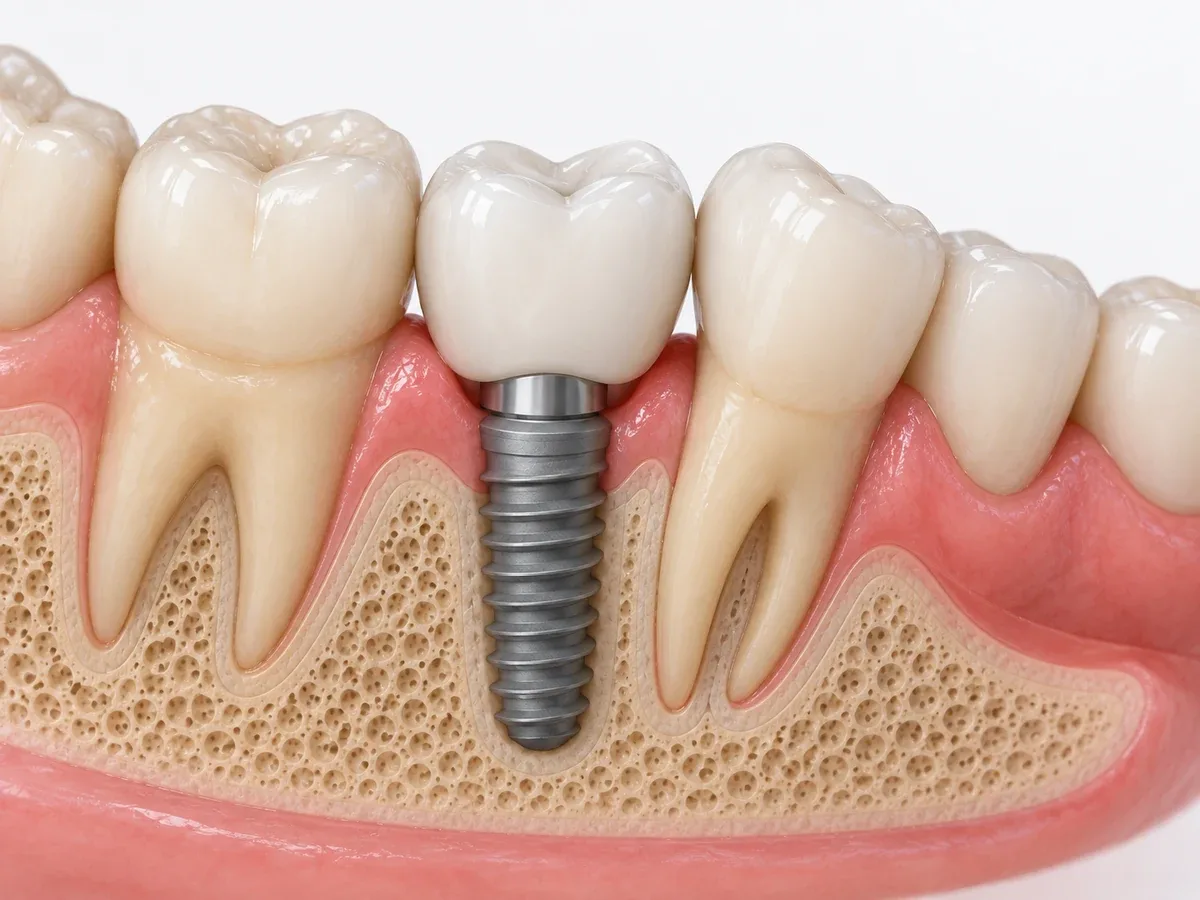
Gaps were more common on the front side of the implant. In the 186-patient study, contact loss reached 80% on the front side and about 50% on the back side.
The condition of the neighboring tooth also matters. When it was a root-canal-treated tooth, the risk was higher, at 1.825. When the neighboring teeth were splinted together, or the opposing jaw had a partial denture, the risk was lower.
| Condition | Risk |
|---|---|
| Neighboring tooth has had root canal treatment | 1.825, higher than a living tooth |
| Age over 77 | 1.037, a slight contribution |
| Neighboring teeth splinted together | 0.480, lower |
| Partial denture in the opposing jaw | 0.381, lower |
Can the shape of the crown cause it?
The review also cites a Korean study that examined the crowns of patients who came in with food impaction. It named four key causes:
- the shape of the point where the teeth touch
- how tightly the crown touches the neighboring tooth
- the shape of the chewing surface
- how the crown meets the opposing tooth
The shape of the crown itself can be a cause. The author pointed out these shape problems:
- If the side is concave, the edges touch at first and then wear, so contact can be lost suddenly.
- If the top edge sits lower than the neighboring tooth, it becomes a pocket that holds food.
- In the molar area, implants are narrower than the tooth, so the gap near the gum is larger.
- According to the review, this gap does not fill in with gum over time.
On the other hand, making the crown too bulky to block the gap is also a problem. An overly bulky abutment and crown can feel comfortable at first. But they press too hard between the teeth, and bone and gum can shrink over time.
The author wrote that custom abutments designed by computer easily end up this bulky. She stressed that designing a natural, physiological shape is essential.
That does not mean the contact should simply be made as tight as possible. The author wrote that an overly tight contact just causes pain. It can also speed up the drift of the neighboring tooth, and food impaction often returns.
How do the opposing and neighboring teeth play a part?
After a tooth is extracted, it can take anywhere from 3 months to 2 years before the implant crown goes in. During that time, the opposing tooth may drift down into the space, which is called extrusion.
A cited study looked at cases with no opposing tooth for over a year. The opposing tooth had moved 1 mm or more in 68% of them, and 2 mm or more in 27%. Upper teeth drifted down more than lower teeth.
When heights no longer match, food impaction may occur beyond the implant. Food can also get trapped between the drifted tooth and its neighbor.
The tooth behind the gap can also tip forward. In the same study, this tilt grew about ninefold. The author believed it could later create gaps or spots where teeth hit first.
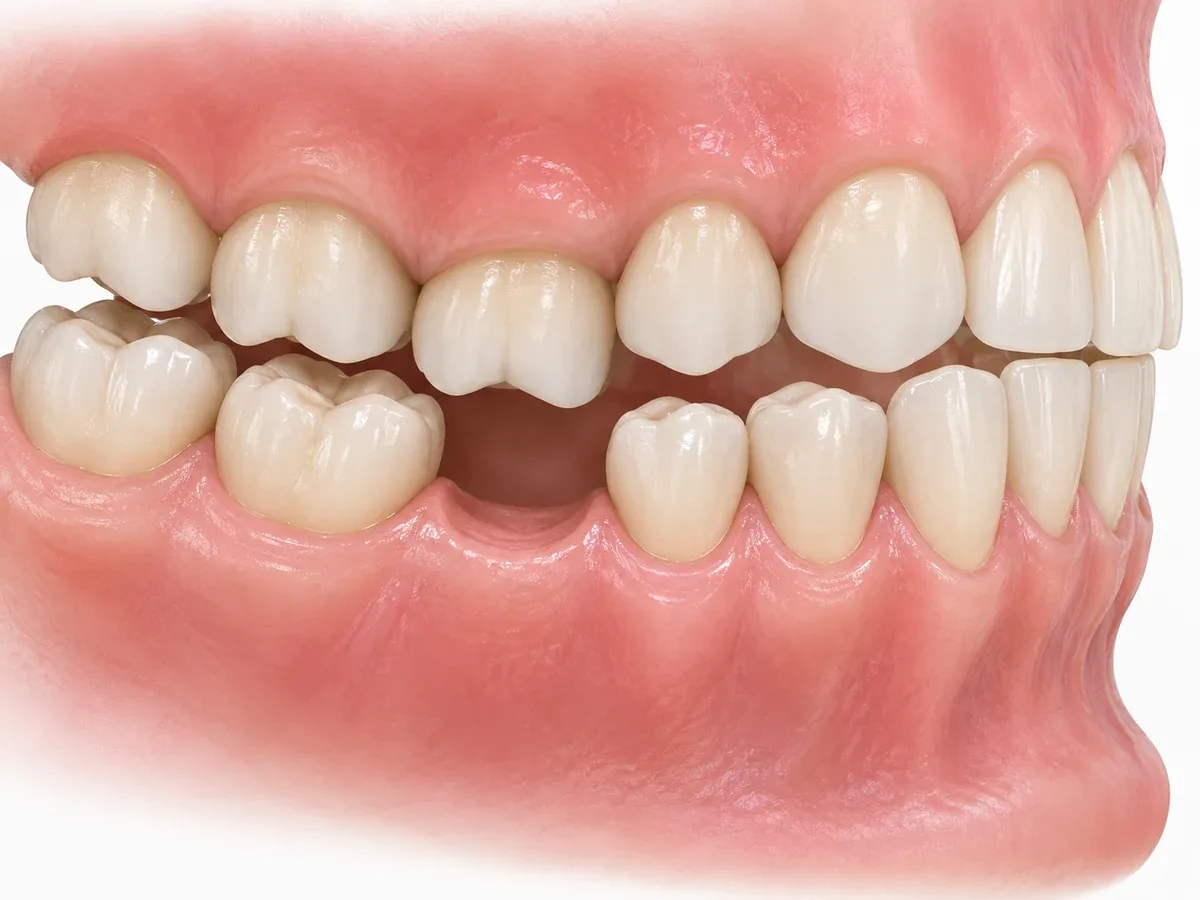
A premature contact, where the neighboring tooth hits first when you bite, is another cause. If this makes the neighbor loose, food impaction can occur even when contact strength is adequate.
The review includes two cases. In one, the bite of a neighboring tooth loosened by bone loss was adjusted, and food stopped getting stuck six months later. In the other, food impaction stopped after the slope of the neighbor's cusp was reshaped.
| Cause | What the review says |
|---|---|
| Neighboring teeth drift | Unlike the fixed implant, neighboring teeth move, so contact can loosen |
| Concave crown side | The edges touch and then wear, so contact can be lost suddenly |
| Overly bulky crown | It presses between the teeth, bone and gum shrink, and food can collect |
| Opposing tooth drifts down | With no opposing tooth for over a year, 68% had moved 1 mm or more |
| Premature contact on a neighbor | In one case, food stopped getting stuck after the bite was adjusted |
What happens if you leave it alone?
Dailydental reported on a study in the Journal of the Korean Dental Association. It analyzed 17 patients (26 implants) whose implants failed and had to be removed or retreated.
Patients whose problems began after the crown was in use had one thing in common. They had not kept their regular check-ups, and they came in once the implant had already started to move.
The researchers concluded that the crown design may have caused food impaction. This may have raised the chance of peri-implantitis, or patients may not have received enough care instructions.
On average, it took about 2.8 years until failure was diagnosed. Of the 17 patients, 8 failed early and 9 failed after the crown was in use. It is a small study, but it shows why trapped food should not be brushed aside.
To reduce such failures, the researchers recommended the following:
- Keep visits close together early on to check the crown and bite.
- Continue regular check-ups and X-rays after that period.
- Review maintenance, crown design and mechanical problems together.
The KDCA adds a warning. Peri-implantitis often does not cause any wobble even when bone is badly damaged, so treatment is often delayed. The discomfort of trapped food can therefore be a useful signal to get checked.
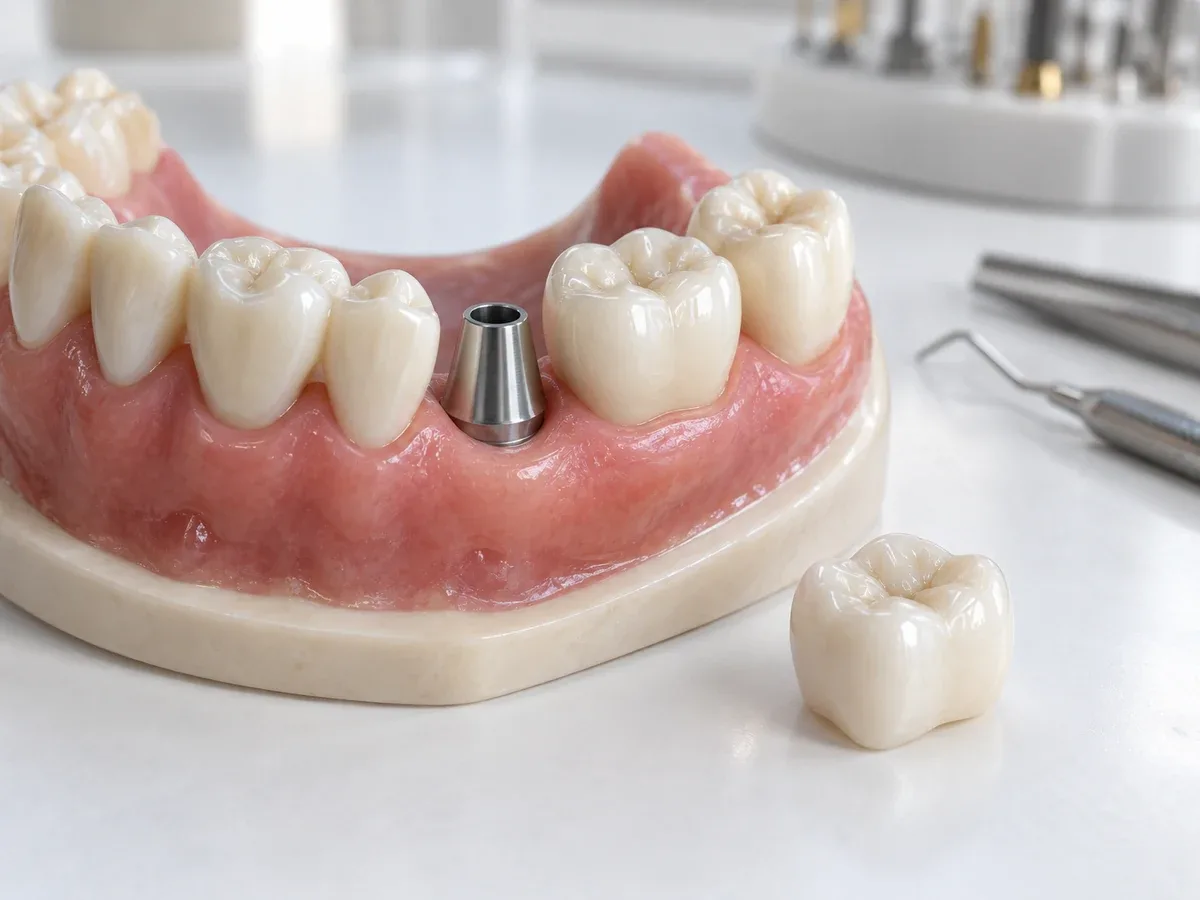
How is food impaction fixed at a clinic in Busan?
Professor Cho wrote that loosening contact should be understood as something hard to avoid. So it is sensible to make the crown removable, so it can be adjusted at any time.
The author noted that several causes often overlap, rather than a single clear one. So we examine where the gap formed and how the teeth meet. The fixes described in the review depend on the cause:
- If the crown side is concave, the edges are smoothed flat first.
- If contact is still weak, material is added where the teeth touch.
- The side of the neighboring tooth is reshaped slightly to narrow the gap near the gum.
- If heights do not match, the edges of the opposing and neighboring teeth are leveled.
- If the neighbor hits first and becomes loose, the bite is adjusted.
Before placing a crown, the author stresses checking whether a neighbor or opposing tooth hits first. The bite should be adjusted in advance. However, if contact strength itself is weak, bite adjustment alone cannot prevent the problem.
Any area reshaped on a neighboring tooth is sealed with a bonding treatment. The author wrote that this helps prevent decay and reduces sensitivity near the gum.
A little care when the crown is first placed can prevent later contact loss, the author wrote. A concave side often forms during fabrication as the crown follows the neighbor's shape. So we check this before the crown goes in.
How should you clean around an implant at home?
The KDCA says implants must be kept as clean as natural teeth to avoid inflammation. Because the gaps between teeth are wider, floss and interdental brushes are essential.
The same material notes that a regular toothbrush cannot reach every surface. The tongue side is easy to miss, so it suggests brushing it while looking in a mirror. Check-ups every 3–6 months are advised after treatment.
Seoul National University Hospital also advises keeping the area under the crown and the gum around the implant clean. Special brushes or floss can help.
If wrapping floss around your fingers is hard, a floss holder is an option. Professor Kim Baek-il of Yonsei University wrote in Dailydental that it works as well as finger flossing. It suits people with limited dexterity, arthritis or trouble opening wide.

Professor Kim describes how to use it:
- Floss before you brush.
- Do not force the floss between the teeth in one push.
- Ease it in and out gently, with a sawing or zigzag motion.
- Move it gently up and down to clean between the teeth.
There is a reason to floss first. After brushing, your mouth feels clean, so flossing is easy to skip. Flossing first also lets the fluoride in toothpaste reach the sides of the teeth.
Pushing hard in one go can injure the gum between the teeth. If food impaction happens in the same spot every time, or tools will not go in easily, the next step is to find the cause of the gap.
Frequently asked questions
Can I just use a toothpick?
The sources recommend floss and interdental brushes. Using force can hurt the gum. If tools do not go in easily or food keeps getting stuck in the same place, have it checked.
It was fine at first, but food impaction started years later. Why?
In the cited studies, contact loss did not decrease with time and tended to build up. Neighboring teeth may have drifted or the opposing tooth may have changed, so we look at what has changed.
Do I need a new implant crown?
It depends on whether the cause is the crown shape, the bite or the neighboring tooth. If the crown can be removed and built up at the side, that option may be considered first.
Can I get this treatment in English in Busan?
Yes. We provide 1:1 English interpretation from the first consultation through the end of treatment. The clinic is near Seomyeon Station Exit 2 (5-min walk), opposite Lotte Hotel Busan, and you can call 010-8555-2854 (+82-10-8555-2854 from abroad).
Food impaction beside an implant is not rare, but the cause differs from person to person.
Is it the crown shape, the bite or the neighboring tooth?
Finding out comes first,
and then the right fix can be chosen.
If food keeps getting stuck around your implant in Busan, Reset Dental Clinic offers 1:1 English interpretation from your first consultation through the end of treatment. Call 010-8555-2854 to book a check-up.
References
- Journal of the Korean Dental Association, Vol. 52 No. 8, "Food Impaction in Implant Prostheses: Occlusal Causes and Management" (Cho Lee-ra, Department of Prosthodontics, Gangneung-Wonju National University, 2014) — food impaction as the most common complaint after implant crowns; tight contacts in over 70% of natural-tooth cases versus 7% of implant cases, pointing to proximal contact loss; neighboring tooth drift as the cause; the 186-patient, 93-patient, 15-year and 55-patient studies; risk factors such as root-canal-treated neighbors; crown shape problems, overly bulky abutments and overly tight contacts; extrusion of opposing teeth; premature contacts and bite adjustment cases; the conclusion that crowns should be made removable so they can be adjusted
- KDCA National Health Information Portal, "Dental Implants" — floss and interdental brushes as essential because of wider gaps; brushing the tongue side with a mirror; keeping implants as clean as natural teeth; peri-implantitis that can damage bone without any wobble; check-ups every 3–6 months
- Seoul National University Hospital, "Dental Implants" — keeping the area under the crown and the surrounding gum clean, the help of special brushes and floss, and how poor hygiene can shorten an implant's life
- KDA newspaper Dailydental, "Half of Implant Failures Due to Poor Maintenance" (Sept 23, 2019) — a retrospective study of 17 patients and 26 implants: late-failure patients had missed regular check-ups, and crown design may have caused food impaction and raised the chance of peri-implantitis
- KDA newspaper Dailydental, "Dental Standards (62): Floss Holders" (Professor Kim Baek-il, Department of Preventive Dentistry, Yonsei University, Aug 20, 2019) — floss holders work as well as finger flossing and help people with limited dexterity, arthritis or trouble opening wide; flossing before brushing; gentle sawing or zigzag insertion to protect the gum
Written by Reset Dental Clinic Support Team
Medical review Dr. Na In-chae, Head Dentist · Periodontics Specialist
Last updated: September 19, 2026
This column is for general information and does not replace diagnosis or treatment for individual patients. If you have symptoms, please see a dentist.


