- "Bone loss around a tooth never comes back" is half right. There are cases where the bone does return.
- There is a condition, though. Treatment must start while the root is still alive. Once a tooth is very loose, it is hard.
- We have seen bone fill back in with basic gum treatment, not major surgery.
- Bone loss around implants is much harder to reverse. Even so, it is worth trying once before removing one.
"If the bone has melted away, won't I need an extraction and an implant anyway?" is a question we hear often at Reset Dental Clinic in Seomyeon, Busan. This column explains how far the belief that bone loss is final holds true, and why we try to save a tooth before removing it. For patients living in or visiting Korea, we provide 1:1 English interpretation from the first consultation through the end of treatment.
Why do we try so hard to keep natural teeth?
Implant technology has come a long way. Yet however good it gets, there are things an implant cannot fully replace in a natural tooth.
The biggest one is the periodontal ligament. It is a thin layer of tissue between the root and the bone.
It holds the tooth in place and absorbs shock. It also creates the feeling of chewing.
Implants do not have this ligament. So at first, chewing can feel slightly odd, and the sense of biting properly is harder to get.
Most people adapt well over time. Still, it is hard to feel things as finely as with your own tooth.
| Point | Natural tooth | Implant |
|---|---|---|
| Periodontal ligament | Present between root and bone | Absent; attached directly to bone |
| Absorbing shock | The ligament cushions biting forces | No ligament to cushion them |
| Feeling of chewing | Fine, detailed sensation | Feels odd at first; most people adapt |
| Bone loss around it | Can recover in some cases | Much harder to recover |
When a natural tooth can be kept, you keep that ligament and the fine sense of chewing that comes with it.
There is a saying we often share with patients: saving a tooth is a hundred times harder than pulling it. But it is worth that effort, so we save the teeth that can be saved.

Can bone loss from gum disease really recover?
Sometimes it can. We have seen it ourselves.
The dentist uses a curette to scrape out every bit of tartar and inflamed tissue deep under the gum. Then the root surface is smoothed.
This removes the bacteria from that spot. As the inflammation settles, the body starts to fill in bone on its own.
This is not major surgery. It is basic gum treatment, done properly and consistently.
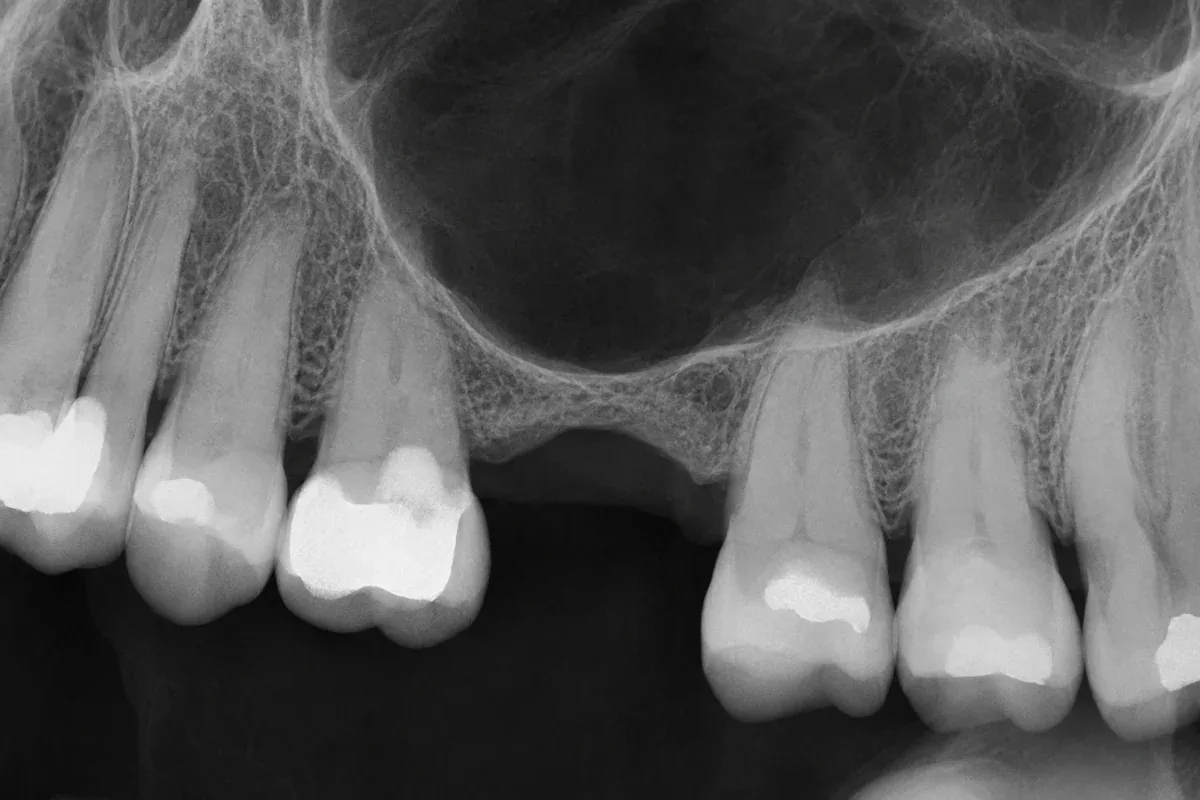
In some cases treated this way, more than half of the dark, empty area on the X-ray filled back in.
We want to be clear, though: not every case turns out like this. How much comes back depends heavily on the shape of the defect and the state of the remaining bone. We never promise that bone loss will reverse.

When can you expect recovery?
The most important factor is when you start.
| Condition | Outlook | Why |
|---|---|---|
| Inflammation limited to the gums | Full recovery | It has not reached the bone yet |
| Bone loss has begun, tooth still firm | Good chance of improvement | The root is alive and still has hold |
| Tooth is loose, root still alive | Worth trying | Controlling inflammation alone sometimes firms it up |
| Very loose, root damaged | Difficult | Nothing is left to hold on to |
As the table shows, the turning point comes before a tooth becomes very loose. If you come in before then, recovery may be possible without surgery.
The shape of the defect matters too. A pit surrounded by bone on all sides tends to fill in, while a site where one wall is gone is much harder.

The problem is that gum disease progresses slowly and does not hurt. Because it does not hurt, it gets worse without you noticing.
That is why so many people who have not seen a dentist for a while already have a lot of bone loss.
Bone keeps shrinking while you wait. The earlier bone loss is found, the more options remain.
What about bone loss around implants?
We will be honest: it is much harder than with natural teeth.
Many dentists believe that inflammation around implants does not improve with gum treatment alone. We partly agree. Around an implant, the structure makes it very hard for bone to fill back in.
However, we will not say it is impossible. We have seen cases where the dark empty space around the implant threads shrank considerably after treatment and maintenance.
In effect, an implant that was failing gained more years of use.
This does not mean every implant with bone loss can be kept. It means the decision is made after trying treatment, not before.
So if inflammation develops around an implant, we suggest not rushing to remove and replace it. Treating and maintaining it for a while can be a good option.
Implants are not cleaned with the same instruments as natural teeth, though. A scratch on the titanium surface becomes a new place for bacteria to settle. If needed, we also disinfect the area with a laser.

What does treatment for bone loss involve at our Busan clinic?
Treatment follows four steps. Each one builds on the one before it.
- Measuring how far it has gone. A probe measures how deep the gum pockets are, and X-rays show the bone height.
- Cleaning under the gums. A curette removes tartar and inflamed tissue, and the root surface is smoothed.
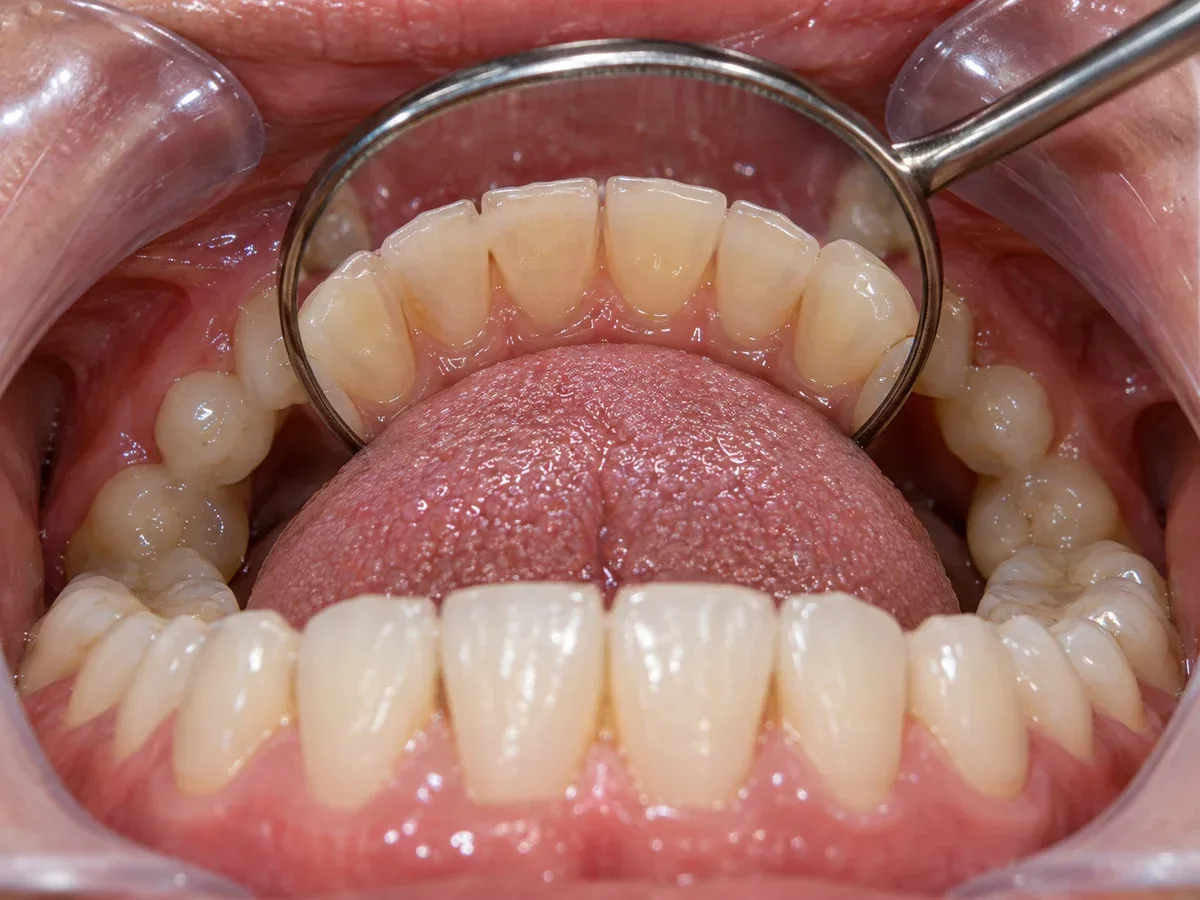
- Finding the spots you miss. We show you where brushing does not reach and why, then adjust your technique.
- Checking again at intervals. You come back every 3–4 months, and new X-rays are compared side by side with the old ones.
The last step matters most. This is not something one visit can finish.
The recovery cases we have seen in our clinic had one thing in common. Those patients came back on the dates we agreed.
| Step | What we do | Why it matters |
|---|---|---|
| 1. Measure | Probe the gum pockets and take X-rays of the bone | Shows how far bone loss has gone and sets a baseline |
| 2. Clean | Remove tartar and inflamed tissue, then smooth the root | Takes away the bacteria so the inflammation can settle |
| 3. Coach | Show the spots your brush misses and adjust your technique | Keeps bacteria from building up again in the same places |
| 4. Recheck | See you every 3–4 months and compare X-rays | Shows whether the bone loss is stable, improving or getting worse |

| Question | What usually happens |
|---|---|
| How long does it take? | Progress is judged over months, with X-rays taken again and compared |
| Is surgery needed? | Often not; deep defects may need the gum opened, sometimes with a bone graft |
| How often are check-ups? | Every 3–4 months with gum disease, longer once recovery is stable |
Progress is measured in months, not days. We treat, wait, take new X-rays and compare them with the old ones.
Rather than judging everything in one visit, we decide the next step as we watch how the bone loss responds.
In many cases we proceed with gum treatment alone, without surgery. If the bone is deeply pitted or needs cleaning further in, the gum may be opened. A bone graft is sometimes added when needed.
The Korean Academy of Periodontology also recommends setting check-up intervals according to each person's risk.
Signs that treatment is working
Recovery from bone loss is slow, so it helps to know what to look for along the way. These are the changes we check at each visit.
- The gums regain their healthy color.
- The gums feel firmer instead of puffy.
- A tooth that was loose because of inflammation becomes steadier.
- On the X-ray, the dark area of bone loss becomes smaller.
- Where bone height increases, the gums sometimes follow it up.
Some of these show up within weeks, while changes in the bone take months. That is why we compare X-rays taken at intervals.
What to do at home
Care at home decides a great deal of the result. These habits make the biggest difference.
- Use interdental brushes to clean between your teeth every day.
- Do not avoid areas that bleed; brush them gently instead.
- Stop using toothpicks.
- If you smoke, quitting helps your gums heal.
Isn't it wrong to hold on to a loose tooth?
That is a fair question. Keeping a tooth at any cost is not the answer.
If you hold on to a tooth that cannot be saved, the bone around it keeps dissolving. You may then lose the bone needed for an implant later.
In that case, removing the tooth now is how you protect your next option. Removing it in time keeps enough bone for an implant later.
So we weigh two questions together:
- Can this tooth be saved?
- Would trying to save it cost more than it gains?
Most teeth we say can be saved do end up being saved. When we say a tooth is difficult to save, we explain why.
Three questions to ask at your consultation
- "Can we try to save this tooth?" Ask this if extraction is suggested first, and see whether the reasons are explained with X-rays.
- "How many millimeters deep are my gum pockets?" Listen for a measured answer in numbers. It also becomes the baseline for later comparison.
- "When will we look again before deciding?" Check whether the clinic follows your progress instead of deciding in one visit.
To be clear, this is not about criticizing other dentists. It is simply meant to protect patients.
Frequently asked questions
How much bone can come back?
It depends heavily on the shape of the bone loss. A defect surrounded by bone on all sides has a better outlook, while one with a wall missing is harder. We explain after looking at your X-rays, and we do not promise that bone will return.
My tooth is already loose. Is it too late?
That needs an examination. If the looseness comes from inflammation, controlling it can make the tooth firmer, but a damaged root is difficult. Bone keeps shrinking while you hesitate, so coming in early is wiser.
Will receded gums come back up?
As swollen gums settle, they can look lower than before, but their color returns and they become firmer. When bone height increases, the gums sometimes follow it up.
Can I get bone loss treatment in English in Busan?
Yes. We offer 1:1 English interpretation from the first consultation through the end of treatment. The clinic is near Seomyeon Station Exit 2 (5-min walk), opposite Lotte Hotel Busan, and you can call 010-8555-2854 (+82-10-8555-2854 from abroad).
"Lost bone never comes back" is half right.
If treatment starts while the root is alive,
basic gum treatment can sometimes
fill in areas that had been empty.
Because gum disease does not hurt, people tend to come in late.
The turning point comes before a tooth becomes very loose.
If you are unsure whether it is too late, come in soon.
If you are worried about bone loss, Reset Dental Clinic in Busan offers 1:1 English interpretation from your first consultation through the end of treatment. Call 010-8555-2854 to book a check-up.
References
- KDCA National Health Information Portal, "Gum Disease (Periodontal Disease)" — the difference between gingivitis and periodontitis, scaling and root planing, and treatment stages such as bone grafts and tissue regeneration
- KDCA National Health Information Portal, "Systemic Diseases and Periodontal Treatment" — how systemic factors such as smoking and diabetes affect healing of periodontal tissue
- KDA newspaper Dailydental (Chiui Sinbo), "65% of Implant Patients Have Experienced Peri-Implant Disease" (Korean Academy of Periodontology, 17th Gum Day) — maintenance intervals by risk level and risk factors for peri-implant disease
- KDA newspaper Dailydental (Chiui Sinbo), "Mastering Peri-Implantitis With the Korean Academy of Periodontology" — non-surgical care for peri-implantitis and the flow of treatment
- KDCA National Health Information Portal, "Dental Implants" — conditions for replacing a natural tooth, osseointegration and aftercare
Written by Reset Dental Clinic Support Team
Medical review Dr. Na In-chae, Head Dentist · Periodontics Specialist
Last updated: September 19, 2026
This column is for general information and does not replace diagnosis or treatment for individual patients. If you have symptoms, please see a dentist.