

- Worn, shortened molars do not always need root canal treatment and crowns.
- Another clinic had advised this patient to crown all 16 back teeth after root canal treatment.
- Posterior Minish filled in the worn-away space instead, without removing tooth to make room.
- After raising the bite height, the jaw joint (TMJ) needs care too, so the new height can hold.
"Your molars are worn down, so all of them need crowns." This patient heard exactly that before coming to Reset Dental Clinic in Seomyeon, Busan. This case review explains how posterior Minish restored the height of 16 worn back teeth without drilling them down for crowns. For patients living in or visiting Korea, we provide 1:1 English interpretation from the first consultation through the end of treatment.
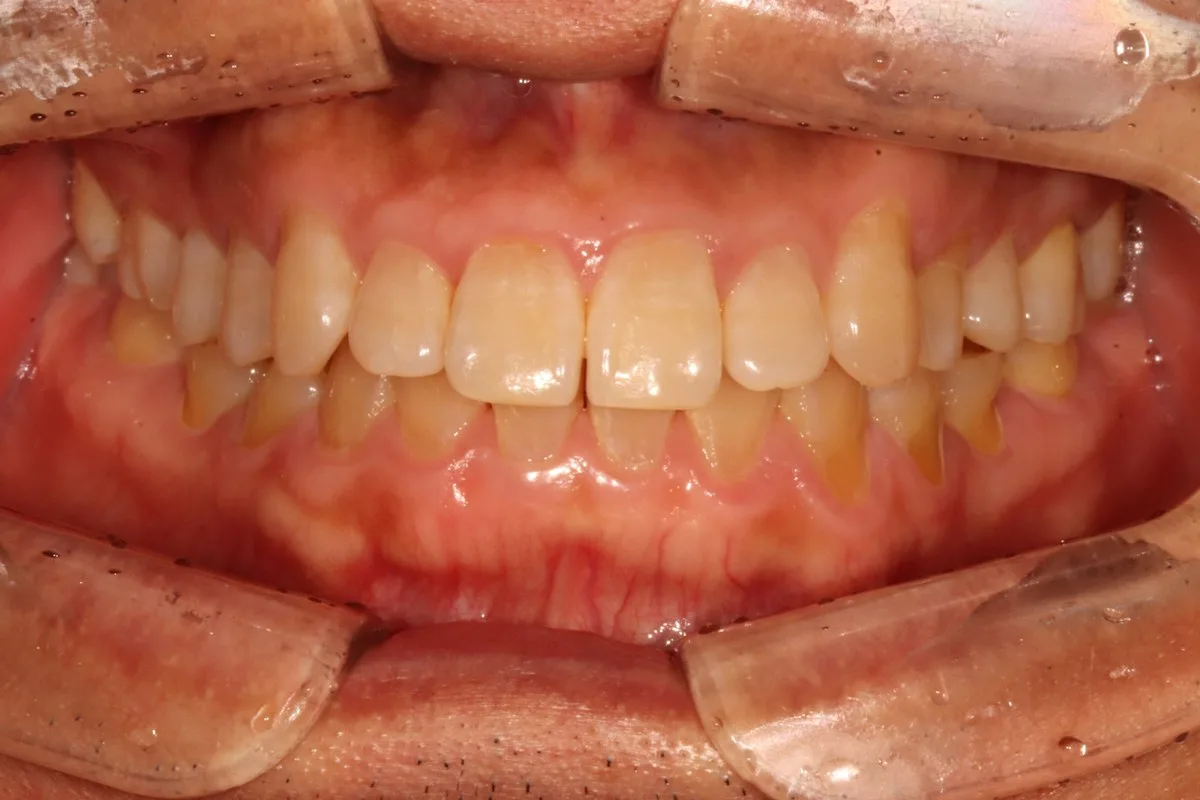
What happens when molars wear down?
Heavily worn molars do not always have to go through root canal treatment and crowns. The options depend on how far the wear has gone, how much tooth remains, the state of the nerve and the bite.
This patient travelled to us from Changwon, a city near Busan. Another clinic had advised root canal treatment on all 16 upper and lower back teeth, followed by crowns.
When we examined the mouth, wear on the back teeth was severe throughout. The bumps and grooves of the chewing surfaces had disappeared, leaving them flat.
The outer enamel had worn away. Underneath it, the yellow dentin was exposed.
In other words, the molars had lost height. They had become shorter than they used to be.
Pain tends to come late with this kind of wear. When wear reaches the dentin, sensitivity usually appears first, and as it progresses the tooth gets closer to the nerve.
So even without pain, it is worth a check if your chewing surfaces look flat or yellow shows through. The table below sums up the signs:
| Sign | What it means |
|---|---|
| Flat chewing surfaces | The natural bumps and grooves have worn away |
| Yellow color on the chewing surface | The enamel is gone and the dentin underneath is exposed |
| Shorter back teeth | The molars have lost height, lowering the bite |
| Sensitivity | Wear has reached the dentin; with more wear, it moves closer to the nerve |
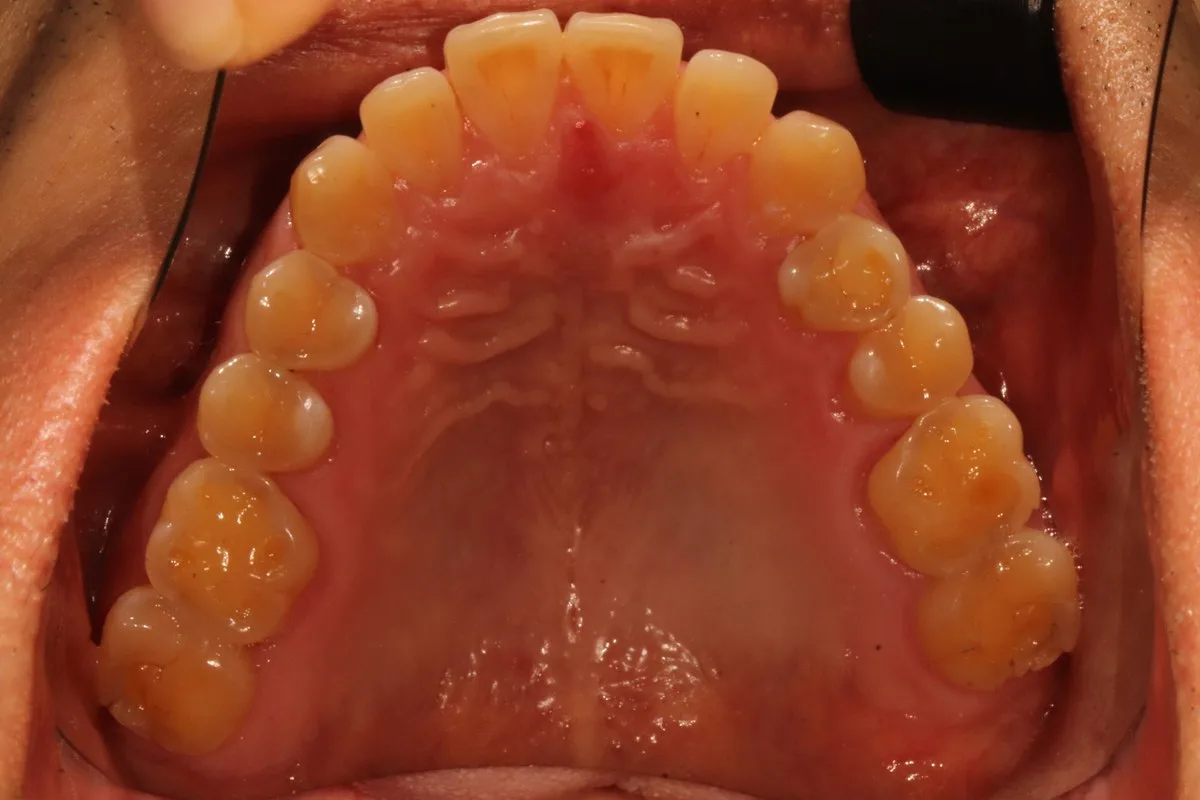
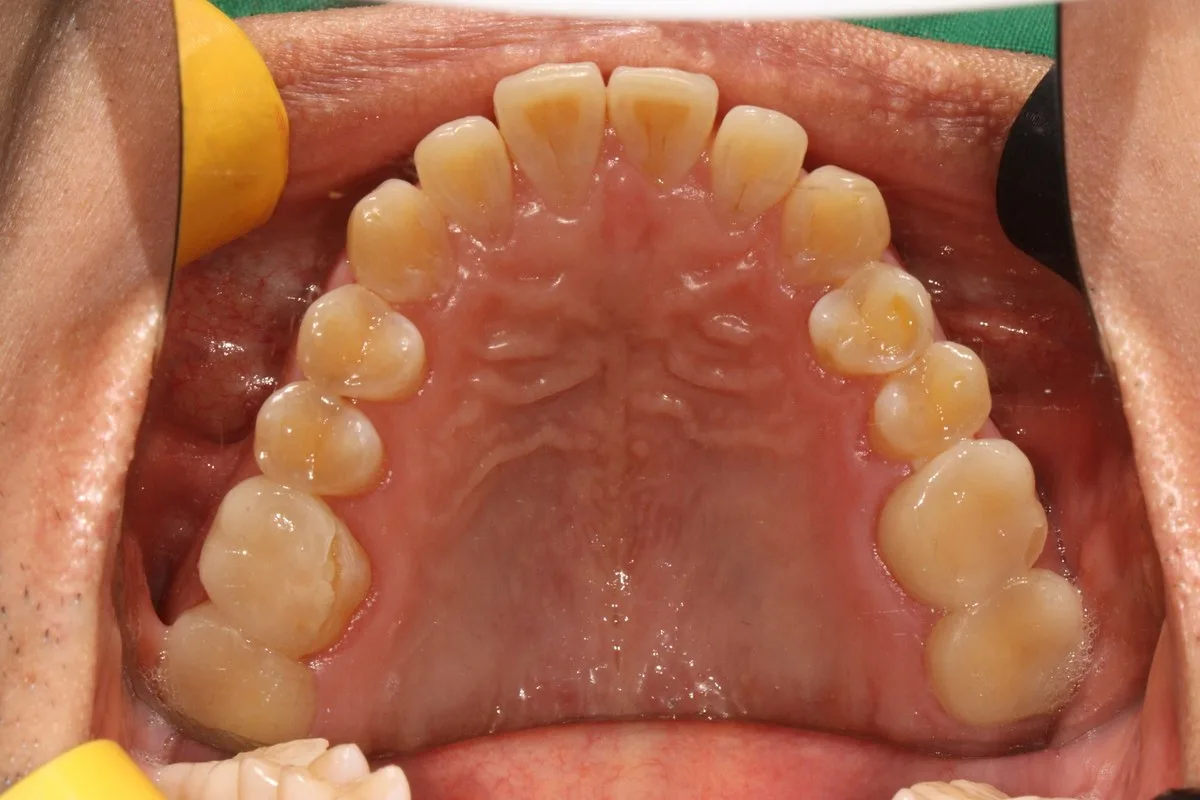
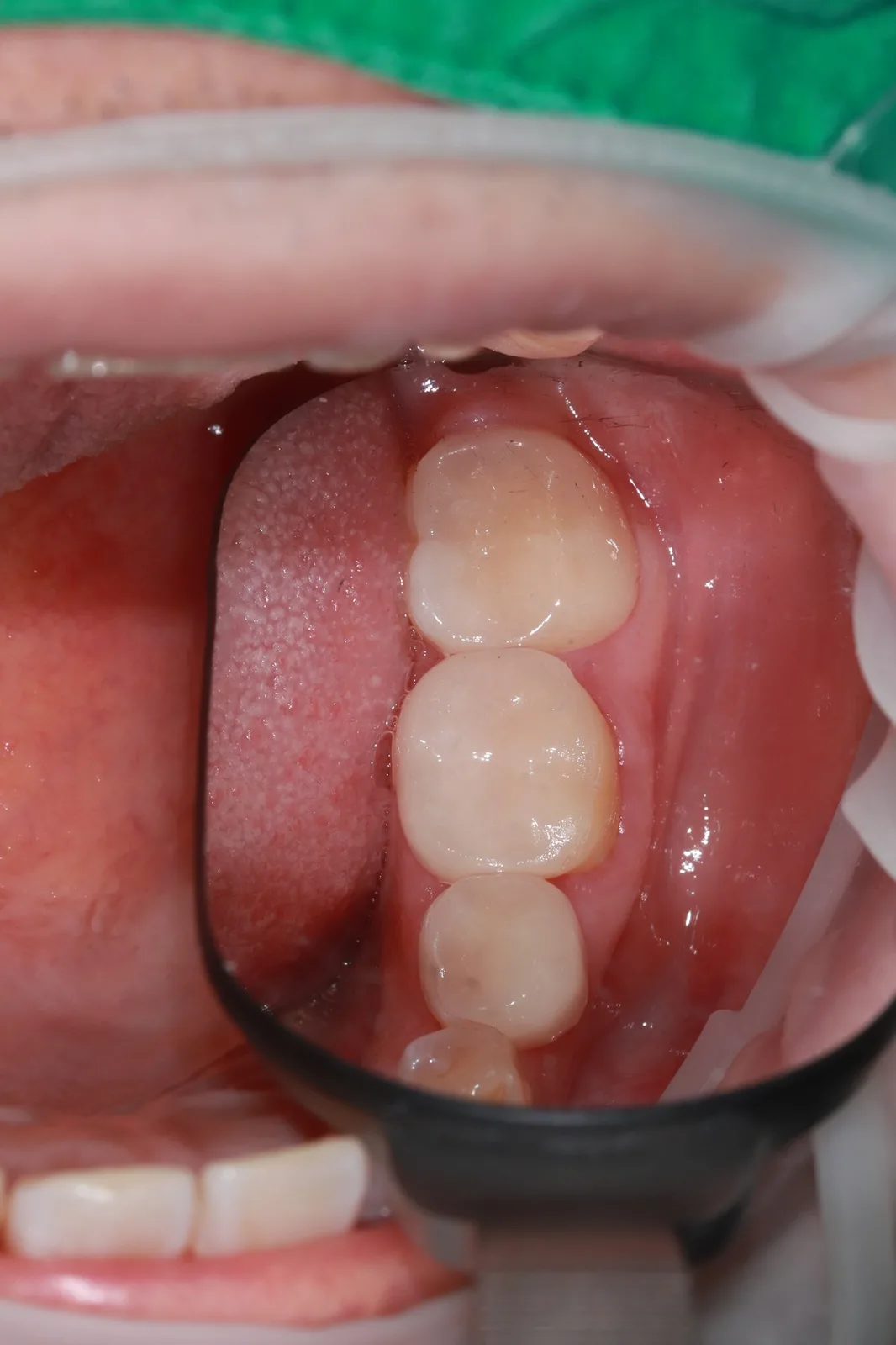
Upper molars, before and after.
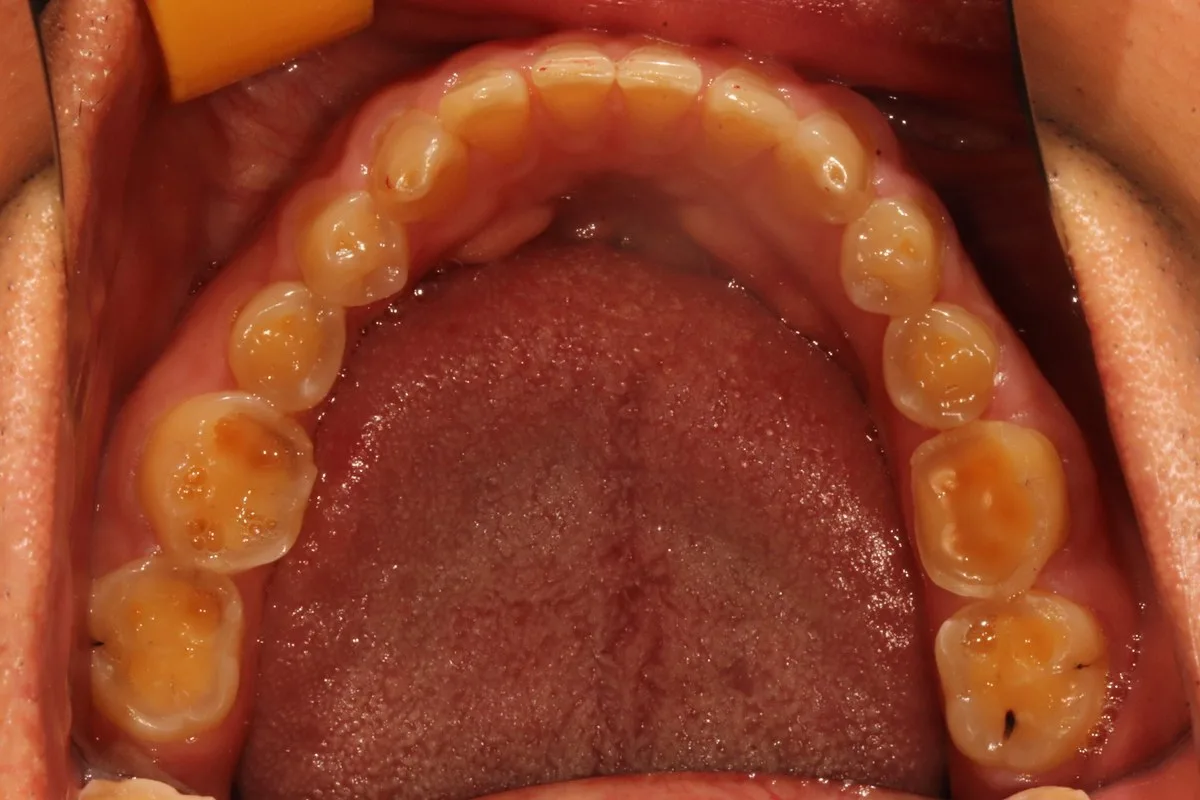
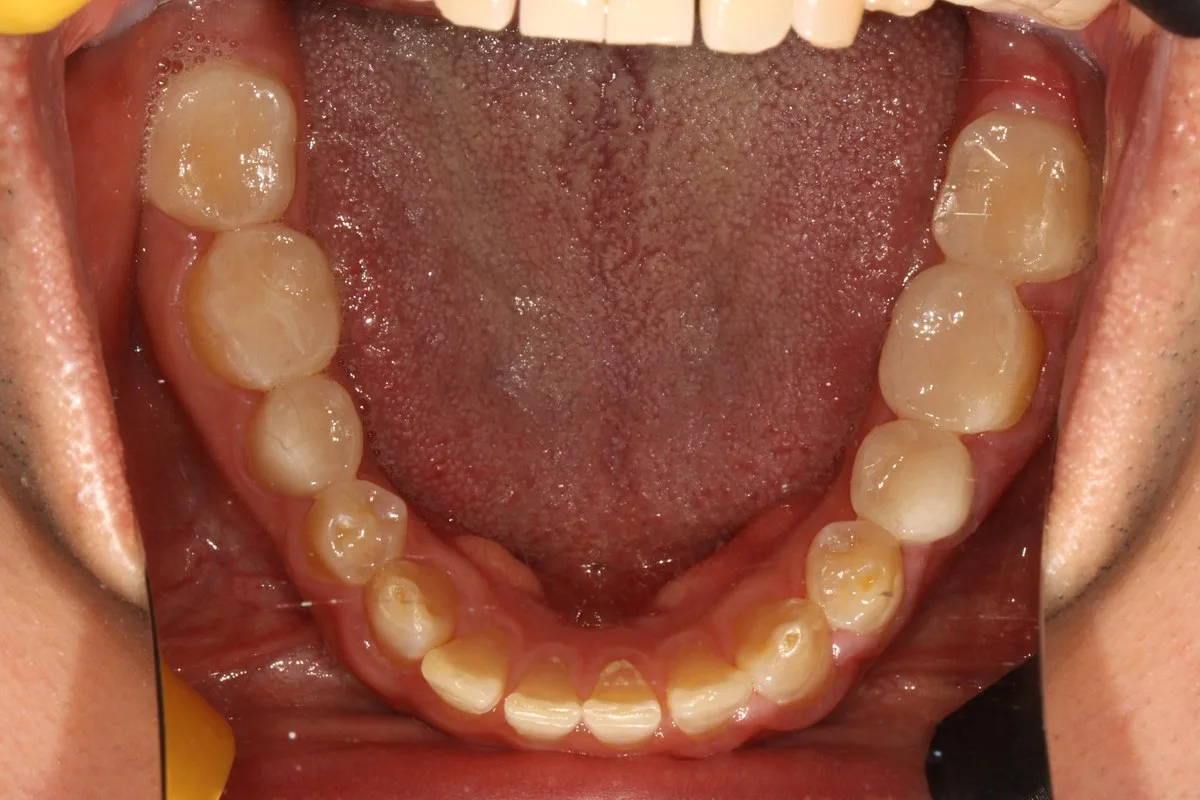
Lower molars, before and after.
Why do some dentists suggest crowning all 16 back teeth?
In a mouth like this, two things need to be done. The first is to restore the lost height of the back teeth, known as the vertical dimension.
The second is to cover and seal the exposed dentin. Once the enamel is gone, this layer needs to be sealed again.
Usually, both jobs are handled with one tool: a crown. A crown rebuilds the height and covers the tooth at the same time.
For this patient, the plan covered all four sections of the mouth, upper and lower, left and right. It included teeth 4 to 7 in each section, the premolars and molars, for 16 teeth in total.
But this creates a problem. A tooth that is already worn and short would have to be cut down further to make room for the thickness of a crown.
After that, very little tooth structure would remain. So the usual order becomes root canal treatment (endo), then a core build-up, then the crown.
This is the route the patient had been offered elsewhere: root canal treatment on the whole set of back teeth, followed by crowns.
- The worn teeth are cut down further to make room for crowns.
- Because too little tooth remains, root canal treatment is done.
- A core is built up inside each tooth.
- Crowns are placed on all 16 teeth.
What are the downsides of root canals and crowns on worn teeth?
This route can work, but three points concerned us. Each one adds up when it is repeated across 16 teeth.
First, a lot of healthy tooth is removed. The teeth have already lost structure to wear, and now the remaining part has to be ground away as well.
Second, root canal treatment becomes a requirement. It is not done because the teeth hurt. It is done so that crowns can be placed.
If a tooth already has a root crack, root canal treatment can sometimes make that crack worse. That is a real cost for a tooth that was not painful to begin with.
Third, the opposing teeth can wear. Zirconia is a very hard crown material. If its surface is not precisely polished, it can wear down the teeth it bites against.
In effect, you would be saving the molars on one side while wearing down the other side. For someone whose teeth are already worn, that is the opposite of the goal.
- Healthy tooth structure is removed on top of what wear has already taken.
- Root canal treatment is done for the crown, not because of pain.
- An existing root crack may get worse after root canal treatment.
- Hard zirconia can wear the opposing teeth if not finely polished.
How does posterior Minish restore worn molars in Busan?
So for this patient, we chose posterior Minish, which simply means Minish placed on the back teeth. Minish is a method that precisely restores the damaged part of a tooth.
It does not remove tooth to create space. Instead, it fills the space that wear has already taken away.
As the lost height comes back, the exposed dentin is covered at the same time. One step answers both needs.
First, there is no unnecessary tooth removal. Because Minish restores the damaged part, there is no reason to touch the tooth that is left.
Some light smoothing of the surface may still be needed. If a tooth already has decay or an old filling, that part is cleaned up first.
Second, in most cases no root canal treatment is done. The root canal was planned in order to place crowns, so without crowns there is no reason for it.
Of course, if the nerve already has a problem, root canal treatment comes first. That can be known after an examination.
Third, the opposing teeth are not worn down. The Minish material has properties similar to natural enamel, so unlike zirconia it does not tend to wear the teeth it meets.
| Root canal treatment and crowns | Posterior Minish | |
|---|---|---|
| Tooth removal | Worn teeth are cut down further to fit crowns | No removal to make room; light smoothing may be needed |
| Root canal treatment | Needed so crowns can be placed | Usually not needed, unless the nerve already has a problem |
| Opposing teeth | Hard zirconia can wear them if not finely polished | Material similar to enamel; does not tend to wear them |
| Exposed dentin | Covered by the crown | Covered as the height is restored |
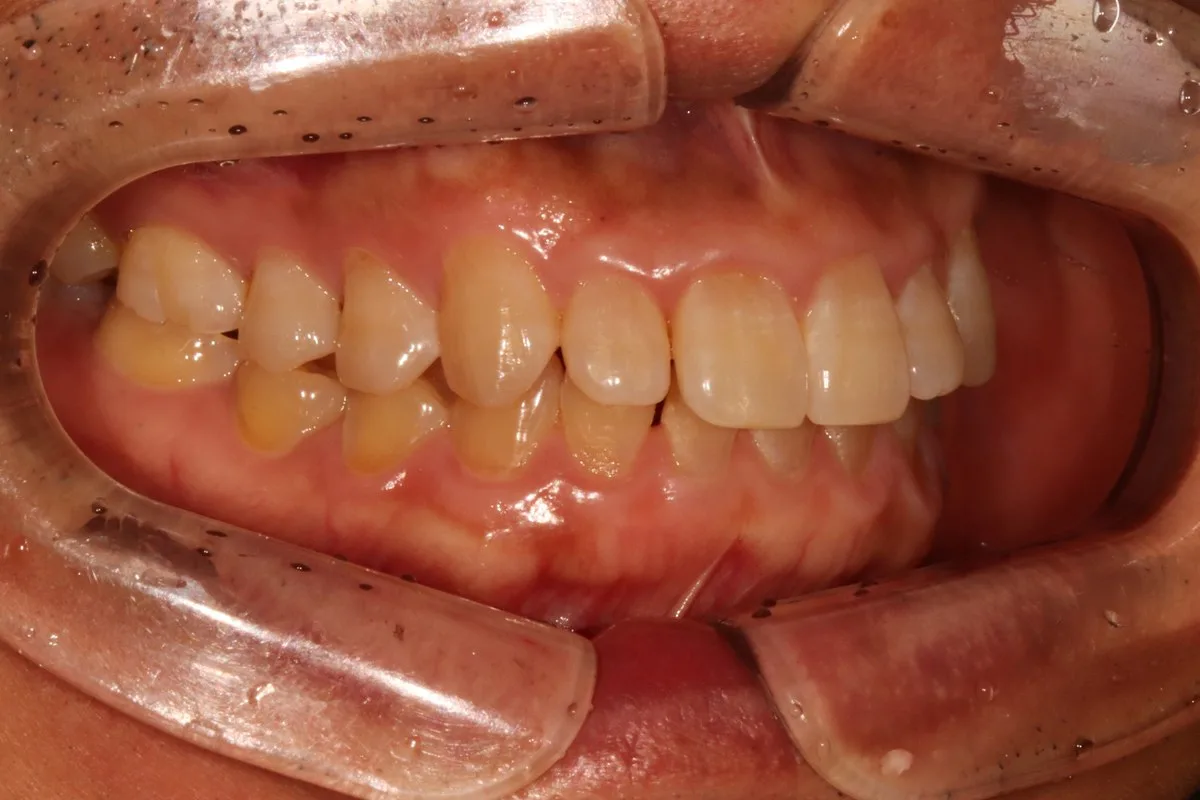
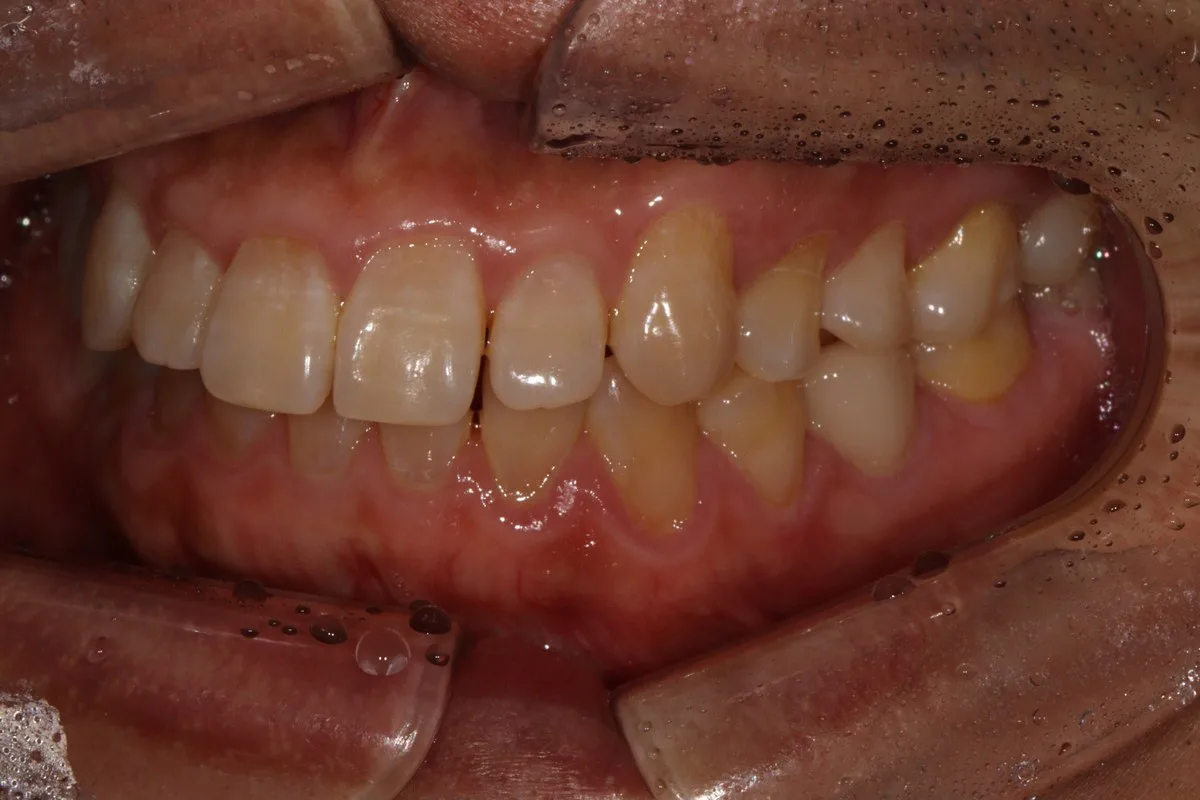
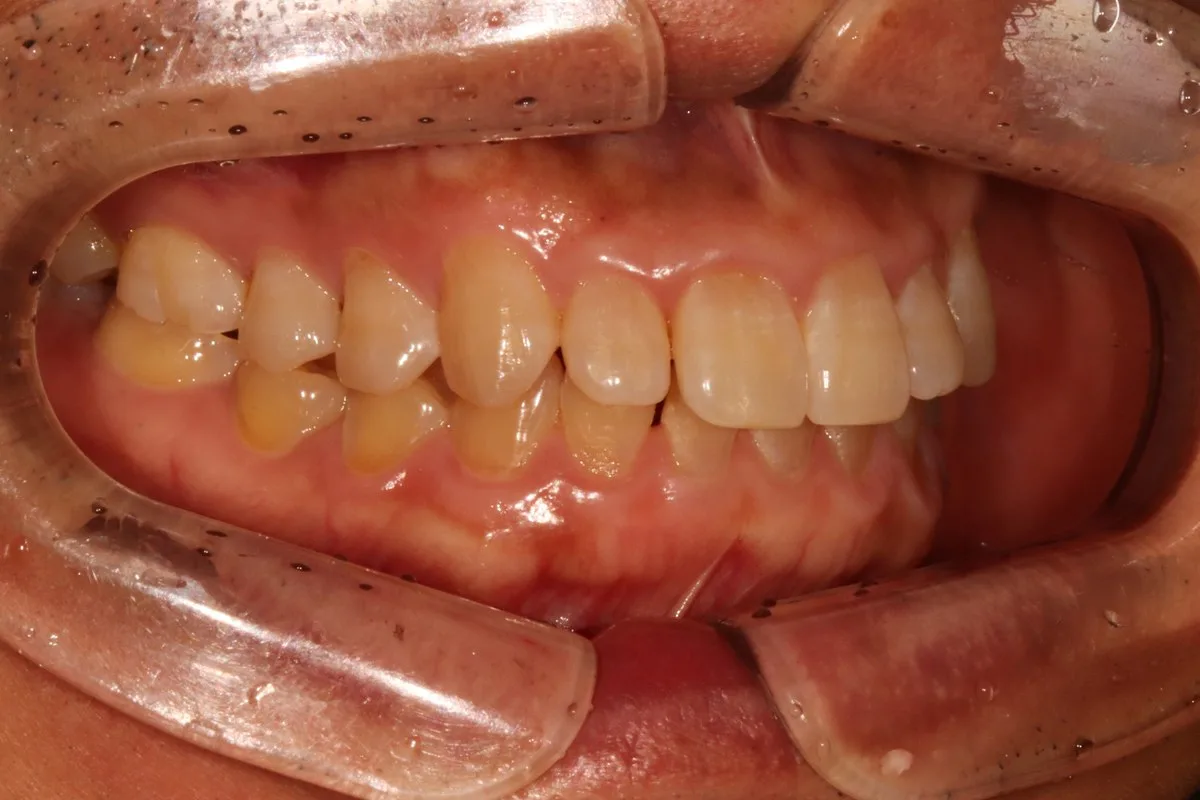
Right side view: the molar height has been restored.
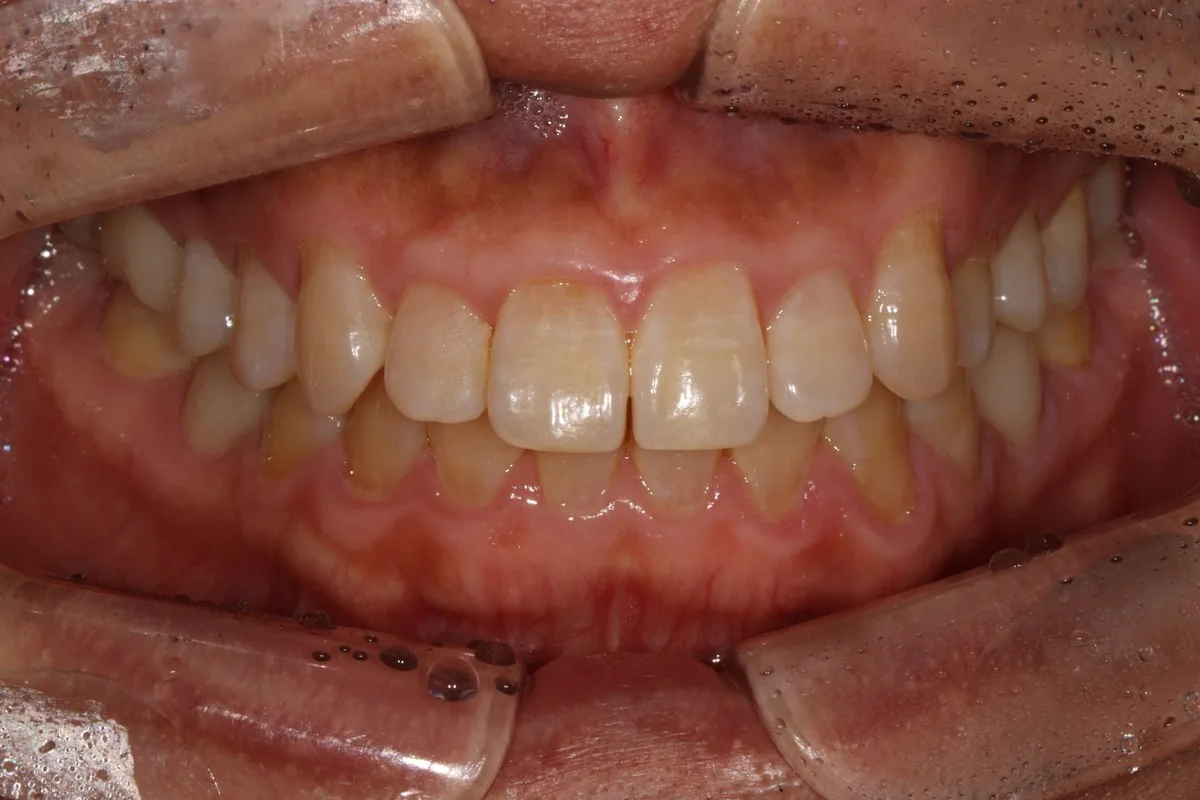
Why check the jaw joint (TMJ) after raising the bite?
This step is often left out. If the molars have been worn for a long time, the jaw has already adapted to that lower height.
When the height is suddenly restored, the jaw has to adapt again to the new height. The muscles tend to tense up during this period.
That is why, when we restore molar height, we also carry out three things together:
- TMJ Botox relaxes tension in the chewing muscle (masseter) and the temple muscle (temporalis).
- TMJ physical therapy helps the joint settle into its new position.
- A dental splint protects the newly built height while you sleep.
Minish restores the height, and this care helps protect it. Keeping the new height is harder than creating it. If this care is skipped, the patient may start grinding again, and the molars we worked to save can wear down once more.
People often ask whether raising the molars changes the face. Because we are restoring height that was lost to wear, it is closer to returning to the original height.
The face does not change much. Many patients do say, however, that closing their mouth feels more comfortable.
| Care | What it does |
|---|---|
| TMJ Botox | Relaxes the masseter and temporalis muscles |
| TMJ physical therapy | Helps the joint settle into its new position |
| Dental splint | Protects the new height during sleep |
When is a crown still the right choice?
Worn, shortened molars do not always have to lead to root canal treatment and crowns. That is the main message of this case.
Still, Minish is not the answer in every case either. A crown is the right choice in some situations:
- Inflammation has already spread to the nerve.
- The tooth is badly broken.
- Too little tooth structure remains.
Which route fits can be known after looking inside the mouth and checking X-rays. The photos alone are not enough to decide.
Molar wear usually takes a long time to develop. Put the other way round, acting when you first notice it leaves many more options.
For this patient, Minish treatment took about two months from the first consultation to completion. The time depends on the number of teeth and the condition of the jaw joint.
If you have been told that all your worn molars need crowns, these questions can help at your next consultation:
- Is root canal treatment needed because of a nerve problem, or just to fit crowns?
- How much more tooth would be removed to make room for each crown?
- Could Minish fill the worn-away space instead of cutting the teeth down?
- After the height is restored, what care will protect it, including the jaw joint?
The answers will differ from person to person. What matters is that the choice between Minish and crowns is made tooth by tooth, based on an examination.
Frequently asked questions
My molars are worn but do not hurt. Can I leave them?
Pain comes late. Once wear reaches the dentin, sensitivity appears first, and with more wear the tooth gets closer to the nerve. If the chewing surfaces look flat or yellow, it is worth having them checked.
Does posterior Minish really involve no tooth removal?
It fills the part that has already worn away, so there is no cutting to make room. Light smoothing of the surface may be needed, and any decay or old fillings are cleaned up.
Will I need root canal treatment with Minish?
We do not do root canal treatment just to place crowns. If the nerve is already inflamed or the tooth is deeply broken, root canal treatment is needed. An examination will tell.
Can I get this treatment in English in Busan?
Yes. We offer 1:1 English interpretation from the first consultation through the end of treatment. The clinic is near Seomyeon Station Exit 2 (5-min walk), opposite Lotte Hotel Busan, and you can call 010-8555-2854 (+82-10-8555-2854 from abroad).
Worn molars do not always have to become crowns.
Filling in what wear has taken away can restore height
while keeping the tooth that remains.
If you are considering Minish for worn molars in Busan, we will examine your teeth and bite first. Patients in Korea can get 1:1 English interpretation from the first consultation through the end of treatment. Call 010-8555-2854 to book a consultation.

References
- KDCA National Health Information Portal, "Laminate Treatment" — what laminates are, how much tooth they remove (0.5–1.0 mm) and when they are used
- KDCA National Health Information Portal, "All-Ceramic Crowns" — pros and cons of all-ceramic crowns and the tooth reduction they require
- KDA newspaper Dailydental (Chiui Sinbo), "Court Orders Damages for Excessive Tooth Reduction in Laminate Treatment" — how the court viewed the duty to explain when more tooth was removed than advertised
- KDCA National Health Information Portal, "Dentin Hypersensitivity" — causes and treatment of sensitive teeth
- KDCA National Health Information Portal, "Gum Disease (Periodontal Disease)" — how the condition of the gums affects esthetic results
Written by Reset Dental Clinic Support Team
Medical review Dr. Kim Hyun-joo, Head Dentist · Esthetic Restorations
Last updated: September 19, 2026
This column is for general information and does not replace diagnosis or treatment for individual patients. If you have symptoms, please see a dentist.


