

- A bone graft is not an optional extra. At our clinic in Busan, we see it as the foundation work for an implant where bone is lacking.
- It does not simply fill in missing bone. It is closer to creating a space and a framework where your own bone can grow.
- Not everyone needs one. If the tooth was lost to decay rather than gum disease, and 4–6 months have passed, a graft is likely not needed.
- The decision is made with 3D CT, not by eye, after measuring bone height, thickness and density and the nerve position.
"I went in for an implant, and they told me I need a bone graft." Most people first wonder whether they really need it. This guide from Reset Dental Clinic in Seomyeon, Busan explains how we tell when a bone graft is truly needed. For patients living in or visiting Korea, we provide 1:1 English interpretation from the first consultation through the end of treatment.
Asking that question is natural. Below, we also cover what you can check for yourself at a consultation.
What exactly does a bone graft do?
An implant is a titanium fixture placed inside the jawbone. It can take chewing force when it sits fully inside the bone.
Jawbone, though, has a different shape in every person. Some people are born with thin bone. In others, periodontitis has dissolved the bone and left it uneven.
Place a fixture of set size in such a spot, and part of it ends up outside the bone. That exposed surface is covered by gum alone, so inflammation starts easily. Over time, the bone around it wears away further.
In the front teeth, the gum line can also sink, which does not look good.
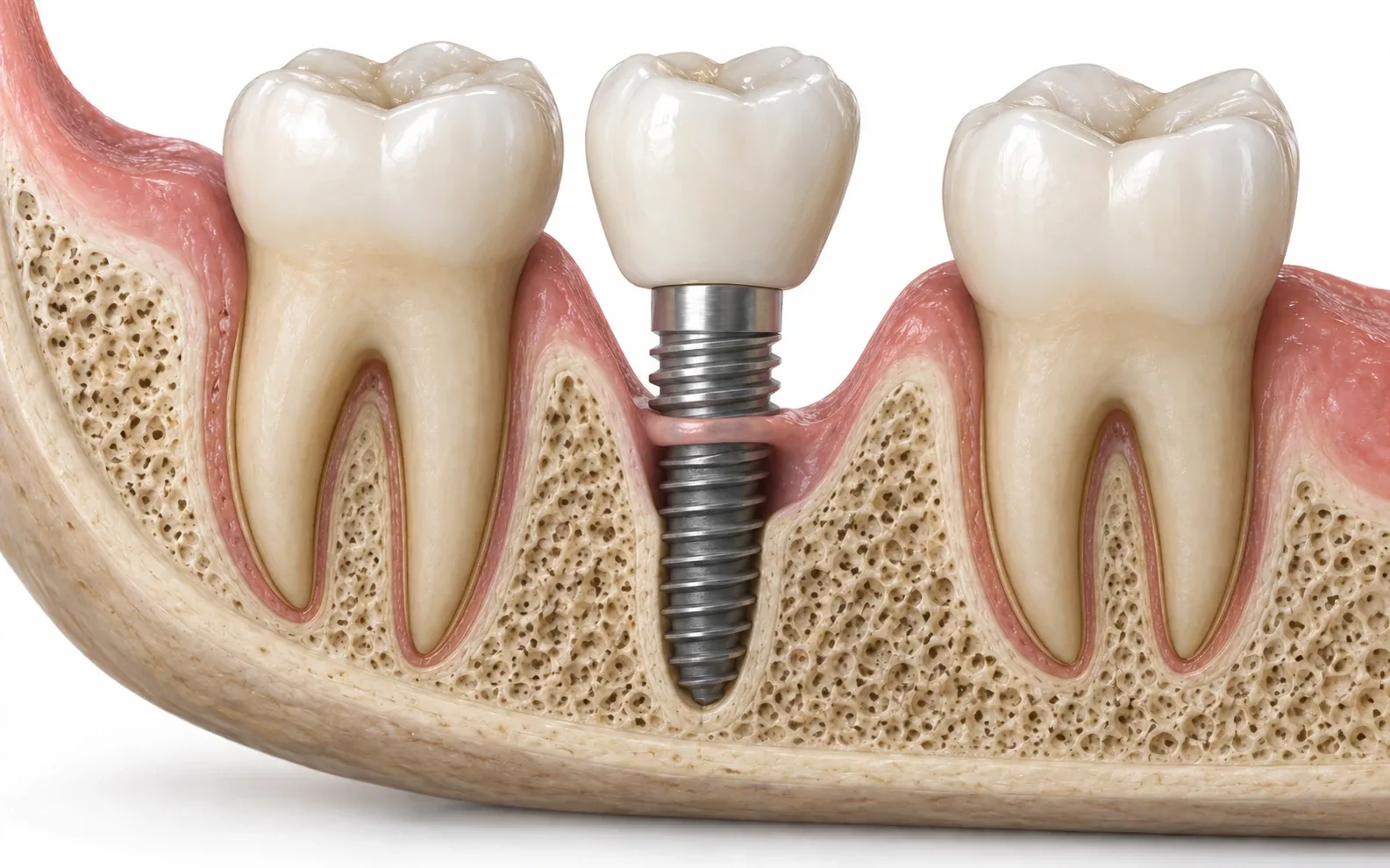
A bone graft covers that exposed part and builds up the missing thickness. Its formal name is guided bone regeneration.
Imagine building a house you plan to live in for many years, on sand instead of solid rock. However good the pillars are, it will tilt in the end. A bone graft is leveling the ground before raising the pillars.
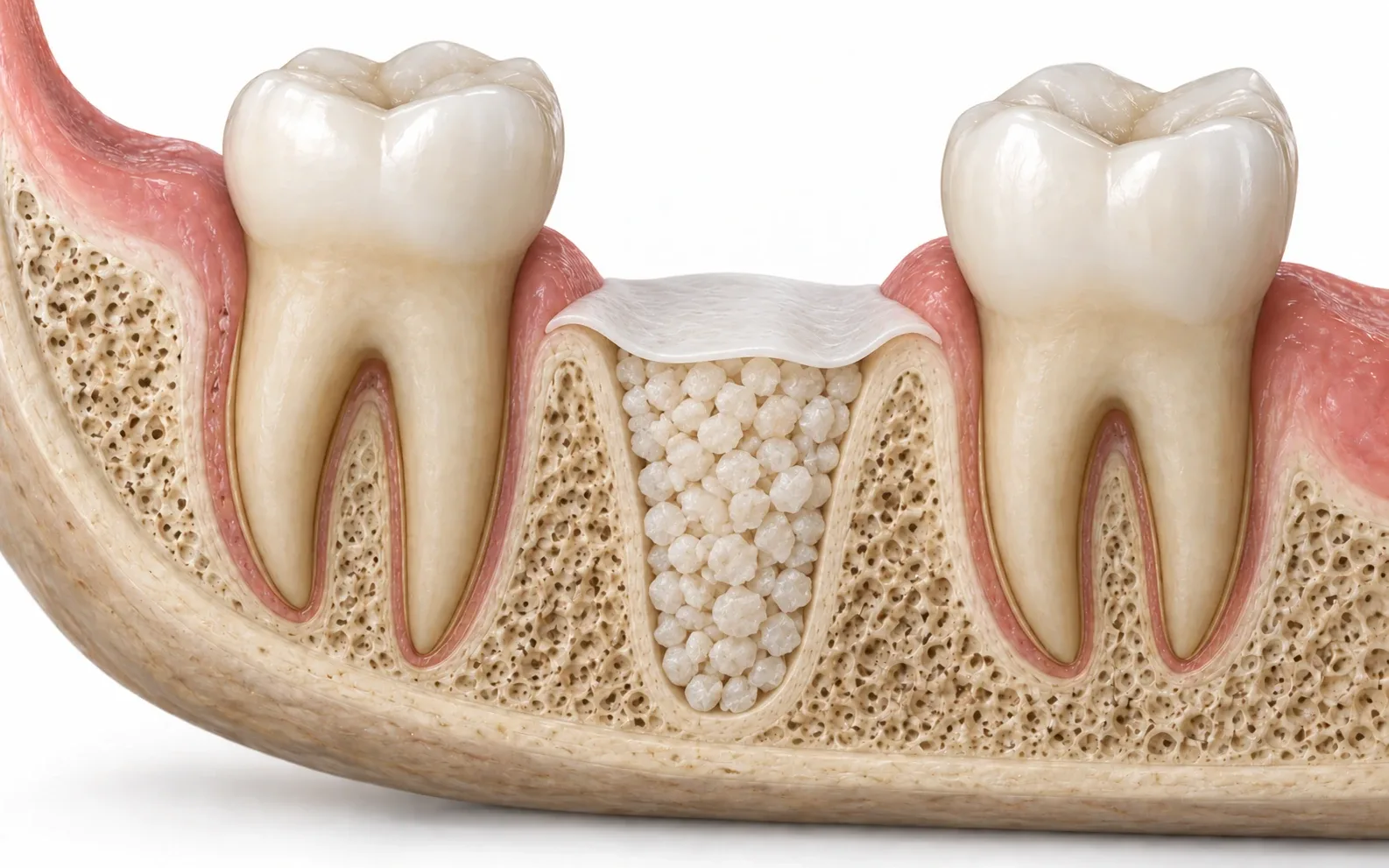
We want to correct one common misunderstanding. A bone graft is not about packing in outside bone and leaving it there.
It is closer to creating a space and a framework for your own bone to grow into. The graft material acts as a scaffold for your bone, and over time it is replaced by your own bone.
When is a bone graft needed?
Some situations call for a bone graft, and others usually do not. The table below sets them side by side.
| Group | Situation |
|---|---|
| Needed | The jawbone is too thin or too low for the fixture to sit fully inside it |
| Needed | Periodontitis has dissolved the bone, leaving pits or an uneven surface |
| Needed | Long-term denture use has worn the jawbone down a lot |
| Needed | In the upper back teeth, the sinus has dropped and the remaining bone height is too low |
| Likely not needed | The tooth was lost to decay, not gum disease, and 4–6 months have passed so the bone has recovered |
| Likely not needed | The jawbone is naturally thick and firm, so the fixture sits fully inside it |

The last two rows are the part you can estimate for yourself. Where a tooth was lost to gum disease, the bone is often already damaged.
Where a tooth was lost to decay, the jawbone took less of a hit and tends to recover well. Younger patients tend to recover faster.
You may be less likely to need a bone graft if:
- the tooth was removed because of decay, not gum disease
- four to six months have passed since the extraction
- your jawbone is naturally thick and firm
Still, these are just likelihoods. Bone inside the gum cannot be seen from the outside, and we cannot judge it by eye either. The accurate answer comes from imaging.
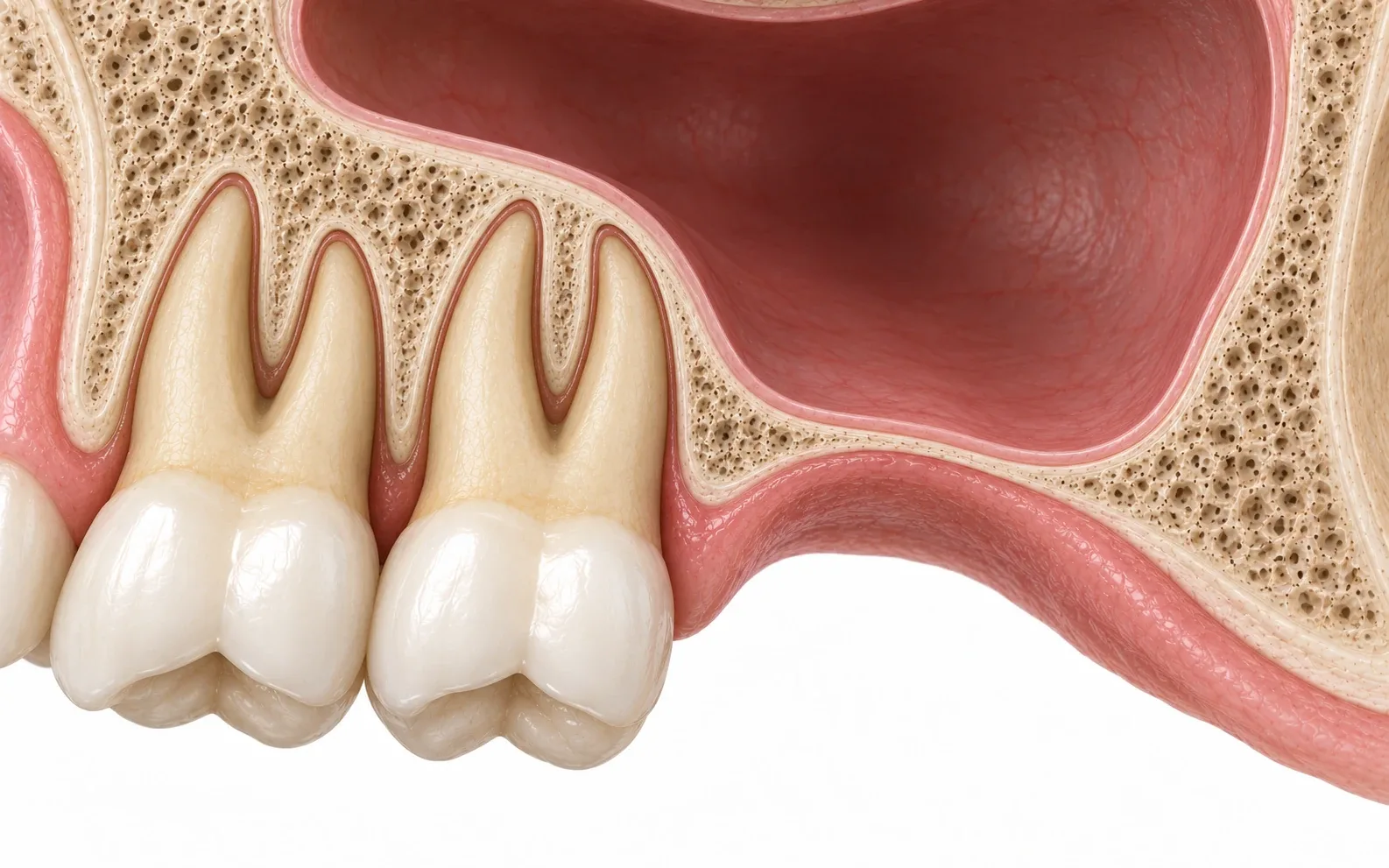
What about placing an implant right after extraction? It has an advantage, because the bone has not shrunk yet. But if inflammation has already left a defect around the lost tooth, it still has to be filled.
In fact, grafting at the same time as extraction can help keep the bone from collapsing.
How do we decide if you need a bone graft at our clinic in Busan?
There was a time when a dentist would put up a single panoramic X-ray and guess. "It looks white here, so there must be bone." With luck it worked, and without luck it failed.
Things are different now. We check in the following order.
1. A panoramic X-ray shows the whole picture
We first see how far the bone level has dropped and whether there are dark shadows at root tips. We also locate the nerve canal in the lower jaw and the sinus in the upper jaw.
2. A 3D CT scan measures the real dimensions
We check the height, thickness and density of bone at the planned site, and the distance to the nerve canal.
The answer is not "you have no bone." It is how many millimeters remain and how many need to be built, in numbers.
3. We explain while you look at the same screen
We point out which area is lacking and why. Our AI periodontal analysis shows the state of the jawbone in color, which makes it easier to follow.
4. Then the plan is set
At this stage we decide whether to graft, how large an area to graft, and whether to graft at the same time as placing the implant. The order should never be reversed.
On the CT scan, we measure these points before deciding on a bone graft:
- bone height at the planned site
- bone thickness
- bone density
- distance to the nerve canal
| Step | What we look at |
|---|---|
| Panoramic X-ray | Overall bone level, shadows at root tips, nerve canal and sinus position |
| 3D CT | Bone height, thickness and density; distance to the nerve, in millimeters |
| Explanation | Viewing the same screen together, with the AI analysis in color |
| Plan | Whether to graft, how much, and whether at the same time as the implant |
What materials are used for a bone graft?
There are four main types of graft material. Each has its own strengths.
| Type | What it is | Features |
|---|---|---|
| Autograft | The patient's own bone | Bonds very well, but bone has to be taken from another site, which adds a burden |
| Allograft | Processed bone from a human donor | Turns into your own bone relatively quickly |
| Xenograft | Processed bone from an animal source | Keeps its shape for a long time, which helps preserve volume |
| Synthetic graft | Man-made material | Steady supply, and mixes well with other materials |
No single material is always the right answer. We choose and mix them according to the site, the shape of the defect and the volume needed.
Expensive imported material is not always better. It is worth asking which material will be used and why.
Many patients worry about safety. The graft materials used today have been tested over decades. How they become one with your own bone is well established.
A thicker jawbone can also help protect against peri-implantitis later. It works like a shield against inflammation working its way inward.

What should you check at a consultation?
You need to check just three things.
- Do they show you on screen why it is needed? If a clinic simply says "you need a bone graft here" and moves on, think again. The test is whether they show you the inside of your gum on a 3D screen or in numbers until it makes sense. Data does not lie.
- Is the cost confirmed before surgery? You should not be told of an extra cost for a larger graft after surgery, while still numb. Surprises can happen during surgery, but a properly read CT predicts most of them.
- Do they promise it will always work without a graft? Some clinics know patients dislike grafts and say their skill makes one unnecessary. A claim that every case can be done without a graft is hard to accept.
It is true that a graft can be avoided by using a very short implant or by placing it deep. Each has a trade-off.
The upper jaw has softer bone than the lower jaw, and the sinus often makes it thin. A short fixture there may not hold up for long.
We have redone several cases where there was no trouble for the first two or three years, and then the implant loosened and came out. Placing it deep can also leave the crown badly shaped, so food gets stuck and cleaning becomes hard.
| Approach | What can go wrong |
|---|---|
| A very short implant | In the softer, thinner upper jaw, it may loosen after the first two or three years |
| Placing the implant deep | The crown can end up badly shaped, trapping food and making cleaning hard |
Does a bone graft cause a lot of swelling and pain?
That is an old story. In the past, the gum was opened widely and several extra procedures were done at once. Surgery took longer, and swelling and pain were greater too.
Today we make the smallest opening that is needed. With shorter surgery, swelling and pain have dropped a great deal compared with the past.
Where possible, we place the implant and do the bone graft in one surgery. The fixture bonds while the bone hardens, so the number of surgeries stays low and treatment time is shorter.
How much longer does treatment take with a graft? It depends on the site and the extent. When the sinus is involved in the upper jaw, we plan for about 5–6 months on average, including the time for the bone to firm up.
After a bone graft, a few precautions help healing:
- if the sinus was involved, do not blow your nose hard for a while
- take the prescribed medicine as directed
- avoid irritating the surgical site
We give you detailed instructions separately after surgery.
Frequently asked questions
Is it safe to have bone that is not my own in my body?
The materials used today have been tested over a long period. The graft material does not stay there forever. It serves as a scaffold for your own bone and is then replaced by it.
Does a bone graft help an implant last longer?
The more fully the fixture sits in bone, and the thicker the bone around it, the better. Thick jawbone also acts as a shield against inflammation working its way inward.
Another clinic said I don't need a bone graft. Why do you say I do?
Differing opinions are not unusual. The judgment depends on the length and width of the fixture and how deep it is placed. What matters is hearing why each judgment was made.
Can I get bone graft and implant treatment in English in Busan?
Yes, we provide 1:1 English interpretation from the first consultation through the end of treatment. The clinic is near Seomyeon Station Exit 2 (5-min walk), opposite Lotte Hotel Busan. Call 010-8555-2854, or +82-10-8555-2854 from abroad.
A bone graft is not a step added to raise the bill.
It is leveling the ground before raising the pillars.
A house built in a hurry tends to run into trouble.
Avoiding a tedious step now and redoing everything later takes longer.
Doing it properly once is, in the end, the faster road.
If you are wondering whether you need a bone graft in Busan, we offer 1:1 English interpretation for patients living in or visiting Korea. Call 010-8555-2854 to book a consultation.
References
- KDCA National Health Information Portal, "Dental implants" — definition of implants and osseointegration, treatment time, care and complications
- KDA Dental News, "65% of implant patients have experienced peri-implant disease" (17th Gum Day, Korean Academy of Periodontology) — prevalence and risk factors of peri-implant disease, maintenance intervals
- KDCA National Health Information Portal, "Gum disease (periodontal disease)" — how gum inflammation progresses to the jawbone
- KDCA National Health Information Portal, "Systemic disease and periodontal treatment" — general health factors such as smoking and diabetes, and the gum tissues
- KDA Dental News, "Implant patients aged 65 and over exceed 800,000 last year" — growth in the number of implant patients in the country
Written by Reset Dental Clinic Support Team
Medical review Dr. Na In-chae, Head Dentist · Periodontics Specialist
Last updated: September 19, 2026
This column is for general information and does not replace diagnosis or treatment for individual patients. If you have symptoms, please see a dentist.


