

- It is not your imagination. The thickness of veneers is added straight onto the front of your teeth.
- Front teeth are the pillars that support your lips from inside. Thicker pillars push the lips forward.
- There are three ways to fix it: make them thinner, tilt them back, or move the teeth inward.
- When veneers are remade, the side profile matters most. A front photo alone is not enough to decide.
Some patients find their teeth are whiter after veneers, but their mouth now seems to stick out. We hear this at Reset Dental Clinic in Seomyeon, Busan, often from people who were told it is just their imagination. For patients living in or visiting Korea, we offer 1:1 English interpretation from the first consultation through the end of treatment.
It is not your imagination. In many cases, the teeth really have come forward.
This column explains why it happens and what can be done from where you are now.
Why do veneers make your mouth look pushed forward?
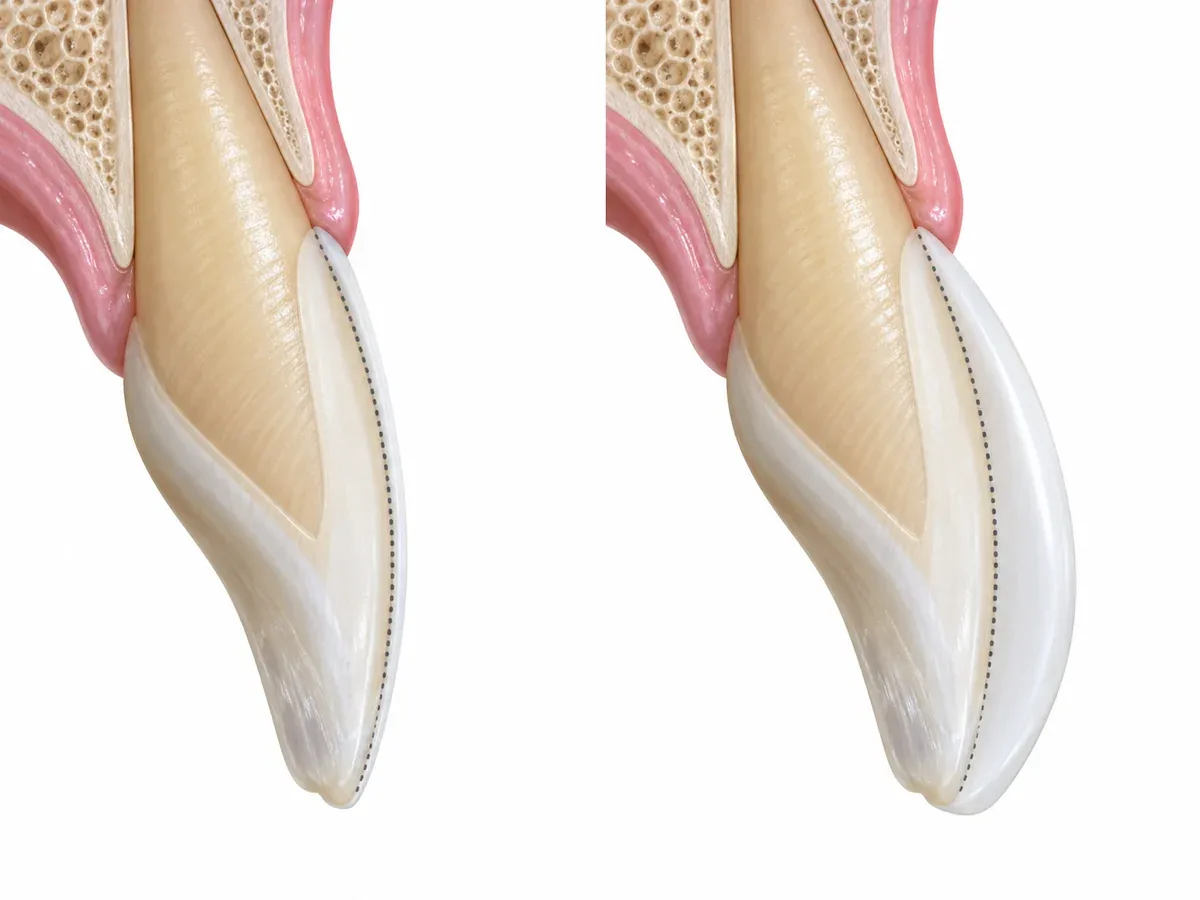
The reason is simple. When something is bonded onto a tooth that was not reduced, the tooth comes forward by that thickness.
If 0.6 mm was bonded, the tooth came 0.6 mm forward. The number sounds small.
But when six front teeth each come forward by 0.6 mm at once, the look of the whole mouth changes.
A second factor adds to this. Front teeth are the pillars that support the lips from inside.
The upper lip rests on the upper front teeth, and the lower lip rests on the lower front teeth. When the pillars get thicker, the lips are pushed out by the same amount.
Some people also feel that their lips no longer close comfortably. That feeling has a physical cause, too.
Seen from the front, this change is hard to spot. Seen from the side, it is obvious.

When is this most likely to happen?
It does not happen in every case. It tends to happen in the situations below.
| Front teeth before treatment | If veneers are bonded without reduction |
|---|---|
| Sat further back | They look more natural. The thickness was needed |
| Sat in a normal position | They come forward a little, depending on thickness |
| Already stuck out | They come further forward. This is the biggest problem |
| Dark color, made thick to cover it | They come further forward, because covering takes thickness |
In short, the effect is largest when teeth that already stuck out received thick veneers without reduction.
This is more common than you might think. The reason is that "no reduction" is often taken to mean "always better."
No reduction can be the right choice for teeth that sit further back. For teeth that already stick out, it adds to the very thing that was bothering you.
A dark color adds its own problem. To cover it, the veneers need thickness, and that thickness also goes forward.
That is why the starting position of the teeth matters as much as the method.
How can thick veneers change speech and lip closure?
It is not just about how things look. Thick veneers can also change these:
- Speech: the tongue touches the teeth in a new place, so "s," "j" and "ch" sounds can feel awkward.
- Lip closure: at rest, the lips no longer close by themselves, and you have to make an effort.
- Jaw movement: front teeth act like a steering wheel that guides the jaw. When they get thicker, every movement meets a brake.
- Dry lips: when the mouth tends to stay open, the lips and gums dry out.
Among these, jaw movement matters most.
A brake that catches thousands of times a day can eventually chip the veneers or make them come off.
This is the point where a problem of looks becomes a problem of function. It is one more reason to look at thickness early, before chipping starts.
Will you get used to it over time? You do get used to the look to some degree. However, a catching jaw and lips that will not close are not things you simply adapt to.
If the discomfort continues, it is better to have it checked.
| Area | What changes | Do you adapt? |
|---|---|---|
| Appearance | The mouth looks pushed forward | Partly |
| Speech | "S," "j" and "ch" sounds feel awkward | Usually, unless very thick |
| Lip closure | Effort is needed to close the lips | Not easily |
| Jaw movement | A brake on every movement | No, it can lead to chipping |
What can be done if your veneers look too thick?
There are three directions.
Which one fits depends on your teeth, your bite and how much time you have. Sometimes two are combined, such as moving the teeth slightly and then making thinner veneers.
1. Remake them thinner
This is the most direct option. The current veneers are removed, and thinner ones are made to replace them.
There is a condition, though. To make them thin, there must be no dark color to cover.
If the natural tooth is dark, a thin veneer cannot hide it. In that case we look at whitening first, or at other methods alongside it.
Whitening first often helps. The lighter the color to cover, the thinner the veneers can be, so some plans go whitening first, then remaking. How much whitening brightens teeth differs from person to person.
2. Tilt them back
Even at a similar thickness, tilting the front teeth back slightly changes the profile. The same thickness then sticks out less.
This works within the limits of how the upper teeth meet the lower front teeth. Tilt them back too far, and they hit the lower teeth.
3. Move the teeth inward
This is the most fundamental option. Orthodontic treatment moves the front teeth inward, and thin veneers are then made on top.
It takes longer, but the result looks the most natural. It also means no more tooth has to be removed. For younger patients, we tend to suggest this direction first.
How far can teeth move inward? It depends on the teeth and the gum bone, and there is a limit. Teeth can move within a set range inside the bone, so we check that range with an X-ray first.
| Option | What changes | Condition |
|---|---|---|
| Remake thinner | Less thickness in front of the teeth | No dark color to cover, or whitening first |
| Tilt back | A flatter profile at similar thickness | Must not hit the lower front teeth |
| Move teeth inward | The teeth sit further back | Within the range the bone allows |

What do we check when veneers are remade?
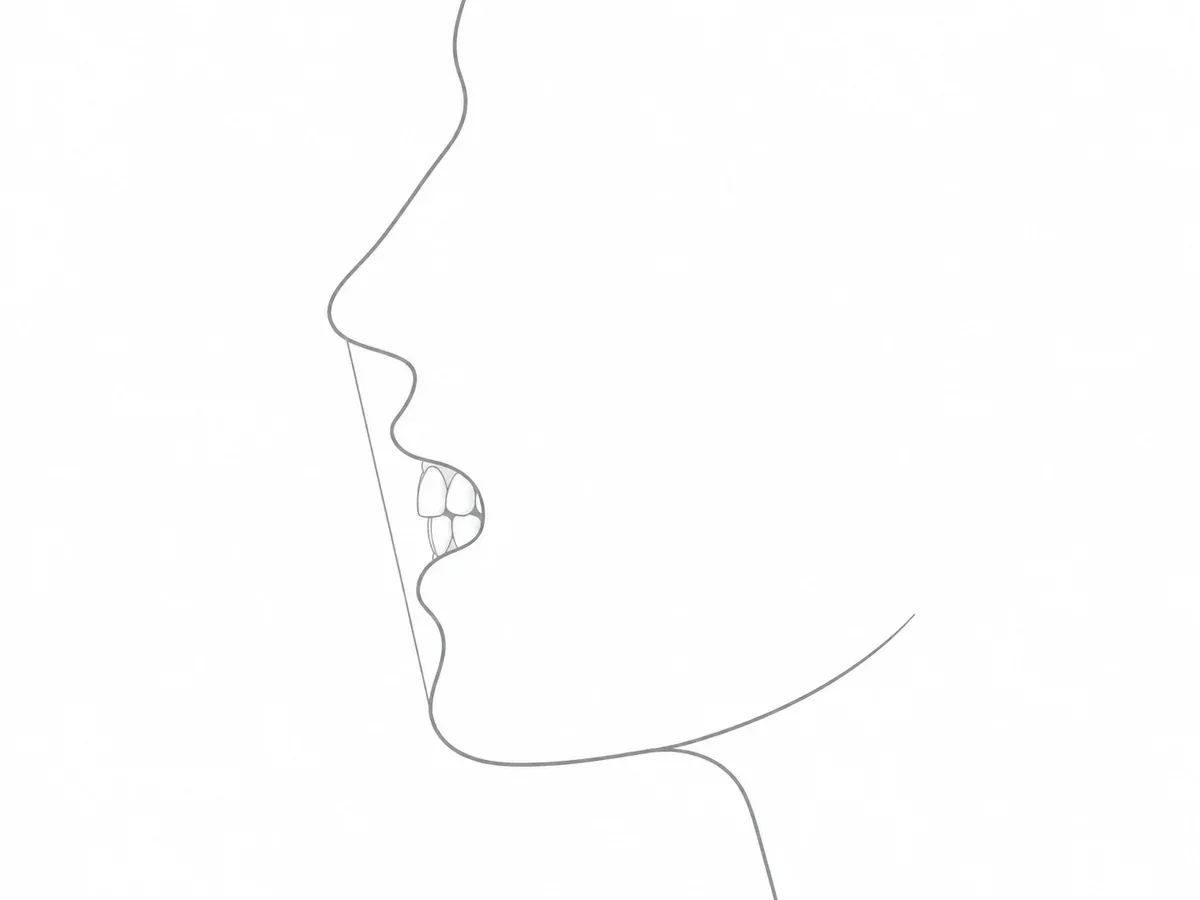
The most important thing is the side profile.
Front photos show color and shape. Side photos show thickness, which is what caused the problem in the first place.
If the decision is made from front photos alone, the same problem tends to repeat. From the front, thickness cannot be seen.
So we always look at side photos of the lip line as well. Specifically, we check these points:
- Do the lips close comfortably at rest?
- What line do the tip of the nose, the lips and the chin form?
- How much of the upper front teeth shows when you smile?
- Where do the upper teeth meet the lower front teeth?
- Does anything catch when the jaw moves side to side?
| Check | What it shows |
|---|---|
| Lips at rest | Whether the front teeth are pushing the lips out |
| Nose, lips and chin | How the added thickness changes the profile |
| Teeth shown when smiling | How long and how prominent the front teeth should be |
| Meeting point with lower teeth | How far the teeth can be thinned or tilted back |
| Side-to-side jaw movement | Whether the new shape will put a brake on the jaw |
After all of this is checked, we decide how many millimeters thick the veneers should be. The order must never be reversed. Deciding the thickness first and checking the profile later is how the problem often starts.
Can you redo just one or two teeth? Sometimes. However, if two of six become thinner, those two will look set back, so the neighboring teeth have to be considered too.
Removing the old veneers is also a step to plan for. If they were bonded without reduction, the tooth itself usually remains, but the surface can be slightly damaged and the adhesive must be cleaned off.
Can you preview the result before remaking veneers in Busan?
Yes, and you should insist on it. Whether you are treated in Busan or elsewhere, a preview step is available.
A model or temporary material is used to place the planned shape directly in your mouth. With it in place, you can:
- look in the mirror
- have side photos taken
- try speaking
- tell us how it feels
If you say "this looks too far forward" at this stage, it can be reduced on the spot. After the veneers are finished, reducing them is much harder.
A preview also makes it easier to speak up. Asking for a little less on a temporary shape feels far simpler than asking for changes to finished veneers.
This is also why we listen to patients at length during consultations. The more you tell us, the better we understand your taste and the direction you want.
A dress can look flawless on a store mannequin and feel awkward on you. A good shape for teeth differs from person to person in the same way.
Should you go back to the clinic that placed your veneers? Consulting there first is the natural order, since adjustment sometimes solves it. If you still have no answer, get another opinion; this is not about criticizing other dentists.
Worried it will happen again? That worry is natural, so insist on two things:
- a try-in of the planned shape before the veneers are finished
- side-view photos, not just front photos
Keeping just these two makes a repeat much less likely.
Frequently asked questions
If my veneers are removed, will my teeth go back to how they were?
If they were bonded without reduction, the teeth themselves usually remain. The surface can be slightly damaged during removal, and the adhesive needs to be cleaned off.
Can the veneers be tilted back instead of remade?
Sometimes a change in angle reduces how far they stick out. It works within the limits of how the upper teeth meet the lower front teeth.
Will whitening let me have thinner veneers?
Often, yes. The lighter the color to cover, the thinner the veneers can be. How much whitening brightens teeth differs from person to person.
Can I get veneers checked in English in Busan?
Yes. We offer 1:1 English interpretation from the first consultation through the end of treatment. The clinic is near Seomyeon Station Exit 2 (5-min walk), opposite Lotte Hotel Busan, and you can call 010-8555-2854 (+82-10-8555-2854 from abroad).
It is not your imagination.
The thickness of veneers is added straight to the front,
and front teeth are the pillars that support your lips.
Make them thinner, change the angle, or move the teeth inward.
If you are in Busan, Reset Dental Clinic offers 1:1 English interpretation from your first consultation through the end of treatment.
Call 010-8555-2854, and we will start by looking at your profile together.
References
- KDCA National Health Information Portal, "Laminate Treatment" — the thickness of laminates (veneers) and when they are used
- KDCA National Health Information Portal, "Orthognathic Surgery and Orthodontic Treatment" — how teeth relate to the lips and profile, and what orthodontics can adjust
- KDCA National Health Information Portal, "All-Ceramic Crowns" — how the thickness and shape of a restoration affect the result
- KDA newspaper Dailydental (Chiui Sinbo), "Court Orders Damages for Excessive Tooth Reduction in Laminate Treatment" — how the court viewed explanation before treatment and predictability
- KDA newspaper Dailydental (Chiui Sinbo), "Clear Aligners: Tooth Slenderizing, Explaining Limits and Keeping Records Are Essential" — why the limits of treatment should be explained in advance
Written by Reset Dental Clinic Support Team
Medical review Dr. Kim Hyun-joo, Head Dentist · Esthetic Restorations
Last updated: September 19, 2026
This column is for general information and does not replace diagnosis or treatment for individual patients. If you have symptoms, please see a dentist.


