- In most cases you can switch from dentures to implants. But years of wear usually mean less bone, so bone often has to be rebuilt first.
- Dentures get loose not because they are old, but because the jawbone beneath them is shrinking.
- Fixing all the teeth in place is not the sole option. A few implants can hold your dentures firmly as a middle path.
- Even if several clinics said "it cannot be done," your X-rays are worth a second look.
"I have worn dentures for years. Can I switch to implants now?" We hear this often at our clinic in Seomyeon, Busan, and in most cases the answer is yes. For patients living in or visiting Korea, we offer 1:1 English interpretation from your first consultation through the end of treatment.
There is one condition. The longer you have worn dentures, the more the bone underneath has shrunk.
This column explains why dentures slowly get loose, what has to come first when switching to implants, and what options exist besides fixing every tooth in place.
Why do dentures get looser over time?
Many people think their dentures have simply worn out. They have not. The appliance is the same, but the jawbone beneath it has shrunk.
Each time you chew, a tooth root passes force into the jawbone. That stimulation is what keeps the bone in place.
When a tooth is lost, that stimulation disappears. It is like a muscle that wastes away when it is not used.
Dentures rest on top of the gums and have no roots in the bone. So chewing force does not reach the bone properly.
Instead, pressure from above keeps pressing on the bone and speeds up its loss. Over time, the ridge that supports the dentures becomes lower and narrower.
That is why a set that fits well at first starts to move after a few years. You begin to use adhesive, and then chewing becomes hard.
The cause is the shrinking jawbone. So even a new set will go through the same thing again.
- Teeth are lost, and the bone loses its stimulation.
- Dentures press on the gums, and the bone keeps shrinking.
- The fit loosens, and adhesive becomes a habit.
- Chewing gets harder, and a new set follows the same path.

Can you switch from dentures to implants in Busan?
In most cases, yes. But there is an order to follow.
If you have worn dentures for a long time, the remaining bone is likely to be thin. Sometimes implants can be placed right away.
In other cases, the bone has to be built up first. In the upper back teeth, a sinus lift may also be needed.
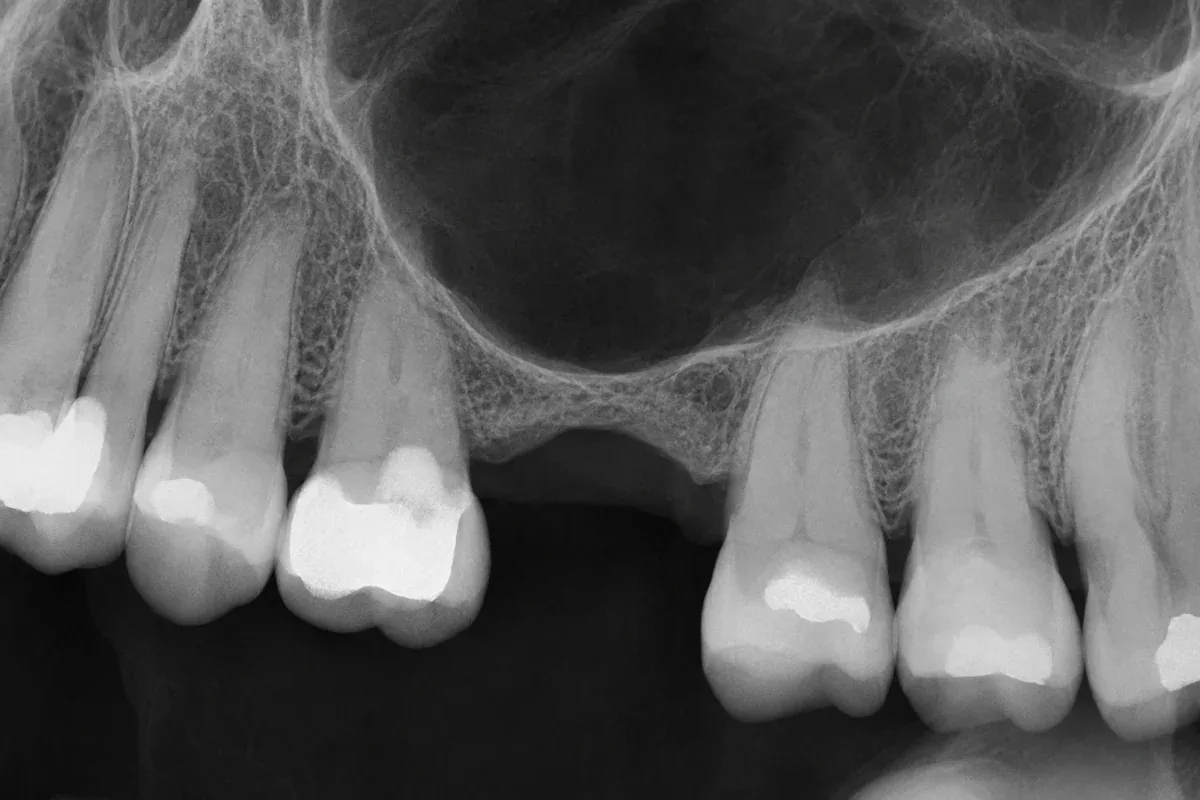
Before any plan is made, we look at a few things with X-rays and 3D CT.
- how much bone remains, and how thick it is
- whether a bone graft is needed first
- in the upper jaw, how close the sinus sits to the back teeth
- your general health and any medicines you take
What matters is checking what is possible with what remains now. The longer you wait, the more bone you lose, and your options shrink with it.
Even after more than 20 years of dentures, we do not assume it is too late. Much bone may be gone, but grafting or implant-held dentures are often still possible.
How long the switch takes depends on the bone. Without grafting it takes a few months, and grafting adds more time.
You are not left without teeth for those months, though. A temporary appliance keeps you eating while the work goes on, as explained further below.

Is fixing every tooth in place the sole option?
No, and this surprises many people. There is a middle step.
A few implants are placed, and the dentures click onto them. You still take the dentures in and out. But the implants hold them, so they do not wobble.
| Point | Dentures on the gums | Implant-held dentures | Fixed full-arch implants |
|---|---|---|---|
| Taking in and out | Yes | Yes | No |
| Wobbling | Gets worse over time | Very little | None |
| Chewing force | Very limited | Much better | Stronger still |
| Implants needed | None | A few | Six to eight |
| Bone needed | Little | Relatively little | A lot |
| Cleaning | Take them out and clean | Take them out and clean | Clean underneath with floss |
For people with little bone, or for whom major surgery is a concern because of their general health, the middle option can be a very good choice.
Fewer implants mean less strain on the body. Yet chewing changes a great deal.
Day to day, you still remove the appliance to clean it, just as before. The difference is that it stays put while you eat and talk, because the implants grip it.
It also needs less bone than a fixed full arch. For patients who have lost a lot of bone over the years, this can make implants possible with the bone that remains.
How many implants are needed depends on the remaining bone and which jaw it is. It is clearly fewer than for fixed full-arch implants.
We do not say "everything must be fixed, no matter what." The right choice depends on your remaining bone and your daily life.

Can one jaw be done first?
Yes. If you wear dentures in both jaws, many people start with the side that bothers them more. This also spreads the treatment over time, which some patients find easier.
Lower dentures tend to move more, so many people start with the lower jaw. The upper dentures can then be kept and adjusted to match.
What if you wear a partial denture?
A partial denture hooks onto your remaining natural teeth. But the teeth it hooks onto keep taking extra force.
A tooth with a clasp on it carries far more force than its own share. Over time it starts to loosen, and it is often lost in the end.
This tends to become a cycle:
- the clasped tooth loosens and is removed
- a new partial denture has to be made
- the clasp is hooked onto the next tooth
- that tooth now takes the extra force
So if you wear partial dentures, it is worth having a check before you lose more teeth. The more teeth remain, the more options you have.
Each lost tooth also means a little more bone lost in that spot. Checking early is how you keep the most choices open.

What if other clinics said it cannot be done?
Many patients who come to us have already visited several clinics. These are the reasons they hear most often.
A second look starts with new X-rays and a 3D scan of the remaining bone. Sometimes the answer turns out the same, and then we will tell you so honestly. But sometimes a different route appears, as the table below shows.
| What you were told | What we check |
|---|---|
| "There is no bone" | Whether bone can be built with grafting, and whether firm bone remains deeper down |
| "Not with your osteoporosis injections" | The type of drug, how long it was used and whether it was stopped, checked with your doctor |
| "It is too close to the nerve" | We measure the real distance in 3D and recalculate length and angle |
| "We cannot touch an implant placed elsewhere" | Whether that implant can be kept and used in the plan |
First, to be clear, that judgment is not careless. Restoring a whole arch where there is no bone is difficult and carries real risk. It is also true that a cautious answer is the safer one.
But after 20 years of working with gums and bone, we do not want to hide behind that safety. If we give up, that patient may be left eating soft food for the rest of their life. We simply do not want to see that.
If you take osteoporosis medication, please tell us in advance. A rare side effect on the jawbone is known, so we look carefully.
Depending on the drug and how long you have taken it, treatment is often still possible. We check first, and we talk with the prescribing doctor if needed.
This is not meant as criticism of other dentists. It is simply there to protect you as a patient.
How do you eat while switching from dentures?
This is what patients worry about most. We do not leave you without teeth.
If conditions allow, temporary teeth are fitted on the day the implants are placed. Some patients can eat that same evening.
If there is not enough bone for same-day teeth, we make a temporary appliance to wear while the implants heal.
Sometimes we modify your current dentures so you can keep wearing them. Whatever the approach, we plan so that your meals and social life are not interrupted.
| Situation | What you wear meanwhile |
|---|---|
| Bone allows same-day teeth | Temporary teeth fitted on the day of surgery |
| Not enough bone for same-day teeth | A temporary appliance made for the healing period |
| Current dentures can be adapted | Your own dentures, modified to fit |
The healing period can last a few months, so this part of the plan matters as much as the implants themselves. We explain it before treatment begins, not after.
Please do not throw away your current dentures; bring them with you. We often modify them for use during treatment. They also show us how your teeth meet now.

Three questions to ask at any consultation
- "How much bone do I have left?" Listen for an answer in numbers, based on your X-rays. This also shows whether a bone graft is needed.
- "Are there options besides fixing everything in place?" See whether the options are explained, or one choice is pushed.
- "How will I eat during treatment?" A clinic that explains this first is a good sign.
Frequently asked questions
I have worn dentures for over 20 years. Is it too late?
We do not assume so. Much bone may be gone, but grafting or implant-held dentures are often still possible. We will take X-rays and tell you what can be done with what remains.
Does chewing really feel different after switching from dentures?
Very different. Dentures sit on the gums and slide under pressure, while implants are fixed in bone and pass the force directly. Natural teeth have a sensing tissue called the periodontal ligament, though, so the feel is a little different.
Can I get this treatment in English in Busan?
Yes. We provide 1:1 English interpretation from the first consultation through the end of treatment. The clinic is near Seomyeon Station Exit 2 (5-min walk), opposite Lotte Hotel Busan, and you can call 010-8555-2854 (+82-10-8555-2854 from abroad).
Loose dentures are not the dentures' fault.
The bone beneath them is shrinking.
So the longer you wait, the fewer options remain.
The first step is to check
what is possible with what you have now.
Fixing everything in place is not the sole option.
A few implants can also hold your dentures.
We will decide together, looking at your bone and your daily life.
If you are thinking of replacing dentures with implants in Busan, Reset Dental Clinic offers 1:1 English interpretation from your first consultation through the end of treatment. Call 010-8555-2854 to book a consultation.
References
- KDCA National Health Information Portal, "Dental Implants" — when implants are used, osseointegration, treatment time and complications
- KDA newspaper Dailydental (Chiui Sinbo), "Implant Patients Aged 65 and Over Top 800,000 Last Year" — the trend of fewer insured denture patients and more implant patients
- KDCA National Health Information Portal, "Gum Disease (Periodontal Disease)" — how teeth are lost and how jawbone is lost
- KDCA National Health Information Portal, "Systemic Disease and Periodontal Treatment" — how diabetes, osteoporosis and other conditions relate to bone and gums
- KDA newspaper Dailydental (Chiui Sinbo), "65% of Implant Patients Have Had Peri-Implant Disease" (Korean Academy of Periodontology, 17th Gum Day) — risk factors for peri-implant disease, including osteoporosis medication
Written by Reset Dental Clinic Support Team
Medical review Dr. Na In-chae, Head Dentist · Periodontics Specialist
Last updated: September 19, 2026
This column is for general information and does not replace diagnosis or treatment for individual patients. If you have symptoms, please see a dentist.