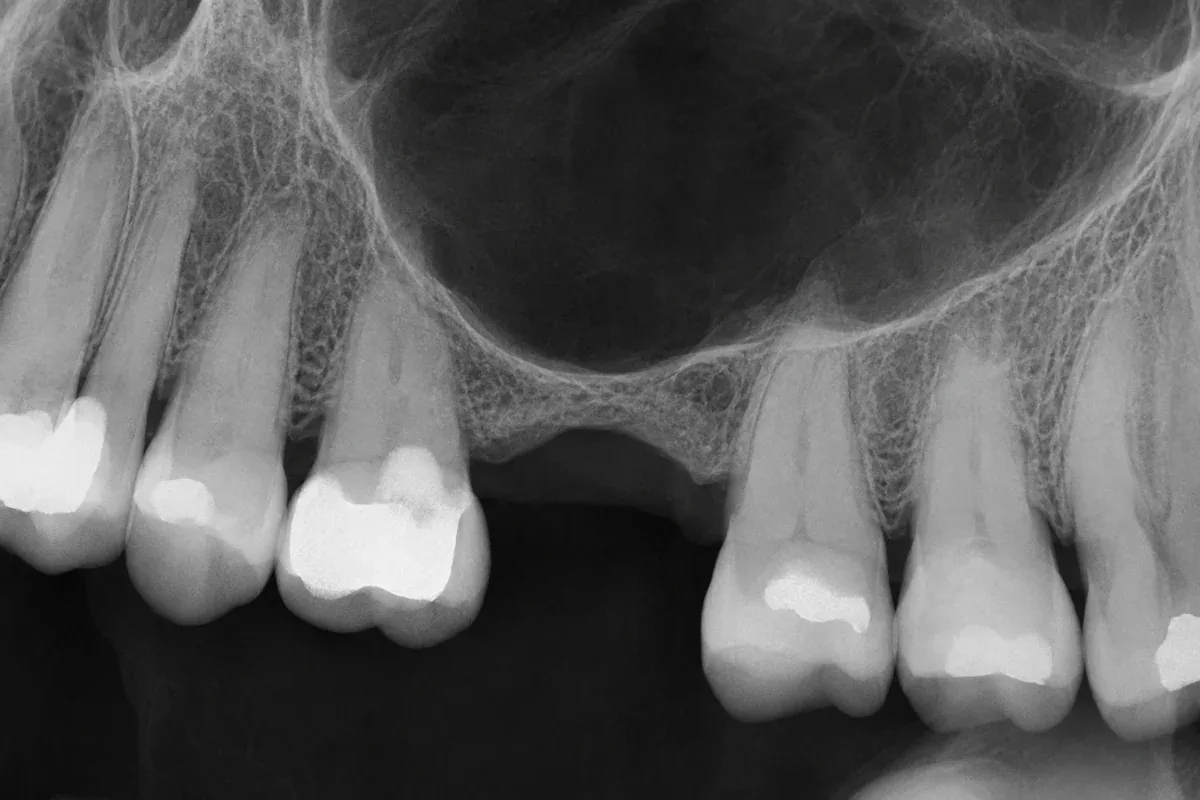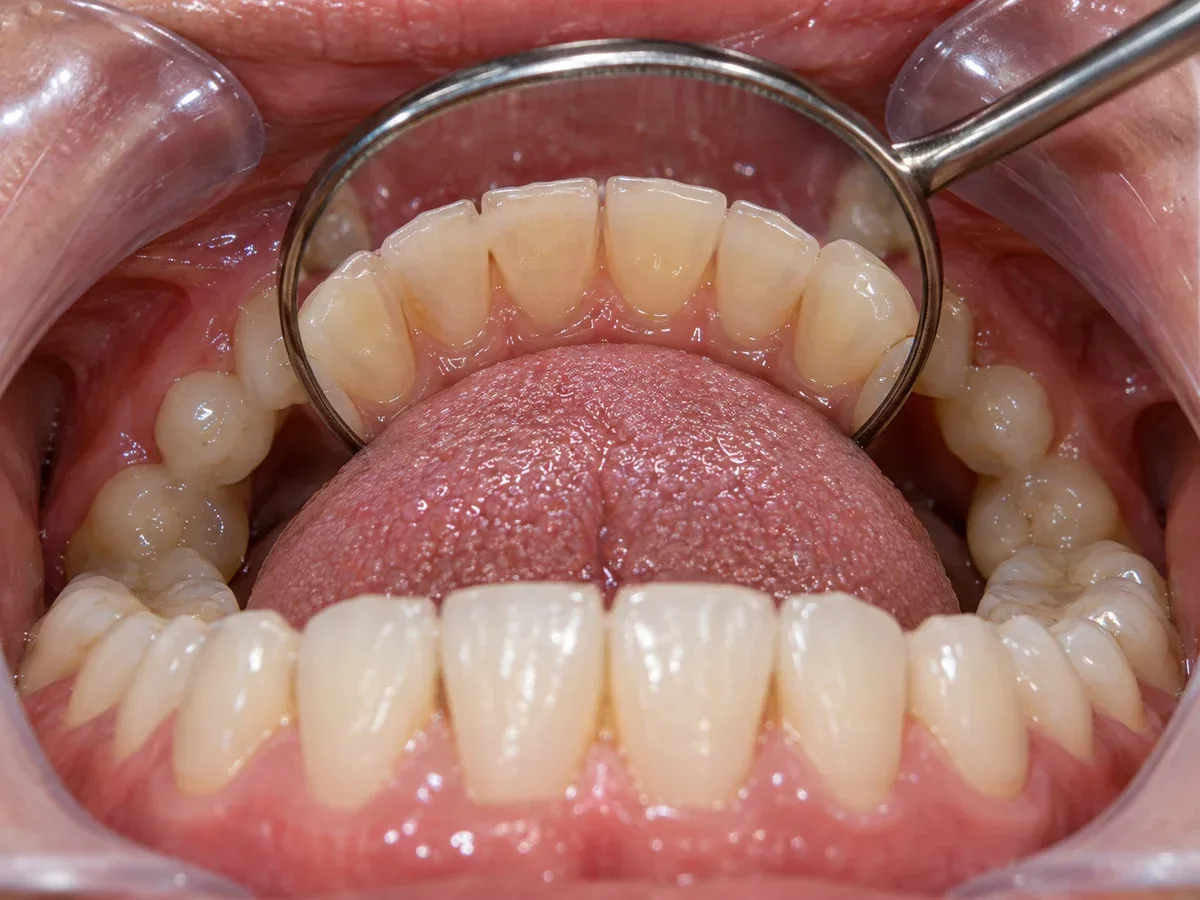
- Tooth decay starts when acid made by bacteria in plaque dissolves the tooth's outer layer. Brushing is about clearing away that sticky layer of bacteria.
- In Seomyeon, Busan, we often meet patients who brush well yet keep getting cavities. Fluoride helps refill the spots where minerals were lost and makes the surface harder for acid to dissolve. It does not fill a cavity that is already there.
- A professional fluoride treatment is repeated every 3–6 months, while fluoride toothpaste and mouthrinse are used every day. One does not replace the other.
- Not rinsing or eating for a set time afterwards is part of the treatment itself.
"I brush every day, but they keep finding new cavities." We hear this often at our clinic in Seomyeon, Busan, even from people who brush for a long time. In cases like this, one thing we look at together is a fluoride treatment. For patients living in or visiting Korea, we provide 1:1 English interpretation from the first consultation through the end of treatment.
A fluoride treatment does not mean you will never get another cavity. This column explains calmly what it does, how it is done and what you can reasonably expect from it.
How does tooth decay start, even when you brush?
The Korea Disease Control and Prevention Agency (KDCA) describes tooth decay (dental caries) as a disease caused by bacteria. It is not a worm eating the tooth. It is closer to an infection.
Here is how it happens. Bacteria use the carbohydrates in food to stick to the tooth surface, and that sticky mass becomes dental plaque.
The bacteria in plaque break down carbohydrates and make acids such as lactic acid. These acids dissolve enamel, the hard outer layer of the tooth.
This loss of minerals is called demineralization. The reverse process, where calcium, phosphate and fluoride from saliva settle back into the tooth, is called remineralization.
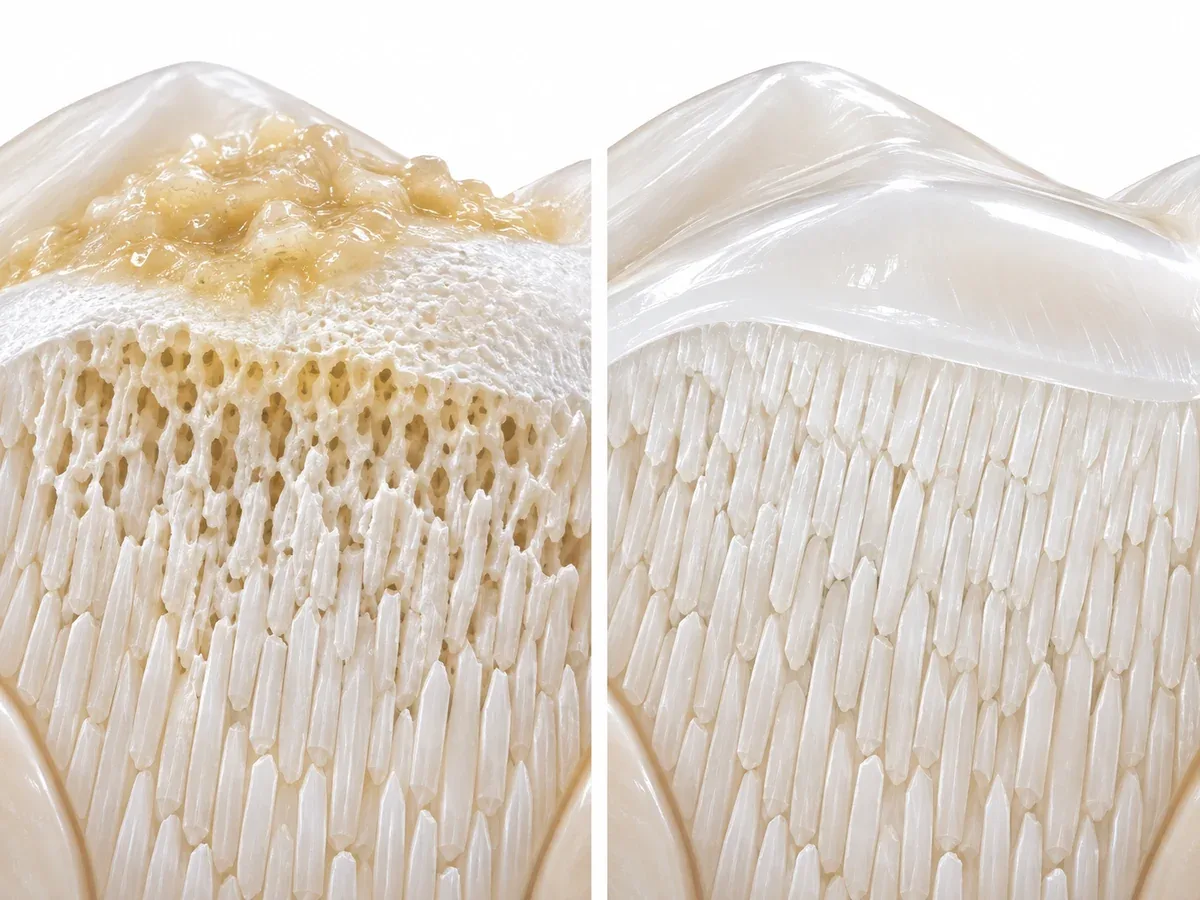
The key point is that both processes take turns every single day. When the balance stays tipped toward dissolving for a long time, a cavity forms.
Caring for your teeth is really about tipping that balance back, a little at a time. Brushing removes the plaque that makes acid. A fluoride treatment and fluoride toothpaste help the rebuilding side.
| Process | What happens | What pushes it |
|---|---|---|
| Demineralization | Minerals leave the enamel and the surface weakens | Acid made by bacteria in plaque |
| Remineralization | Minerals settle back into the enamel | Calcium, phosphate and fluoride in saliva |
| Cavity | A hole forms in the tooth | Dissolving wins for a long time |
What does fluoride actually do for your teeth?
Fluoride is a trace element the human body needs. The KDCA describes it as having properties that help prevent tooth decay.
When fluoride is applied to the teeth, its work can be summed up in four points.
- It binds to the tooth and makes the tooth harder.
- It builds up in the outer layer and raises resistance to the acid made by bacteria.
- Plaque and saliva act as a store, releasing fluoride slowly and helping the tooth harden.
- It has an antibacterial effect that makes it harder for decay-causing bacteria to settle.
In short, fluoride works to prevent decay from starting and to slow down decay that has already begun.
We want to be clear about one thing. Fluoride is not a treatment that reverses a hole once it has formed.
It helps the surface. It does not rebuild what is already gone. That difference shapes how we plan care for each patient.
What happens during a professional fluoride treatment in Busan?
A professional fluoride treatment, done by a dentist or dental hygienist, uses a much higher concentration than home products. The KDCA notes that misuse by individuals can cause poisoning.
For that reason, a professional fluoride treatment should be done under a professional's judgment and control. There are two common methods.
Fluoride gel
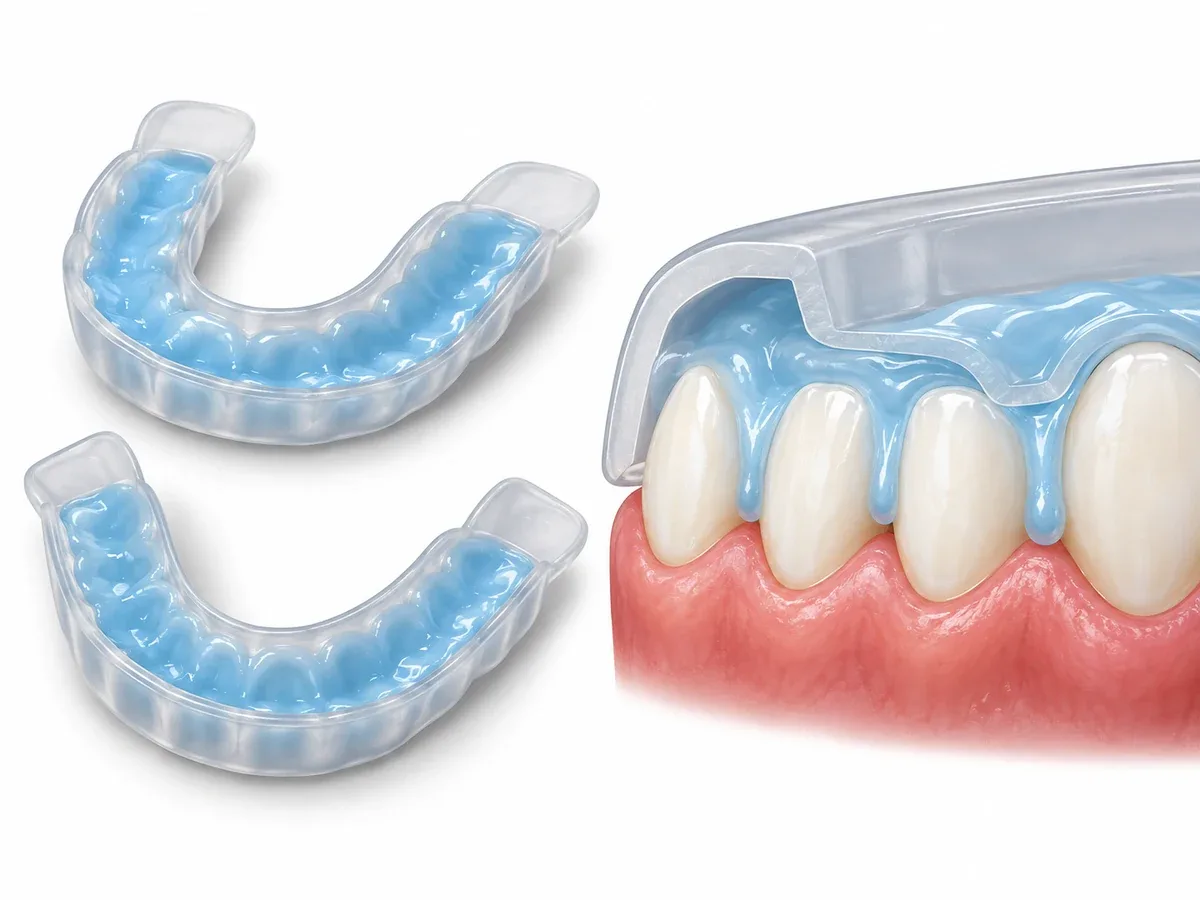
A gel is placed in trays that fit over the upper and lower teeth, and you bite down gently. Both arches can be treated at once, so it is quick.
The gel does not run off, so it stays in contact with the teeth for longer. We ask you to spit out saliva as it builds up.
- The gel is loaded into U-shaped trays.
- The trays go over your upper and lower teeth.
- You bite gently while the gel reaches between the teeth.
- You spit out saliva as it collects.
Fluoride varnish
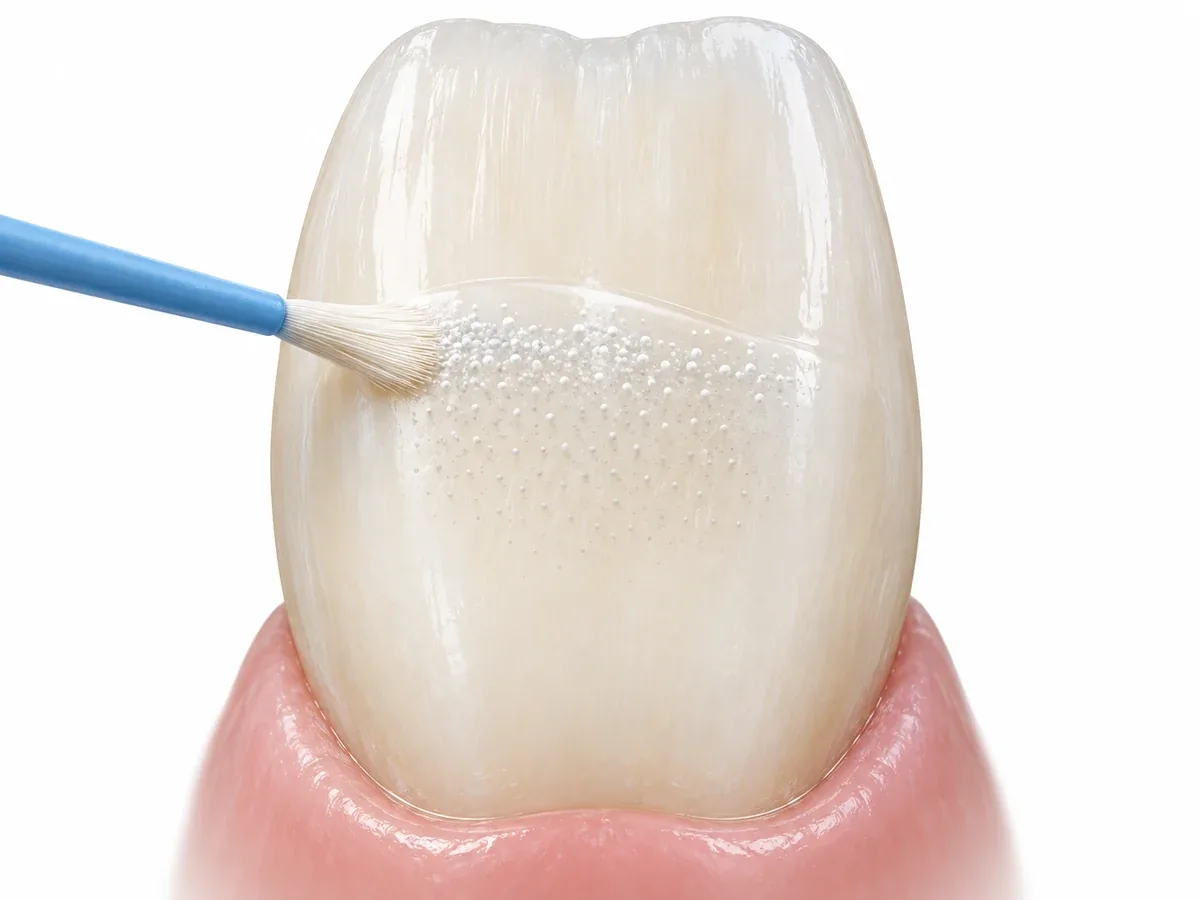
Fluoride varnish forms a thin film after it is applied. The film stays on the tooth for a while and releases fluoride steadily.
We remove saliva and dry the teeth first. Then the varnish is spread in a thin layer with a small brush, much like painting on nail polish.
| Method | Rinsing and eating | Brushing |
|---|---|---|
| Fluoride gel | No rinsing, eating or drinking for 30 minutes | As usual |
| Fluoride varnish | No rinsing, eating or drinking for 1 hour | Gently, after 4 hours |
Varnish is very sticky and can damage toothbrush bristles. So we suggest brushing with an old toothbrush or a disposable one.
If you do not keep to these times, the fluoride you just had applied simply washes away. If you have a meal planned, tell us beforehand and we can adjust the order of your visit.
A fluoride treatment can also be done on the same day as scaling. Since the teeth must be free of saliva and dry anyway, it fits naturally after a cleaning. Depending on your gums, we may split them into separate days.
How do you use fluoride at home?
Low-concentration fluoride that you use yourself every day is called self-applied fluoride. Fluoride toothpaste and fluoride mouthrinse both belong here.
Fluoride toothpaste
The KDCA recommends toothpaste with 1,000–1,500 ppm fluoride for all ages. The amount, however, changes with age.
| Age | Amount of toothpaste | Note |
|---|---|---|
| Under 3 | The size of a grain of rice | A parent squeezes it out |
| 3 to 6 | The size of a pea | Watch that the child spits it out |
| Over 6 | A pea-sized amount or a little more | 1,000–1,500 ppm toothpaste |
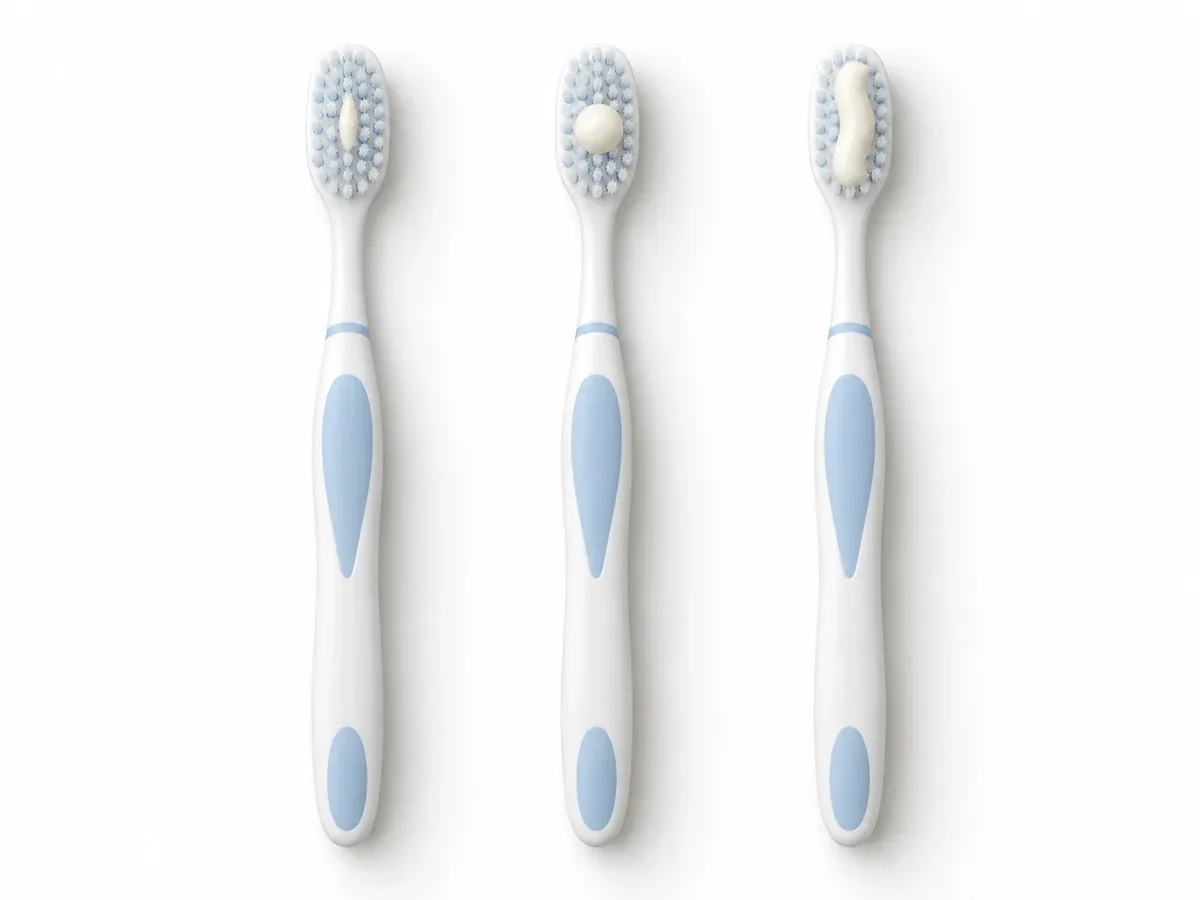
Fluoride toothpaste is recommended even for children under 2. But if a child aged 6 or under cannot spit well yet, a parent should control the amount.
If your child keeps swallowing toothpaste, use less and squeeze it out yourself. Stay close by until they have learned to spit.
Fluoride mouthrinse
Mouthrinses sold in stores contain 0.05% sodium fluoride and are used once a day. Here is how to use one:
- Take about 10 ml into your mouth.
- Swish it around for 1 minute so it reaches every tooth.
- Spit it out.
- Do not rinse with water, and do not eat or drink for 30 minutes.
Children aged 6 or under may swallow the rinse, so the amount is cut to about 5 ml. An adult must watch them the whole time.
The rule of no rinsing and no food for 30 minutes follows the same logic as the professional fluoride treatment. The fluoride needs time to stay on the teeth.
How often do you need a fluoride treatment?
Applied fluoride soaks in shallowly, into the very outer layer of enamel. Over time, much of it wears away.
That is why the KDCA recommends repeating a professional fluoride treatment every 3 to 6 months. The guidance on frequency goes further than that.
The Korean Academy of Dental Sciences recommends it at least twice a year for children and teenagers aged 3 and over, and for adults prone to decay. The American Dental Association recommends 2 to 4 times a year, depending on risk.
In other words, the interval is set after looking at your risk. It is not the same for everyone.
Timing matters too. According to the KDCA, enamel becomes fully hard about 2 years after a tooth comes through the gum.
So fluoride is described as most helpful from the time the first baby teeth appear until 2 years after the last adult teeth come in. That is roughly up to age 14 or 15.
| Type | Concentration | How often |
|---|---|---|
| At the dental clinic | High | Every 3–6 months |
| At home | Low | Every day |
Many people believe fluoride does nothing for adults. The KDCA explains that adults at high risk of decay can also benefit. It adds that fluoride can reduce and prevent sensitive teeth.
If your toothpaste already contains fluoride, you may wonder whether you still need a clinic visit. Toothpaste gives a low dose every day, while the clinic gives a high dose every few months. Whether you need it, and how often, is decided after checking your decay risk.
Can too much fluoride be a problem?
We are asked this almost every time. The concern the KDCA describes is dental fluorosis, which shows up as spots on the teeth.
Fluorosis can appear when too much fluoride is swallowed in infancy and early childhood, while the adult teeth are still forming.
The same source adds an important sentence. Once adult teeth have come into the mouth, taking in a lot of fluoride does not cause fluorosis.
So for children aged 6 or under, parents should watch the amount and make sure the child spits. Adults can worry much less about this.
Swallowing a large amount at once can cause nausea or vomiting. The KDCA advises making the person vomit it up, or giving something rich in calcium, such as milk, so less is absorbed in the gut.
This is why a child should never use a fluoride rinse alone. An adult should always be nearby.
During pregnancy, a fluoride treatment is not something you swallow, so it is usually not a heavy burden. Still, it depends on your stage and health, so we decide together with your obstetrician. Many pregnant women have sensitive gums, so we check the gums as well.
What fluoride cannot do, and who should get checked
Fluoride helps the surface of the tooth. A cavity that has already formed needs to be filled.
The KDCA explains that composite resin is used for both front and back teeth while keeping tooth removal to a minimum. This matches the approach we always talk about: touch the tooth as little as needed.
If the decay is still at a very early white-spot stage, we sometimes watch and manage it instead. Which applies to you is something we can tell after an exam.
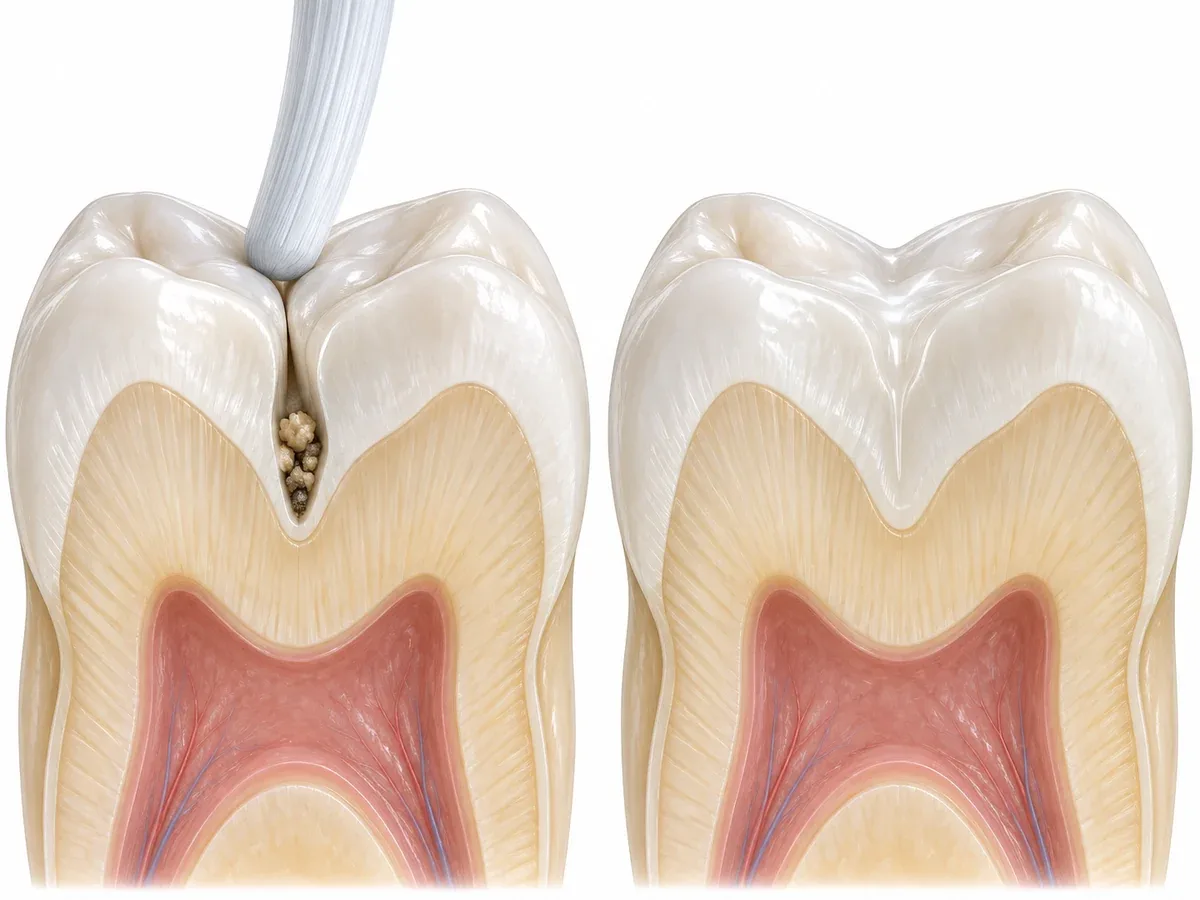
The chewing surfaces of back teeth have narrow, deep grooves that toothbrush bristles cannot reach. This is where decay most often starts. Filling these grooves in advance is called a sealant (pit and fissure sealant).
Then there are the gums. Plaque does more than cause cavities. The KDCA explains that toxins from plaque bacteria inflame the gums and, if left alone, can destroy the bone around the teeth.
A fluoride treatment cannot take over that job. It still falls to three habits.
- brushing every day
- flossing between the teeth
- regular scaling to remove tartar
A fluoride treatment may be worth discussing if any of these apply to you.
- You brush long enough but get a new cavity at almost every checkup.
- Braces or crowns have created spots that are hard to clean.
- Your gums have receded and the roots of your teeth are exposed.
- Your mouth often feels dry, or you seem to have little saliva.
- Your child's back teeth have just come in.
For reference, the KDCA notes that in Korea, national health insurance covers fluoride application for certain groups. These include people who had radiation therapy to the head and neck, and people with Sjögren's syndrome or dry mouth. If this applies to you, please tell us in advance.
Frequently asked questions
If I get a fluoride treatment, will I stop getting cavities?
We cannot promise that. A fluoride treatment helps lower the chance of decay and slow its progress. If brushing and eating habits stay the same, it has limits.
Does fluoride work for adults too?
According to the KDCA, adults at high risk of decay can expect a preventive effect. It is also described as helpful for people with sensitive teeth.
Can I eat right after a fluoride treatment?
No. Do not rinse, eat or drink for 30 minutes after gel and 1 hour after varnish. After varnish, wait 4 hours before brushing gently.
Can I get this treatment in English in Busan?
Yes. We offer 1:1 English interpretation from the first consultation through the end of treatment. The clinic is near Seomyeon Station Exit 2 (5-min walk), opposite Lotte Hotel Busan, and you can call 010-8555-2854 (+82-10-8555-2854 from abroad).
If you brush hard and still get cavities,
there is a reason behind it.
A fluoride treatment is one way
to help with part of that reason.
If you are in Busan, Reset Dental Clinic offers 1:1 English interpretation from your first consultation through the end of treatment. Call 010-8555-2854 and we will check your current risk with you first.
References
- KDCA National Health Information Portal, "Fluoride Application" — how decay forms, demineralization and remineralization, professional and home fluoride methods and waiting times, recommended intervals and timing, dental fluorosis, and health insurance coverage
- KDCA National Health Information Portal, "Resin Treatment (Dental Composite Resin)" — properties of composite resin, minimal tooth removal, and sealants to prevent early decay
- KDCA National Health Information Portal, "Dentin Hypersensitivity" — tooth structure, exposed dentin, and desensitizing agents including fluoride
- KDCA National Health Information Portal, "Gum Disease (Periodontal Disease)" — how plaque and tartar lead to gum inflammation and bone loss, and why brushing and regular scaling matter
- KDCA National Health Information Portal, "Tooth Eruption Disorders" — how teeth come into place on time, and what happens when they do not
Written by Reset Dental Clinic Support Team
Medical review Dr. Kim Hyun-joo, Head Dentist · Esthetic Restorations
Last updated: September 19, 2026
This column is for general information and does not replace diagnosis or treatment for individual patients. If you have symptoms, please see a dentist.