

- When one front tooth turns dark, fixing that one tooth is not always the right answer.
- Matching one dark tooth is harder, because the neighboring teeth show every difference.
- A dark tooth needs a different thickness and opacity of ceramic to hide the color underneath.
- In this case, four front teeth were also broken, so six upper front teeth were treated to one standard.
Patients at Reset Dental Clinic in Seomyeon, Busan often ask us to fix "just the one dark front tooth", and the honest answer is that it depends. This case review explains how Minish was used to match a single darkened front tooth to its neighbors. For patients living in or visiting Korea, we provide 1:1 English interpretation from the first consultation through the end of treatment.
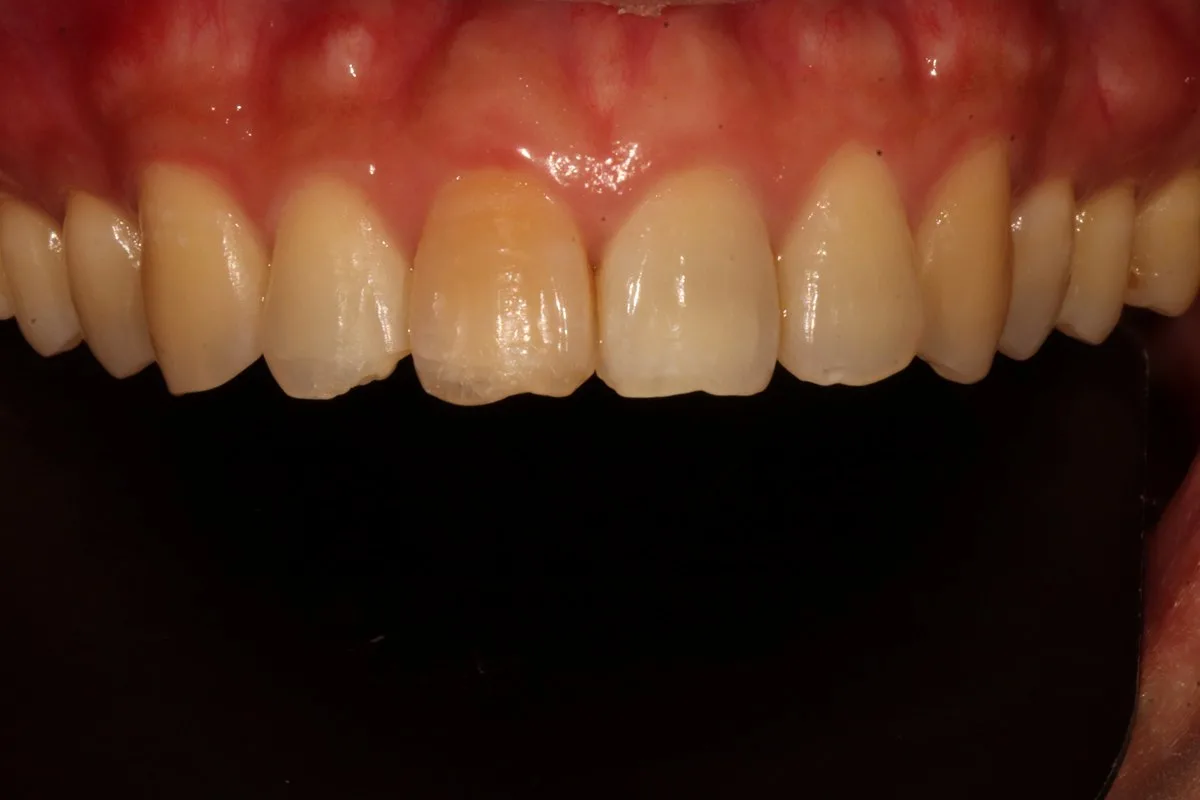
Why is one dark tooth harder to match than six?
When just one front tooth has darkened, it seems natural to treat that one tooth alone. It looks like the smallest, simplest job.
But when it comes to matching color, a single tooth that differs is the hardest case. The reason is that the teeth it has to match sit right beside it.
If all six front teeth are evenly dark, we can brighten all six together. There is no reference tooth to compare against, so a slight difference does not stand out.
When just one tooth is dark, it is as if the answer key is stuck on both sides. Every small difference is easy to see.
If the treated tooth ends up a little too bright, it stands out from the rest. If it ends up a little too dark, it still looks lifeless.
In this patient, the dark tooth was #11, the upper right central incisor. The goal of the Minish treatment was to bring it to the same color as the other front teeth.
| Six teeth evenly dark | One tooth dark | |
|---|---|---|
| Approach | Brighten all six together | Match one tooth to its natural neighbors |
| Reference tooth | None nearby | Right next to it, on both sides |
| Small color differences | Hard to notice | Easy to notice |
| If slightly too bright | Not obvious | The tooth stands out |
| If slightly too dark | Not obvious | The tooth still looks lifeless |
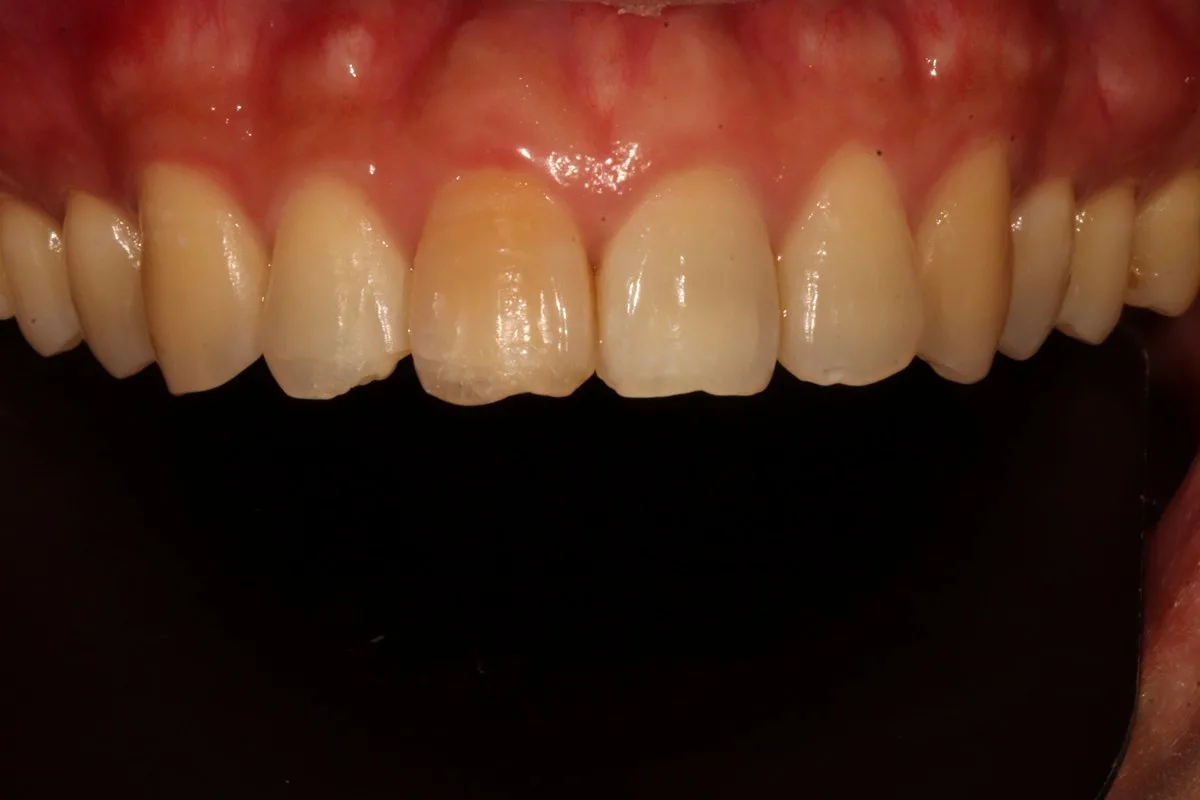
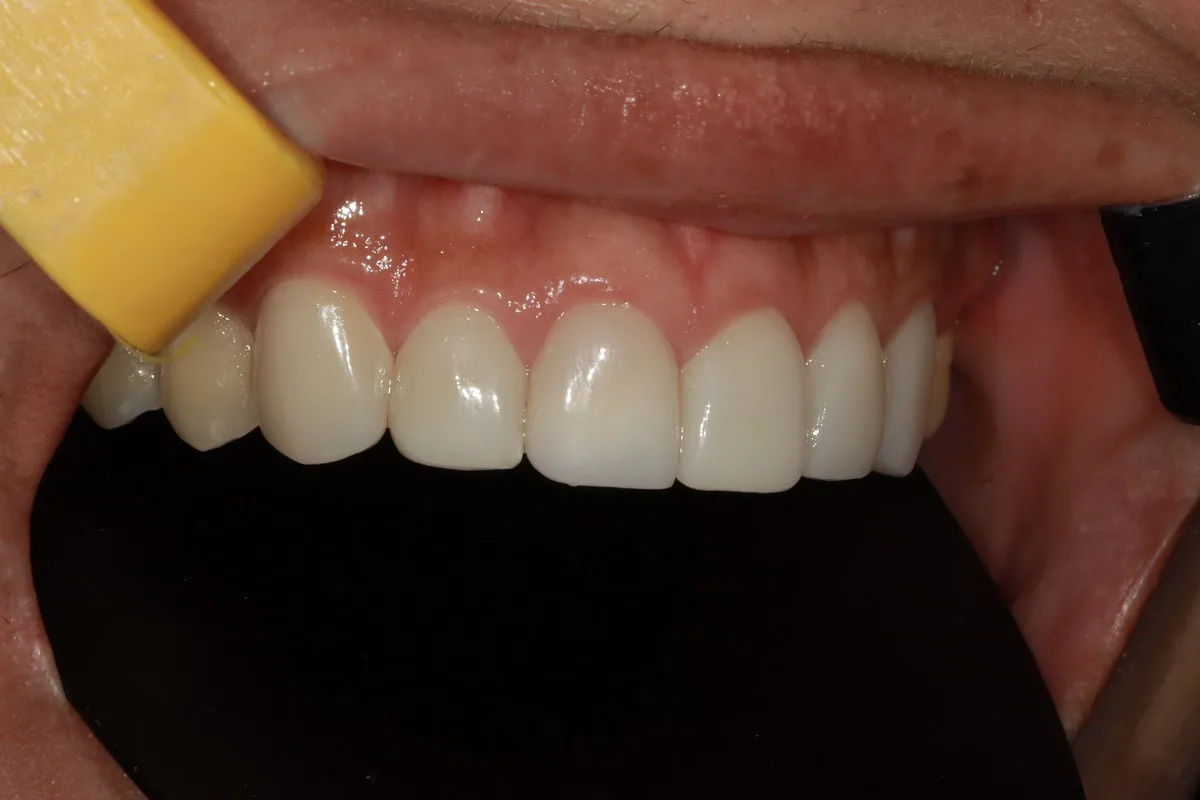
Tooth #11, once the one dark tooth, now matches the other front teeth.
Why does Minish thickness matter on a dark tooth?
Minish bonds a very thin layer of ceramic to the tooth. Because it is thin, the color of the tooth underneath shows through.
On a bright tooth, this is not a problem. The restoration comes out bright, just as planned.
On a dark tooth, the same thickness gives a different result. The dark color underneath shows through, and the tooth still looks dark.
So on a dark tooth, we make sure the ceramic is thick enough to hide the color underneath. We also set the opacity of the material differently.
This leads to a point that surprises many people. To make teeth look like the same color, each tooth often needs a different calculation.
The same Minish ceramic can look quite different depending on what lies under it. That is why the color of the underlying tooth is part of the plan from the start.
In this case, the Minish restoration on #11 had to hide a dark tooth, while the teeth beside it were not dark. Each one needed its own settings.
| Tooth underneath | Thin ceramic gives | What we adjust |
|---|---|---|
| Bright tooth | A bright result | Little adjustment needed |
| Dark tooth | A dark result, as the color shows through | Enough thickness to hide it, and a different opacity |
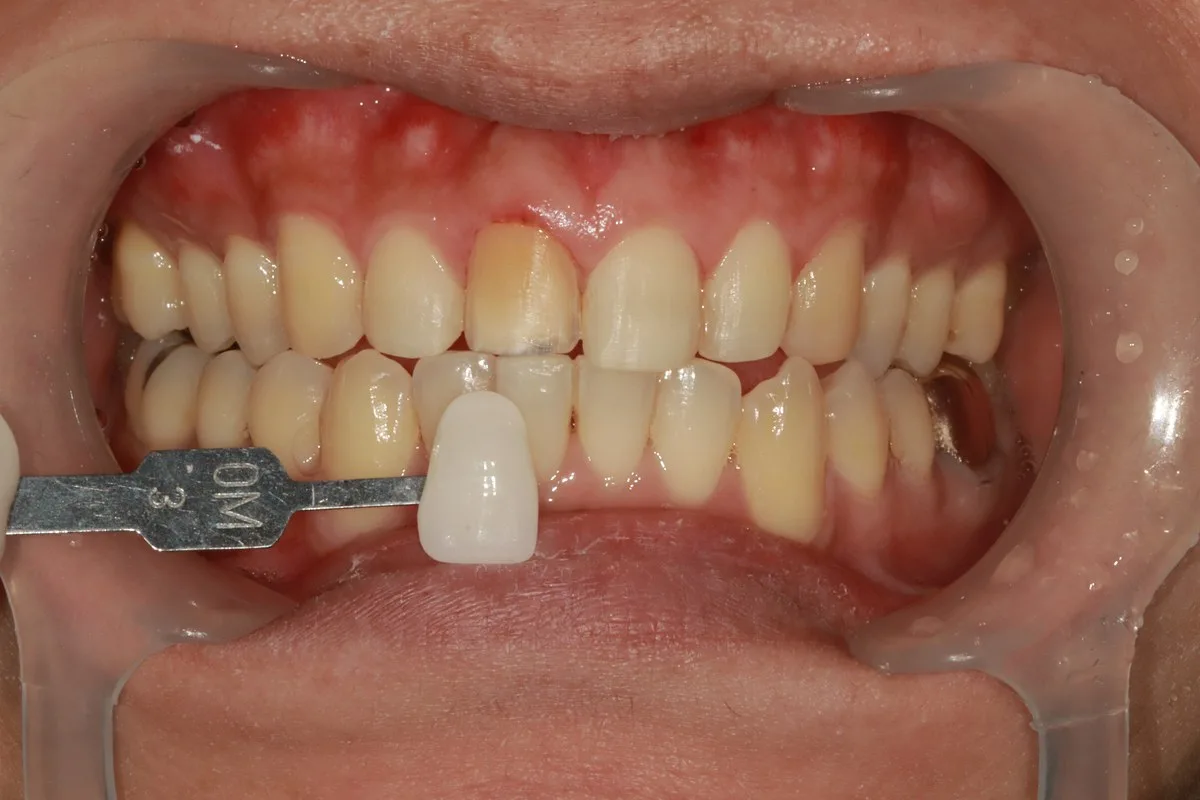
The shade is matched by holding a shade guide against the neighboring teeth. The natural teeth beside the dark one are the standard we aim for. Held side by side, the guide shows how close each Minish shade is to them.
Why did we treat six front teeth together?
Looking at color alone, two teeth, #11 and #21, could have been enough. Those are the two central front teeth.
However, this patient had suffered an injury. As a result, four teeth, #12, #11, #21 and #22, were fractured (FX).
One option was to match the color on two teeth and repair the broken areas separately. But then the materials and the timing would differ, and visible boundaries would remain.
So we treated all six upper front teeth at once with Minish. This let us set color and shape to the same standard across the smile. It also meant one shade decision for the whole front of the smile.
This does not mean six teeth are always needed. The number depends on the condition of the teeth, and in this case the four broken teeth were the reason.
- #11: the dark tooth, also fractured
- #21: the other central front tooth, fractured
- #12 and #22: the lateral front teeth, both fractured
- #13 and #23: the canines, treated to keep color and shape even across the six
| Plan | What it involves | Result |
|---|---|---|
| Two teeth for color, fractures repaired separately | Different materials, done at different times | Boundaries between the repairs can remain |
| Six upper front teeth at once | One material, one standard for color and shape | Fewer visible boundaries |
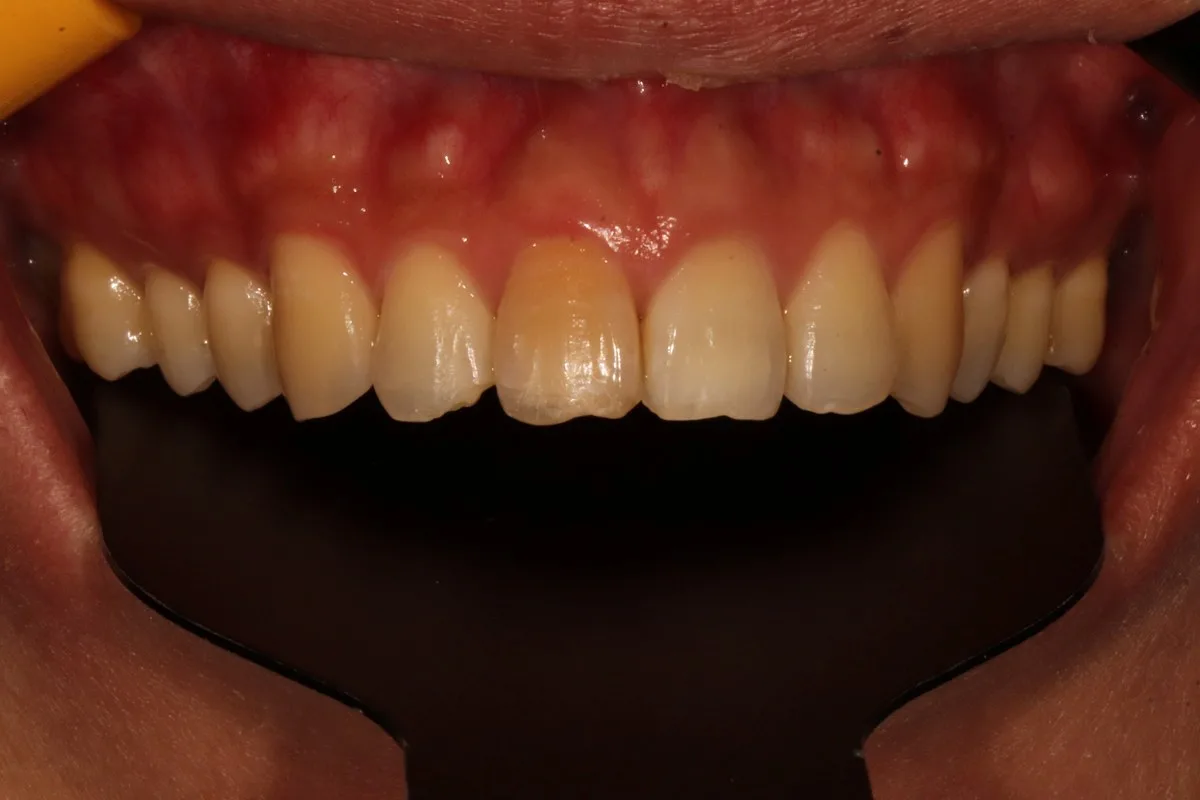
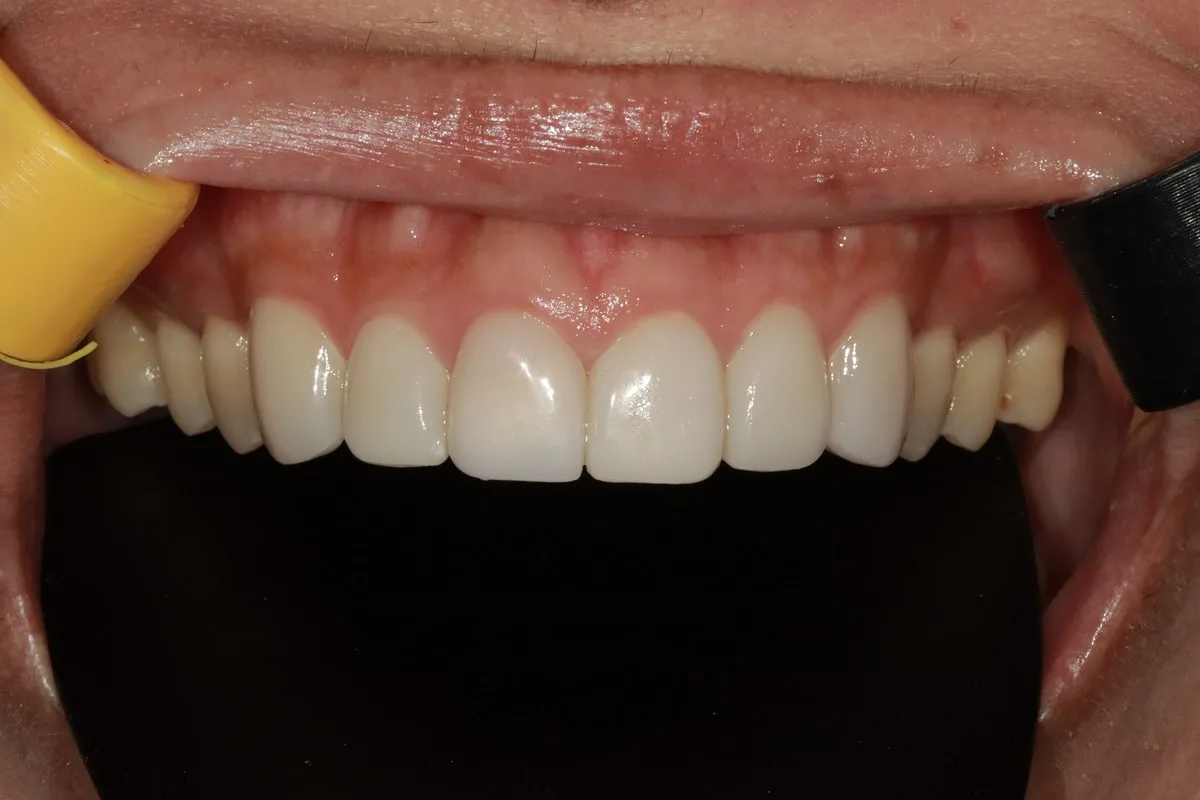
The six front teeth were matched to one standard.
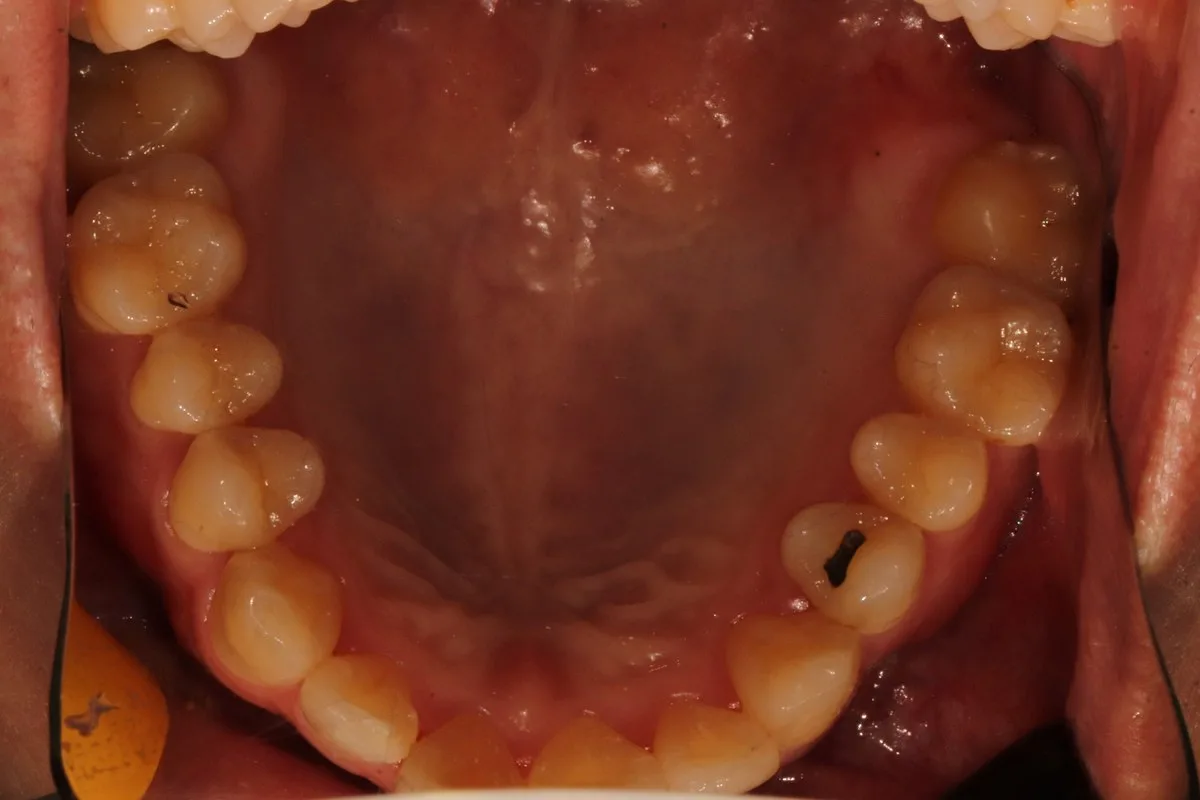
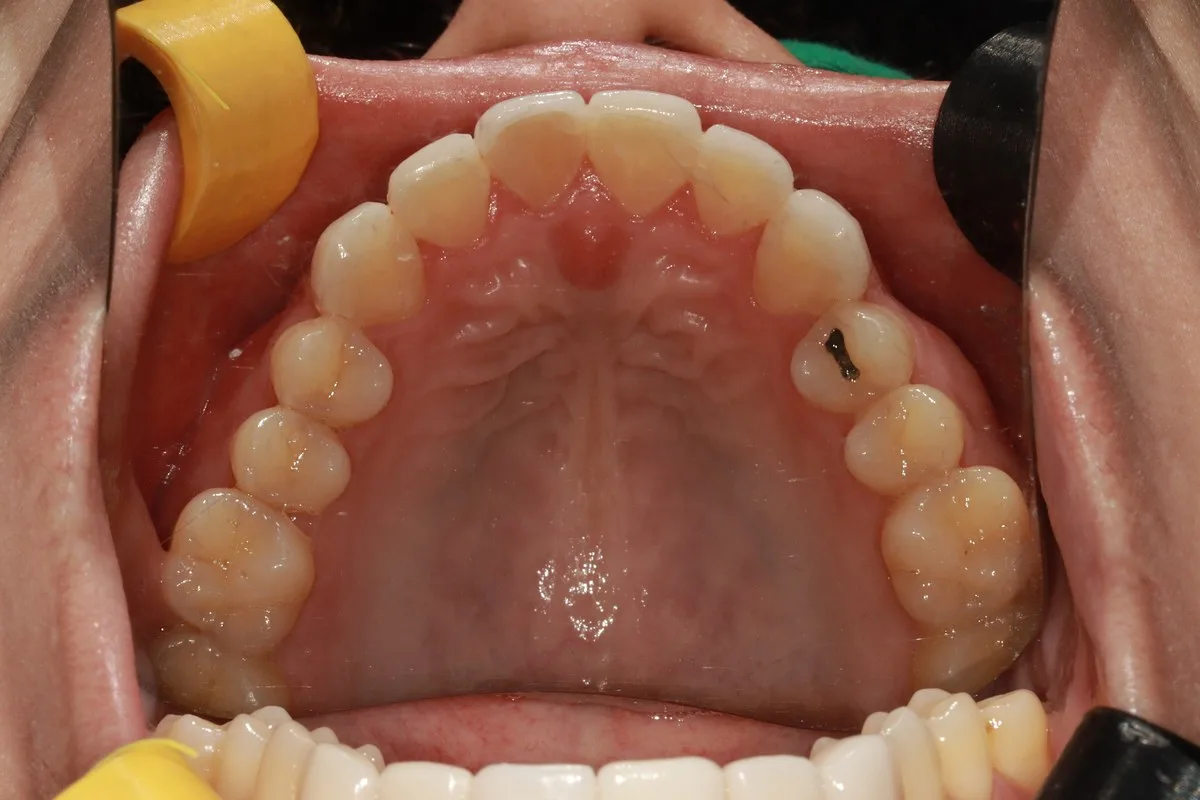
Upper jaw, before and after.
Why does a front tooth turn dark after an injury?
It is common for a front tooth that was injured to darken over time. The change often shows up long after the injury itself.
When an impact kills the nerve inside the tooth (the pulp), pigment from inside the tooth seeps into the dentin. The tooth then darkens from within.
This color is not a surface stain. It comes from inside the tooth, and it slowly deepens as time passes.
That is why whitening does not remove it well, and why the thickness of Minish matters on such a tooth. Whitening acts on the surface and on staining just below it, while this discoloration sits inside the dentin.
If a front tooth darkened gradually over months or years after a knock, this is likely the cause. Signs that point in this direction include:
- You remember hitting the tooth, even long ago.
- The color changed slowly, over months or years.
- One tooth is dark while its neighbors are not.
- Whitening has made little difference.
| Surface stain | Discoloration from inside | |
|---|---|---|
| Where the color sits | On the surface and just below it | Inside the dentin |
| Typical cause | Staining | Pigment from a pulp that died after an impact |
| How it develops | From the outside | Slowly deepens over months or years |
| Whitening | Works on this kind of stain | Does not remove it well |
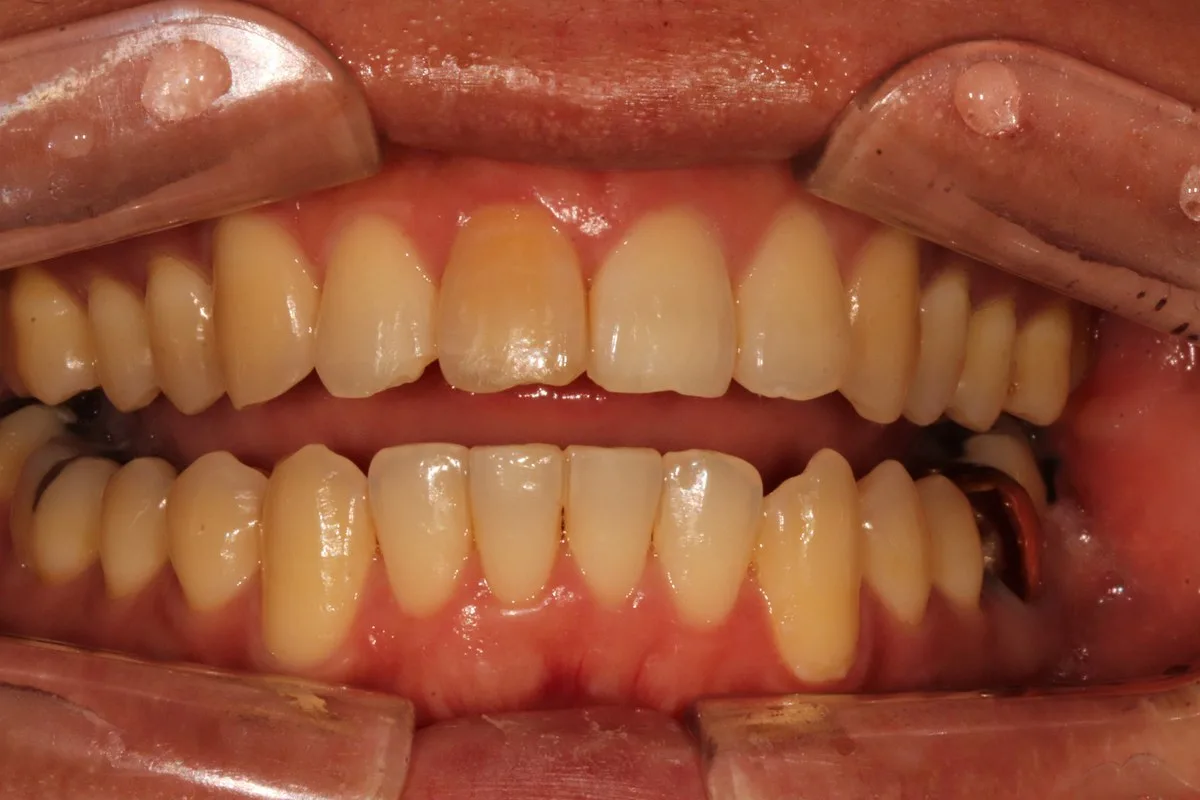
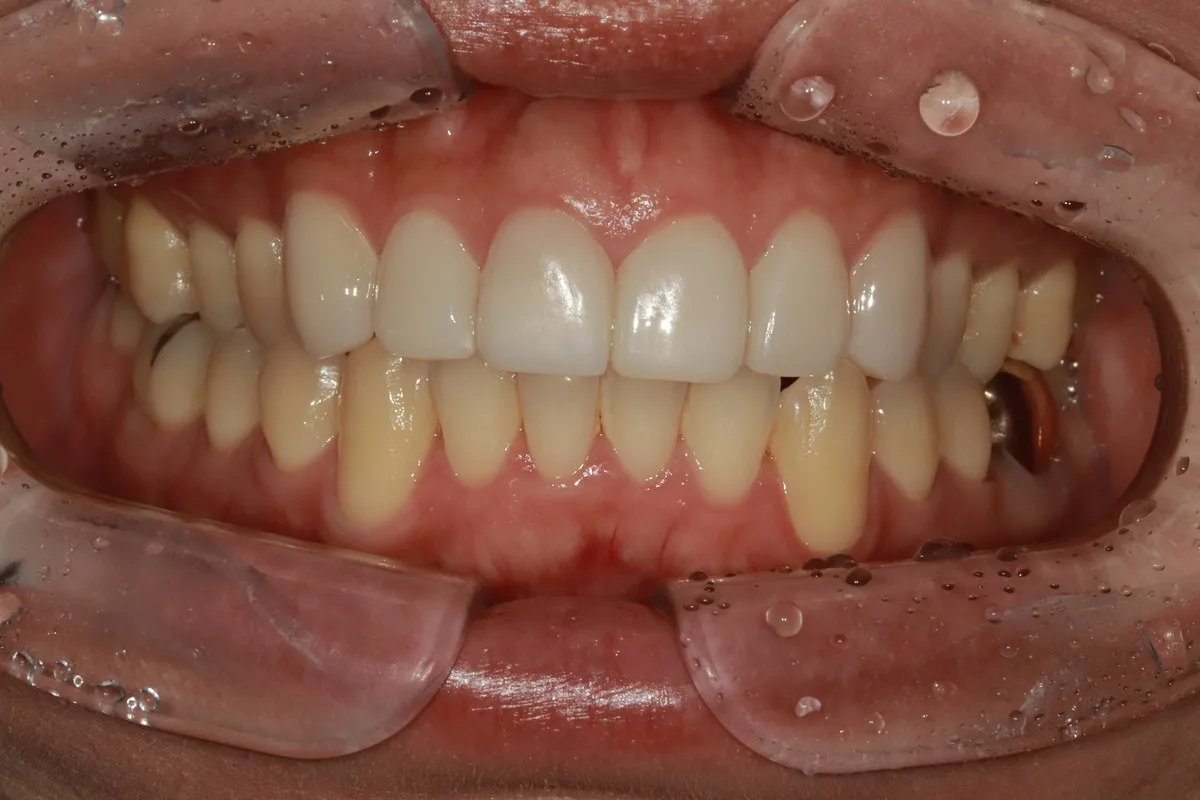
Before and after treatment.
A dark tooth after an injury is not purely a matter of looks. The state of the pulp and the root tip has to be checked before any Minish work begins.
When does a dark front tooth need other treatment first in Busan?
When one front tooth is dark, fixing that one tooth alone is not always the answer. To blend naturally with the neighboring teeth, we have to work out how many teeth to treat and how.
If there are broken areas, setting color and shape together tends to leave fewer boundaries. That was the reasoning behind this Minish case.
Still, not every discoloration can be solved this way. If there is inflammation at the tip of the root, or the tooth is badly broken, that treatment comes first.
If the nerve has already died and there is inflammation, root canal treatment comes first. If the root tip is clean, color and shape can sometimes be treated without root canal treatment.
Which applies to you can be known after an X-ray. At our clinic in Seomyeon, we check the cause of the discoloration first, then decide with you how many teeth to treat and how.
For this patient, Minish treatment took about two weeks from the first consultation to completion. The time depends on the number of teeth and their condition.
- Check with an X-ray whether there is inflammation at the root tip.
- Treat the root or a large fracture first, if needed.
- Decide how many teeth to include, based on color and any fractures.
- Set the thickness and opacity of each Minish restoration for the tooth underneath.
- Match the shade against the neighboring natural teeth.
What should you ask before treating a dark front tooth with Minish?
A dark front tooth raises several questions at once. It helps to go into a consultation knowing what to ask.
The first question is about the cause. A tooth that darkened after an injury may have a pulp that has died, and the root tip needs to be checked.
The second is about the number of teeth. One tooth, two teeth or six teeth can each be right, depending on the color difference and any fractures.
The third is about the material itself. With Minish on a dark tooth, the thickness and opacity have to be planned for the color underneath.
- What caused my tooth to darken, and is the root tip healthy?
- Do I need root canal treatment first, or can color and shape be treated directly?
- How many teeth should be included to get an even result?
- How will the ceramic hide the dark color underneath?
- If other teeth are broken, can they be treated at the same time?
Clear answers to these questions make the plan easier to understand. They also show how the color will be matched to your own teeth.
If an answer is unclear, it is fine to ask again. The plan should make sense to you before treatment starts.
Frequently asked questions
Can I treat the one dark front tooth on its own?
Sometimes yes, sometimes no. If the color difference from the neighboring teeth is large, matching one tooth is harder. Treating two or three teeth together often looks more natural.
My front tooth darkened years after I hit it. Why?
When an impact kills the nerve inside the tooth, its pigment seeps out from within. Because the color comes from inside rather than the surface, it slowly deepens over time.
Do I need root canal treatment before Minish?
If the nerve has already died and there is inflammation, that treatment comes first. If the root tip is clean, color and shape can sometimes be treated without it. An X-ray will tell.
Can I get this treatment in English in Busan?
Yes. We offer 1:1 English interpretation from the first consultation through the end of treatment. The clinic is near Seomyeon Station Exit 2 (5-min walk), opposite Lotte Hotel Busan, and you can call 010-8555-2854 (+82-10-8555-2854 from abroad).
One dark front tooth is not always a one-tooth job.
Matching it to its neighbors takes the right thickness, the right opacity
and a clear decision on how many teeth to include.
If you are considering Minish for a darkened front tooth in Busan, we will check the cause first. Patients in Korea can get 1:1 English interpretation from the first consultation through the end of treatment. Call 010-8555-2854 to book a consultation.

References
- KDCA National Health Information Portal, "Laminate Treatment" — what laminates are, how much tooth they remove (0.5–1.0 mm) and when they are used
- KDCA National Health Information Portal, "All-Ceramic Crowns" — pros and cons of all-ceramic crowns and the tooth reduction they require
- KDA newspaper Dailydental (Chiui Sinbo), "Court Orders Damages for Excessive Tooth Reduction in Laminate Treatment" — how the court viewed the duty to explain when more tooth was removed than advertised
- KDCA National Health Information Portal, "Dentin Hypersensitivity" — causes and treatment of sensitive teeth
- KDCA National Health Information Portal, "Gum Disease (Periodontal Disease)" — how the condition of the gums affects esthetic results
Written by Reset Dental Clinic Support Team
Medical review Dr. Kim Hyun-joo, Head Dentist · Esthetic Restorations
Last updated: September 19, 2026
This column is for general information and does not replace diagnosis or treatment for individual patients. If you have symptoms, please see a dentist.


