

- Gum disease may not stay in the gums. Korean health authorities explain that inflammatory substances and bacteria can spread through the blood vessels to the rest of the body.
- But "linked to" is not the same as "cured by." The evidence is strong for some conditions and still debated for others.
- Gum inflammation alone can be reversed. Once it reaches the bone, lost bone often stays lost even after the inflammation clears.
- Pain comes late. By the time it hurts, the tooth may already need removal. A simple check in Busan can catch it earlier.
"I heard bad gums can affect your heart or diabetes. Is that true?" Many patients ask this in passing during scaling at our clinic in Seomyeon, Busan. For patients living in or visiting Korea, we provide 1:1 English interpretation from the first consultation through the end of treatment.
People have heard the claim somewhere but are not sure how much of it is true. Based on national health information on gum disease and its links to general health, this column sorts out what has been shown and what is still uncertain.
How common is gum disease?
The numbers tell the story quickly. The Korea Disease Control and Prevention Agency (KDCA) cites 2024 national statistics on the most frequent conditions. About 19.6 million people were treated for gingivitis and periodontal disease that year.
By total medical costs, it ranked first among conditions treated as outpatients. It has held that position almost every year.
The KDCA's gum disease guide also reports how widespread it is. In a 2018 national health and nutrition survey with oral exams, 23.4% of adults aged 19 and over had periodontal disease. The rate varies a great deal with age.
| Age | Men | Women |
|---|---|---|
| 20s | 5.2% | 2.9% |
| 30s | 19.3% | 9.1% |
| 40s | 39.2% | 16.0% |
| 50s | 49.7% | 32.8% |
| 60s | 55.2% | 39.5% |
| 70 and over | 53.2% | 44.1% |
The KDCA notes that the rate rises sharply after age 50. It also explains that gum disease usually begins in the mid-30s.
If your gums started to bother you after 40, you are far from alone. It is a common condition, not a rare one.
What is the difference between gingivitis and periodontitis?
Gum disease comes in two stages that behave very differently. The KDCA draws the line like this.
When inflammation stays in the gums, the soft tissue, it is called gingivitis. When it spreads down to the jawbone around the teeth and the bone starts to break down, it is called periodontitis.
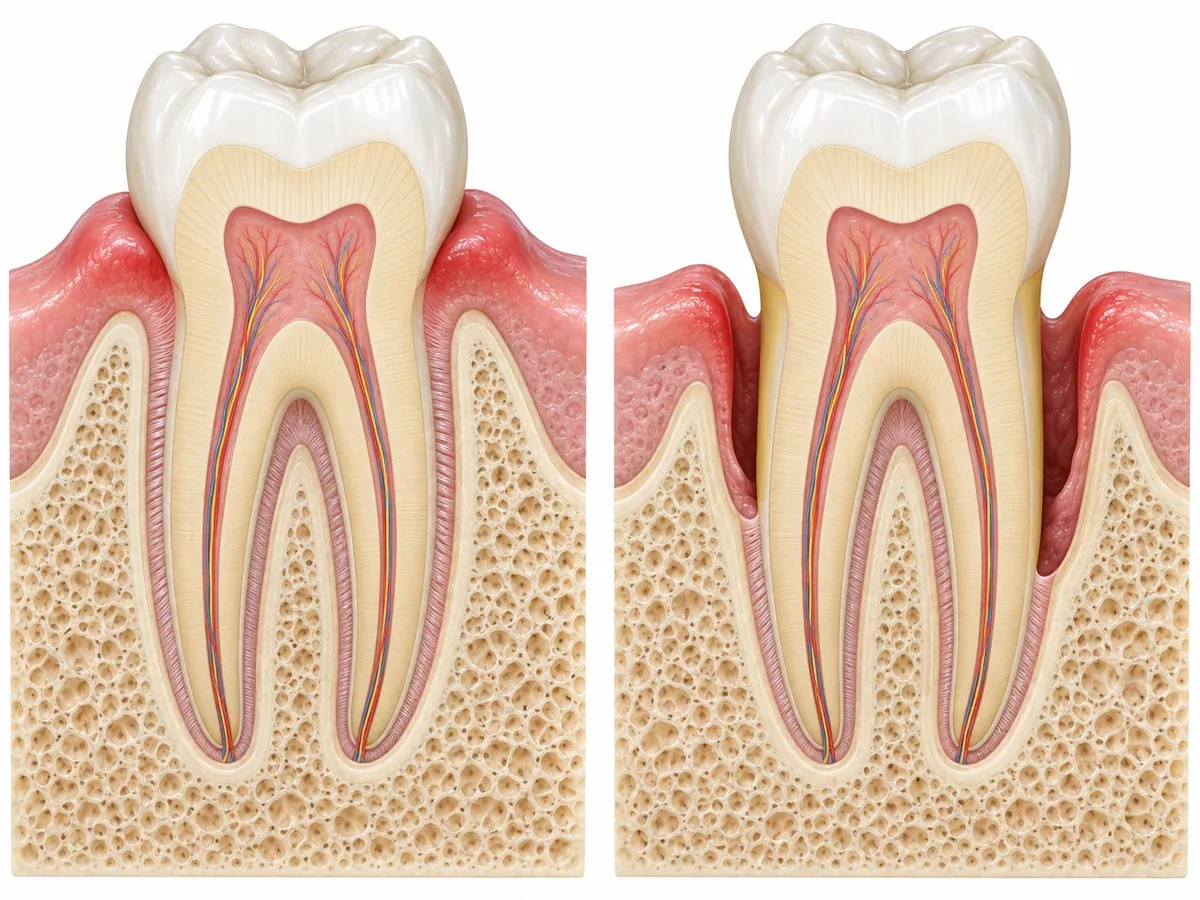
For gingivitis, the KDCA says removing tartar alone can return the tissue to normal.
Periodontitis is different. It needs treatment in stages, and sometimes tissue must be regenerated. The KDCA adds that damage involving bone loss often remains even after the inflammation is gone.
This is what we mean when we say timing matters with gum disease. Treating it at the gum stage keeps more options open.
| Situation | Treatment |
|---|---|
| Plaque and tartar above the gum | Scaling, the basic step that treats gingivitis |
| Plaque and tartar below the gum | Root planing and deep cleaning under the gum |
| More advanced disease | Flap surgery or bone grafting |
How can gum disease affect the rest of the body?
The KDCA describes the pathway like this. Dental plaque, the sticky mass of bacteria on the teeth, is a kind of biofilm. It shields bacteria from the body's immune response.
When plaque overcomes the immune system, the gum tissues become inflamed. At that point, inflammatory substances (cytokines) and the bacteria themselves can spread through the blood vessels to the whole body. A well-studied example is the bacterium Porphyromonas gingivalis.
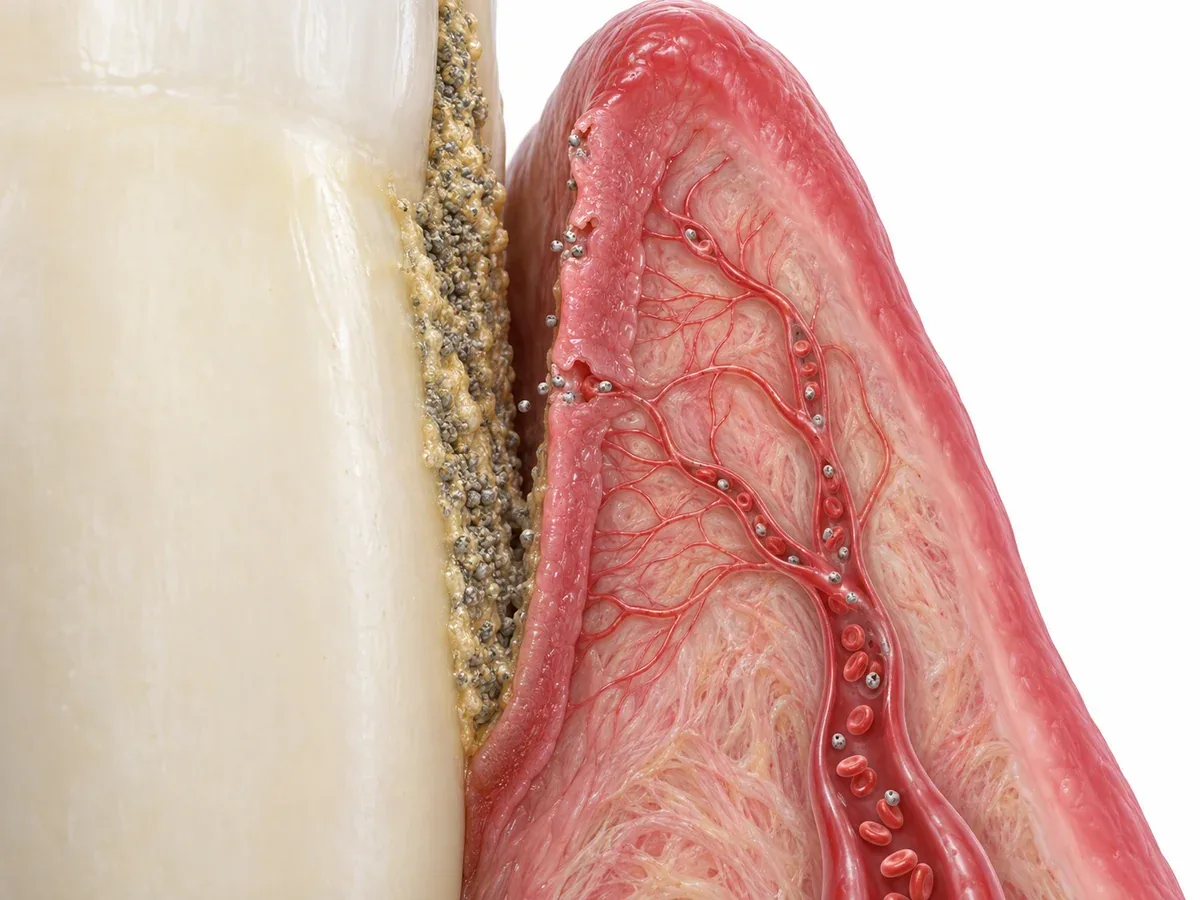
The KDCA views gum disease as a chronic infection caused by bacteria. It shares risk factors with other chronic diseases.
- smoking
- poor eating habits
- alcohol
- stress
- age
Diseases that share these risk factors are grouped and managed as non-communicable diseases (NCDs). According to the KDCA, the World Health Organization recommends managing gum disease alongside heart disease, diabetes and obesity.
In short, gum disease is no longer treated as a problem of the mouth alone. It sits in the same group as other chronic conditions.
Which conditions are linked to gum disease?
Here is the KDCA's summary, condition by condition. Please notice that the strength of the wording differs from one row to the next.
| Condition | What the KDCA says |
|---|---|
| Heart and blood vessel disease | Linked to hardened arteries, heart attack and high blood pressure. Several meta-analyses found rates 19–34% higher with gum disease. The American Heart Association and the American Academy of Periodontology say the link is well supported. |
| Diabetes | The most studied area. The two diseases affect each other: gum inflammation makes blood sugar harder to control, and poor control can worsen periodontitis. |
| Preterm birth and low birth weight | A risk factor during pregnancy. But there is no strong evidence that gum treatment improves pregnancy outcomes. |
| Rheumatoid arthritis | Similar inflammation and bone loss patterns; each raises the chance of the other. |
| Lung disease | Linked to chronic obstructive lung disease and bacterial pneumonia. Gum care may reduce acquired pneumonia by about 40%. |
| Obesity | Overweight, obesity and weight gain are risk factors for gum disease. |
| Osteoporosis | A clear link in women, especially women over 50 with gum disease. |
| Dementia | One of the most active research areas; gum disease is thought to affect it negatively. |

One point deserves to be said plainly. While describing these links, the KDCA separates hope from proof.
For heart disease, it says gum treatment is expected to lower rates or severity. For diabetes, some reports show better blood sugar control after gum treatment, but this remains debated. For obesity, the evidence is still weak.
So please do not read this as "gum treatment cures other diseases." What it does show is that these conditions share risks and are worth managing together.
If you take osteoporosis medicine, please tell us. The KDCA warns that some of these drugs raise the risk of bone necrosis during procedures that expose bone, such as extractions or implants.
What are the warning signs, and how is the stage checked?
The KDCA is firm on this. Unless it turns into an abscess, gum disease often causes no pain at all. If it hurts, it may already be severe enough to need an extraction.
That is why the KDCA lists signs to check before pain appears.
- Bleeding: blood when brushing or eating often points to gum disease. Heavy bleeding does not mean severe disease, and scaling alone may solve it.
- Loosening: a tooth that moves without any injury suggests inflamed gum tissue. We treat first, then judge the outlook.
- Sensitivity: not a symptom of gum disease itself, but it can follow receding gums.
- Swelling: a classic sign. Swelling near the root tip may be a nerve problem instead, so it needs checking.
- Color change: caused by inflammation, and seen in both mild and severe cases.
The KDCA's guide on sensitive teeth explains why sensitivity appears. When gum tissue breaks down, the root is exposed to direct stimulation. Cementum, the layer covering the root, wears easily, so dentin is soon exposed.
The same guide cites reports that 60–98% of people with gum disease also have sensitive teeth.
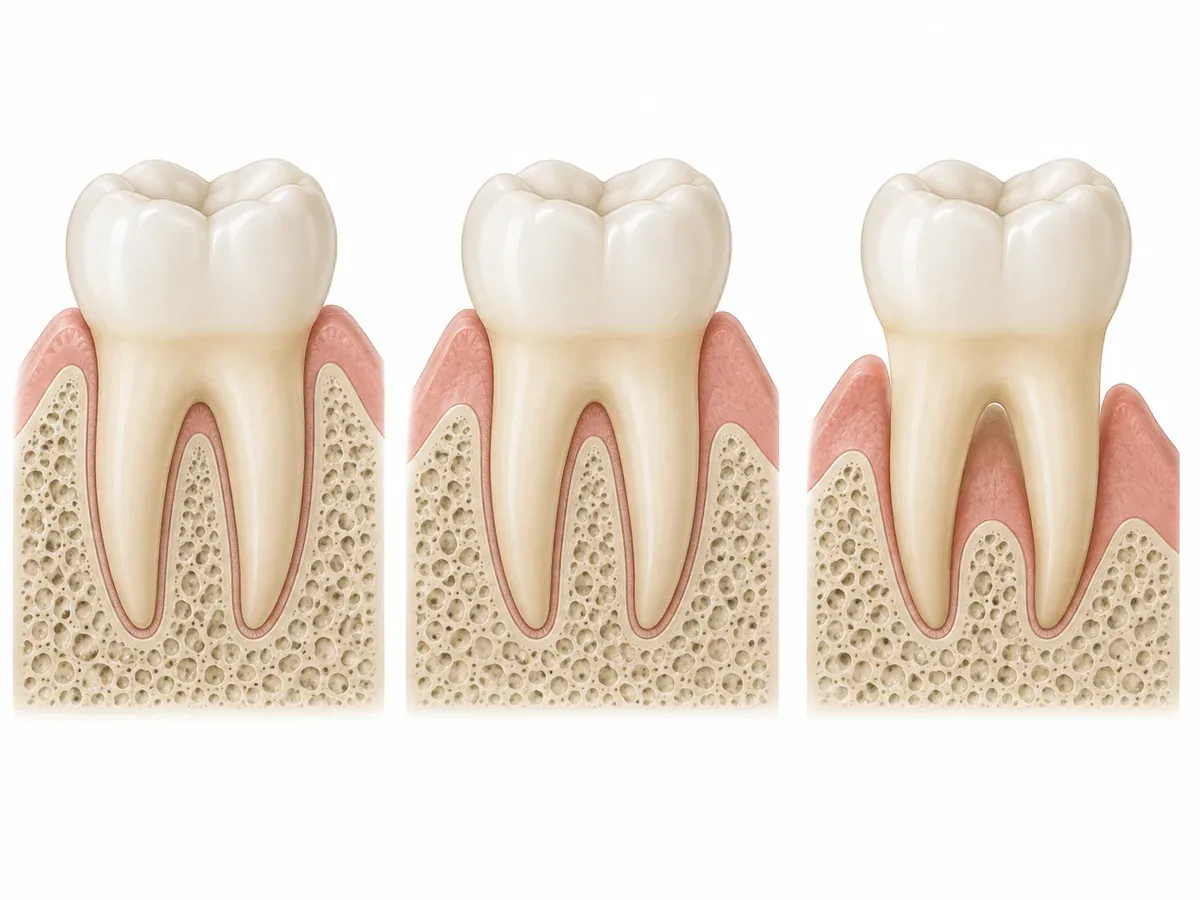
One measure is worth knowing. The KDCA says the outlook of a tooth depends on bone loss. When the bone covers half the root or less, the tooth is likely to need removal later.
To judge severity, the dentist combines two kinds of checks.
- X-rays to see how the bone level has changed
- a periodontal probe to measure pocket depth
- how far the gum has receded
- how much the gum bleeds
If you have never heard your gum condition described in numbers, it is worth asking at your next visit.
What can you do to protect your gums in Busan?
The KDCA recommends two things: the right interval and the right tools.
First, the interval. The KDCA recommends scaling once a year even without gum disease. If you have had gum disease or need upkeep after treatment, it recommends every 3 to 6 months.
In Korea, national health insurance covers one scaling a year for adults aged 19 and over. If you are enrolled, it is worth using.

Next, the tools. Gum disease usually starts between the teeth, so the KDCA says to clean between them at least once a day.
- dental floss
- interdental brushes
- a water flosser
The KDCA adds that mouthwash is a supporting aid and does not replace these. Brush at least three times a day in a way that suits you. With deep pockets, the modified Bass technique is recommended.
The gum disease guide suggests placing the brush against the gum first. Then start brushing from the line where tooth meets gum.
The KDCA also names risk factors: obesity, smoking, diabetes and psychological and social factors. Current smokers have a poorer outlook than former smokers or non-smokers, and gum treatment works less well for them. It is worth noticing that the guide lists people who quit separately from current smokers.
Hormonal changes during puberty, periods and pregnancy can also inflame the gums. During pregnancy, the KDCA advises treating severe gum disease, and we plan it together with your obstetrician.
Do dental implants need the same care?
They do. The KDCA's implant guide notes that periodontitis is a major cause of tooth loss. Implants also need to be kept clean to last.
Implants tend to leave wider gaps between teeth, so floss and interdental brushes are essential. Regular checkups every 3 to 6 months are recommended as well.
Figures from the Korean Academy of Periodontology's Gum Day, reported by Dailydental, point the same way. Among implant patients, 43% had inflammation of the soft tissue around the implant, and 22% had peri-implantitis.
In the same survey, 89.4% said they skipped aftercare because nothing felt wrong. An implant often stands where a tooth was lost to gum disease, so care after placement matters even more.
Frequently asked questions
Will treating my gum disease improve my diabetes?
That is not something to count on. The KDCA notes reports of better blood sugar control after gum treatment, but says this is still debated. It does clearly explain that the two diseases affect each other.
My gums bleed. Is it serious?
The amount of bleeding does not match how severe the disease is. The KDCA says heavy bleeding does not mean severe gum disease, and scaling may resolve it. Bleeding does mean inflammation, so it should be checked.
Does a loose tooth always have to come out?
There is an order. The KDCA says the gum disease is treated first, and then the tooth's outlook can be judged. We decide by how much bone is left.
Can I get this treatment in English in Busan?
Yes. We offer 1:1 English interpretation from the first consultation through the end of treatment. The clinic is near Seomyeon Station Exit 2 (5-min walk), opposite Lotte Hotel Busan, and you can call 010-8555-2854 (+82-10-8555-2854 from abroad).
Gum disease may not stay in the mouth.
Yet gum treatment does not cure other diseases.
The message is simple.
These chronic conditions share the same risks,
so they are worth managing together.
If you are in Busan, Reset Dental Clinic can check your pocket depth and bone level with 1:1 English interpretation throughout. Call 010-8555-2854 to see your gum health in numbers.
References
- KDCA National Health Information Portal, "General Diseases and Periodontal Treatment" — 2024 statistics on frequent conditions (about 19.6 million patients), how inflammatory substances and bacteria spread through the body and P. gingivalis, non-communicable diseases and the WHO recommendation, links with heart disease (19–34%), diabetes, preterm birth, rheumatoid arthritis, pneumonia (40%), obesity, osteoporosis and dementia and the strength of evidence, recovery in gingivitis versus periodontitis, extraction risk when bone covers half the root or less, pocket depth and recession, treatment stages, scaling intervals (once a year / 3–6 months), five self-check signs, and mouthwash as a supporting aid
- KDCA National Health Information Portal, "Gum Disease (Periodontal Disease)" — prevalence of 23.4% in adults 19 and over by age and sex, onset in the mid-30s and a sharp rise after 50, definitions of gingivitis and periodontitis, gum inflammation from hormonal changes and medicines, risk factors and the poorer outlook for smokers, brushing methods and 3–6 month checkups, and yearly insured scaling for adults 19 and over
- KDCA National Health Information Portal, "Dentin Hypersensitivity" — how breakdown of gum tissue exposes roots to direct stimulation, wear of cementum and exposed dentin, and reports that 60–98% of people with gum disease have sensitive teeth
- KDCA National Health Information Portal, "Dental Implants" — periodontitis as a major cause of tooth loss, hygiene for implant teeth and the need for floss and interdental brushes, and checkups every 3–6 months
- Korean Dental Association newspaper Dailydental, "65% of Implant Patients Experience Peri-Implant Disease" (17th Gum Day, Korean Academy of Periodontology) — peri-implant mucositis 43%, peri-implantitis 22%, and 89.4% reporting no aftercare
Written by Reset Dental Clinic Support Team
Medical review Dr. Na In-chae, Head Dentist · Periodontics Specialist
Last updated: September 19, 2026
This column is for general information and does not replace diagnosis or treatment for individual patients. If you have symptoms, please see a dentist.


