

- One jaw holds 14 teeth, but we do not place 14 implants. Full mouth implants work by supporting the whole arch with fewer implants.
- The usual guide is about six in the lower jaw and seven or eight in the upper jaw. The upper jaw needs more because its bone is softer.
- Even in the same jaw, the number changes with bone quality and bite force. If the bone proves weak during surgery, we add one or two.
- Even if you were told "there is no bone," your X-rays are worth a second look.
"I am missing 14 teeth. How can four implants be enough?" Patients at our clinic in Seomyeon, Busan often ask this good question about full mouth implants after seeing ads. For patients living in or visiting Korea, we offer 1:1 English interpretation from your first consultation through the end of treatment.
The answer is that supporting many teeth with fewer implants is the right principle, but how few is enough differs from person to person. This column explains how many implants are actually placed, and what moves that number up or down.
Why are 14 teeth not replaced with 14 implants?
One jaw usually has 14 teeth, from the front teeth to the molars. Yet full mouth implants do not replace them one by one. There are three reasons.
- Drilling 14 holes in the jawbone makes surgery a heavy burden.
- The process becomes far more complex and longer.
- Above all, placing too many makes the bone between them dissolve.
The last reason is the key one. Between one fixture and the next, there must be bone that blood can flow through.
If implants are packed close together, the bone between them dries up and dissolves. It is like trees planted too close in a small plot, whose roots tangle until they all die.
So we place six to eight implants in strategic spots. On top, we fit a restoration that looks like 14 teeth.
It works like a bridge, where a deck rests on a few well-placed piers. The piers do not need to stand under every metre of the deck.
In the same way, full mouth implants do not need a root under every tooth. What matters is that each implant stands in firm bone, with healthy bone around it.
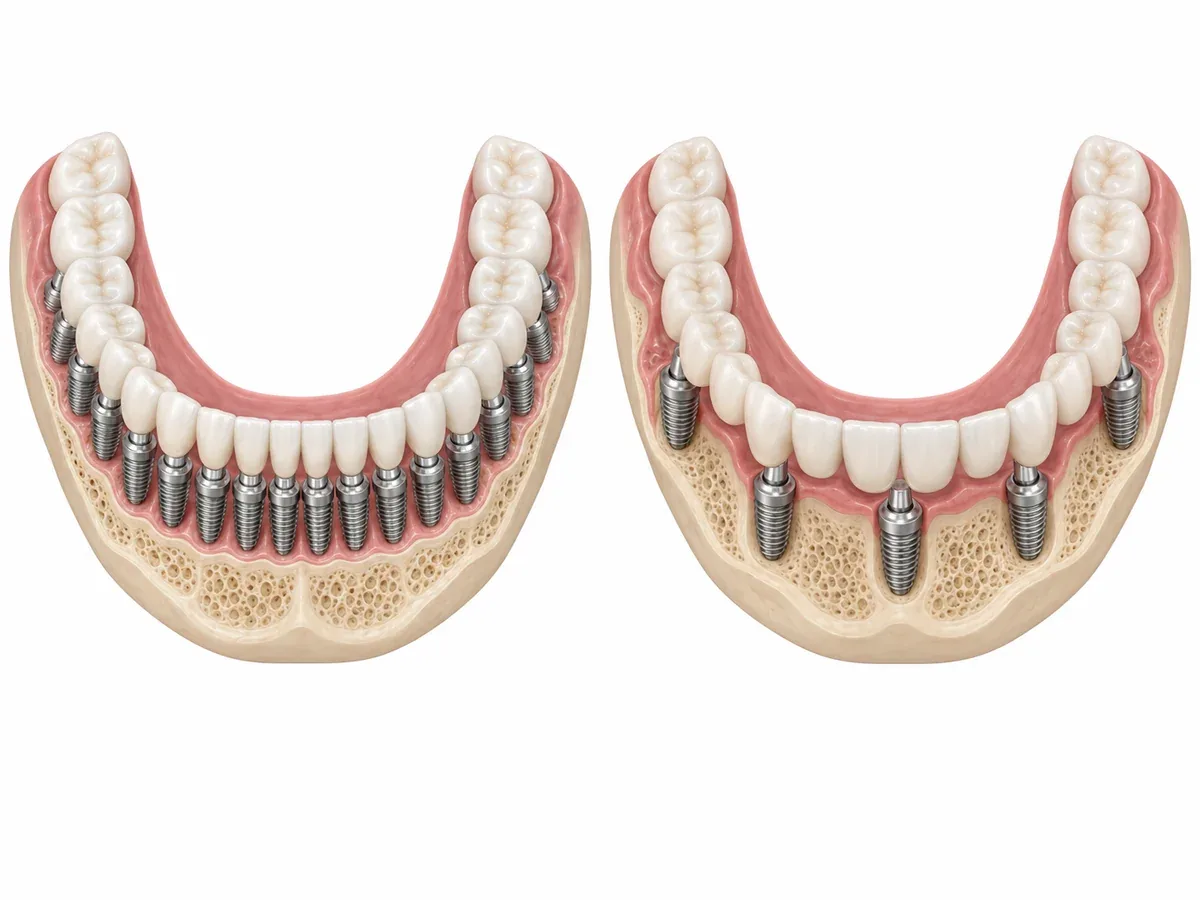
How many full mouth implants are standard?
For an adult with average bone, these are the numbers we start from.
| Jaw | Usual number | Why |
|---|---|---|
| Lower jaw | About six | The bone is firm, so this is usually enough support |
| Upper jaw | Seven or eight | The bone is softer, and the sinus leaves many thin areas |
This explains why the upper jaw needs more. Even in the same person, the upper and lower jaws have different bone.
The lower jaw is firm and holds well with six. With the same number, the upper jaw is often unstable.
Combined, full mouth implants for both jaws often come to about 13 or 14 implants. That is an average, though, and an exact plan needs your X-rays.
These numbers are a starting point for planning full mouth implants, not a fixed rule. The next section explains what moves them up or down.
What changes the number from person to person?
In practice, the number of full mouth implants rises or falls after we look at the factors below. Two people of the same age can need different plans.
| Factor | How it works |
|---|---|
| Bone quality | With the same amount of bone, softer bone grips less firmly |
| Osteoporosis | Porous bone calls for more margin |
| Bite force | A strong, well-developed jaw can put several times more load on the implants |
| Grinding or clenching | Force keeps coming even during sleep |
| The opposing jaw | How upper and lower teeth meet sets the direction of force |
| Where bone remains | The location of firm bone decides the layout |
For full mouth implants, bone quality matters far more than age.
Many women develop osteoporosis as they get older, and their bone tends to be weaker. For them, we often place one or two more full mouth implants.

Sometimes we place more than planned
We will be honest about this. Sometimes we plan six implants for the lower jaw, and during surgery the bone turns out softer than expected. In that case, we add one or two on the spot.
To avoid any misunderstanding, this is not about charging more. It takes more materials and more time. Honestly, our management team is not thrilled about it.
We still do it. Whether one more implant goes in can shape how the next 20 or 30 years go.
Full mouth implants are expected to carry every meal for many years. Adding one implant during surgery is far simpler than adding one after the teeth are fitted.
That way, you can use your teeth with peace of mind, and so can we.
Can wider implants do the work of extra ones?
With full mouth implants, the number is not the sole answer. A very strong bite does not automatically mean more implants.
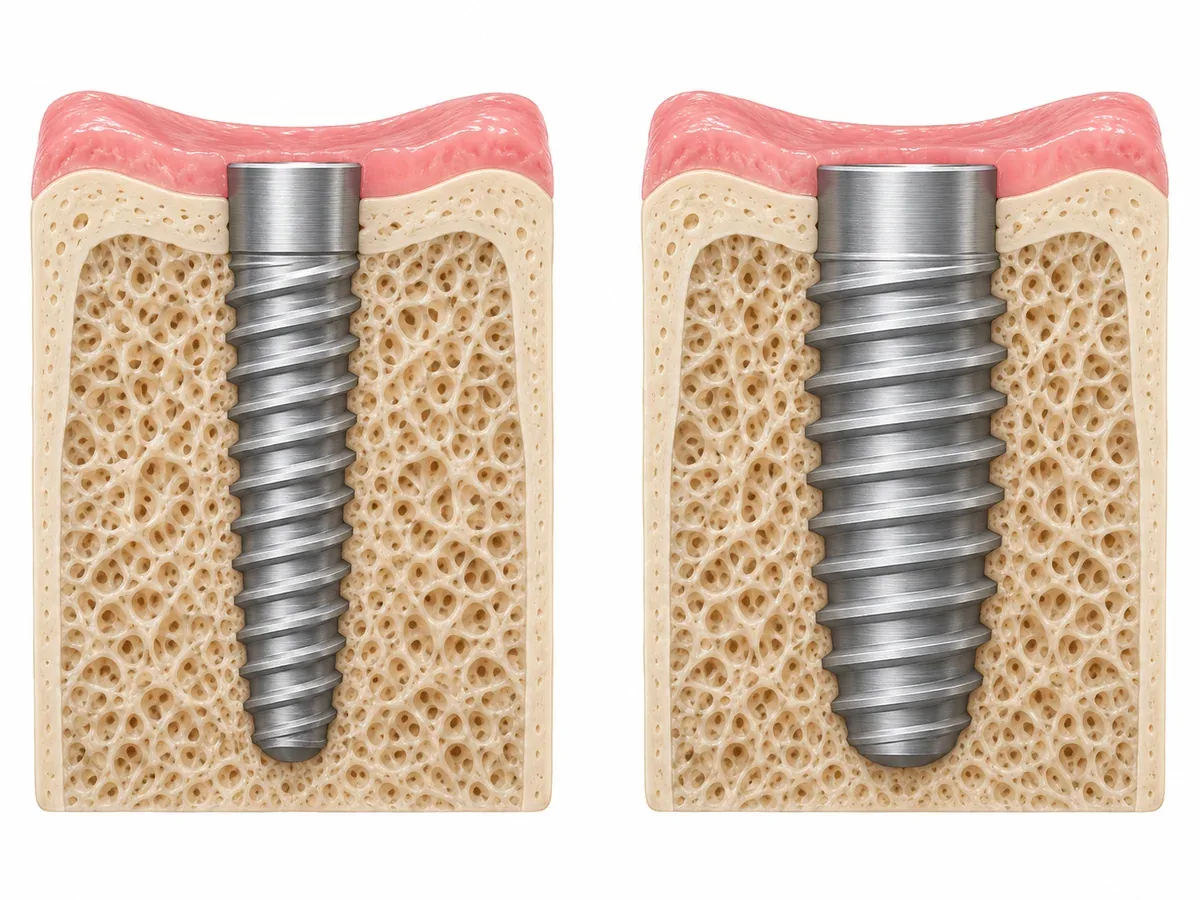
A wider implant can carry much of the extra load. With the same number, a larger diameter means more contact with the bone, so the force is shared better.
If the space is too narrow for a wide implant, we then look at adding more.
So when we plan full mouth implants, we look at a combination of five things. The number alone does not give an answer.
- number
- width (diameter)
- length
- position
- angle
If you also grind your teeth, the story changes. In that case we plan a night guard as well.
What if you were told there is not enough bone?
This is what we hear most often from new patients: "Everywhere else said it cannot be done."
First, to be clear, that judgment is not careless. Full mouth implants where the bone has dissolved are difficult and carry real risk.
We fully understand a dentist who says, "Dentures would be the safer choice." That is the safe path.
But after 20 years of working with gums and bone, we do not want to hide behind that safety. If we give up, that patient may live with dentures or soft food for the rest of their life. We simply do not want to see that.
When we look again, we do sometimes find a way to place full mouth implants. The table below shows what we recheck.
| What you were told | What we look at again |
|---|---|
| "There is no bone" | Whether bone can be built with grafting, and whether firm bone remains deeper down |
| "It is too close to the nerve" | We measure the real distance in 3D and recalculate length and angle |
| "Not with your osteoporosis injections" | The type of drug, how long it was used and your general health |
| "We cannot touch another clinic's work" | Whether existing implants can be kept and used in the plan |
In other words, "no bone" is sometimes a question of where to look and what can be rebuilt. Grafting may create a site, and firm bone deeper down may still hold an implant. A 3D scan shows the real distance to the nerve, so length and angle can be planned again.
If you take osteoporosis medication, please tell us in advance. A rare side effect on the jawbone is known, which is why many clinics are cautious.
We do not take it lightly either. But depending on the drug and how long you have used it, treatment is often still possible, so we check before deciding.

What do we check in Busan before deciding the number?
- A panoramic X-ray of the whole mouth. It shows the height and shape of the remaining bone, and where the nerve canal and sinus sit.
- 3D CT to find firm bone. We see where density is high, where force is taken well and how far apart the fixtures should be.
- Your bite and habits. We ask whether you grind your teeth and which side you mainly chew on.
- Your general health. We review diabetes, osteoporosis and any medicines you take.
- An explanation on the same screen. We start once you understand why this number was chosen.
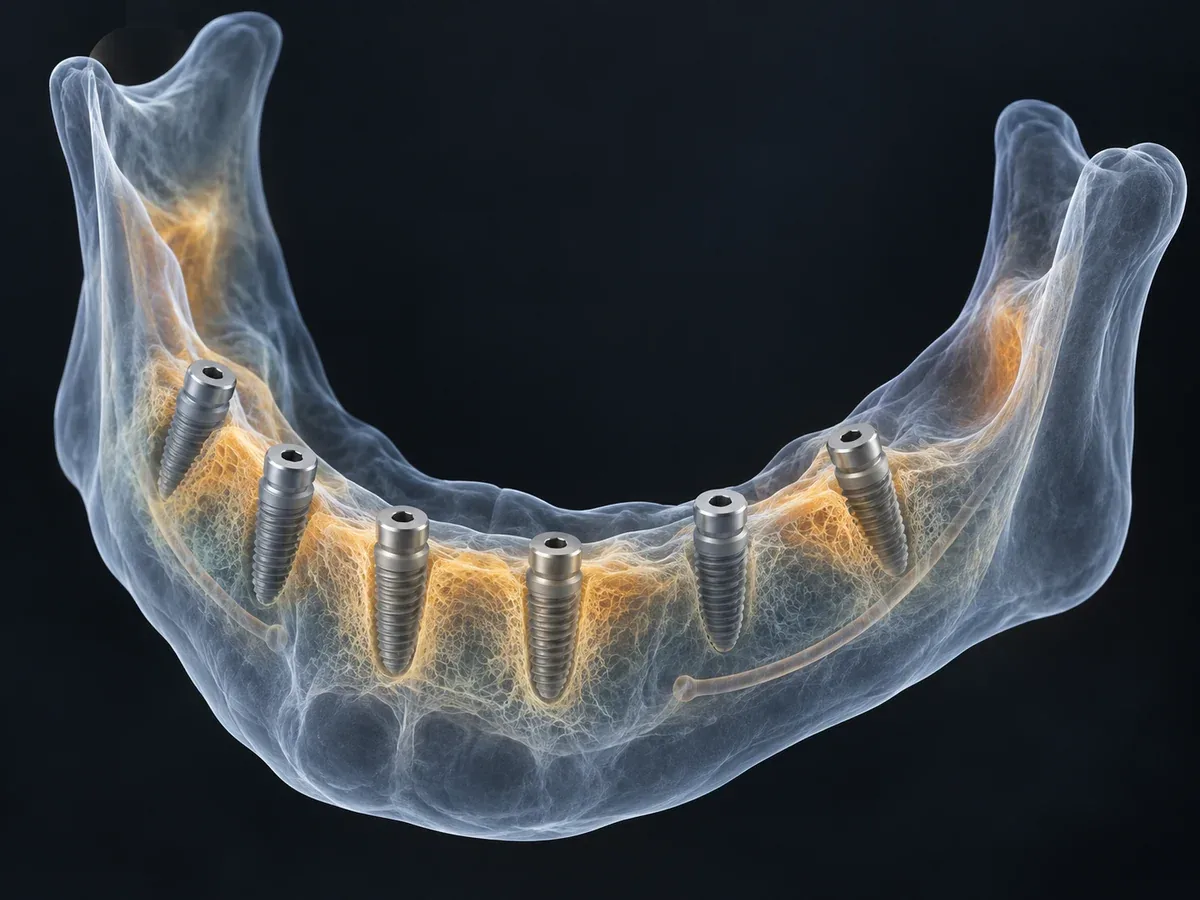
If you come from another city, or are visiting Korea for a short stay, the consultation and scans can be done in one day. We take the panoramic X-ray and 3D CT together and explain the plan that day.
Many patients travel a long way to see us, so we group the stages to reduce the number of visits. For people who live abroad or move often, this makes full mouth implants easier to plan around work and travel.
We also try to save any remaining natural teeth where possible. Even a few healthy teeth can help the plan a great deal.
But keeping a loose tooth by force can shake the whole plan. So we decide together which teeth to keep and which to remove.
How easy the implants are to clean depends more on the shape of the restoration than on the number. There must be room for cleaning tools, which is why we make the teeth in sections rather than one piece.
Three questions to ask at any consultation
- "Why that number?" Listen for an answer based on where your bone is and how dense it is. If the answer is just "this is how we usually do it," ask again.
- "What will you do if the bone turns out weak during surgery?" Check in advance whether the plan will be adjusted on the spot or kept as it is.
- "Are any of my medicines a problem?" Osteoporosis drugs and blood-related medicines must be discussed.
This is not meant as criticism of other dentists. It is simply there to protect you as a patient.
A clear answer to these three questions tells you a lot. It shows whether the number of full mouth implants comes from your own bone, or from a standard package.
Frequently asked questions
Is recovery faster with fewer full mouth implants?
Not much. The implants are placed in one session, so there is one round of anesthesia and one recovery. Whether bone grafting or sinus work was needed affects recovery more than the number.
Can more implants be added later?
Adding implants after the teeth are fitted is not easy. So it is better to leave some margin at the start, because placing one more at the beginning is far simpler.
Can I get this treatment in English in Busan?
Yes. We provide 1:1 English interpretation from the first consultation through the end of treatment. The clinic is near Seomyeon Station Exit 2 (5-min walk), opposite Lotte Hotel Busan, and you can call 010-8555-2854 (+82-10-8555-2854 from abroad).
There is no fixed right number.
Six in the lower jaw and seven or eight in the upper jaw are a starting point.
The number moves with bone quality and bite force,
and if the bone proves weak during surgery, we add more on the spot.
That one implant can shape the next 20 or 30 years.
Even if you were told it cannot be done,
your X-rays are worth a second look.
We will check and tell you honestly.
If you are considering full mouth implants in Busan, Reset Dental Clinic offers 1:1 English interpretation from your first consultation through the end of treatment. Call 010-8555-2854 to book a consultation.
References
- KDCA National Health Information Portal, "Dental Implants" — when implants are used, osseointegration, treatment time and complications
- KDA newspaper Dailydental (Chiui Sinbo), "65% of Implant Patients Have Had Peri-Implant Disease" (Korean Academy of Periodontology, 17th Gum Day) — risk factors for peri-implant disease, including osteoporosis medication
- KDCA National Health Information Portal, "Systemic Disease and Periodontal Treatment" — how diabetes and other conditions relate to the gums and supporting tissue
- KDCA National Health Information Portal, "Gum Disease (Periodontal Disease)" — how all the teeth can be lost and how jawbone is lost
- KDA newspaper Dailydental (Chiui Sinbo), "Implant Patients Aged 65 and Over Top 800,000 Last Year" — the growing number of implant patients in Korea
Written by Reset Dental Clinic Support Team
Medical review Dr. Na In-chae, Head Dentist · Periodontics Specialist
Last updated: September 19, 2026
This column is for general information and does not replace diagnosis or treatment for individual patients. If you have symptoms, please see a dentist.


