

- The first thing to find out is whether an underbite comes from tilted teeth or from the jawbone itself.
- In a growing child, orthodontics may make surgery unnecessary. For an adult who has stopped growing, the situation is different.
- Orthodontics adjusts the tilt of the teeth within the bone. It can go as far as the bone allows, and no further.
- If surgery is needed, we plan together with the surgical team. Before starting, ask to hear the limits first.
"I have an underbite. Can braces fix it, or do I need surgery?" Patients often ask this very carefully at Reset Dental Clinic in Seomyeon, Busan. For international patients, we provide 1:1 English interpretation from your first consultation through the end of treatment.
The answer starts with one check: is the problem in the teeth, or in the jawbone? Two underbites can look the same from the outside, yet this answer sends them down very different paths.
Is your underbite a tooth problem or a jaw problem?
When the lower front teeth bite in front of the upper front teeth, people usually call it an underbite.

Even when an underbite looks the same, its cause falls into two broad groups.
In the first group, the jawbones are a normal size, but the teeth are tilted forward or backward so the bite is reversed. This is called dental malocclusion.
In the second group, the lower jaw itself is large or sits forward, or the upper jaw is small or sits back. This is called skeletal malocclusion.
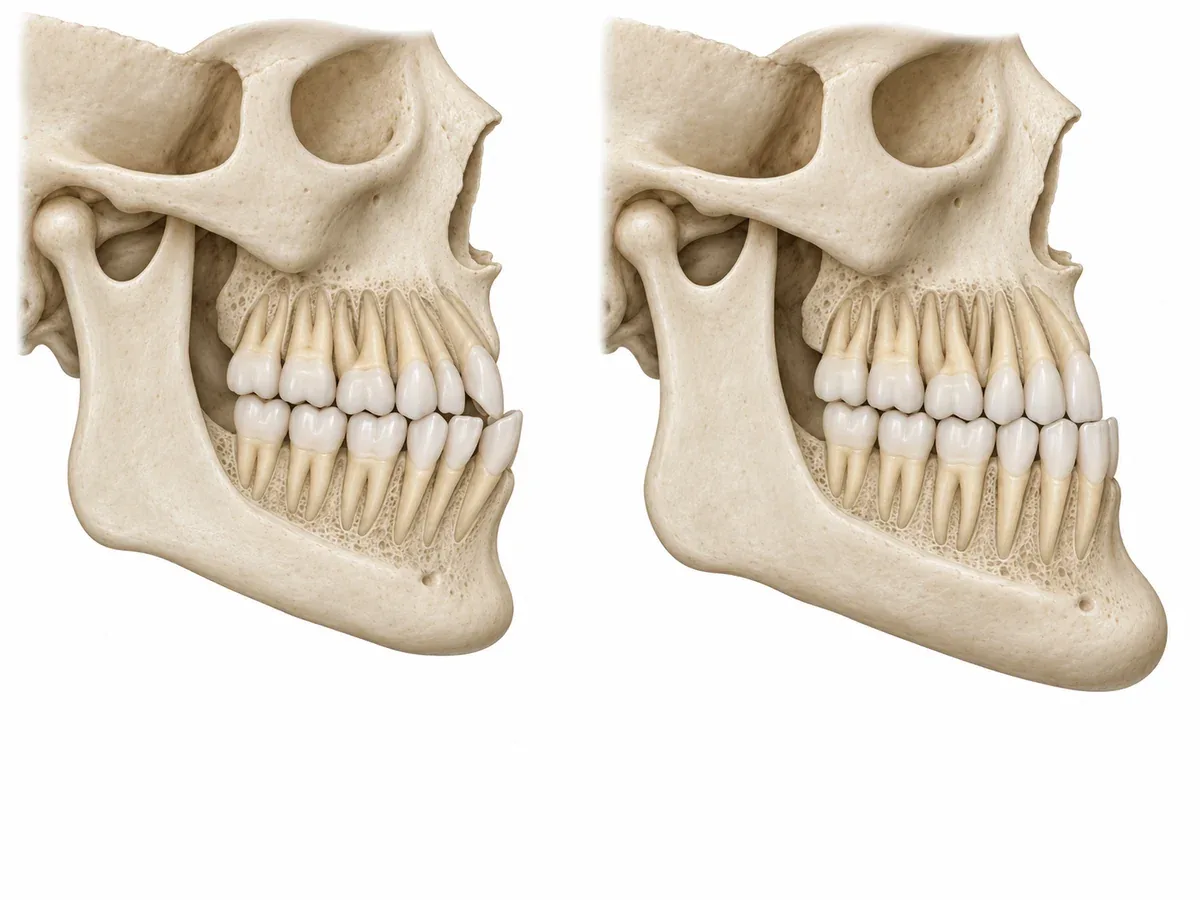
A reversed bite of the front teeth, called anterior crossbite, can appear in both groups. So it is hard to tell them apart just by looking inside the mouth.
To know which group you belong to, we need to look at diagnostic records together. These include:
- a side-view X-ray of the skull and jaws
- models of your teeth
- photos of your face
| Item | Tooth problem | Jaw problem |
|---|---|---|
| What is out of place | The position and tilt of teeth within the bone | The size and position of the jawbone |
| Side profile | The chin outline tends to look fairly normal | The chin tends to look pushed forward |
| With braces alone | Reviewed within the range of orthodontics | Limited, depending on how large the bone difference is |
| What else to check | Appliance choice and treatment plan | Whether growth continues, and whether surgery is needed |
Why does it matter whether the jaw is still growing?
Even with the same bone problem, the story changes depending on whether the jawbone is still growing.
The KDCA National Health Information Portal explains that in growing children, orthodontic treatment can improve skeletal problems and may make surgery unnecessary. There is room to guide the direction of growth while it is still happening.
In contrast, it advises that adults who have finished growing need surgery to correct a skeletal imbalance. Once the bone has fully grown, orthodontic appliances cannot change its size.

So if your child seems to have an underbite, it is wise to have diagnostic records taken early. After growth ends, the choices for the same problem become narrower.
Adults sometimes hear of orthodontic methods that claim to grow the jawbone. After growth has ended, orthodontic appliances cannot change the size of the bone.
A dental journal has even reported cases where trying to stimulate bone growth in a fully grown jaw caused problems with the roots and gum bone. We return to those cases later in this column.
What can braces alone do for an underbite, and where are the limits?
Even in adults, if the bone difference is not large, we consider correcting the bite with orthodontics alone. This is called camouflage treatment.
The principle is simple. The jawbones stay as they are, while the upper front teeth are tilted slightly forward and the lower front teeth slightly back. This way the front teeth meet, and the bone difference is made up by the tilt of the teeth.
There are clear limits to this. The alveolar bone that surrounds the tooth roots is not very wide, and its thickness sets how far teeth can be tilted.
Tilting them too far can put strain on the roots and the gum bone. That is a cost we do not want to accept for the sake of a better-looking bite.

There is one more point. What orthodontics corrects is the bite of the teeth, not the outline of the jaw. The bite may be corrected while the chin in the side profile stays the same.
| Situation | Direction |
|---|---|
| Crossbite caused by tooth tilt | Reviewed within the range of orthodontics |
| Skeletal problem in a growing child | Orthodontics may improve it and make surgery unnecessary |
| Adult with a small bone difference | Camouflage treatment using tooth tilt is reviewed |
| Adult with a large bone difference | Surgery is reviewed as well |
| Orthodontics alone would leave the facial shape incomplete | Surgery is reviewed as well |
Clear aligners are no exception to these limits. If an underbite comes from tooth tilt, both clear aligners and bracket braces can be options, but a large bone difference limits any appliance.
When is jaw surgery considered for an underbite?
Orthognathic surgery corrects the jawbones when orthodontics alone cannot treat the problem. It is also used when orthodontics alone would leave the improvement in facial shape incomplete.
The KDCA portal lists several examples of cases that may need surgery. Here are some of them:
- a severe underbite or a receding chin
- difficulty closing the lips
- an asymmetric face
- front teeth that do not touch each other
- teeth that are worn down far more than normal
Fitting one of these descriptions does not mean everyone needs surgery. It takes a range of examinations to judge whether surgery is needed or whether orthodontics alone can improve things.
This surgery is not simply cosmetic surgery; it is functional surgery. It has to take the bite and the movement of the jaw joint into account.
For that reason, an orthodontist and an oral and maxillofacial surgeon carry it out together. Neither can plan it well alone.
We provide clear aligners and bracket braces. If examinations show that surgery is needed, we refer you to an oral and maxillofacial surgery team and coordinate the orthodontic plan with them. We will not push the idea that braces alone can solve every underbite.
How does surgical underbite treatment proceed?
This is not a treatment that ends with a single operation. It usually goes through three stages.
- Orthodontics before surgery — the teeth are aligned and moved to fit their own jawbones, so they will meet well after surgery.
- Orthognathic surgery — an oral and maxillofacial surgeon moves one or both jawbones into the correct position.
- Orthodontics after surgery — the remaining tooth movement is finished, and rubber bands are sometimes used to help the bite meet better.

| Stage | What happens | Duration |
|---|---|---|
| Orthodontics before surgery | Teeth are arranged to fit the jawbones | Usually 6 months to over a year, sometimes 2–4 months |
| Right after surgery | Swelling goes down | About 2 weeks |
| Orthodontics after surgery | Remaining tooth movement and bite finishing | Starts 4–6 weeks after surgery and takes about 6 months to a year |
In some cases, surgery comes first and orthodontics follows. This is chosen when moving the teeth before surgery is not needed for the operation, and the result is expected to hold.
After surgery, swelling goes down in roughly two weeks, and the shape of the face changes. Recovery speed differs from person to person.
Today the operated jawbone is fixed from the inside with small screws. So the upper and lower jaws are not kept wired together for long, although you will eat a liquid diet while the jaw is held in place.
Finishing orthodontics begins about three to four weeks after leaving the hospital. Timing differs from person to person, depending on the teeth and the skeleton, and the actual schedule is set after examination.
What happens when the limits are not explained?
The more the bone is involved, the more important it is to hear the limits before starting. Cases reported in the dental press show why.
Trying to grow a fully grown jaw
Dailydental, the newspaper of the Korean Dental Association, reported on adult orthodontic complications described in a special issue of an academic journal. In these cases, attempts were made to stimulate growth in a jaw that had stopped growing.
The result was root resorption, loss of alveolar bone and an unstable bite. A professor also expressed concern that more patients are being drawn in by unscientific orthodontic theories found online.
Not explaining the limits of clear aligners in advance
In one case handled by the national medical dispute mediation agency, the clinic was found responsible. It had not properly explained or recorded the limits of clear aligners, the need for interproximal reduction (trimming between teeth) and possible midline changes.
An official noted that orthodontic treatment carries responsibility not just for the process but for the result as well.
Another case was filed with the Korea Consumer Agency. Over four years of clear aligner treatment, the treating dentist changed without explanation, too much tooth was trimmed between teeth, and needed attachments were not used.
Failing to check progress every 4–6 weeks was also pointed out as a problem. In the end, the patient developed a Class II malocclusion, sensitivity, jaw joint pain and gaps between teeth, and needed orthodontic treatment again.
The lesson is that diagnosis, explanation and steady follow-up shape the result more than the type of appliance.
What should you ask before starting underbite treatment in Busan?
You are welcome to ask these questions word for word at any consultation.
- Is my underbite a tooth problem or a bone problem?
- Which diagnostic records did you base that on? Ask to see the side-view X-ray, models and photos together.
- If I choose braces alone, how far will things change, and what will remain?
- If surgery is needed, which team will I work with, and how?
- For clear aligners: will I need trimming between teeth or attachments, and could my midline change?
- Will my dentist change during treatment, and how often will progress be checked?
A clinic that answers these questions while showing you the records is also explaining the limits. That is the kind of answer worth waiting for.
Bring any previous records or X-rays you have. They can help us compare how your bite has changed.
If you are unsure whether your concern counts as an underbite at all, that is also a fine reason to come in. The diagnosis itself is where treatment starts.
Frequently asked questions
My child seems to have an underbite. Should we get it checked now?
During growth, orthodontics can improve skeletal problems and may make surgery unnecessary. Records are needed to see the direction of growth, so it is wise to have an examination when you first feel concerned.
Can clear aligners fix an underbite?
Diagnosis comes before the appliance. If the underbite comes from tooth tilt, clear aligners and bracket braces can both be options. If the bone difference is large, every appliance has limits, and we explain this before starting.
Do you perform the jaw surgery yourselves?
We provide clear aligners and bracket braces. If surgery is needed, we refer you to an oral and maxillofacial surgery team and work with them. We first tell you whether braces alone can work or whether surgery is needed.
Can I get underbite treatment in English in Busan?
Yes. We offer 1:1 English interpretation from the first consultation through the end of treatment. The clinic is near Seomyeon Station Exit 2 (5-min walk), opposite Lotte Hotel Busan, and you can call 010-8555-2854 (+82-10-8555-2854 from abroad).
The answer to an underbite
starts with teeth or bone.
If braces can correct it, we use braces.
If it is a bone problem, we work with a surgical team.
Which one is it for you?
We will tell them apart with diagnostic records first.
If you are looking into underbite treatment in Busan, Reset Dental Clinic offers 1:1 English interpretation from your first consultation through the end of treatment. Call 010-8555-2854 to book a consultation.
References
- KDCA National Health Information Portal, "Orthognathic Surgery and Orthodontic Treatment" — differences between growing children and adults, cases that need surgery, and orthodontics before and after surgery with timing
- KDA newspaper Dailydental (Chiui Sinbo), "Retreatment Strategies for Adult Orthodontic Complications Draw Attention" — complications from trying to stimulate bone growth in adults who had stopped growing
- KDA newspaper Dailydental (Chiui Sinbo), "Clear Aligners: Explaining and Recording Interproximal Reduction and Treatment Limits Is Essential" — explaining and recording the limits of clear aligners, trimming between teeth and midline changes
- KDA newspaper Dailydental (Chiui Sinbo), "Clear Aligner Treatment: Care Needed With Attachments and Interproximal Reduction" — a clear aligner case with poor management of attachments and trimming, and missed regular checks
Written by Reset Dental Clinic Support Team
Medical review Dr. Kim Hyun-joo, Head Dentist · Esthetic Restorations
Last updated: September 19, 2026
This column is for general information and does not replace diagnosis or treatment for individual patients. If you have symptoms, please see a dentist.


