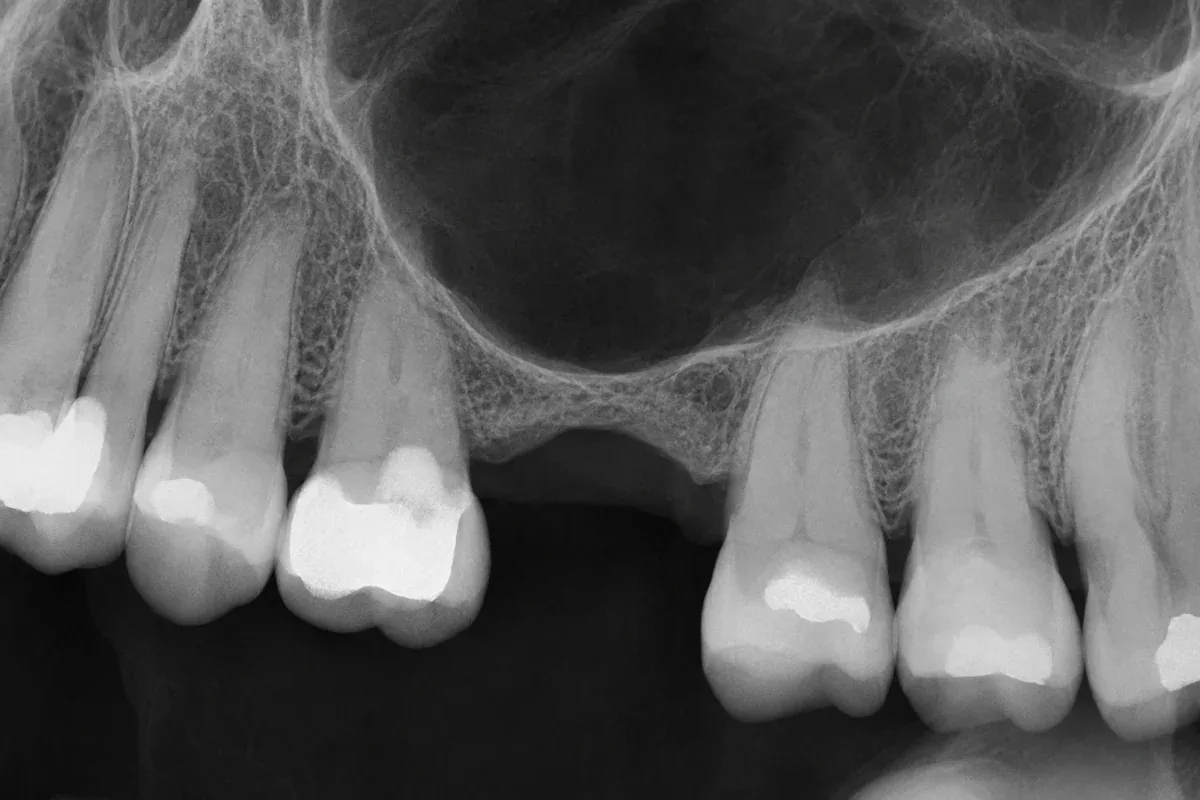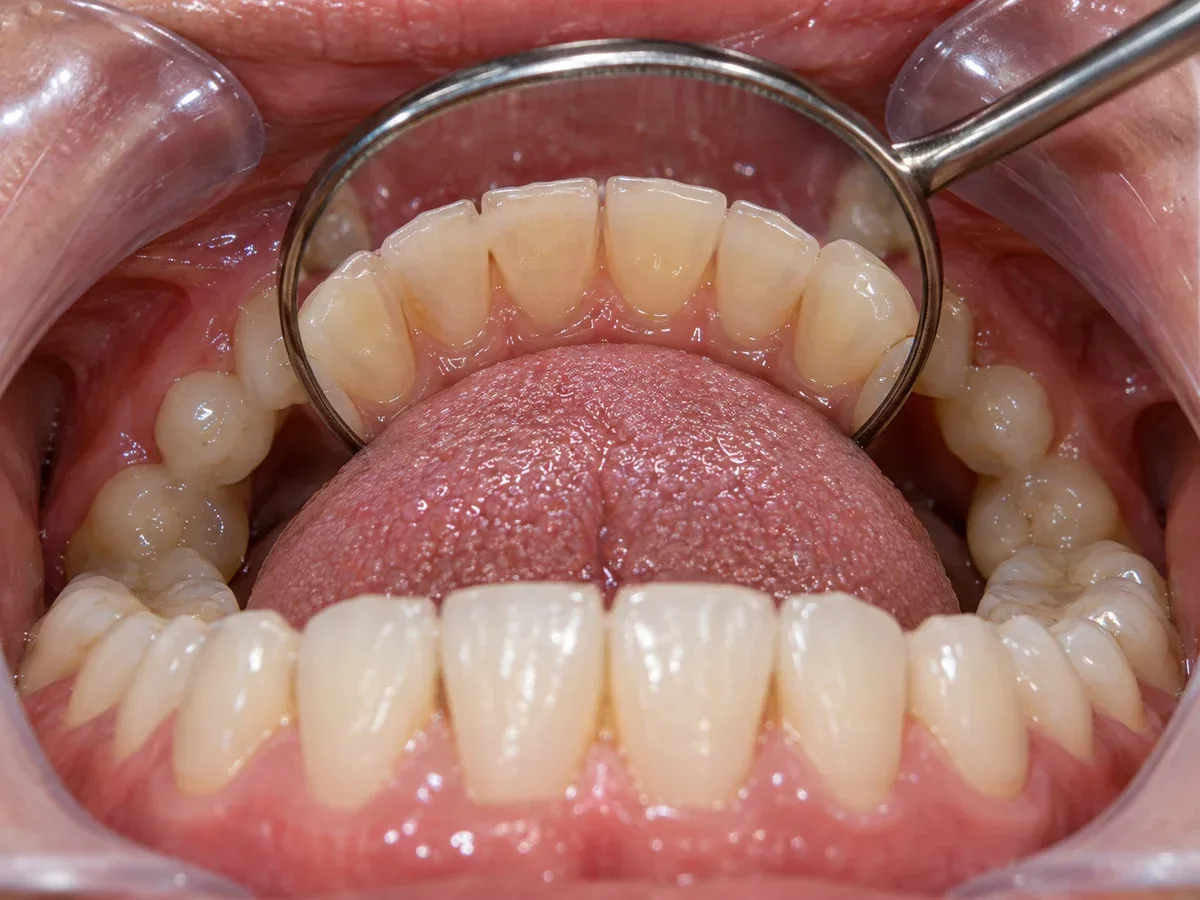
- If an adult front tooth is knocked out, keeping the root surface from drying out matters more than anything else. The source warns that the root dries out within minutes.
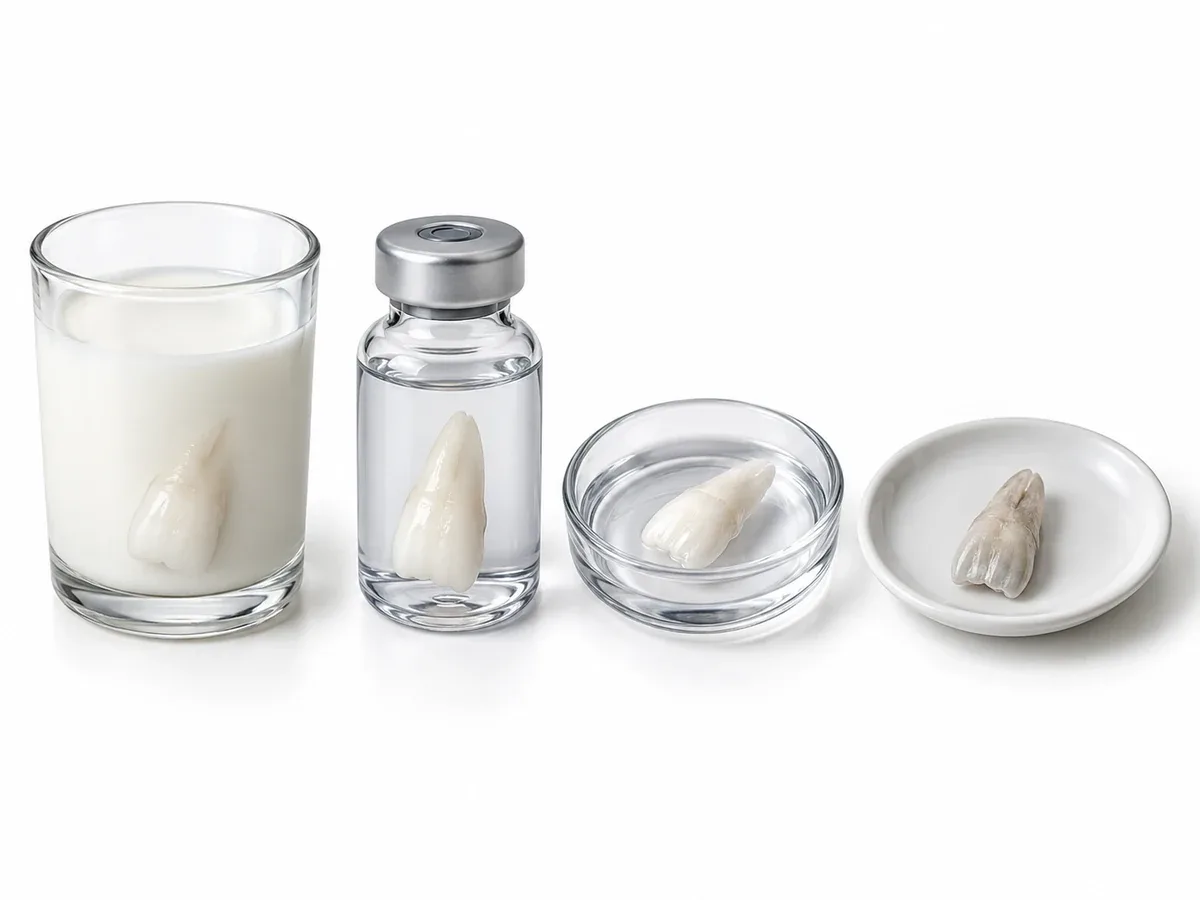
- Storage liquids come in a set order: milk, HBSS, saliva, then saline. Water is not recommended.
- Do not throw away a broken piece. Reattaching it gives a very natural-looking result.
- Care does not end on the day of the injury. Complications can appear later, so follow-up checks are essential.
A fall or a knock to a front tooth leaves anyone shaken. At Reset Dental Clinic in Seomyeon, Busan, we know how hard it is to decide on the spot whether to keep the piece and how to carry the tooth. For patients living in or visiting Korea, we provide 1:1 English interpretation from the first consultation to the end of treatment.
This guide is based on the KDCA National Health Information Portal pages on dental trauma, root canal treatment, tooth extraction, autotransplantation and tooth decay. It starts with what to do right now and explains the reasons afterwards.
What should you do in the first minutes after a front tooth injury?
The details come later. First, here is what to do in each situation, in short.
- If a front tooth broke: find the broken piece and bring it with you. The source says reattaching the fragment gives a very natural-looking result, so bring it if you can find it. An exposed break can also feel sensitive, so come in as soon as you can.
- If the whole tooth came out: hold it by the crown, the white part you normally see, and avoid touching the root. If it is dirty, rinse it gently with milk, saline or the patient's own saliva. Then place it carefully back into its socket, bite on gauze or a handkerchief to hold it, and come to a dentist. The source describes this immediate replanting as the preferred step at the scene.
- If it is hard to put back, or the tooth is dirty: do not force it in, because that carries a risk of infection. Put it straight into a storage liquid and bring it along with the patient.
- If the tooth is loose or pushed up into the gum: do not try to straighten it by hand. The source advises seeing a dentist right away for a root fracture, a tooth pushed into the bone, or a loosened tooth.
- If a child's baby tooth came out: the source states clearly that baby teeth are not replanted. Do not try to put it back; just bring the child.
Two things matter in every case. Move quickly, and keep any tooth or fragment wet.
Even if you managed to put the front tooth back yourself, a dental visit is still needed. X-rays and a splint are part of treatment.
The sections below explain why each step matters. Knowing the reasons makes the steps easier to remember.
What should a knocked-out front tooth be stored in?
The source lists storage liquids in this order: milk, HBSS (Hank's Balanced Salt Solution), saliva spat into a container, and saline. Water is not recommended. Even so, water is better than leaving the tooth to dry in the air.
| Option | What the source says |
|---|---|
| Milk | First in the recommended order, and the easiest to find |
| HBSS | Second in the order; a balanced salt solution |
| Saliva | Third; spit into a clean container and keep the tooth in it |
| Saline | Fourth in the order |
| Water | Not recommended, but better than drying in the air |
| Dry (tissue, pocket, plate) | The root surface dries out within minutes |
At home or on the street, milk is usually the easiest to find. A single carton from a convenience store is enough.
Why does the order matter so much? The source says keeping the root surface moist has a large effect on the future of the tooth. It adds that the root dries out within minutes.
People sometimes wrap a knocked-out front tooth or a piece in tissue and put it in a pocket. In that time, the root surface dries.
Wiping or scrubbing the front tooth does harm as well. Rinsing and wiping are two different things.
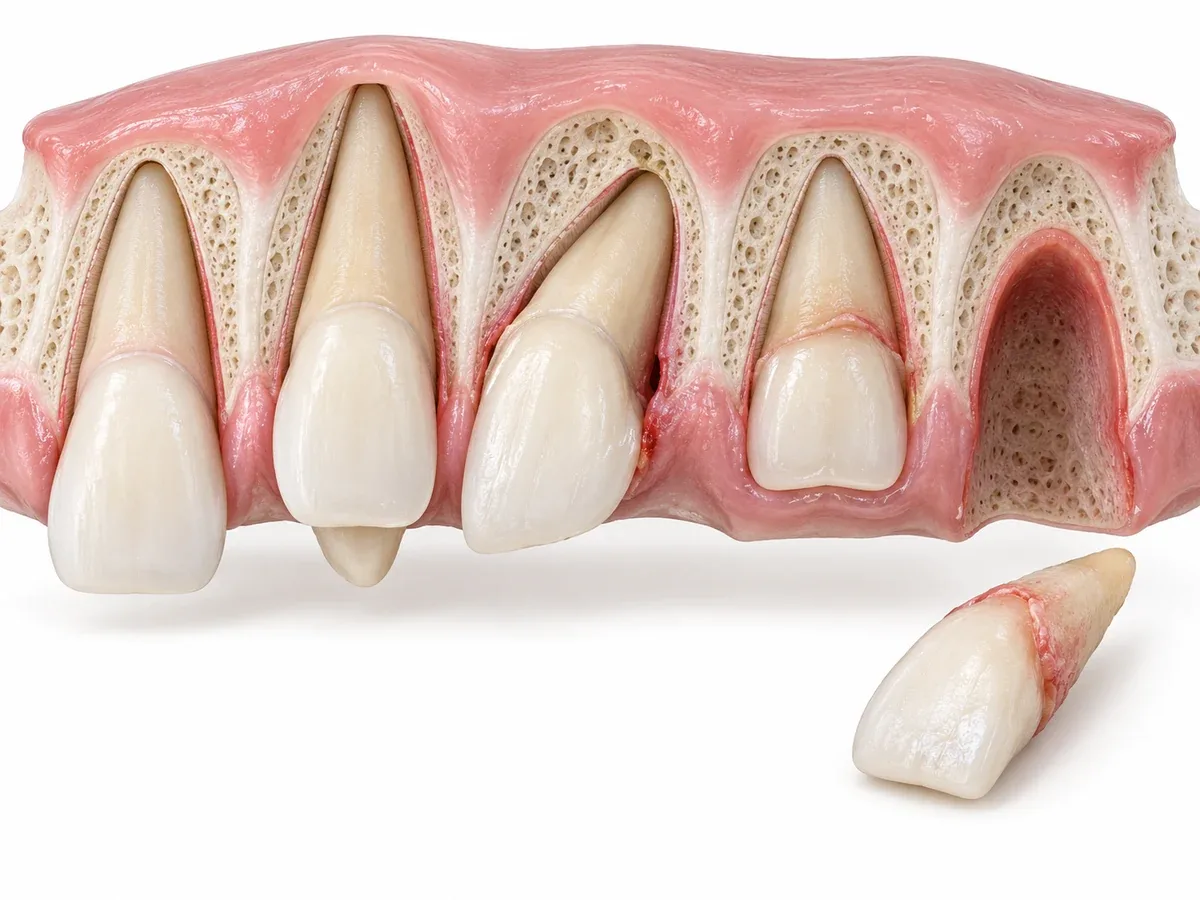
Front tooth injuries come in several types
Even "I hurt my front tooth" covers many different injuries in the source. They fall into two broad groups.
One group is fractures, where the tooth or the bone around it breaks. The other is damage to the supporting tissues, where the tooth does not break but is loosened or moved out of place.
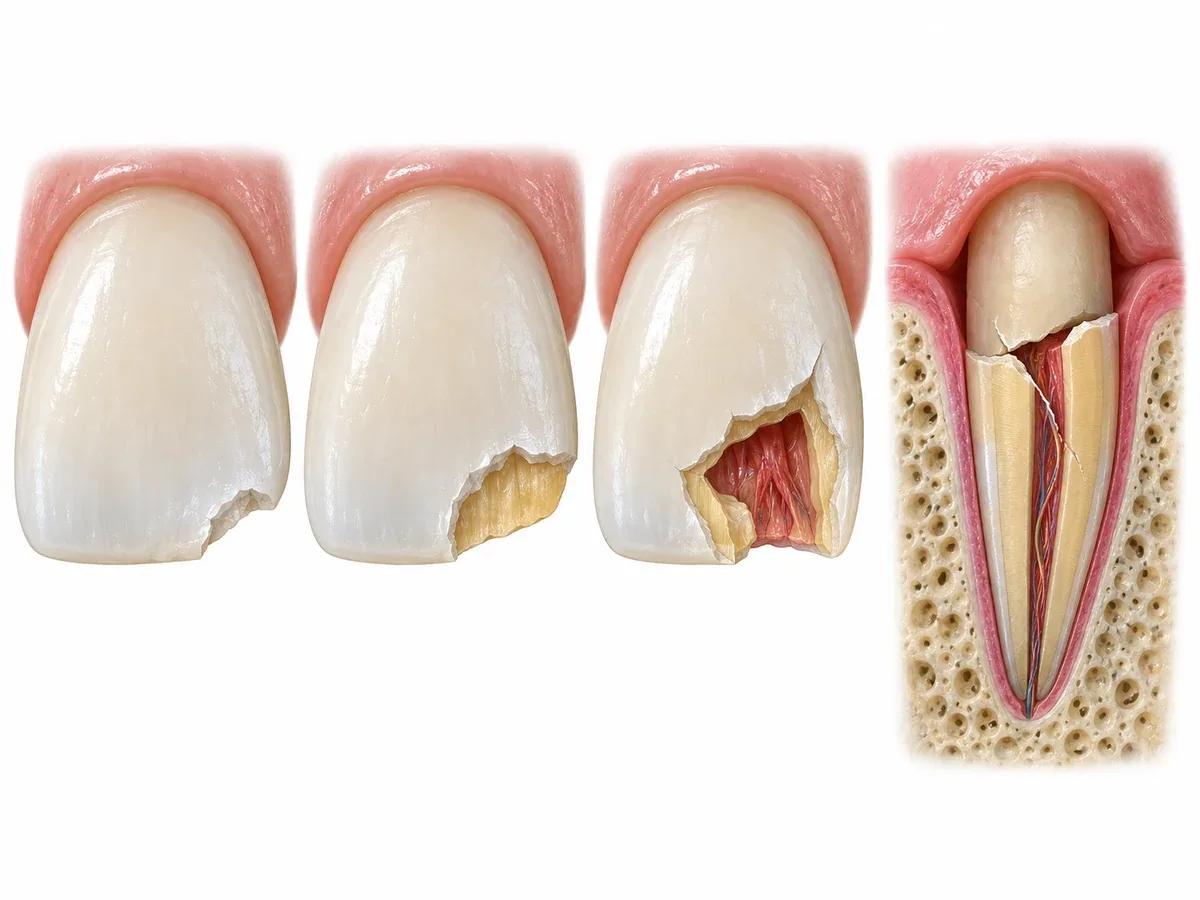
The fractures listed in the source run from mild to severe:
- an enamel crack (infraction) with no loss of tooth structure
- a fracture of the enamel alone
- a fracture of enamel and dentin that does not expose the pulp
- a fracture that exposes the pulp, the nerve and blood vessels inside the tooth
- a crown-root fracture that runs below the gum into the root
- a root fracture, where just the root breaks
- an alveolar fracture, where the bone holding the teeth breaks
Injuries to the supporting tissues are divided as follows.
| Name | Condition |
|---|---|
| Concussion | The tooth has not moved or loosened, but reacts sharply when tapped |
| Subluxation | The tooth is in place but abnormally loose |
| Extrusive luxation | The tooth has partly come out of its socket |
| Lateral luxation | The tooth has been pushed sideways |
| Intrusive luxation | The tooth has been driven up into the bone |
| Avulsion | The tooth has come completely out of its socket |
How common are these injuries?
The numbers below are taken directly from the source. Dental injuries are common, and most happen at a young age.
| Group | Figure |
|---|---|
| All traumatic injuries | Dental injuries make up about 5% |
| School-age children | 25% have had a dental injury |
| Adults | 33% have had an injury to their adult teeth, mostly before age 19 |
| Children aged 0–6 | Mouth injuries are about 18% of all body injuries, the second most common |
| Baby teeth worldwide | About 22.7% prevalence in a recent meta-analysis |
The most common type also depends on age. In baby teeth, luxation injuries are the most common. In adult teeth, crown fractures are the most common.
What will a dentist in Busan check first?
The source does not look at the injured front tooth alone. An injury can also break bone or cause bruises, scrapes and cuts in the soft tissue, so a careful exam is needed.
- clinical photos of the starting condition
- X-rays, and CBCT (cone-beam CT) where needed
- pulp tests with cold or heat and with a mild electric current
Photos record the starting point. Later, the dentist compares soft tissue healing, color changes, whether a pushed-in tooth comes back down, and signs of ankylosis, where the root fuses to the bone.
X-rays are needed too, both for diagnosis and as a baseline for later checks. The source says CBCT is useful for root fractures, crown-root fractures and lateral luxation. It also shows the location, extent and direction of a bone fracture.
For children, the source advises taking just the minimum images needed for an accurate diagnosis. This keeps radiation exposure low.
Pulp tests show whether the nerve and blood vessels inside the tooth are alive. The source says they should be done at the first visit and at later visits, because what matters is change over time. The KDCA page on tooth decay also describes these tests as the way to tell whether root canal treatment is needed.
How long is the tooth splinted?
A front tooth that was replanted or moved back into place will shift if left alone. So it is bonded to the neighboring teeth to hold it still.
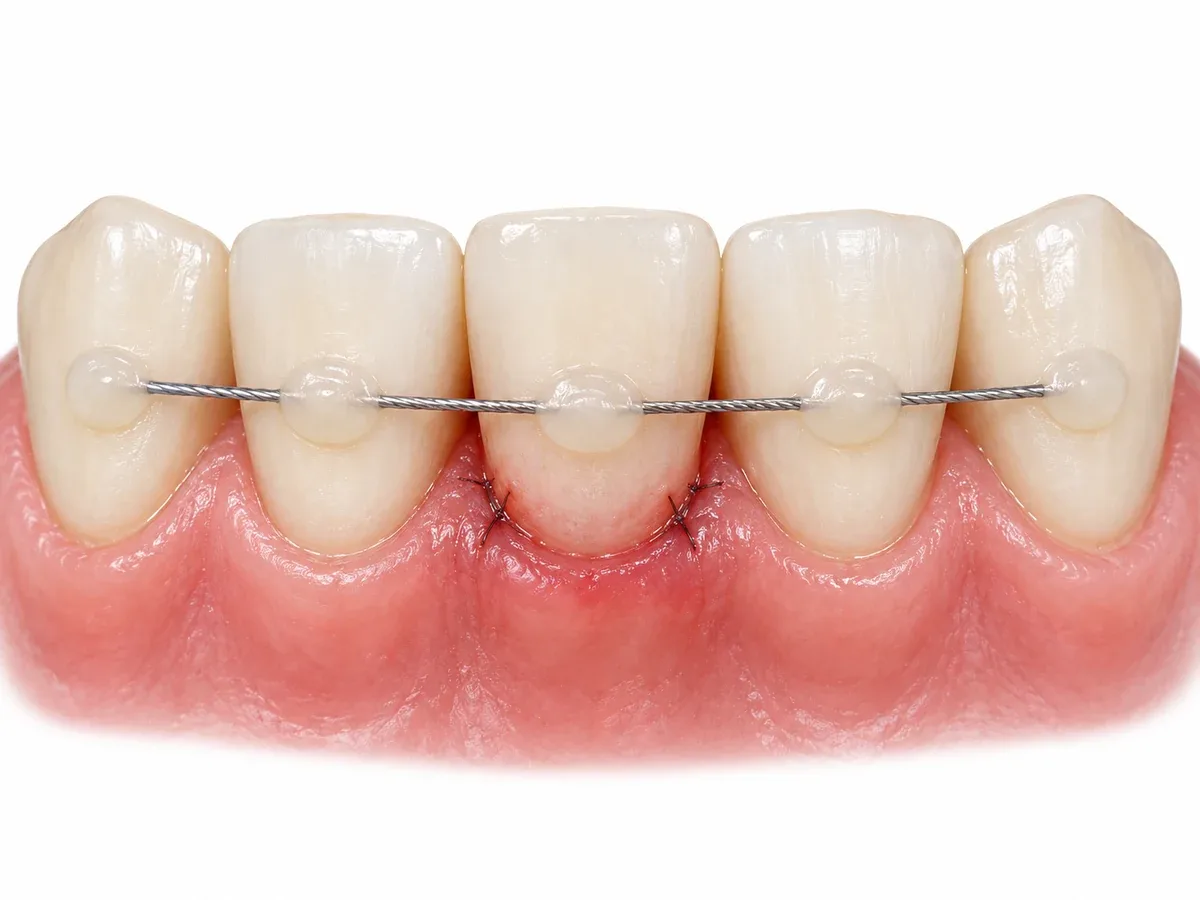
| Injury | Splint period |
|---|---|
| Avulsion (knocked out) | About 2 weeks |
| Lateral luxation | About 4 weeks |
| Intrusion (pushed in) | About 4 weeks |
| Root fracture | About 4 weeks |
Even if you put the tooth back at the scene, you still need a dental visit. The source says an X-ray assessment and about two weeks of splinting are needed after replanting. An X-ray also confirms that the tooth went back in the right direction.
Why are a child's baby teeth treated differently?
Injuries to baby teeth need a different approach from injuries in adults. The source says most baby tooth injuries also damage the surrounding gum and bone.
In particular, damage near the root tip can seriously affect the adult tooth growing underneath. The developing adult tooth may form abnormally or fail to come in properly, which is called an eruption disorder.
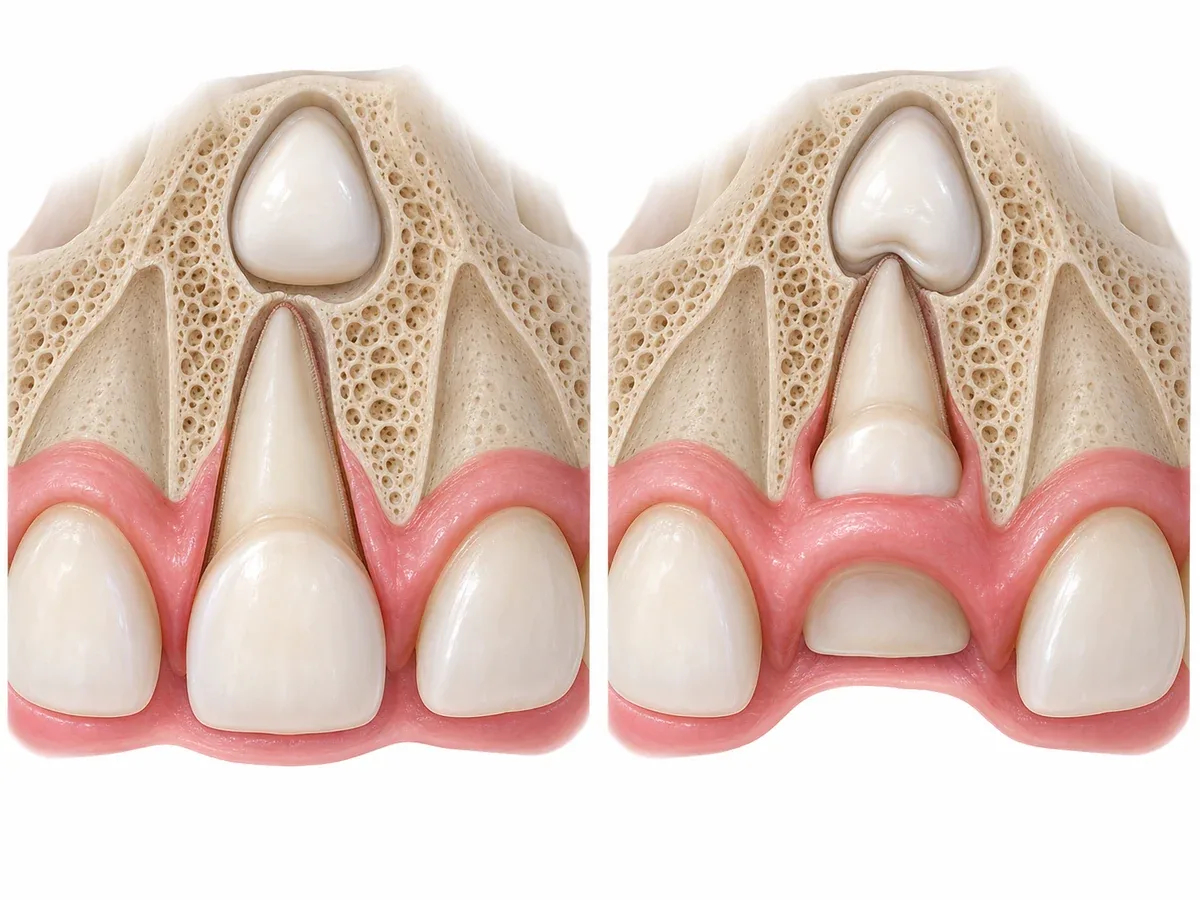
So even if the child seems fine, a check is needed. The baby tooth will fall out soon, but the adult tooth below it is still forming.
Keep three more points in mind:
- Baby teeth are not replanted.
- For luxation of baby teeth, the source says antibiotics taken by mouth are generally not recommended. They may be used when there is soft tissue injury, when surgery is needed, or depending on the child's medical condition.
- If the wound is contaminated, a tetanus shot may be needed.
The KDCA page on extraction adds a related caution. Before a baby tooth is removed, the position of the adult tooth below should be checked on an X-ray.
Why does an injured front tooth need follow-up for years?
This is the part most easily missed. The source says an injury to an adult tooth is irreversible and lasting.
Complications can affect the injured front tooth and the teeth beside it. They often show up long after the day of the injury.
- death of the pulp, with or without infection
- narrowing or closing of the pulp space
- several types of root resorption, where the root is gradually worn away
- resorption at the gum line and loss of the surrounding bone
- ankylosis, and in some cases extraction
The source is firm here. Follow-up after a dental injury is essential. Finding and managing these problems early can improve the outlook for the tooth.
Not every injured tooth needs root canal treatment, the source says. However, a tooth that was knocked out or pushed into the bone needs root canal treatment soon.
| Situation | What the source says |
|---|---|
| Knocked out (avulsion) | Root canal treatment is needed soon |
| Pushed into the bone (intrusion) | Root canal treatment is needed soon |
| Other injuries | Regular pulp tests; treatment starts if the pulp is found to have died |
| Gray color or a lesion at the root tip | A sign of pulp death; root canal treatment is needed |
The KDCA root canal page explains why this matters. Infected pulp left in place can spread inflammation through the root tip into the surrounding bone.
Removing the splint is one step, not the end. Even after proper root canal treatment of a replanted tooth, resorption or ankylosis can occur, so the source says regular checkups are needed.
What if the front tooth cannot be saved?
We cannot promise that every tooth can be kept. The KDCA extraction page lists a cracked or broken tooth that still hurts after treatment as a reason for extraction.
The same page opens with a principle. Extraction cannot be undone, so it should be a careful decision, made when it is truly needed.
If extraction is unavoidable, there is a lesser-known option. The KDCA page on autotransplantation describes removing a tooth that cannot be kept and moving the patient's own healthy tooth, such as a wisdom tooth, into that spot.
In clinical studies, more than 80% of these transplanted teeth were still in place after about five years. The outlook is better for people under 30 without gum disease. It can be worse when the transplant is done long after the extraction.
Frequently asked questions
Can I keep a knocked-out front tooth in water?
The source does not recommend water, although it is better than letting the tooth dry in the air. Milk is the easiest first choice. If nothing else is at hand, spit into a clean container and keep the tooth in your saliva.
The bleeding stopped and it does not hurt. Do I still need to go?
Yes. Pulp death, root resorption and bone loss can appear later, so the source calls follow-up essential. No pain does not mean the tooth is fine.
My injured front tooth has turned gray. What does that mean?
The source lists a grayish color as a sign that the pulp may have died, and says root canal treatment is then needed. Please have it checked without waiting.
Can I get front tooth injury care in English in Busan?
Yes. We offer 1:1 English interpretation from the first consultation through the end of treatment. The clinic is near Seomyeon Station Exit 2 (5-min walk), opposite Lotte Hotel Busan, and you can call 010-8555-2854.
The first few minutes after an injury
can change a tooth's future a great deal.
Pick up the broken piece.
Put a knocked-out tooth in milk.
Then bring it with you.
And do not stop on that day.
Keep the follow-up schedule, even when the tooth feels fine.
If you injure a front tooth in Busan, Reset Dental Clinic offers 1:1 English interpretation from the first consultation through the end of treatment. For patients living in or visiting Korea, call 010-8555-2854 (+82-10-8555-2854 from abroad).
References
- KDCA National Health Information Portal, "Dental Trauma (Tooth Injury)" — classification of 8 fracture types and 6 supporting-tissue injuries; statistics (about 5% of all injuries, 25% of school-age children, 33% of adults, 18% of injuries in ages 0–6, 22.7% prevalence in baby teeth); fragment reattachment; replanting at the scene and holding the tooth by the crown; storage liquids (milk, HBSS, saliva, saline) and why water is not recommended; root drying within minutes; no replanting of baby teeth; eruption problems of adult teeth; clinical photos, X-rays, CBCT and pulp tests; splint periods of about 2 and 4 weeks; follow-up and complications; antibiotics and tetanus shots for baby-tooth luxation
- KDCA National Health Information Portal, "Root Canal Treatment" — definition of removing, disinfecting and sealing infected pulp; how untreated pulp inflammation spreads through the root tip into the bone; when a crown is needed afterwards to prevent fracture
- KDCA National Health Information Portal, "Tooth Extraction" — extraction cannot be undone and should be decided carefully; a cracked or broken tooth that still hurts after treatment as a reason for extraction; checking the adult tooth on an X-ray before removing a baby tooth
- KDCA National Health Information Portal, "Tooth Autotransplantation" — moving the patient's own wisdom tooth or other tooth into the site of a tooth that cannot be kept; over 80% retained at about 5 years in clinical studies; better outlook under age 30 without gum disease, poorer outlook long after extraction
- KDCA National Health Information Portal, "Tooth Decay" — temperature and electric pulp tests to decide whether root canal treatment is needed; X-rays to see lesions around the root; tapping and mobility tests to find the painful or loose tooth
Written by Reset Dental Clinic Support Team
Medical review Dr. Na In-chae, Head Dentist · Periodontics Specialist
Last updated: September 19, 2026
This article is general information and does not replace diagnosis or treatment for individual patients. If you have symptoms, please see a dentist.