

- Whitening changes color alone. Veneers change shape and color together, and many veneer indications have nothing to do with color.
- Korean food and drug authorities define whitening as returning stained teeth to their original color, or whiter and brighter.
- Whitening usually comes first, because bonded veneers do not get lighter with bleach and veneer treatment includes a shade and fit check before bonding.
"Should I whiten first and then get veneers, or just get veneers?" We hear this often at Reset Dental Clinic in Seomyeon, Busan. The two do different jobs, and that is why the order matters. For patients living in or visiting Korea, we offer 1:1 English interpretation from the first consultation through the end of treatment.
This column is based on material from the Korean government's national health information portal on laminate treatment and all-ceramic crowns. It also draws on guidance on tooth-whitening products from the Korean Ministry of Food and Drug Safety (MFDS).
Do whitening and veneers do the same job?
The MFDS defines tooth whitening like this. It is making stained or discolored teeth return to their original color, or whiter and brighter, using a substance with a whitening function.
The limit is already inside that sentence. Whitening deals with one thing: color. It does not touch the shape of a tooth.
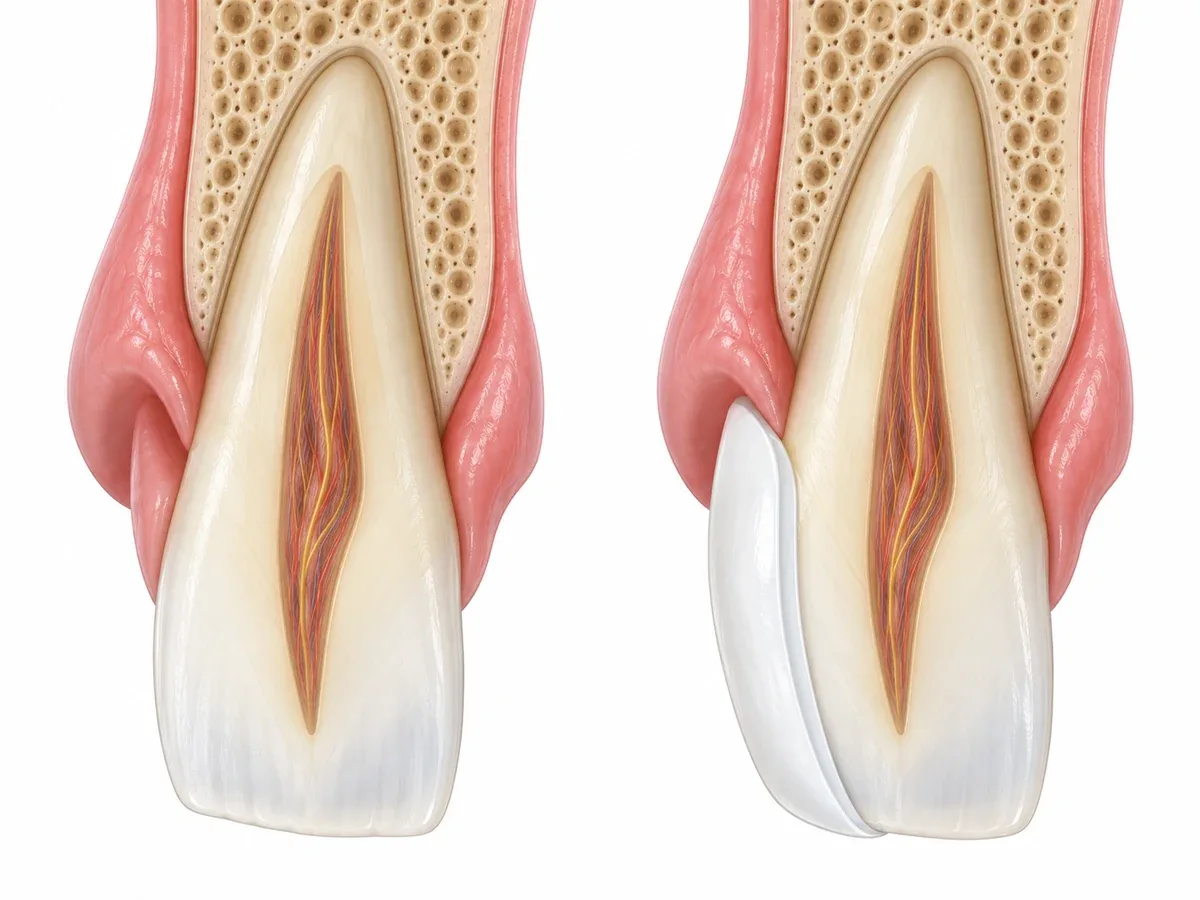
The definition of a veneer is different. The health portal describes it as a prosthetic process done mainly for appearance, usually on the upper front teeth. A minimal amount of the enamel surface is removed first.
Then a thin, tooth-colored shell of porcelain or composite resin is bonded with resin cement, much like a false fingernail. The portal gives the thickness of this shell as about 0.5 to 1.0 mm. So it adds thickness and shape, not just color.
That is why more than half of the indications listed by the portal have nothing to do with color. They are:
- gaps between teeth (diastema)
- tooth discoloration, present from birth or acquired later
- partial demineralization or small cavities on the outer surface
- mild problems with tooth position
- small, oddly shaped teeth from birth (peg-shaped teeth)
- teeth with edges chipped by an impact
Of these six, whitening can help with just one: the second.
| Point | Whitening | Veneers |
|---|---|---|
| What it changes | Color | Shape and color together |
| Tooth reduction | None | A minimal amount of enamel |
| What is added | Nothing is attached | A shell about 0.5–1.0 mm thick |
| Main material | Hydrogen peroxide or carbamide peroxide | Porcelain or composite resin |
Which tooth colors can whitening change?
Look again at the MFDS definition. It says "their original color, or whiter and brighter." The baseline is the tooth's original color.
If stain has built up on top and is hiding the original color, removing it brings that color back. But if the original color itself is different, the story changes.
This is why the laminate material lists discoloration from birth or acquired later as an indication. It says this treatment can clearly improve the appearance of such teeth.
In other words, color that is hard to lighten is handled by covering it. The two sources simply cover different ground.
One thing should be clear. The sources give no figures on how many shades a given kind of discoloration can lighten. So we do not give such numbers here either.
In our clinic, we first check where the current color comes from. Then we see how far lightening can go before deciding on the plan.
What are the three types of tooth whitening?
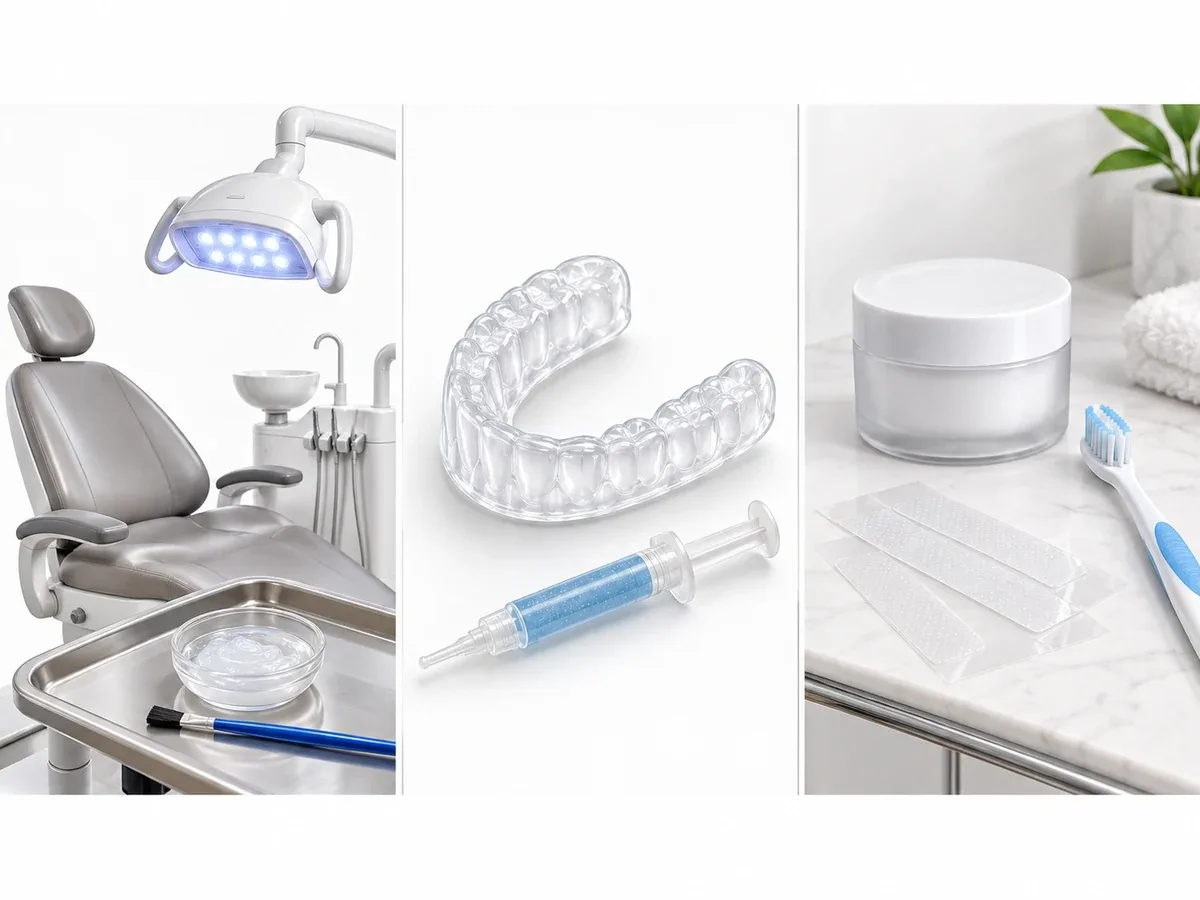
The MFDS divides whitening into three types. They differ in where it is done, what is used and how strong the product is.
| Type | Where | How it works |
|---|---|---|
| In-office whitening | Dental clinic | A high-concentration hydrogen peroxide agent is applied, then a whitening light is used |
| Take-home whitening | Home, with a clinic-made tray | A tray is made from your tooth impressions and filled with whitening agent |
| Over-the-counter whitening | Home | A quasi-drug product with 3% or less hydrogen peroxide is used by the user |
The main ingredients are hydrogen peroxide or carbamide peroxide. As they break down, they release active oxygen. According to the MFDS, this breaks down or removes the staining substances on the tooth surface.
The MFDS also explains how to use each form of over-the-counter product:
- Gel: dry the tooth surface and apply just enough not to run. Keep your mouth open for about 30 seconds to 1 minute until it dries, then rinse with water after 30 minutes.
- Strips: apply and remove as the directions say, then rinse with water.
- Toothpaste type: put a suitable amount on a toothbrush, brush and rinse.
The cautions are stated clearly. Products bought in shops must be approved and labelled as quasi-drugs. Used differently from the directions, they may weaken and damage teeth.
Right after whitening, skip toothpaste and brush with a soft toothbrush. Rinse well so no whitening agent is left in the mouth.
The MFDS also lists people who are better off not using whitening products:
- people with a hypersensitivity to hydrogen peroxide
- patients in orthodontic treatment
- children and teenagers
- pregnant women
- breastfeeding mothers
Mouth infections, damaged teeth or gum disease can make irritation stronger. So check your mouth and talk to a professional before use.
For sensitivity, it says that it usually settles after stopping for 1 to 2 days. If it continues, stop using the product and see a dentist.
How is the order decided for patients in Busan?
This is the part we most want to explain. There are three reasons whitening usually comes before veneers.
- Bonded veneers do not get lighter with whitening agents.
- Veneer treatment includes a step where the shade is matched.
- When there is less color to hide, the veneer can be thinner.
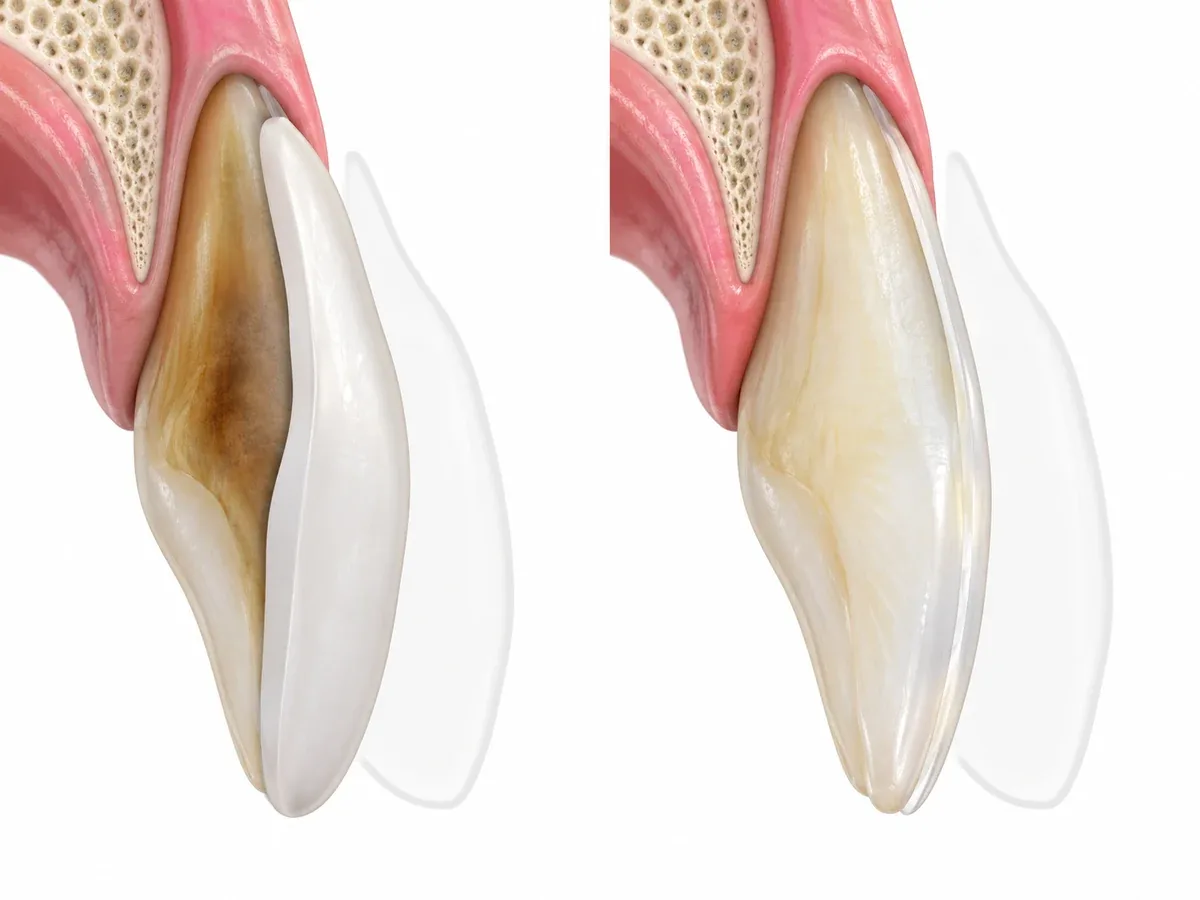
First, whitening works on natural teeth. The sources say whitening agents break down or remove staining on the tooth surface. A bonded porcelain or resin shell is not their target.
If the natural teeth alone get lighter, the bonded shell stays as it is. Next to them, it will look darker.
Second, there is a shade-matching step. The fifth step of treatment in the portal's list goes like this. The finished shell is tried on to check color, shape and fit, and it is bonded once both patient and dentist are satisfied.
The color of the neighboring teeth at that moment becomes the reference. If that reference is still changing, the target keeps moving.
Third, a lighter tooth allows a thinner shell. The all-ceramic crown material explains a basic property of ceramics. Strong ceramics are less translucent, and highly translucent ceramics are weaker.
To hide a dark color, you need a less translucent material or more thickness. More thickness means more tooth reduction or a bulkier tooth. Lightening the teeth first reduces that burden.

How long should you wait before veneers are bonded?
The sources give no set number of days to wait. So we will not give one here either.
There are useful hints, though. The laminate material advises avoiding drinks that stain for about 2 to 3 days after bonding.
The MFDS says sensitivity after whitening usually settles after stopping for 1 to 2 days. Both sources show that the state right after treatment does not stay exactly the same, whether it is color or symptoms.
In our clinic, we allow time for the color to settle after whitening. We then check photos and the shade again before moving on to veneers.
If veneers are placed in a rush, the neighboring teeth may drift back a little later. Then the bonded tooth stands out on its own.
Once a shell is bonded, that difference is hard to correct by changing its color.
When can whitening be skipped before veneers?
Whitening does not always come first. If color is not the problem, there is no place for it.
Among the listed indications, gaps, peg-shaped teeth, chipped edges and mild position problems are all about shape. Whitening first solves none of them.
On the other hand, whitening alone is sometimes enough. The portal describes laminates as bonded after removing a minimal amount of tooth.
So if the teeth do not need to be reduced at all, leaving them untouched comes first in the order.
The portal also says clearly that for severely misaligned teeth, metal-ceramic crowns, all-ceramic crowns or orthodontic treatment are recommended over veneers. Some problems cannot be solved by lightening teeth or by adding a thin shell.
| Main concern | Usual first step |
|---|---|
| Color alone | Whitening, which may be enough without veneers |
| Color plus shape | Whitening first, then veneers matched to the settled shade |
| Shape alone (gaps, small or chipped teeth) | Whitening is not needed for the problem itself |
| Severe misalignment | Crowns or orthodontic treatment rather than veneers |
How does care change after veneers are bonded?
What comes after matters as much as the order. The laminate material lists three points of aftercare.
| When | What to do |
|---|---|
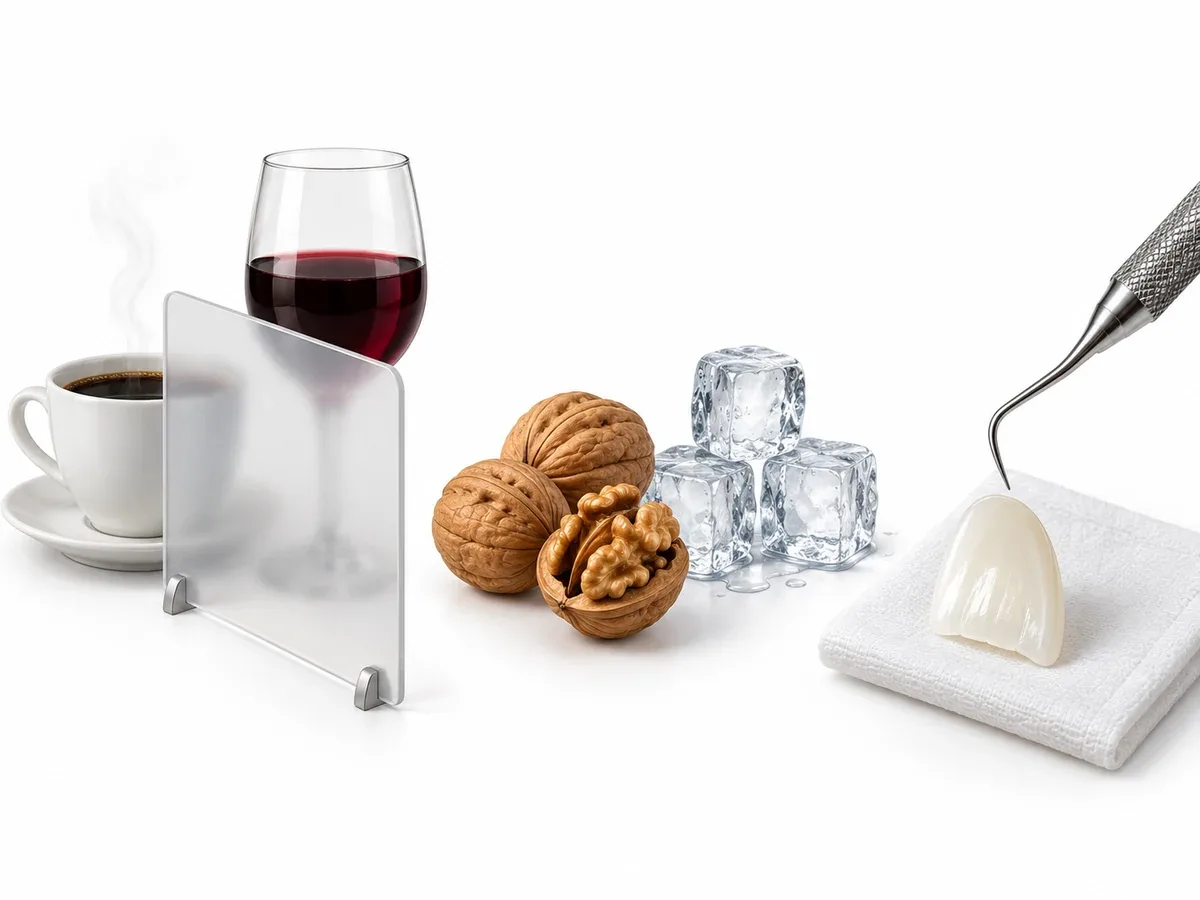
| About 2–3 days after bonding | Avoid drinks that may stain, such as cola, black tea and coffee |
| From then on | Avoid irritating foods, and do not bite hard foods with the treated teeth so they are not overloaded |
| Before scaling | Tell the dental team you have laminates, because ultrasonic scalers may partly damage porcelain |
The last point is easy to miss. It applies when you have your teeth cleaned at any dental clinic.
The material also notes that veneers cover part of a tooth, not all of it. So they are relatively weaker than other restorations and may come off under harmful forces.
On lifespan, it says veneers can be used for around 5 to 10 years with proper care. It adds that this varies widely with oral health and how well the teeth are looked after.
Whitening is not a one-time event either. Whichever you choose, care continues afterwards.
Frequently asked questions
If I whiten my teeth, can I skip veneers?
If color is the whole problem, possibly. Of the six listed indications, just one is about color. The rest, such as gaps, small teeth, chips and position, are about shape or surface.
Can I whiten after getting veneers?
Bonded veneers do not get lighter with whitening agents. If the natural teeth get lighter, the difference shows, so we do not reverse the order. If you already have veneers and the color bothers you, we will first check which teeth are involved.
Is sensitivity after whitening unavoidable?
The MFDS says gum irritation or sensitivity can occur but usually settles after stopping for 1 to 2 days. Tooth sensitivity is also listed as a complication of laminates. Either way, do not ignore sensitivity that keeps going.
Can I get whitening and veneers in English in Busan?
Yes. We provide 1:1 English interpretation from the first consultation through the end of treatment. The clinic is near Seomyeon Station Exit 2 (5-min walk), opposite Lotte Hotel Busan, and you can call 010-8555-2854 (+82-10-8555-2854 from abroad).
Whitening deals with color.
Veneers deal with shape and color together.
Bonded veneers do not lighten with whitening agents,
and bonding includes a shade-matching step.
That is why lightening usually comes first.
If color is not the problem, the order changes.
If you are weighing whitening or veneers in Busan, Reset Dental Clinic offers 1:1 English interpretation for patients living in or visiting Korea. Call 010-8555-2854, and we will start with what bothers you.
References
- Ministry of Food and Drug Safety / Korea.kr policy briefing, "How to use tooth-whitening products correctly" — the definition of tooth whitening; hydrogen peroxide and carbamide peroxide as main ingredients; in-office, take-home and over-the-counter whitening and the 3% limit; how to use gels, strips and toothpaste types; quasi-drug labelling and the warning that misuse may weaken and damage teeth; who should avoid whitening; sensitivity that usually settles after stopping for 1–2 days
- KDCA National Health Information Portal, "Laminate Treatment" — the definition of veneers and their 0.5–1.0 mm thickness; six indications and the recommendation of crowns or orthodontics for severe misalignment; the treatment steps including the shade and fit check before bonding; complications; aftercare; use for around 5–10 years with proper care
- KDCA National Health Information Portal, "All-Ceramic Crowns" — the trade-off between strength and translucency in ceramics, reduction compared with metal restorations, and lifespan that varies with care
- KDCA National Health Information Portal, "Dentin Hypersensitivity" — how stimuli reach the nerve when enamel thins or dentin is exposed
- KDCA National Health Information Portal, "Resin Fillings" — features and limits of composite resin for shape and color
Written by Reset Dental Clinic Support Team
Medical review Dr. Kim Hyun-joo, Head Dentist · Integrated Dentistry Specialist
Last updated: September 19, 2026
This column is for general information and does not replace diagnosis or treatment for individual patients. If you have symptoms, please see a dentist.


