

- Veneers are made outside the mouth and then bonded on. So treatment always passes through consultation, preparation, impressions, temporaries and bonding.
- The public health guide says tooth reduction can generally be done without local anesthesia.
- Impressions are taken with a precise impression material, or with an intraoral scanner instead.
- No public source gives a visit count for veneers. For all-ceramic crowns, a related treatment, it states 1–3 weeks and 1–3 visits.
"How many visits will my veneers take?" is often the first question we hear at our clinic in Seomyeon, Busan. A number alone leaves out what you really want to know: what happens on each visit, and how you live in between. We offer 1:1 English interpretation from the first consultation through the end of treatment, so every step can be explained in English.
This guide follows the steps written in two public guides from the Korea Disease Control and Prevention Agency (KDCA). One covers laminate veneers, and the other covers all-ceramic crowns. Let us walk through them from start to finish.
Why can't veneers be finished in a single visit?
The KDCA laminate guide defines this treatment in simple terms. A minimal amount of the enamel surface is removed, and a thin, shell-like restoration is bonded on with resin cement.
The key word is "bonded." To bond something on, it first has to exist, and veneers are made outside the mouth.
The shape of your mouth must be carried outside, the veneers made there, and then brought back to be tried in. Treatment spreads over several days because of this round trip, not to make you wait.
So cutting the number of visits should not become a goal in itself. What can be shortened is the travel back and forth, not the checks that need to happen.
The public guides describe the treatment in these steps:
- Consultation and diagnosis
- Preparing the teeth
- Impressions or a scan
- A period with temporaries
- Bonding and a bite check
The sections below take each step in turn. For each one, we cover what the clinic does and what you do.
What happens at the consultation and diagnosis?
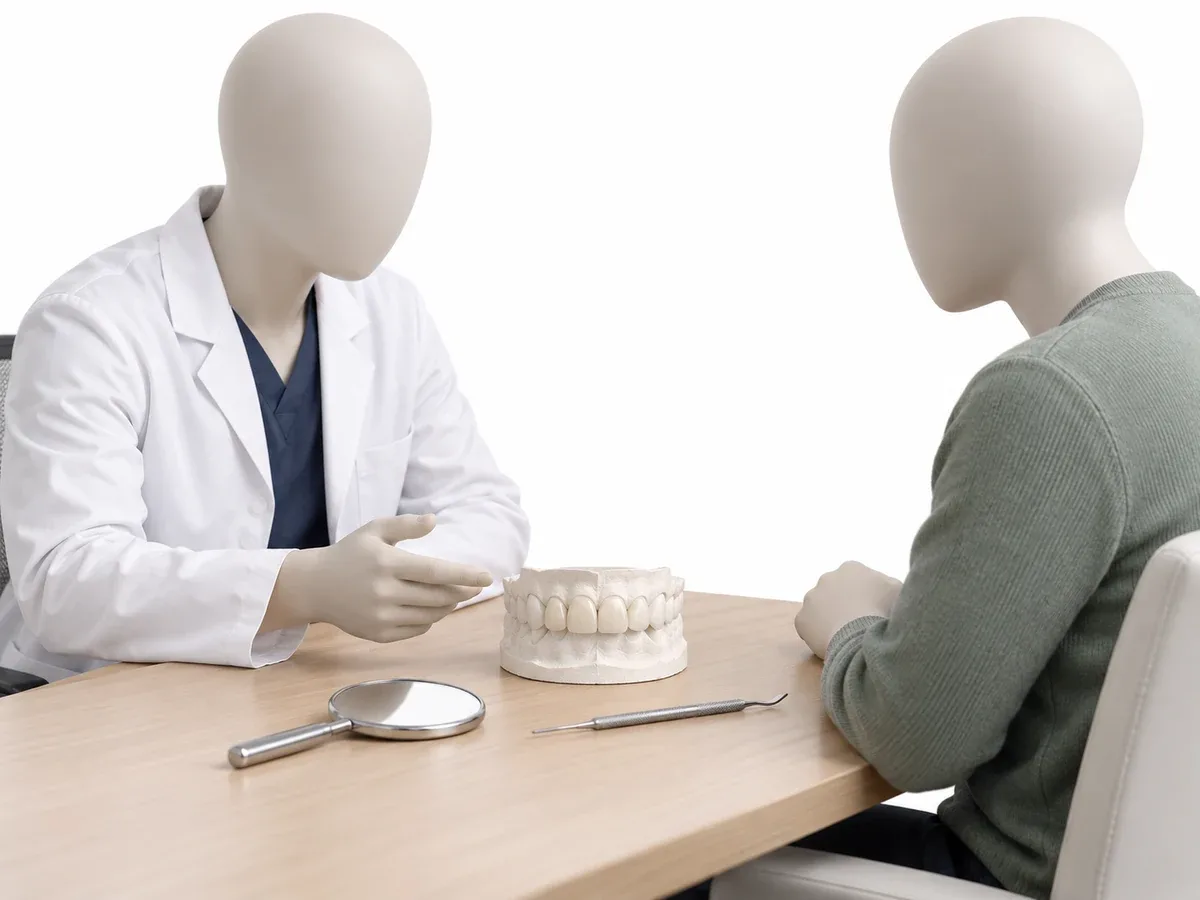
The laminate guide puts making a diagnostic model at the very start. It names two purposes: understanding your current condition, and previewing the shape of the final restorations.
Your job at this stage is to talk. It helps to tell us about:
- what bothers you about your front teeth
- the look you are hoping for
- any photos you would like to show us
That is why our consultations run long. Agreeing on a direction before preparation begins is much easier than changing it afterwards.
If anything else needs checking, it shows up here. The KDCA all-ceramic crown guide, which covers a related treatment, lists several checks before treatment.
| Check | What it looks at |
|---|---|
| Oral hygiene and gum disease exam | How well you clean, and whether the gums are healthy |
| Bite (occlusion) check | How the upper and lower teeth meet |
| Opposing teeth | What material the new teeth will bite against |
| Pulp vitality test | Whether the nerve inside the tooth is alive |
| X-rays | What cannot be seen from the outside |
| Diagnostic model and photos | Intraoral and facial photos used for planning |
If gum treatment or cavity treatment is needed first, it is added to the schedule ahead of the veneers.
What happens when the teeth are prepared and copied?
Step 2: Preparing the teeth
The guide says tooth reduction can generally be done without local anesthesia. Many people come in worried about the injection.
It means that when reduction stays within the outer layer, it is sometimes done without numbing. Sensitive patients, or cases with wider preparation, may still receive anesthesia.
In terms of time, this is not a long step. Yet it is the one step in this treatment that cannot be undone. Removed enamel does not grow back.
All you do that day is sit in the chair. Before we start, though, it helps to confirm three things:
- How many teeth are being treated
- Which surfaces are being reduced, and how far
- How many days you will live with the prepared teeth
The preparation day also runs longer than people expect. Impressions, color selection and temporaries follow right after, so leave room in your schedule that day.

Step 3: Impressions or a scan
The guide describes this step as taking an impression with a precise impression material. It copies the prepared shape and carries it outside the mouth. If this copy is off, even well-made veneers will not fit when they come back.
An intraoral scanner can do the same job. The all-ceramic crown guide notes in brackets that scanning the teeth this way is also possible.
The clinical lecture pages of Dailydental, the Korean Dental Association's newspaper, also cover scanner-based digital diagnosis and treatment. Still, the sources describe scanning as an option, not a requirement. If impressions have been hard for you in the past, let us know ahead of time.
Color is usually chosen around this time as well. We look in natural light and compare with the neighboring teeth and the lower front teeth.
The impression then goes to the dental lab. The guide lists making the veneers at the lab as a separate step for a reason.
This step happens outside the treatment room, so the schedule depends on skilled hands and travel time. If the color or shape changes, the work makes that trip again and the date moves back. That is why changes are better raised before impressions or during the temporary period.

How do you live with temporary veneers?
There is a gap between the impression and the day the finished veneers arrive. For this period, the laminate guide says temporary teeth made of composite resin are placed when needed.
The all-ceramic crown guide also has its own temporary step. It describes making and placing a temporary restoration to use until the final one is fitted.
For many patients, this is the hardest stretch of the treatment. Temporaries are not bonded as firmly as the final restorations.
| Caution | Where it is written |
|---|---|
| Avoid very sticky foods | KDCA all-ceramic crown guide |
| Avoid foods with big temperature changes | KDCA gold inlay guide, on temporary fillings |
| Avoid tough, chewy foods | KDCA gold inlay guide, on temporary fillings |
The gold inlay guide explains the reason. A temporary filling is not a material that bonds to the tooth.
At the same time, this period is a preview. You get to live with the new shape and check a few things for yourself:
- whether the length feels right
- how much shows when you smile
- whether any sounds catch when you speak
If something feels uncomfortable or bothers you, tell us now. Fixing it before the final veneers are made is far easier.
The same goes for a change of mind about shape, length or color. That is exactly what this period is for. After bonding, a change means making the veneers again.

What happens on the day veneers are bonded?
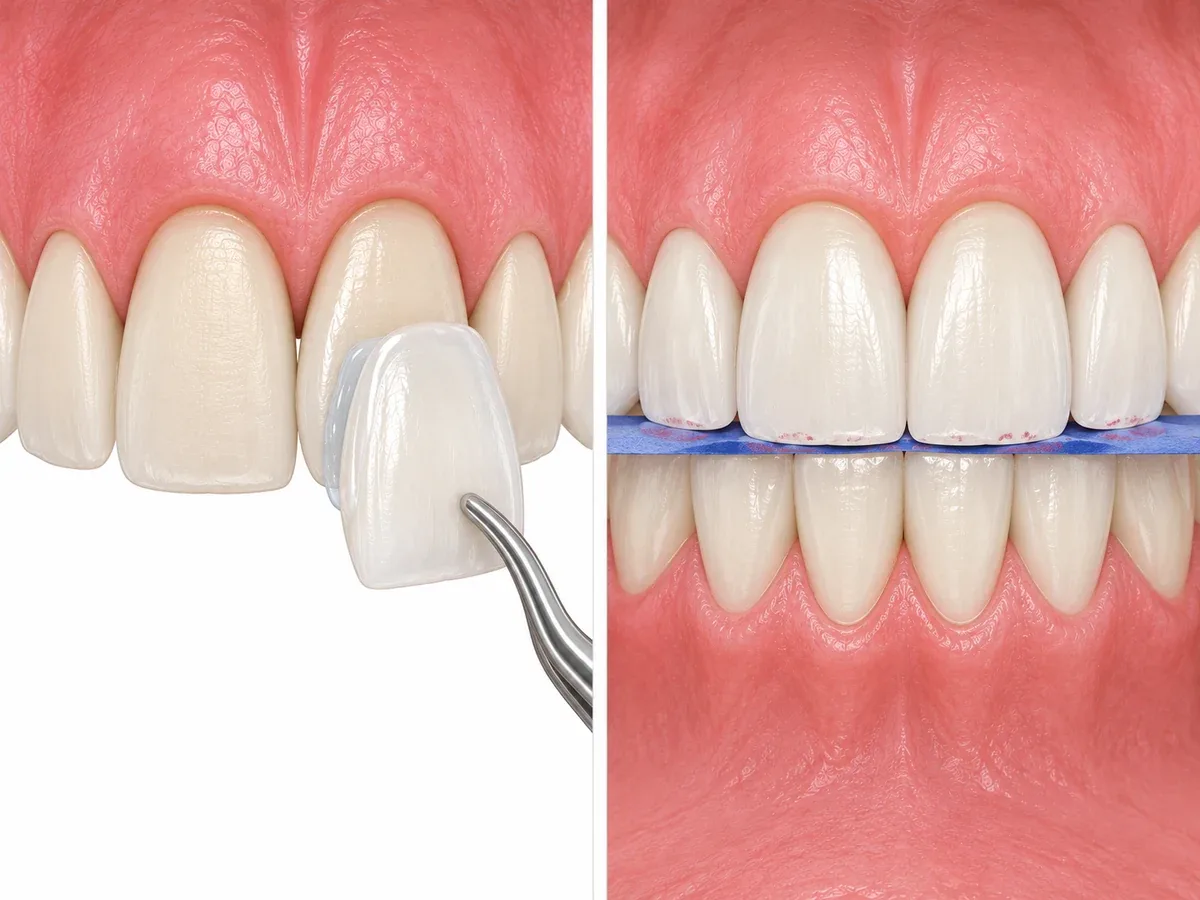
The guide describes the last steps like this. The veneers are tried on, the tooth surface is roughened with acid, and they are bonded with resin cement. Finally, the bite is checked.
Bonding day is often the longest visit. Several tasks follow one after another:
- Trying the veneers in
- Checking the color
- Bonding them
- Cleaning away extra cement
- Adjusting the bite
The final bite adjustment cannot be rushed. Front teeth are not just for biting. They also guide the lower jaw as it moves forward and back.
The guide also gives advice for after bonding. For about 2–3 days after bonding, avoid drinks that may stain.
Veneers attach to part of the tooth surface and do not cover the whole tooth. Because of this they are relatively weaker, and the guide says to avoid biting hard foods.
One more note from the guide concerns scaling. Tell the dental team you have veneers before they use ultrasonic instruments.
What if other treatment is needed first?
Everything so far describes treatment with veneers alone. In practice, other treatment often comes first.
The most common is gum care. The crown guide puts oral hygiene and gum disease checks first on its list for a reason. With inflamed gums, the gum line has not yet settled.
If the front teeth are shaped at that stage, the edge can show later as the swelling goes down.
Cavities are similar. The laminate guide lists small cavities among the uses of veneers, but a wide cavity changes things. Covering a problem and treating it before covering it are different jobs.
If a tooth's nerve is already damaged and needs root canal treatment, that moves even further forward.
| Treatment | Why it comes first |
|---|---|
| Gum treatment | Inflamed gums have not settled, and the edge may show later |
| Cavity treatment | A wide cavity needs treating, not just covering |
| Root canal treatment | A damaged nerve has to be treated first |
So at the first consultation, we explain the schedule in two parts. One is the veneer schedule itself, and the other is the treatment that comes before it.
The second part may feel slow. Yet we often see cases in our clinic that skipped it and needed the work redone.
So how many visits should you plan for veneers in Busan?
To be honest, we could not find a public source that gives a visit count for veneers. We will not make up a number that is not written anywhere.
A related treatment does have numbers. The all-ceramic crown guide says that when prosthetic treatment alone is done, it generally takes about 1–3 weeks and 1–3 visits.
Please note the condition "prosthetic treatment alone." If gum or nerve treatment is needed first, that time is added in front.
If you have a deadline, tell us when you need to be finished at the first consultation. With no extra treatment before or after, there may be room to tighten the schedule.
Skipping steps with inflamed gums or cavities, though, more often leads to redoing work later. For patients visiting Korea for a short stay, sharing your travel dates early helps us plan the steps around them.
| Step | What the clinic does | What you do |
|---|---|---|
| Consultation and diagnosis | Makes a diagnostic model, reviews your current condition, previews the final shape, runs any needed tests | Describe the look you want and what bothers you |
| Preparing the teeth | Removes a minimal amount of enamel, with local anesthesia if needed | Confirm the extent and number of teeth before starting |
| Impressions | Takes a precise impression or an intraoral scan, and chooses the color | Tell us in advance if impressions are hard for you |
| Temporary period | Places composite resin temporaries when needed | Avoid sticky or chewy foods, and check shape and speech |
| Bonding | Tries in, treats the surface, bonds, and checks the bite | Avoid staining drinks for 2–3 days, and avoid hard foods |
Frequently asked questions
Can veneers be bonded on the same day the teeth are prepared?
Usually not, because the veneers have to be made in between. The all-ceramic crown guide does mention same-day treatment, but under a condition: depending on the digital equipment a clinic has. It is a conditional statement, not something that applies to every case.
Can I go without temporaries after preparation?
We do not recommend it. A prepared surface left bare is exposed to every stimulus. The KDCA guide on sensitive teeth notes that reduction can expose the sensitive inner layer, which is why temporaries are part of the steps.
Does the number of veneers change the number of visits?
The number of visits follows the steps more than the number of teeth. Chair time per visit does grow with more teeth. More teeth also mean more checking to match color and shape.
Can I get veneers with English support in Busan?
Yes, Reset Dental Clinic offers 1:1 English interpretation from the first consultation through the end of treatment. We are near Seomyeon Station Exit 2 (5-min walk), opposite Lotte Hotel Busan. Call 010-8555-2854, or +82-10-8555-2854 from abroad.
Veneers are made outside the mouth,
then brought back and bonded on.
Consultation and diagnosis, preparation, impressions,
time with temporaries, and bonding.
That is the path the public guides describe.
What can be shortened is the travel back and forth,
not the checks that need to happen.
If you are planning veneers in Busan, Reset Dental Clinic provides 1:1 English interpretation throughout. Call 010-8555-2854, and we will set your schedule together at the first consultation.
References
- KDCA National Health Information Portal, "Laminate Treatment" — defines laminates as removing a minimal amount of enamel and bonding a 0.5–1.0 mm porcelain or composite resin restoration with resin cement; describes the diagnostic model, reduction generally possible without local anesthesia, precise impressions, composite resin temporaries when needed, lab fabrication, acid etching, bonding and bite check; advises avoiding staining drinks for about 2–3 days and hard foods, and telling the dental team before ultrasonic scaling
- KDCA National Health Information Portal, "All-Ceramic Crowns" — five steps from diagnosis, tooth preparation, impressions (intraoral scanning also possible) and temporaries to placement; 1–3 weeks and 1–3 visits when prosthetic treatment alone is done; avoiding very sticky foods with temporaries; the list of checks before treatment; same-day treatment possible depending on a clinic's equipment
- KDCA National Health Information Portal, "Amalgam and Inlays (Gold Inlays)" — temporary fillings do not bond to the tooth, so foods with big temperature changes and tough foods should be avoided; treatments made outside the mouth are split into a first and second visit
- Dailydental (Chiui Sinbo), "Scanner-Based Digital Diagnosis and Treatment: Why Is It Needed?" — a clinical lecture in the Korean Dental Association's newspaper by Assoc. Prof. Oh Kyung-chul, Department of Prosthodontics, Yonsei University College of Dentistry, on intraoral-scanner-based digital diagnosis and prosthetic treatment
Written by Reset Dental Clinic Support Team
Medical review Dr. Kim Hyun-joo, Head Dentist · Esthetic Restorations
Last updated: September 19, 2026
This column is for general information and does not replace diagnosis or treatment for individual patients. If you have symptoms, please see a dentist.


