

- The space left by a missing tooth does not stay the same. Delaying treatment can disturb the remaining teeth and make treatment more complex.
- Where a tooth is missing, the jawbone shrinks over time. That is why the options change if you wait.
- Studies treat 20 remaining teeth as a turning point. Below it, the numbers change clearly.
- "Linked to" is not the same as "replacing it makes you live longer." We report each finding at the strength its source used.
"I lost a back tooth years ago, and it never bothered me," many patients tell us at Reset Dental Clinic in Seomyeon, Busan. That may be true, since a back tooth is hard to see. For patients living in or visiting Korea, we provide 1:1 English interpretation from the first consultation through the end of treatment.
Yet while the space stays empty, changes happen quietly inside the mouth. This column draws on the Korea Disease Control and Prevention Agency (KDCA) page on removable dentures. It also uses Korean and international studies reported by the Korean Dental Association's newspaper, Dailydental, to explain what changes when a missing tooth is left unreplaced.
What happens to the space left by a missing tooth?
Teeth lean on each other. Neighboring teeth touch and keep each other from drifting sideways.
Upper and lower teeth meet and keep each other from rising further. When a missing tooth leaves a gap, one support in that balance is gone.

Public health material describes this change briefly but clearly. The KDCA denture page says delaying a replacement can disturb the arrangement of the remaining teeth and make treatment more complex. It advises starting treatment early.
In other words, the space you plan to fill later does not wait for you. While you wait, the space itself changes.
A missing tooth at the very back may not feel urgent if nothing hurts. But deciding to leave it now is different from keeping the same options later. We suggest at least taking an X-ray to record how things look today.
How do the neighboring and opposing teeth move?
Here is what we often see around a missing tooth. The neighboring teeth slowly tilt toward the empty space.
When a tooth that should stand straight starts to lean, a gap forms that is hard to clean. It becomes a new place for food to get trapped.
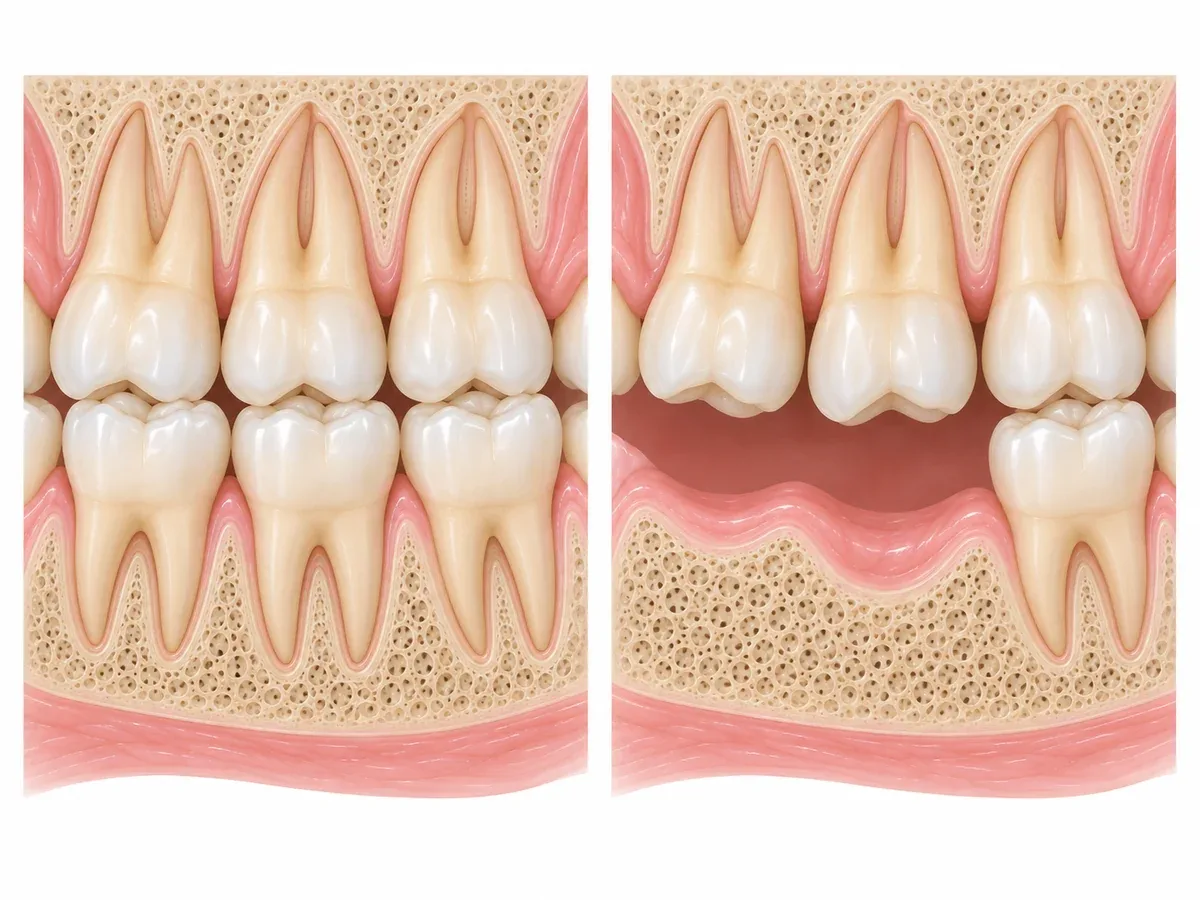
Opposite a missing tooth, the tooth that has lost its partner slowly moves down or up. If an upper molar is lost, the lower molar rises; if a lower molar is lost, the upper molar comes down.
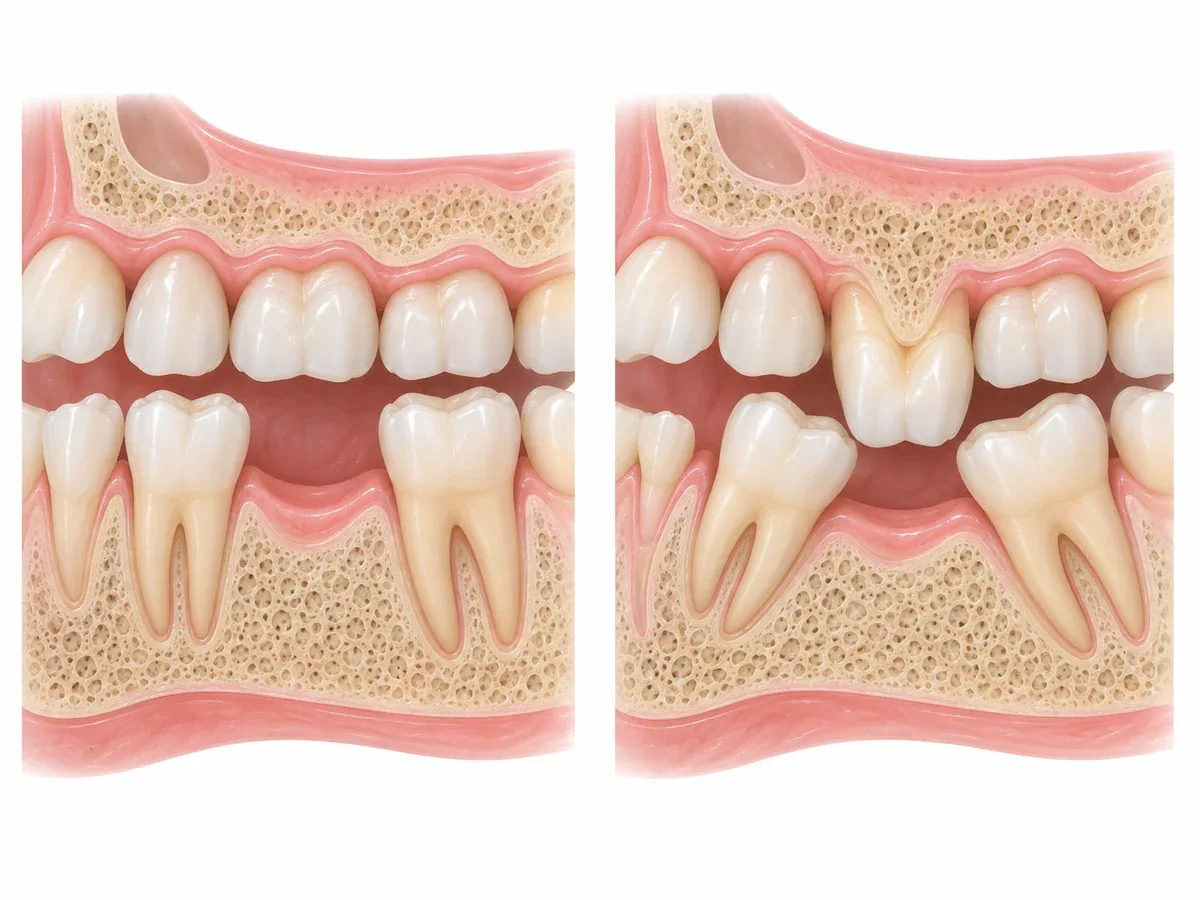
Once things reach this stage, replacing the missing tooth is no longer simple. A tilted tooth may need to be straightened, or the opposing tooth may need reshaping to make room.
That is what the KDCA phrase "treatment can become more complex" includes. If years have already passed, it is not necessarily too late, but there is more to check:
- how far the neighboring teeth have tilted
- how far the opposing tooth has moved down or up
- how much width and height of bone remain
Why does the jawbone shrink where a tooth is missing?
There is another change you cannot see. The KDCA denture page says the bone in areas without teeth is gradually resorbed over time. So a denture that fits well at first slowly stops fitting after a few years.
This does not apply to denture wearers alone. It describes a basic fact: bone shrinks where a missing tooth leaves nothing behind.
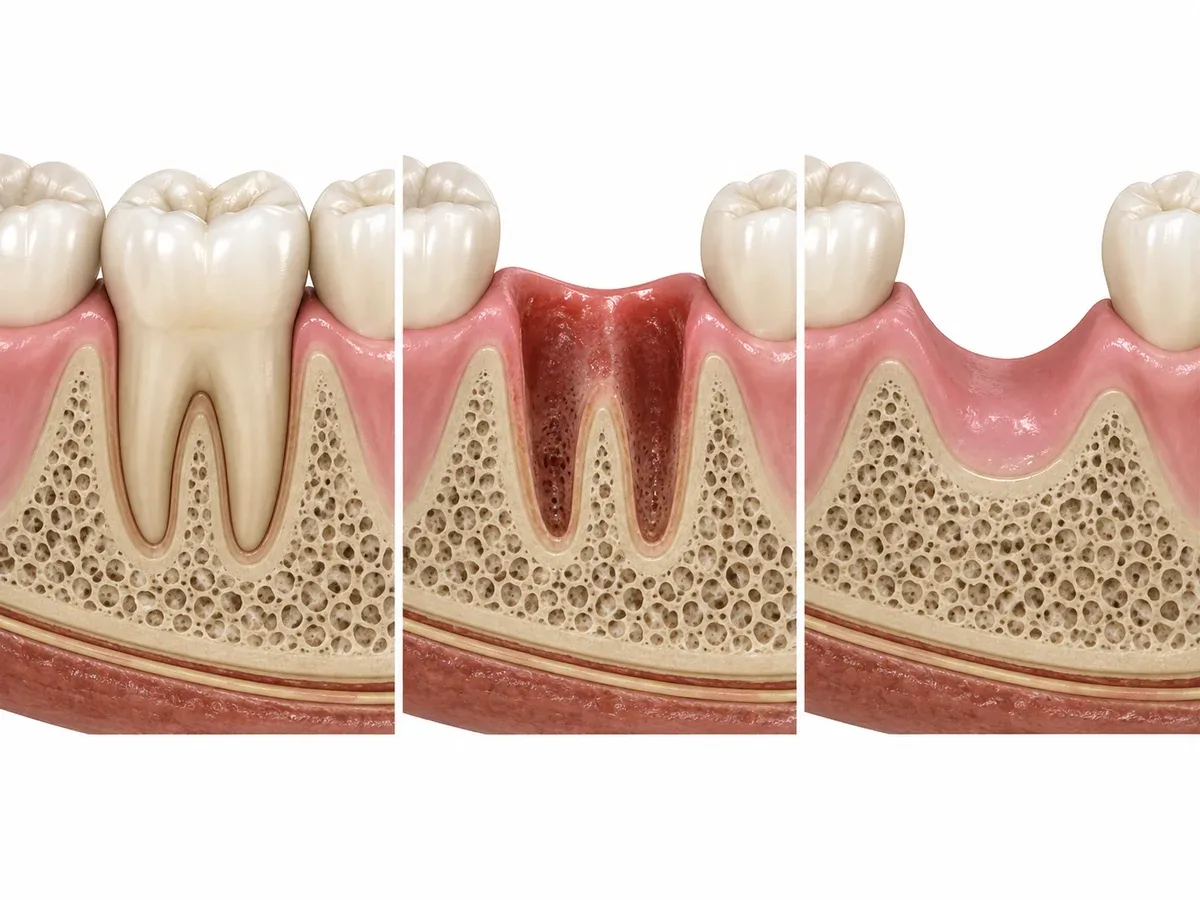
As bone shrinks, the choices shrink too. The material says fixed treatment plans can become more complex or limited when bone loss is severe.
On the other hand, a removable denture can be an alternative when bone loss makes implant placement difficult. For the same person, the recommended option may depend on when they come in.
| Change | What happens | Effect on later treatment |
|---|---|---|
| Neighboring teeth | Tilt toward the empty space | May need straightening; new food traps form |
| Opposing tooth | Moves down or up without a partner | May need reshaping to make room |
| Jawbone | Resorbed over time | Treatment plans can become complex or limited |
What do studies say about the number of teeth you keep?
From here on, we report findings from several published studies. We keep each finding at the strength its source used.
The Korean Academy of Prosthodontics linked national health survey data with cause-of-death statistics. It analyzed 14,253 people aged 60 and over.
It reported that among Koreans aged 60 and over, the risk of death rose by about 1.2% for each tooth lost. That would be about 5% for four teeth and about 10% for eight.
| Group | Reported finding |
|---|---|
| Each tooth lost | Risk of death up about 1.2% |
| Fewer than 20 teeth (vs 20 or more) | 10-year survival rate 14.9% lower |
| Fewer than 20 teeth (vs 20 or more) | 15-year survival rate 21.5% lower |
| Received prosthetic treatment | Risk of death 15.5% lower than those who did not |
The academy concluded that 20 remaining teeth is not just a number. It acts as a meaningful turning point for survival.
The prosthetic treatment finding compared people with 0–20 remaining teeth. Those treated with fixed bridges, partial dentures or full dentures had a lower risk of death.
This does not mean one missing tooth directly shortens your life. It means that where the loss of teeth stops is what shows up in the statistics.
These are statistics that compare groups. They do not predict any one person's outcome. The academy said the result shows that prosthetic treatment can lower the risk of death when few teeth remain, but it is not a promise of a longer life.
Why does chewing on both sides matter?
An oral frailty column in Dailydental uses a simple test for chewing ability. Can you bite down firmly on your own back teeth on both sides?
People who can bite on one side, or on neither side, are classed as having reduced chewing ability. So chewing on one side already falls into that group. The test is simple enough to try at home.
The same column reports that more than half of people aged 70 and over complain of chewing discomfort with dentures. Among older Koreans, about half or more have chewing problems, and about one in three have swallowing problems.
It cites epidemiological data showing that older adults with reduced chewing ability have about 2.7 times the rate of frailty. The frailty risk rises 3% for each adult tooth lost. It also reports that the risk of coronary artery disease and stroke rises 3% for every two teeth lost.
When chewing becomes uncomfortable, meals themselves can become a burden. People may skip meals, leading to poor nutrition, muscle loss and slower wound healing from weaker immunity. Choosing soft foods also makes it harder to eat vegetables and meat.
A University of Tokyo team followed 2,000 people aged 65 and over for about four years. It looked at six items:
- fewer than 20 teeth remaining
- weak biting or chewing force
- a mouth that does not move easily
- weak tongue strength
- trouble eating hard foods
- frequent choking on food or drink
People with three or more of these items had a death rate 2.09 times that of the group with none. The team added that weakened mouth function is hard to notice yourself, so regular dental check-ups matter.
A Yonsei University team analyzed 963 people aged 60 and over. It compared health markers by the number of remaining teeth, using the group with 24–32 teeth as the baseline.
| Remaining teeth | Reported risk |
|---|---|
| 24–32 teeth | Baseline |
| 7–23 teeth | Dyslipidemia risk 1.073 times |
| 0–6 teeth | Dyslipidemia risk 1.921 times; abnormal HDL cholesterol risk 1.731 times |
Dyslipidemia means abnormal levels of fats in the blood. The team linked it to weaker chewing, lower-quality nutrition, a limited diet and more chronic inflammation from poor oral hygiene. In short, poor chewing shifts the diet, and that shift shows up in blood tests.
How can a missing tooth be replaced in Busan?
The KDCA denture page describes three main options. It does not say that any one way of replacing a missing tooth is always better.

- Fixed bridge. A bridge uses the teeth on both sides of the gap as supports. Depending on the location and the condition of those teeth, it may not be suitable.
- Dental implant. Implants have made fixed treatment possible in more cases. The material also notes higher cost, a longer treatment period and the need for surgery.
- Removable denture. It is an alternative for people who want to reduce cost, time or surgery, or who lack bone. The material notes that dentures function at about 20–30% of natural teeth.
| Option | How it works | Points to consider |
|---|---|---|
| Bridge | Uses the neighboring teeth as supports | May not suit every location or tooth condition |
| Implant | A fixed tooth placed in the bone | Higher cost, longer period, surgery needed; severe bone loss can limit the plan |
| Removable denture | Can be taken in and out | An option when bone is lacking; functions at about 20–30% of natural teeth |
A partial denture also puts strain on the teeth that remain. The most common type holds on with metal clasps.
The material says teeth that carry clasps can become prone to decay or gum disease. They also bear the denture's movement, which can shorten their lifespan.
So partial dentures give better results when more teeth remain and they sit in suitable positions. Here too, acting while many teeth remain works in your favor.
For people enrolled in Korean national health insurance, the material notes coverage for dentures from age 65, once every seven years for each jaw. Under the 2024 rules, it also covers two implants and the related partial denture for partially toothless patients.
How long does it take to replace a missing tooth?
Deciding to replace a missing tooth does not mean it is done next week. The KDCA material gives a treatment period for dentures of at least several months, and sometimes more than a year.
The extraction site takes a few months to heal. With implants, several more months are needed for the implant to bond with the bone.
During that time, many patients have a temporary denture made for eating and daily life. The material notes that this is common.
After completion, getting used to speech, chewing and the feel of the new teeth takes weeks to months. The pace differs from person to person.
The material suggests a few ways to adjust faster:
- Start slowly with soft foods, such as steamed egg.
- Keep your regular check-ups.
- Talk with your dentist about anything that feels uncomfortable.
The later you start, the later this whole schedule moves. For patients staying for a set period, it helps to discuss the timeline early.
Frequently asked questions
Is it fine to chew on one side?
The oral frailty column divides chewing ability by whether you can bite firmly on both sides. Biting on one side places you in the reduced chewing ability group. By that measure, chewing on one side already counts as a loss of chewing ability.
How many teeth should I keep?
The prosthodontics study named 20 remaining teeth as a meaningful turning point for survival. People with fewer than 20 had a 10-year survival rate 14.9% lower and a 15-year rate 21.5% lower. These are group statistics, not a prediction for any one person.
Does replacing a missing tooth mean I will live longer?
No, please do not read it that way. A 15.5% lower risk of death in the treated group comes from comparing two groups. It is not a statement that treatment will extend your life.
Can I get missing tooth treatment in English in Busan?
Yes. We offer 1:1 English interpretation from the first consultation through the end of treatment. The clinic is near Seomyeon Station Exit 2 (5-min walk), opposite Lotte Hotel Busan, and you can call 010-8555-2854 (+82-10-8555-2854 from abroad).
One missing back tooth is not a crisis in itself.
But the empty space does not stay still.
As the neighboring teeth tilt, the opposing tooth moves
and the bone beneath slowly shrinks,
the options you can choose from shrink as well.
If you have a missing tooth and live in or near Busan, Reset Dental Clinic offers 1:1 English interpretation from your first consultation through the end of treatment. Call 010-8555-2854 and check the space with a single X-ray.
References
- KDCA National Health Information Portal, "Removable Prostheses (Dentures)" — delayed treatment disturbing the remaining teeth, bone resorption where teeth are missing, bridges using neighboring teeth as supports, the cost, time and surgery of implants, limits when bone loss is severe, dentures functioning at about 20–30% of natural teeth, and national health insurance for dentures from age 65 and for two implants in partially toothless patients
- KDA newspaper Dailydental, "Fewer Teeth, Shorter Life" (Korean Academy of Prosthodontics) — analysis of 14,253 people aged 60 and over, about 1.2% higher risk of death per tooth lost, 14.9% lower 10-year and 21.5% lower 15-year survival with fewer than 20 teeth, and 15.5% lower risk of death with prosthetic treatment
- KDA newspaper Dailydental, "Oral Frailty (VII): Reduced Chewing Ability" — chewing ability judged by biting firmly on both sides, chewing discomfort in over half of people aged 70 and over, rates of chewing and swallowing problems in older Koreans, about 2.7 times the frailty rate with reduced chewing, 3% higher frailty risk per adult tooth lost, and 3% higher coronary artery disease and stroke risk per two teeth lost
- KDA newspaper Dailydental, "Difficulty Chewing Meat and Frequent Choking Linked to Higher Risk of Death" (University of Tokyo team) — 2,000 people aged 65 and over followed for about four years, a 2.09 times higher death rate with three or more of six items including fewer than 20 teeth, and a recommendation for regular check-ups
- KDA newspaper Dailydental, "Tooth Loss in Older Adults a Warning Sign for Vascular Health" (Yonsei University team) — analysis of 963 people aged 60 and over, dyslipidemia risk of 1.073 times with 7–23 teeth and 1.921 times with 0–6 teeth versus 24–32 teeth, 1.731 times abnormal HDL cholesterol risk with 0–6 teeth, linked to poorer nutrition and chronic inflammation
Written by Reset Dental Clinic Support Team
Medical review Dr. Na In-chae, Head Dentist · Periodontics Specialist
Last updated: September 19, 2026
This column is for general information and does not replace diagnosis or treatment for individual patients. If you have symptoms, please see a dentist.


