

- Sensitivity appears when the hard outer layer of a tooth thins and the dentin underneath is exposed. Dentin is built from countless tiny tubes.
- After veneers or other restorations, the source says sensitivity comes from sensitive inner dentin exposed while the tooth is shaped.
- If the pulp inside is healthy, the symptom usually fades on its own over time. The source gives no number of days or weeks.
- "It always hurts" and "you will feel nothing" are both not what the sources say.
At Reset Dental Clinic in Seomyeon, Busan, one patient has heard that veneers make teeth very sensitive, while another has heard you feel nothing. Neither is what the health sources actually say. For patients living in or visiting Korea, we provide 1:1 English interpretation from the first consultation through the end of treatment.
This column stays within what two articles on the KDCA National Health Information Portal say: "Dentin Hypersensitivity" and "Laminate Treatment". We will be clear about what they say and what they leave out.
Where does tooth sensitivity come from?
The source defines dentin hypersensitivity as a sharp, brief pain in response to an outside stimulus, separate from decay or other disease. It is the quick, sharp twinge you feel when something cold, a breeze, or sweet or sour food touches the tooth.
Many people describe it less as pain and more as a zing. It comes fast and leaves fast.
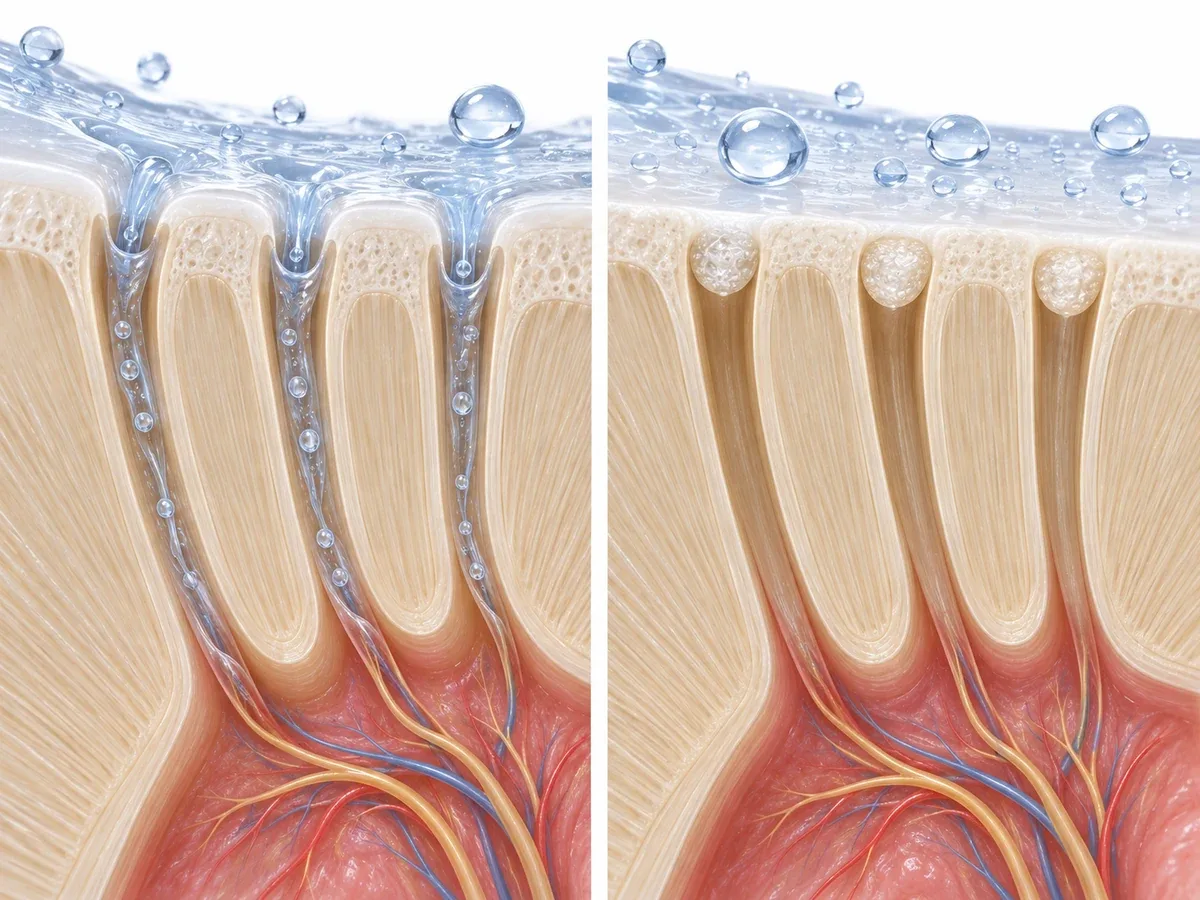
The source also explains why the signal travels so quickly. Under the hard outer layer of the tooth lies dentin, and dentin is a structure made of many tiny tubes. These are called dentinal tubules.
In the source's words, dentin is very permeable, unlike the outer layer. It passes outside stimuli quickly to the nerve in the pulp at the center of the tooth.
So sensitivity is less about a nerve becoming touchy and more about a path opening for the stimulus. When the path is covered, cold water simply passes by. When the path is open, the same cold water reaches deep inside.
That single difference explains most of what patients feel after treatment.

Why can shaping a tooth for veneers cause sensitivity?
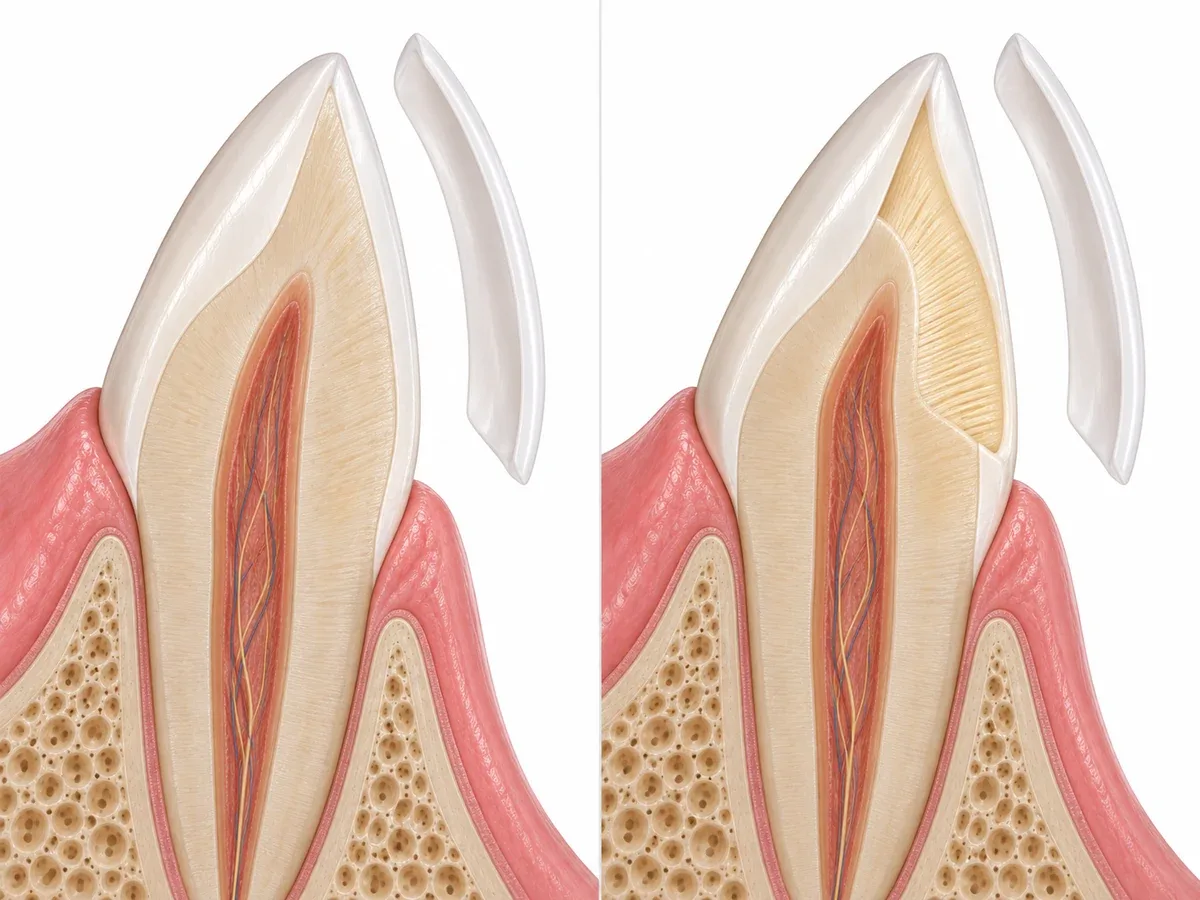
The sensitivity article has a separate section on sensitivity after restorative treatment. It says the symptom appears when sensitive inner dentin is exposed while the tooth is being shaped.
Any treatment that shapes a tooth to bond something onto it follows the same principle. The difference is one of degree.
So where do veneers sit? The laminate article defines them as a thin shell bonded with resin cement, like a false nail. This is done after minimally shaping the enamel surface, mainly on the upper front teeth.
The shell is about 0.5 to 1.0 mm thick. The key words are "the enamel surface". If shaping stays within the outer layer, the openings of the tubes beneath usually stay covered.
If shaping goes past that line, you enter the zone the source describes, where dentin is exposed. That is why the same treatment feels different from one person to the next. The depth of shaping, not the name of the treatment, decides this.
One point works in favor of veneers. The source adds that most restorations contain metal, and metal conducts heat faster than enamel, so cold reaches the dentin and pulp quickly.
The laminate article lists porcelain or composite resin as the materials for veneers. So the point about metal does not apply to them.
What side effects does the source list for veneers?
The laminate article gathers the possible side effects in one place. We share them not to worry you, but because it is better to know exactly what is written.
| What | What the source says |
|---|---|
| Coming off and chipping | Veneers attach to part of the tooth, not the whole, so they are relatively weaker than other restorations and can come off or break |
| Discoloration at the edge | Staining can appear where the veneer meets the tooth |
| Sensitivity | Hypersensitivity, meaning teeth that feel cold or sore, can occur |
The third row is today's topic. The source says sensitivity can occur.
It does not say it always occurs, and it does not say it never occurs. That is as far as we can go in a consultation, too.
We will not invent odds or percentages that are not in the source. If someone quotes you a figure, it is fair to ask where it comes from.
The other two rows matter for comfort as well. A veneer that has come off leaves the shaped surface open again, so it is worth calling the clinic rather than waiting.
How long does sensitivity last after veneers?
This is the question we hear most. The sensitivity article answers: if the pulp inside is healthy, the symptom usually fades on its own over time.
It also explains why. Under "self-healing", it says that over time, small dentin particles build up over the exposed dentin, and the tooth becomes less responsive to stimuli. You can think of the open path slowly filling in from the inside.
We also want to be clear about what the source does not say. It gives no number of days, weeks or months. So we do not tell patients it will pass in a set number of weeks.
In our clinic, we often see the first few days after bonding as the most sensitive, with things easing gradually after that. This is a pattern we have observed, not a sentence from the source, and we keep the two apart.
What matters is the condition the source attaches: if the pulp inside is healthy. The following may fall outside that condition:
- sensitivity that does not ease, or grows worse, over time
- pain that starts on its own, with nothing touching the tooth
- pain from hot things that lingers for a long time
- pain that is worse when you lie down at night
- pain where you cannot tell which tooth it is
In those cases, the right move is to have it checked, not to wait.
What about the temporary period and the days after bonding?
The laminate article's treatment steps include placing a temporary tooth made of composite resin, if needed, after the impression. When the shaped surface is bare, stimuli reach it directly. So discomfort in this period follows the depth of shaping.
Many people feel more sensitive during the temporary period. That can happen, because the temporary material covers the shaped surface but is not sealed as closely as the final veneers.
If sensitivity keeps growing during that time, or if the temporary comes off, do not wait for the bonding day. Please contact the clinic.
There is also a useful sentence about the days right after bonding. The gold inlay article says sensitivity may appear early after a restoration, and advises avoiding very cold or very hot foods during that time. The material differs, but treatments that shape and bond a tooth pass through the same stage.
The laminate article adds its own care points after bonding:
- For about two to three days, avoid drinks that may stain.
- Avoid biting hard foods, because veneers are relatively weaker.
- Early on, go easy on very cold or very hot foods, as the inlay article advises.

How can sensitivity be reduced, according to the source?
The sensitivity article lists treatments step by step, from lightest to most involved.
| Step | What it is |
|---|---|
| 1. Self-healing | Dentin particles build up over exposed dentin |
| 2. Desensitizing toothpaste | Toothpaste made for sensitive teeth |
| 3. Applied agents | Agents such as fluoride or oxalate applied to the tooth |
| 4. Restoration | Covering the exposed area |
| 5. Laser treatment | Listed as a further option |
| 6. Gum graft | Listed as a further option |
| 7. Root canal treatment | The last step in the list |
There is no need to be alarmed by the last line alone. Most cases are settled in the upper steps.
Can you use toothpaste for sensitive teeth in advance? It is one of the treatments the source lists, but it does not change how deeply the tooth is shaped. Put simply, shaping less comes first, and toothpaste comes second.
The prevention advice applies to people with veneers too. The source puts correct brushing first and says scrubbing side to side can even damage the shape of the teeth.
Scrubbing hard from side to side wears a notch into the neck of the tooth, where it meets the gum. That spot is already the most prone to sensitivity. The source also lists other habits and causes:
- brush with a soft brush, sweeping from the gum toward the tip of the tooth
- correct habits such as clenching and grinding
- watch acid, including frequent sour drinks or stomach acid coming up
- visit the dentist regularly
A tooth with a veneer is no exception to any of these.

How do we tell sensitivity from pain at our Busan clinic?
In the clinic, "it feels sensitive" helps less than when, to what, and for how long. The definition explains why.
The pain of this symptom is sharp and brief. It zings the moment cold water touches, and it fades soon after you rinse. It is there when a stimulus is there, and gone when it is not.
That is why the warning signs listed above should not be lumped together as "sensitivity". The sensitivity article lists root canal treatment as the last step for situations like these.
| What you notice | What it points to |
|---|---|
| A sharp zing when cold touches, gone soon after rinsing | Fits the source's definition of sensitivity |
| Easing little by little over time | Fits the self-healing the source describes |
| Pain that starts on its own, with nothing touching | Have it checked |
| Pain from hot things that lingers | Have it checked |
| Worse at night, or hard to tell which tooth | Have it checked |
If it is hard to tell, just describe it as it is. These three details already point us in a direction:
- When did it start?
- Is it triggered by cold, heat or sweets?
- Does it settle in a few seconds, or last a long time?
The diagnostic method in the source checks the same thing. A probe, ice or a puff of air is used to see whether the pain can be reproduced. An X-ray may be needed to tell it apart from decay or a crack.
Checking your teeth this way before treatment also helps later. It lets us tell whether a symptom is new or was already there.
Is it the same as sensitivity after scaling? The mechanism is similar, but the trigger differs. After gum treatment, the source says roots are exposed as tartar is removed, so teeth become sensitive for a while; with veneers, the surface is exposed by shaping.
Frequently asked questions
My teeth are already sensitive. Can I still get veneers?
The first step is to find the cause of the sensitivity you have now. The source lists causes such as wrong brushing habits, heavy chewing force, acid and roots exposed by gum disease. Covering the surface with veneers does not remove a cause that is left untreated.
What if my teeth are still sensitive after several months?
The source says sensitivity fades on its own if the pulp is healthy, so that condition needs to be checked again. Putting up with it is the weakest choice, and depending on the cause, there are options within the treatment steps above.
I want as little shaving as possible to avoid sensitivity. Is that possible?
That direction is right, but aiming for less shaving alone can make the veneers too thick. The source describes veneers as a 0.5–1.0 mm shell bonded after minimal shaping. The amount removed and the thickness are decided together, never one without the other.
Can I get veneers in English in Busan?
Yes. We offer 1:1 English interpretation from the first consultation through the end of treatment. The clinic is near Seomyeon Station Exit 2 (5-min walk), opposite Lotte Hotel Busan, and you can call 010-8555-2854 (+82-10-8555-2854 from abroad).
Sensitivity comes less from a touchy nerve
and more from an open path for the stimulus.
The source says that if the pulp is healthy,
it usually fades over time,
and it gives no number of days.
So it is neither "always sensitive"
nor "never sensitive".
How deeply the tooth is shaped decides where you fall.
If you are considering veneers in Busan, we offer 1:1 English interpretation from your first consultation through the end of treatment. Call 010-8555-2854 to book a consultation.
References
- KDCA National Health Information Portal, "Dentin Hypersensitivity" — the definition as a sharp, brief pain to outside stimuli; dentin as a highly permeable structure of tiny tubes; causes including side-to-side scrubbing, heavy chewing force, acid and exposed roots; sensitivity after restorations and the role of metal; the statement that symptoms usually fade if the pulp is healthy; self-healing; diagnosis by reproducing the pain; treatment steps from toothpaste to root canal treatment; prevention
- KDCA National Health Information Portal, "Laminate Treatment" — the definition (minimal shaping of the enamel surface, a 0.5–1.0 mm porcelain or composite resin shell bonded with resin cement); uses; the temporary tooth step; relatively lower strength and avoiding hard foods; avoiding staining drinks for 2–3 days after bonding; side effects including coming off, chipping, edge discoloration and hypersensitivity
- KDCA National Health Information Portal, "Amalgam and Inlays (Gold Inlays)" — sensitivity may appear early after a restoration, and very cold or hot foods should be avoided during that time
- KDCA National Health Information Portal, "Root Canal Treatment" — what root canal treatment involves: removing infected or damaged pulp, disinfecting and sealing the inside of the tooth
- KDA newspaper Dailydental (Chiui Sinbo), "If Your Teeth Feel Sensitive, Suspect Tooth Wear" — an article on the link between sensitivity and tooth wear
Written by Reset Dental Clinic Support Team
Medical review Dr. Kim Hyun-joo, Head Dentist · Esthetic Restorations
Last updated: September 19, 2026
This column is for general information and does not replace diagnosis or treatment for individual patients. If you have symptoms, please see a dentist.


