

- The public guide describes veneers as thin shells similar to tooth color. Color is set in relation to the neighboring teeth, not on its own.
- Ceramics with high strength lack translucency, and highly translucent ceramics are weaker. Color and strength pull against each other.
- Porcelain lets light through, so the tooth color underneath shows through. A dark base needs more thickness to cover it.
- No source describes a way to brighten veneers after bonding. What it describes is removing them and making new ones.
Some patients at our clinic in Seomyeon, Busan ask for the whitest shade we have, while others ask us to keep it from looking too white. Both come in thinking of color as something to pick, but the real work is closer to matching. For patients living in or visiting Korea, we provide 1:1 English interpretation from the first consultation through the end of treatment.
This column draws on the Korea Disease Control and Prevention Agency (KDCA) guides on laminate veneers and all-ceramic crowns. It explains what the color of veneers depends on, and why it is hard to undo once it is set.
Why is the color of veneers matched, not picked?
Take one phrase from the guide's definition. It describes laminate veneers as thin shells similar to tooth color, bonded on much like artificial nails.
Notice that the guide does not say "white." The standard is not a degree of whiteness but the color of teeth.
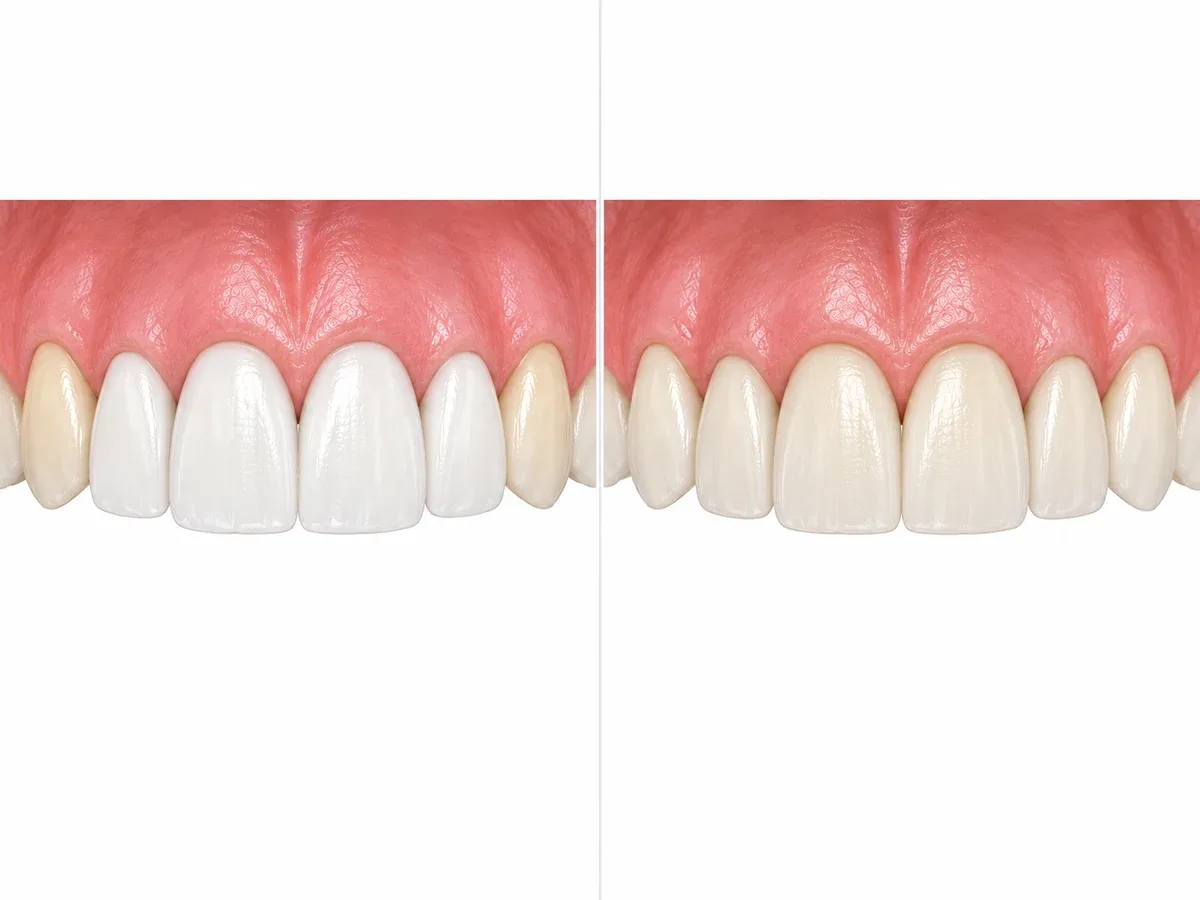
That standard is usually your own natural teeth right next to the new ones. The reference tooth depends on how many teeth are treated:
- for two front teeth, the teeth on either side
- for six front teeth, the canines just beyond them
- in every case, the lower front teeth that show when you talk
So the same shade can look natural on one person and stand out on another. No color is good or bad in itself. What matters is whether it flows with the rest of your mouth.
Canines are naturally a little darker than the front teeth. If just the six front teeth are made brighter, the color breaks sharply just beyond them.
The wider your smile, the more this boundary shows. That is why how many veneers to place and what color to choose are decided together, not separately.
Why does the tooth underneath show through porcelain veneers?
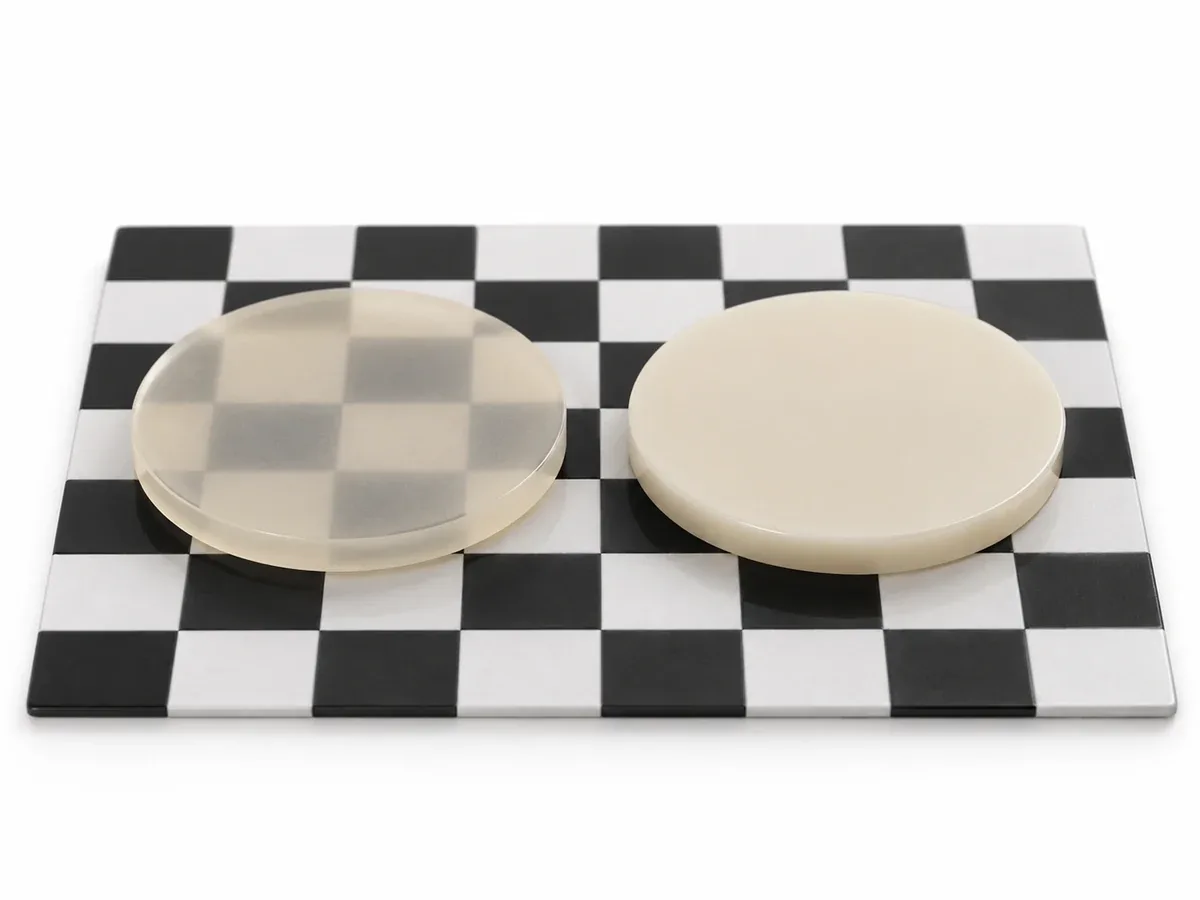
This is the part most often missed in talks about color. The porcelain used for veneers does not hide what is beneath it the way wallpaper does. It lets a certain amount of light pass through.
Natural teeth look alive for the same reason. The outer enamel is translucent, so light enters, reaches the dentin inside and comes back out.
Color therefore does not stop at the surface, and there is depth coming from within. The tip of a front tooth looks clearer and slightly bluish because the dentin there is thin and more light passes through.
A bonded shell has to imitate this quality to look natural. But that also means whatever lies beneath shows through.
The thinner and more translucent the shell, the more the base color affects the result. Choosing a color is not just choosing a shell color. It also means taking the current tooth color into account.

Why don't strength and translucency go together?
A natural question follows: why not simply use a clearer material? The guide gives a clear answer.
Explaining the properties of porcelain, the all-ceramic crown guide states that ceramics with high strength lack translucency, while highly translucent ceramics are weaker. It names zirconia and lithium disilicate as typical materials.
This one line is the basis of every color consultation. A clearer result gives up some strength, and a stronger result gives up some clarity.
Neither choice is right in every case. It depends on what forces that tooth has to handle. Someone who bites through things with the front teeth may need a different answer from someone who does not.
The guides are clear about why porcelain is used at all. The crown guide notes that because there is no metal, the gums do not turn dark and the edges do not show a dark line.
The tooth-colored inlay guide adds that porcelain is more esthetic and more biocompatible than composite resin. Porcelain is a good material for handling color, but those good qualities have limits.
| Material | What the sources say |
|---|---|
| Resin laminates (1970s) | Wore down and discolored easily |
| Porcelain laminates (from the 1980s) | Introduced after resin laminates |
| Porcelain compared with composite resin | More esthetic and more biocompatible |
| Porcelain in the past and now | Once more brittle, with wear and toughness improved recently |
| Factor | How it affects color |
|---|---|
| Your current tooth color | The shell lets light through, so it shows from beneath |
| Shell thickness | Thicker covers the base color better, but also blocks light |
| Material translucency | The guide says higher translucency means lower strength |
| Neighboring teeth and canines | If the color does not flow, it breaks at the boundary |
| Gum condition | Red or swollen gums make the same color look different |
What if the tooth underneath is dark?
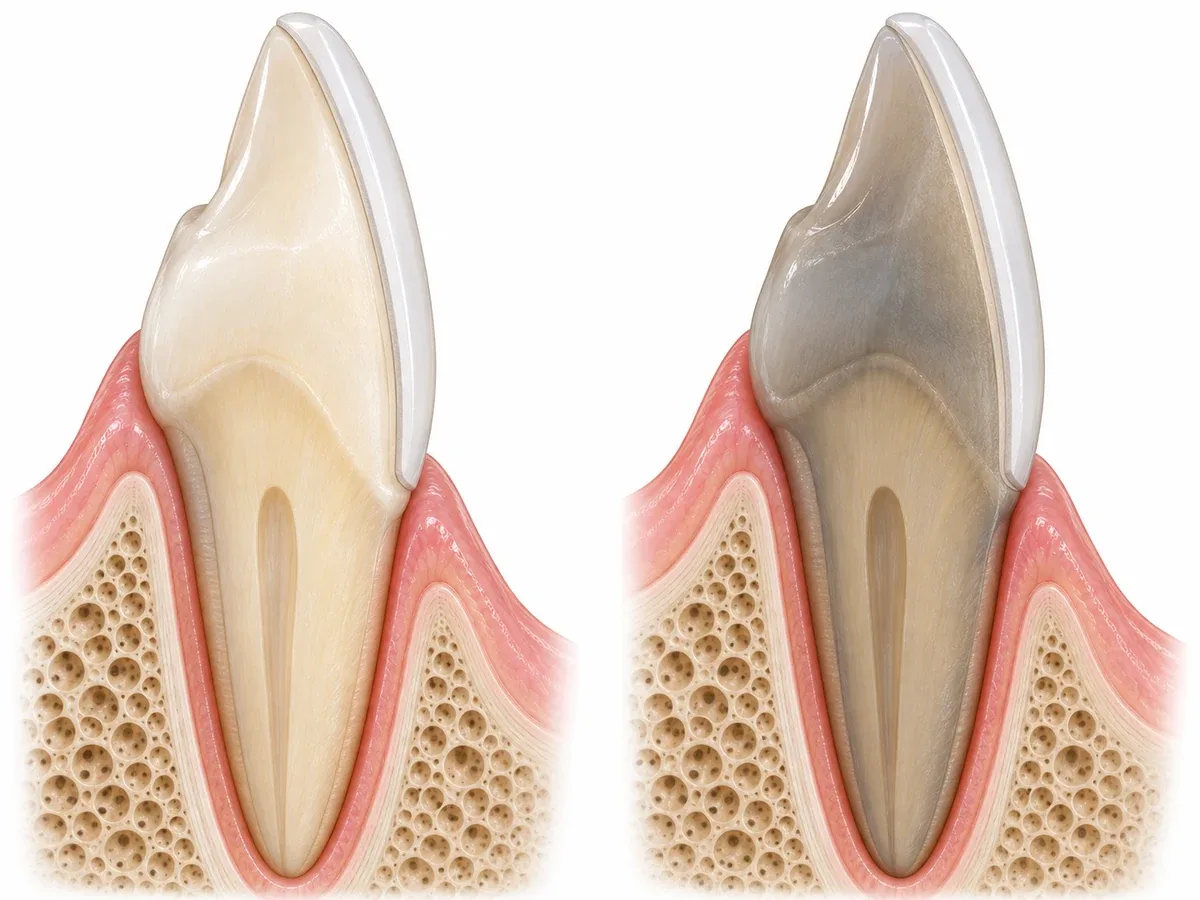
The guide lists teeth discolored by inborn or acquired causes among the uses of veneers. It says esthetics can be improved considerably in these cases.
In fact, color is the most common reason people come to us. But the properties above come along with it.
The darker the base, the more it takes to cover it. There are two ways to do that:
- a less translucent material
- a thicker shell
Yet the guide describes veneers as thin shells of about 0.5–1.0 mm.
More thickness means the shell sits further out, or more tooth is removed underneath. This is where how much you want to change the color connects to how much tooth will be removed.
Sometimes the discoloration is not across all the teeth but in one spot. The KDCA resin treatment guide says that when discoloration is partial or limited to a single tooth, composite resin can make the surface look natural.
So the first step is to find out whether the color problem involves six teeth or one.
How do we choose the shade for veneers in Busan?
The treatment steps in the guide include a color check. After the veneers are made, color, shape and fit are checked before bonding, and the bite is adjusted at the end. In other words, they are tried in once before being bonded.
From here on, we describe what we do in our clinic, not a procedure written in the guide. We follow four checks when choosing the shade:
- We look at color before treatment starts, because prepared teeth dry out and look brighter than they are.
- We look more than once, under the treatment room light and in natural light by the window.
- We look at the color while you smile, rather than with your mouth open and head tilted back.
- We look at the gums as well as the teeth.
As the table above shows, red or swollen gums make the same color look different. On a day when the gums are very red, the same tooth looks more yellow.
Once swelling settles, even the position of the gum line can change. So if the gums need care first, choosing the color waits until after that.
We also take photos. We read the crown guide's inclusion of photographs in its pre-treatment checks the same way.
"A little brighter" means different things to different people. Looking at the same photos together narrows the gap.
| Check | Why it matters |
|---|---|
| Before treatment | Prepared teeth dry out and look brighter than they are |
| Two light sources | Room light and natural light can show different colors |
| While you smile | A reclined, open-mouth view differs from a face-to-face smile |
| Gums as well as teeth | Red gums make teeth look more yellow |
A photo you bring can also look different from reality. That is why we never set the color from a single picture. The try-in before bonding is part of the guide's steps, so that moment is the surest time to tell us.
Family members often ask if they can simply share a shade. The same color will not look the same on two people, because the base color, gum color and lip thickness all differ. Above all, the remaining neighboring teeth differ.
What becomes hard if veneers are made too white?
This is the point we most want to make. Unlike other features, color is hard to change with small adjustments.
Shape can be refined. A long tooth can be shortened a little, and a sharp corner can be softened.
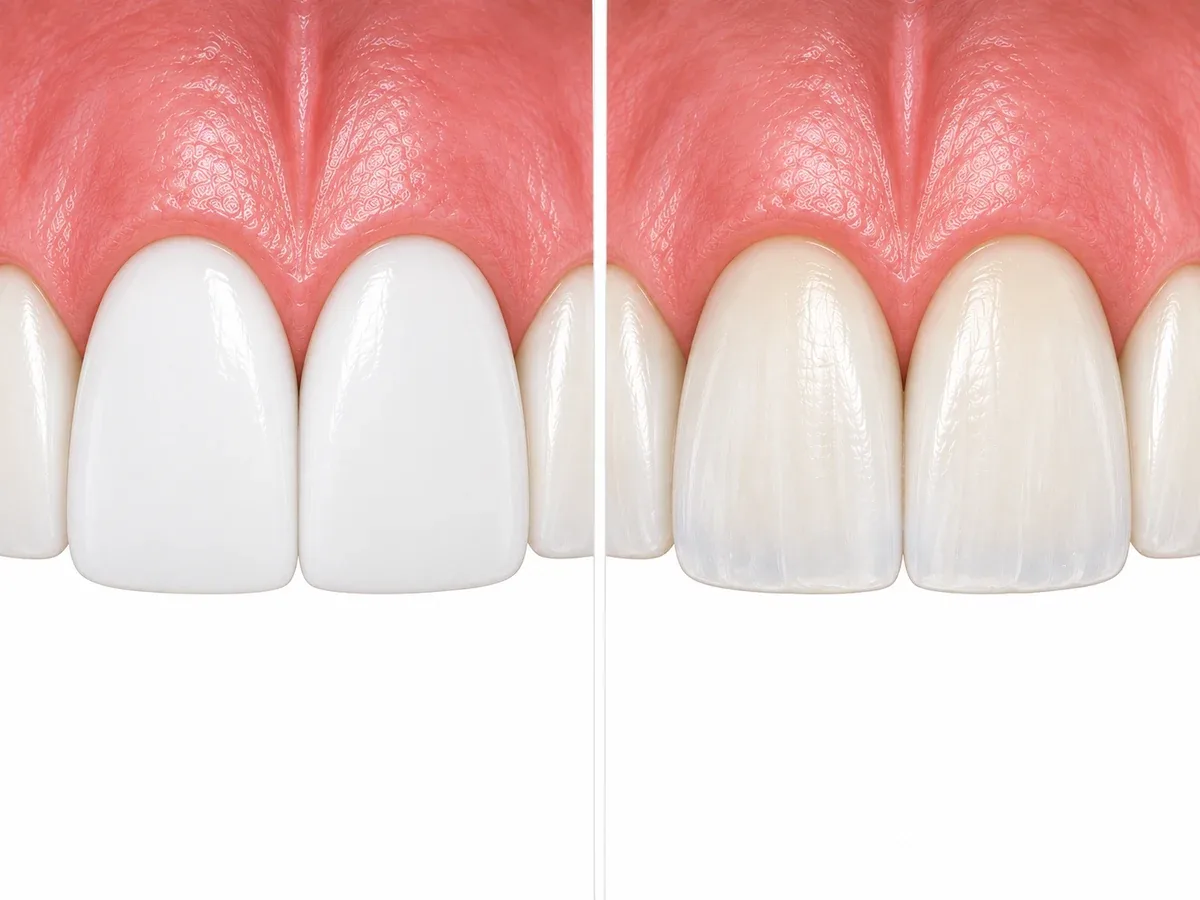
The color of fired porcelain, however, does not change when the surface is polished. It does not change with whitening either.
As the resin treatment guide notes, bonded restorations do not change color with whitening. Your natural teeth get brighter, and the bonded ones stay as they are.
So the remedy the guides describe is mostly making new ones. The crown guide's FAQ says that grinding down a restoration makes it easier to break, so a new one is usually needed. It adds that, apart from very small damage, a damaged restoration must be removed completely and remade.
The laminate guide covers re-bonding a veneer that has come off and polishing very small damage. But it describes no way to change the color.
| Situation | What the guides describe |
|---|---|
| Shape or length | Can be refined by reshaping |
| A veneer that came off | Can be bonded again |
| Very small damage | Can be polished and kept in use |
| Larger damage | Removed completely and remade |
| Color | No method described; polishing and whitening do not change it |
Remaking starts with removing what is already bonded. In that process, the tooth surface, already thinned, is worked on once more.
Removed tooth does not come back. Each color change can leave a little less natural tooth behind.
That is why we tend to recommend a shade one step less bright. Wanting to go brighter later is easier to handle than living with teeth that feel too bright.
Care after bonding also protects the color. The laminate guide lists these points:
- For about 2–3 days after bonding, avoid staining drinks such as cola, black tea and coffee.
- Avoid chewing hard foods that put too much force on the veneers.
- Tell the team you have veneers before scaling, since ultrasonic scalers may damage porcelain.
The last point does not mean you should skip scaling. It means letting the team know in advance.
Frequently asked questions
Can't you just pick a shade number for my veneers?
We do use numbered shade guides. But the number is a starting point, not the result. With the same number, the finished look still changes with the base color, thickness and neighboring teeth.
If I whiten first, can I go brighter?
That is a question of order, so we advise after seeing your teeth. One thing is clear: bonded restorations do not get brighter with whitening. To match natural teeth and veneers, decide which color to set first before starting.
Does the color change over time?
The side effect the guide lists is discoloration at the margin, where your tooth and the veneer meet. The guide also notes that resin laminates in the 1970s wore and discolored easily, and porcelain laminates came in from the 1980s.
Can I get veneers with English support in Busan?
Yes, Reset Dental Clinic offers 1:1 English interpretation from the first consultation through the end of treatment. We are near Seomyeon Station Exit 2 (5-min walk), opposite Lotte Hotel Busan. Call 010-8555-2854, or +82-10-8555-2854 from abroad.
Color is not something you pick.
It is matched to the teeth you have now.
The guide says high strength means less translucency,
and high translucency means less strength.
Clarity and strength pull against each other in one material.
And color is the hardest thing to adjust later.
We suggest starting one step less bright.
If you are considering veneers in Busan, Reset Dental Clinic provides 1:1 English interpretation throughout. Call 010-8555-2854 to book a consultation.
References
- KDCA National Health Information Portal, "Laminate Treatment" — definition as a thin 0.5–1.0 mm shell similar to tooth color bonded after minimal enamel reduction; discolored teeth as an indication; checking color, shape and fit before bonding; 1970s resin laminates and porcelain laminates from the 1980s; side effects including margin discoloration, debonding, partial fracture and sensitivity; avoiding staining drinks for 2–3 days and hard foods; telling the team before ultrasonic scaling
- KDCA National Health Information Portal, "All-Ceramic Crowns" — high-strength ceramics lack translucency and highly translucent ceramics are weaker; zirconia and lithium disilicate as typical materials; no metal, so no dark gums or dark margins; photographs and diagnostic models in pre-treatment checks; ground-down or damaged restorations usually need to be remade
- KDCA National Health Information Portal, "Amalgam and Inlays (Tooth-Colored Inlays)" — porcelain is more esthetic and more biocompatible than composite resin; it was once more brittle, with wear and toughness improved recently
- KDCA National Health Information Portal, "Resin Treatment (Dental Resin)" — composite resin can make the surface look natural when discoloration is partial or limited to one tooth; bonded restorations do not change color with whitening
Written by Reset Dental Clinic Support Team
Medical review Dr. Kim Hyun-joo, Head Dentist · Esthetic Restorations
Last updated: September 19, 2026
This column is for general information and does not replace diagnosis or treatment for individual patients. If you have symptoms, please see a dentist.


