

- In Korea, veneers are not covered by National Health Insurance. There is no set fee, so each clinic sets and discloses its own.
- A government sample survey found that fees for the same named item varied widely between clinics, for reasons such as the extent and difficulty of the work.
- Veneer fees differ not just by material, but by steps such as the diagnostic model, try-in and bite adjustment. Skipping steps changes the result.
"It is the same veneer, so why is the fee so different from one clinic to the next?" We hear this question often at Reset Dental Clinic in Seomyeon, Busan. For patients living in or visiting Korea, we offer 1:1 English interpretation from the first consultation through the end of treatment.
This column is not about our own fees. It explains, from public sources alone, why veneer fees are not fixed and what really changes when they differ.
We draw on reports in Dailydental, the Korean Dental Association's newspaper, about disclosed non-covered fees, illegal dental ads on an app and a court ruling on excessive tooth reduction. We also use the Korean government health portal's pages on veneer (laminate) treatment and all-ceramic crowns.
Why is there no set fee for veneers in Korea?
For treatment covered by National Health Insurance, the government sets the fee. It is the same at every dental clinic.
Treatment that insurance does not cover, such as veneers, works differently. The clinic sets the fee and discloses it. So under the system, the same named treatment can carry a different fee at each clinic.
Read the government health portal's veneer page from start to finish, and you will not find a single line about cost. It covers what the treatment is, when it is used, which steps it involves and what can go wrong.
Cost is simply not what that page is for. It describes the treatment, not the fee.
Where can fees be checked, then? The Health Insurance Review and Assessment Service (HIRA) surveys and discloses fees for non-covered care. Dailydental once summarized the results of such a survey, and we borrow its findings below.
How much can fees for the same item differ?
HIRA ran a sample survey of non-covered fees at dental clinics across 42 items. They included light-cured composite resin fillings, gold crowns, dental implants, tooth autotransplantation and patient education.
First, one point must be clear: veneers were not among the items named in this survey. So what follows is not a statement about veneer fees. It simply shows how fees for non-covered care can spread apart.
For several items, the gap between the average and the highest fee was wide. The article also reported differences between regions. It noted that fees varied more among dental clinics than among larger dental hospitals.
There is a detail in the article that is easy to miss. It also gave the reasons for the differences, and they were about the work itself.
| Item in the survey | Reasons given for the difference |
|---|---|
| Composite resin fillings | How much of the tooth surface was decayed, which tooth and its condition, and difficulty |
| Gummy smile correction | How many teeth were used as the reference |
Even under the same name, the amount of work actually done can differ. That is the key point to take from the survey.
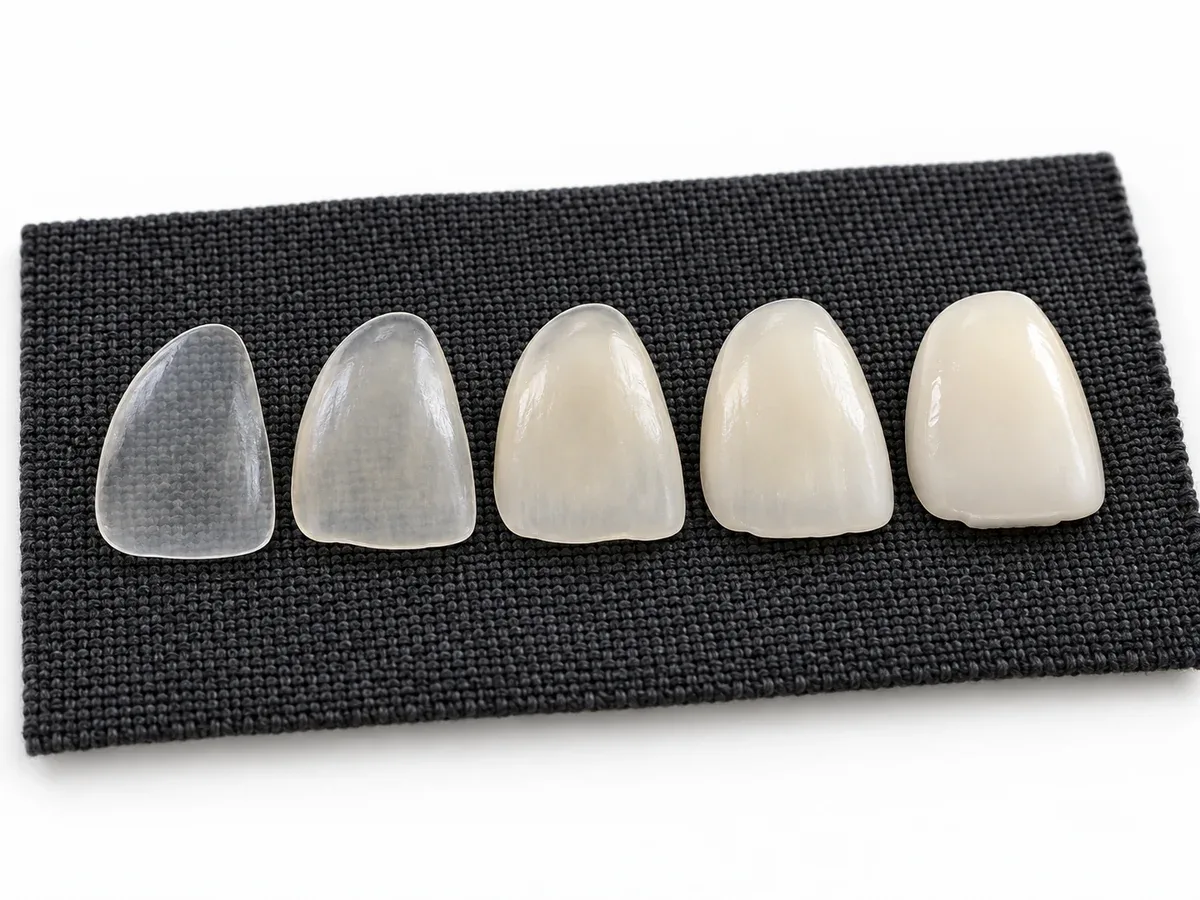
Where do veneer fees actually differ?
So what makes veneer fees differ? Following the treatment steps listed on the health portal gives a good idea.
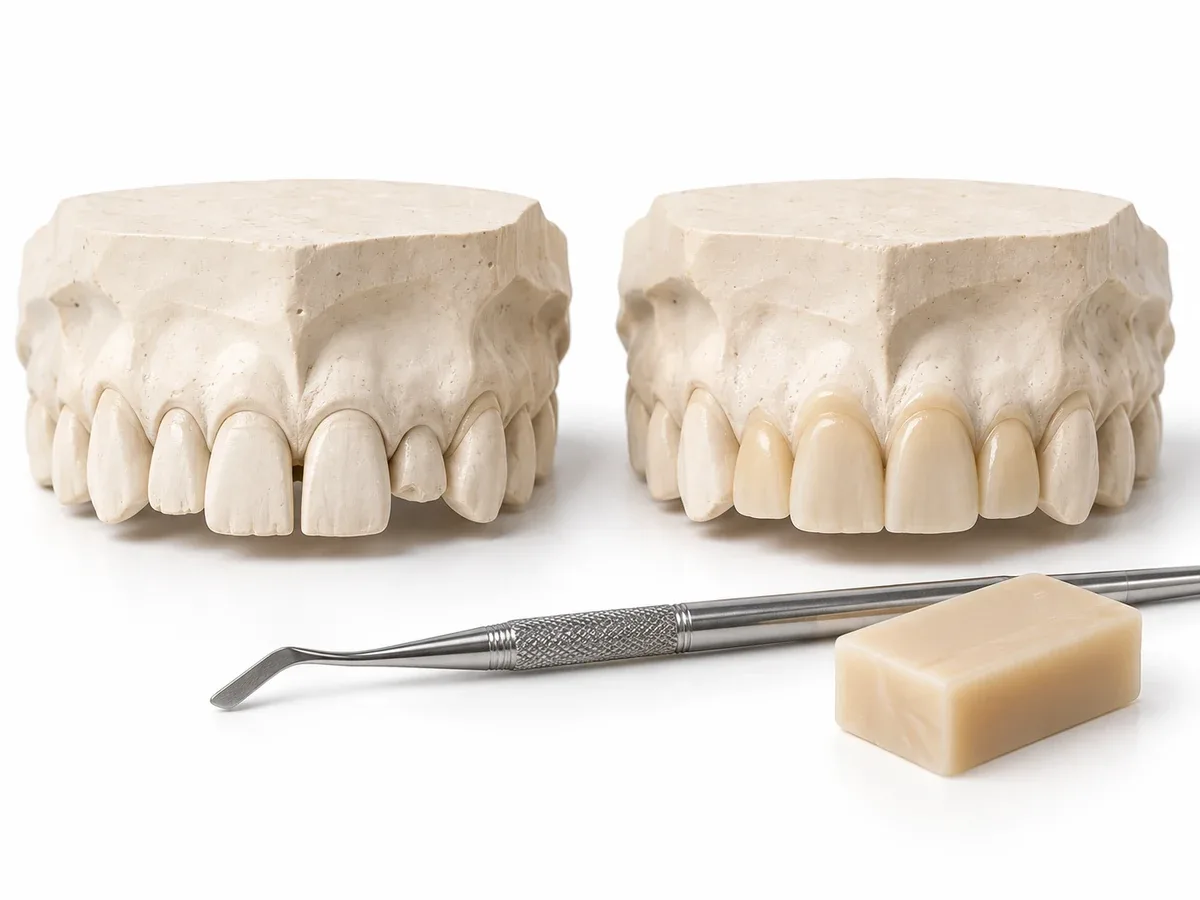
Before treatment, the portal puts making a diagnostic model first. The model is used to understand the patient's current state and wishes, and to picture the final result. The portal says this is essential when a large area is treated.
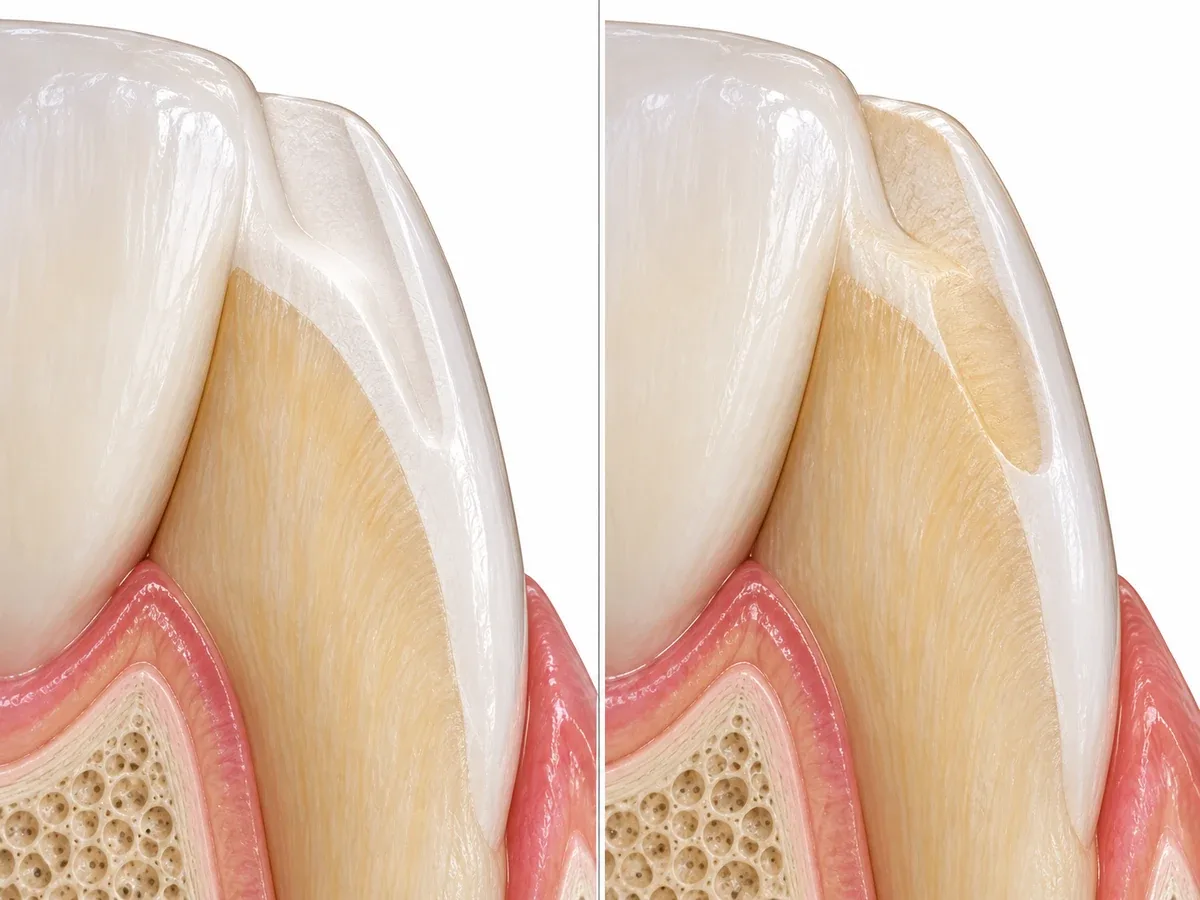
It helps decide whether veneers will work or whether a crown is needed instead. The portal then adds that it lets the amount of tooth reduction be predicted in advance, reducing unnecessary reduction.
That sentence matters. The source is saying that planning ahead can mean removing less tooth.
This step leaves nothing you can see in the final result. That is also why it is the easiest step to drop when a fee needs to come down.
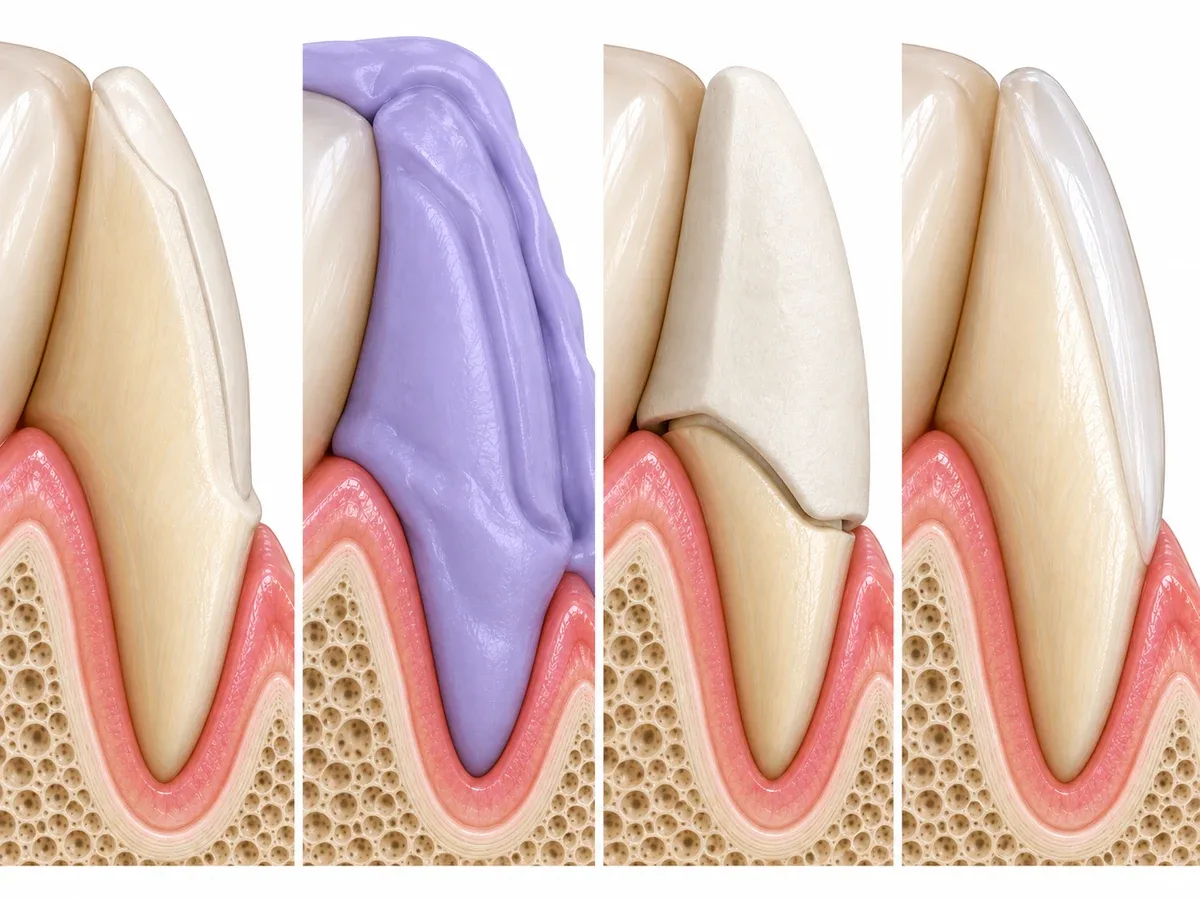
After that come six treatment steps:
| Step | What happens |
|---|---|
| 1. Tooth reduction | A minimal amount of enamel is shaped |
| 2. Impressions | A mold of the teeth is taken |
| 3. Temporary teeth | If needed, temporaries are made from composite resin and placed |
| 4. Lab fabrication | The veneers are made in a dental lab |
| 5. Try-in and bonding | Shade, shape and fit are checked before final bonding |
| 6. Bite adjustment and check | Heavy contact points are adjusted for stability |
The description of the fifth step is especially detailed. The finished veneer is tried on to check color, shape and fit. It is bonded when the fit is good and both patient and dentist are satisfied.
Several preparations take place around bonding:
- the tooth surface is roughened with a mild acid
- the inside of the veneer is cleaned and treated with hydrofluoric acid
- after bonding, excess cement is removed with a fine instrument
- in the sixth step, the bite is adjusted if any contact is too heavy
Veneer treatment is not simply "stick it on and done." The source lists step after step of checking, treating, cleaning and adjusting. What these steps take is time, not material.
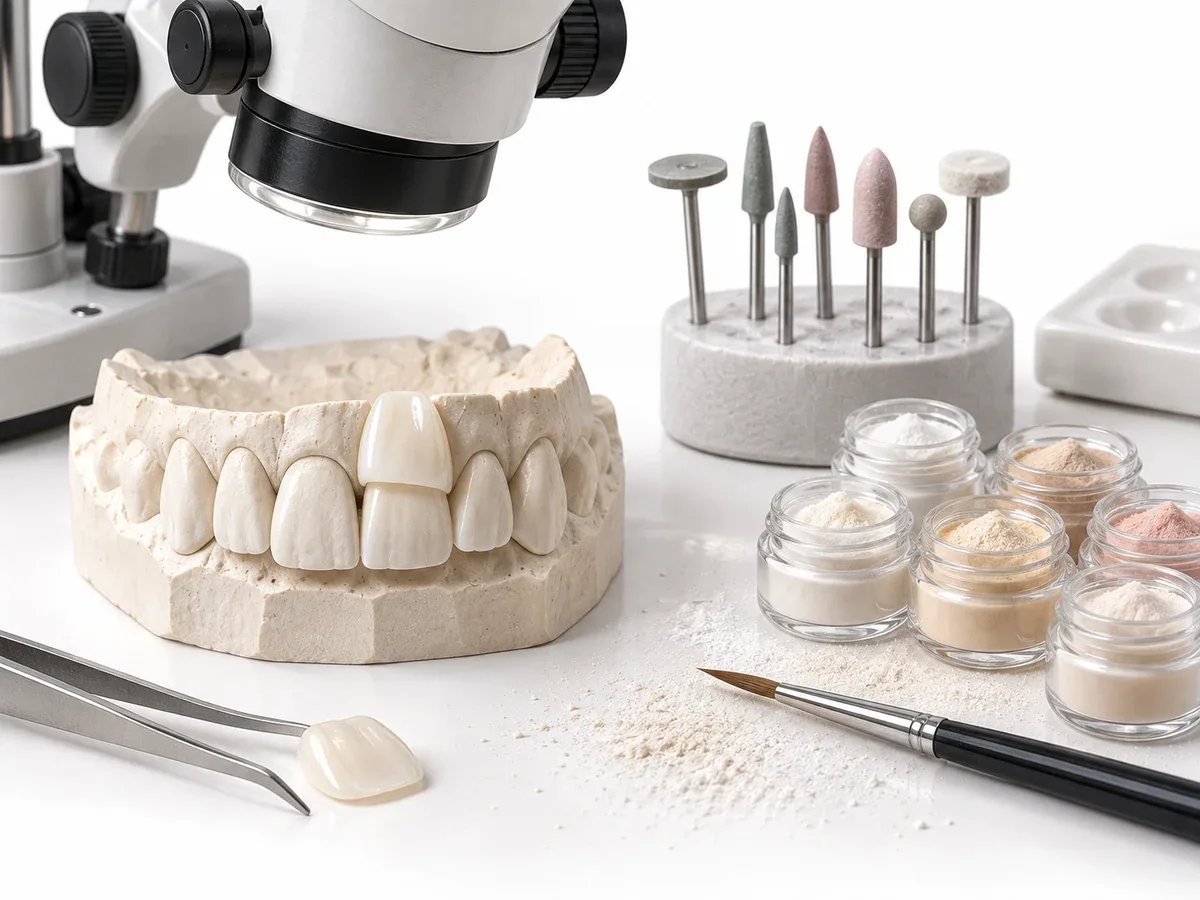
How do materials and fabrication affect the fee?
The portal names porcelain and composite resin as veneer materials. It also gives some history.
In the 1970s, resin veneers made with light-cured resin came into clinical use. But the resin of that time wore down and stained easily.
Porcelain veneers arrived from the 1980s. Today, the portal says, veneer treatment generally means treatment with porcelain veneers.
Bonding has limits too. The portal notes that veneers have a limited choice of cements compared with other restorations. Resin-based cements that are clear or lightly tinted are mainly used, to keep the look natural.
A veneer is thin and translucent, so what lies behind it can show through. That is why the cement matters.
The all-ceramic crown page states a trade-off inside the material itself. Strong ceramics are less translucent, and highly translucent ceramics are weaker.
| Factor | What the sources say |
|---|---|
| Shell material | Porcelain is the usual choice today; composite resin is also used |
| Ceramic types | Zirconia and lithium disilicate are named as typical materials |
| Fabrication | CAD/CAM milling from a block, or heat pressing of melted ceramic into a mold |
| Cement | Mainly resin-based, clear or lightly tinted |
What goes into a veneer depends on which of these is chosen. That, too, is part of the fee.
What happened when a patient chose on price alone?
One court ruling shows what can happen when the fee does not match the treatment. Dailydental reported the case.
A patient considering veneers visited a clinic after seeing its ad for low-cost no-prep veneers. According to the article, the ad promised the following.
- tooth reduction of just 0.1–0.2 mm
- treatment without any tooth reduction
In the actual treatment, however, about 0.3–0.5 mm of tooth was removed, unlike what the ad said.
The Suwon District Court ruled for the patient. It said that if the usual amount of reduction for veneers is needed, unlike the ad, the patient's consent must be obtained in advance.
The court considered that the dentist had not properly explained how much tooth would be removed. It also noted that, because the patient's teeth were of normal size, no-prep veneers could not be applied. It ordered the clinic to pay damages.
The issue in this ruling was not the fee itself. It was that the condition attached to the fee could not apply to that patient.
The figure in the ad did not fit every tooth. Not being told this in advance became the basis for damages.
What do price-cut ads leave out?
In 2021, Dailydental reported on price-cut ads that some dental clinics posted on a secondhand-trading app with over 10 million users. The ads offered lower fees for treatments such as ceramic inlays and in-office whitening.
The article explained that Article 27(3) of the Korean Medical Service Act bans referring, brokering or inducing patients to a clinic for profit. Violations carry criminal penalties. It added that the Ministry of Health and Welfare had confirmed this in an official legal opinion.
For our purposes, the more telling part is the concern voiced by dentists in the article. The concerns reported were these:
- some clinics attract patients with low prices alone, without considering each patient's oral condition
- comparing clinics by price on the internet or apps could become a fixed habit
- fee disclosure could be misused for exaggerated ads claiming lower fees than other clinics
These points came from practicing dentists, not from a regulator. Still, they describe the same gap between a fee and the care behind it.
A fee on a screen says nothing about which steps are included. It also says nothing about whether that treatment suits your teeth.
What should you ask at a veneer consultation in Busan?
These questions follow directly from the sources above. You can ask them at any dental clinic.
- Which steps does this fee include? The portal lists the diagnostic model as a separate preparation, and temporaries are made when needed. Ask whether each is included.
- How many millimeters will be removed in my case? This explanation was exactly what the court case was about. Ask for the figure that applies to your teeth, not the one in an ad.
- Are my teeth suitable for no-prep veneers? The court based its ruling partly on the patient's normal tooth size. Whether no-prep is possible differs from person to person.
- Is it porcelain or composite resin? The portal names both, and notes that veneers today usually means porcelain.
- How many visits are there for adjustment after bonding? The last step in the portal is bite adjustment and checking. Knowing what aftercare is included makes comparison easier.
Getting estimates from several clinics is fine. But setting the amounts side by side does not tell you much by itself.
Ask whether each step is included: the diagnostic model, temporaries, and bite adjustment and checks after bonding. Then you are comparing on the same terms.
This column does not list our own fees. It explains why fees are not fixed.
We discuss cost once we have examined your mouth and decided which teeth to treat and how. A figure given before that is always a figure with conditions attached.
Frequently asked questions
Does a lower veneer fee mean less skill?
The sources do not say that. The HIRA survey gave the extent of decay, the tooth and its condition, difficulty and the number of reference teeth as reasons, not skill. What to check is which steps the fee covers, not whether it is high or low.
Can I trust the reduction amount in a veneer ad?
It is not that the figure is false. The question is whether it applies to your teeth. In the ruling, the court took into account that the patient's normal tooth size made the advertised method impossible.
Does a higher fee mean the veneers last longer?
The sources do not link fee and lifespan. The portal says average lifespan is hard to state, because it depends on habits, chewing, tooth shape and care. It says veneers can be used for around 5 to 10 years with proper care.
Can I get a veneer consultation in English in Busan?
Yes. We offer 1:1 English interpretation from the first consultation through the end of treatment. The clinic is near Seomyeon Station Exit 2 (5-min walk), opposite Lotte Hotel Busan, and you can call 010-8555-2854 (+82-10-8555-2854 from abroad).
Veneers are non-covered care, so there is no set fee.
Under the same name, the steps, materials and time differ.
So what is included matters more than the figure.
Ask for the reduction that applies to your teeth, not the one in an ad.
If you are considering veneers in Busan, Reset Dental Clinic offers 1:1 English interpretation for patients in Korea. Call 010-8555-2854, and we will start with that explanation.
References
- Korean Dental Association newspaper Dailydental, "HIRA discloses crown and implant fees" — HIRA's sample survey of non-covered fees at dental clinics across 42 items, the survey scale, the gap between average and highest fees, the reasons given for fee differences (extent of decay, tooth and condition, difficulty, number of reference teeth), regional differences, and greater variation among dental clinics than dental hospitals
- Korean Dental Association newspaper Dailydental, "Court orders damages for excessive tooth reduction in laminate treatment" — the no-prep veneer ad promising 0.1–0.2 mm or no reduction, the actual reduction of about 0.3–0.5 mm, the Suwon District Court's view that prior consent is needed when usual reduction is required, and its ruling for damages given the lack of explanation and the patient's normal tooth size
- Korean Dental Association newspaper Dailydental, "Illegal dental ads flood an app with 10 million users" — examples of price-cut dental ads on a secondhand-trading app, the ban on referral, brokering and inducement under Article 27(3) of the Medical Service Act and the ministry's interpretation, and dentists' concerns about attracting patients on price without regard to oral condition
- KDCA National Health Information Portal, "Laminate Treatment" — the definition of veneers, the diagnostic model as essential for large treatment areas and a way to reduce unnecessary reduction, the six treatment steps, the history of resin and porcelain veneers, the limited choice of cements, the risk of fracture or debonding, and use for around 5–10 years with proper care
- KDCA National Health Information Portal, "All-Ceramic Crowns" — the trade-off between strength and translucency, zirconia and lithium disilicate, CAD/CAM milling and heat pressing, and lifespan that varies with material and care
Written by Reset Dental Clinic Support Team
Medical review Dr. Kim Hyun-joo, Head Dentist · Integrated Dentistry Specialist
Last updated: September 19, 2026
This column is for general information and does not replace diagnosis or treatment for individual patients. If you have symptoms, please see a dentist.


