

- The public guide on teeth grinding lists broken restorations next to tooth wear and fractures. Bonded work is on the same list.
- The veneer guide never uses the word grinding. It notes instead that veneers may come off under harmful forces.
- The first step is an occlusal splint, a hard resin appliance that covers all the teeth.
- A misaligned bite does not cause grinding. The guide says bite adjustment is not needed to treat it.
Some patients at our clinic in Seomyeon, Busan tell us early on that they grind their teeth, and ask whether veneers are still possible. Others mention it after treatment is already finished, and by then fewer options remain. For patients living in or visiting Korea, we provide 1:1 English interpretation from the first consultation through the end of treatment.
This column is built on the Korea Disease Control and Prevention Agency (KDCA) guide on teeth grinding. We read it alongside the guides on all-ceramic crowns, tooth-colored inlays and laminate veneers. It covers what grinding does to porcelain, and what should come first.
What does the public guide say about teeth grinding?
The guide defines grinding (bruxism) as repetitive jaw muscle activity: clenching the teeth, grinding them, or bracing the jaw. It divides it into sleep bruxism, which happens while you sleep, and awake bruxism, which happens during the day.
It also gives numbers for how common it is. They show that grinding is far from rare.
| Type | Reported rate |
|---|---|
| Sleep bruxism, ongoing | About 8% of the population |
| Sleep bruxism, occasional | About 15% of the population |
| Sleep bruxism in children | 13–49% |
| Awake bruxism | 16–32% |
That is why grinding is one question we always ask when planning veneers. Daytime clenching counts too, since the guide lists it as its own type.
The guide lists these symptoms and complications:
- tooth wear and fractures
- broken restorations
- toothache and gum disease
- headaches and jaw joint problems
- enlarged chewing muscles
That second item is where the question of veneers begins. The guide puts natural teeth wearing and breaking on the same list as treated teeth breaking.

Is a misaligned bite the cause of grinding?
The guide first states that the exact cause of grinding has not been identified. It then lists the factors known to be related:
- emotional stress, anxiety and depression
- sleep disorders
- nervous system diseases
- smoking, alcohol and caffeine
- certain medications
- genetic factors
The next line is the important one. Grinding has been shown to be unrelated to a misaligned bite, or to the shape of the face and jaw joints.
The treatment section repeats the point. Because a misaligned bite does not cause grinding, bite adjustment is not needed to treat it.
These two lines are worth knowing before any esthetic consultation. They mean that changing the shape or alignment of teeth will not stop grinding.
If you have been told that straightening your teeth will end your grinding, compare that claim with this line from the guide. Changing shape and managing force are separate jobs. Treatment that changes alignment deals with alignment, not with grinding.
What happens when grinding forces reach porcelain?
Porcelain is a good material for handling color in veneers. The tooth-colored inlay guide says it is more esthetic and more biocompatible than composite resin. It adds that its old weakness, breaking easily, has improved recently.
Yet one line stays on that guide's list of drawbacks. Patients who grind or clench their teeth are more likely to break porcelain.
The same guide says composite resin is more elastic than porcelain, so less of the biting impact is passed on. Read side by side, these lines show that the two materials handle force differently.
| Material | What the guide says |
|---|---|
| Porcelain | More esthetic and biocompatible, but breaks more easily in people who grind or clench |
| Composite resin | More elastic, so less impact from biting is passed on |
Each also brings different conditions in looks, wear and staining. So neither can be called better across the board, and either one gives similar results if biting force is not managed.
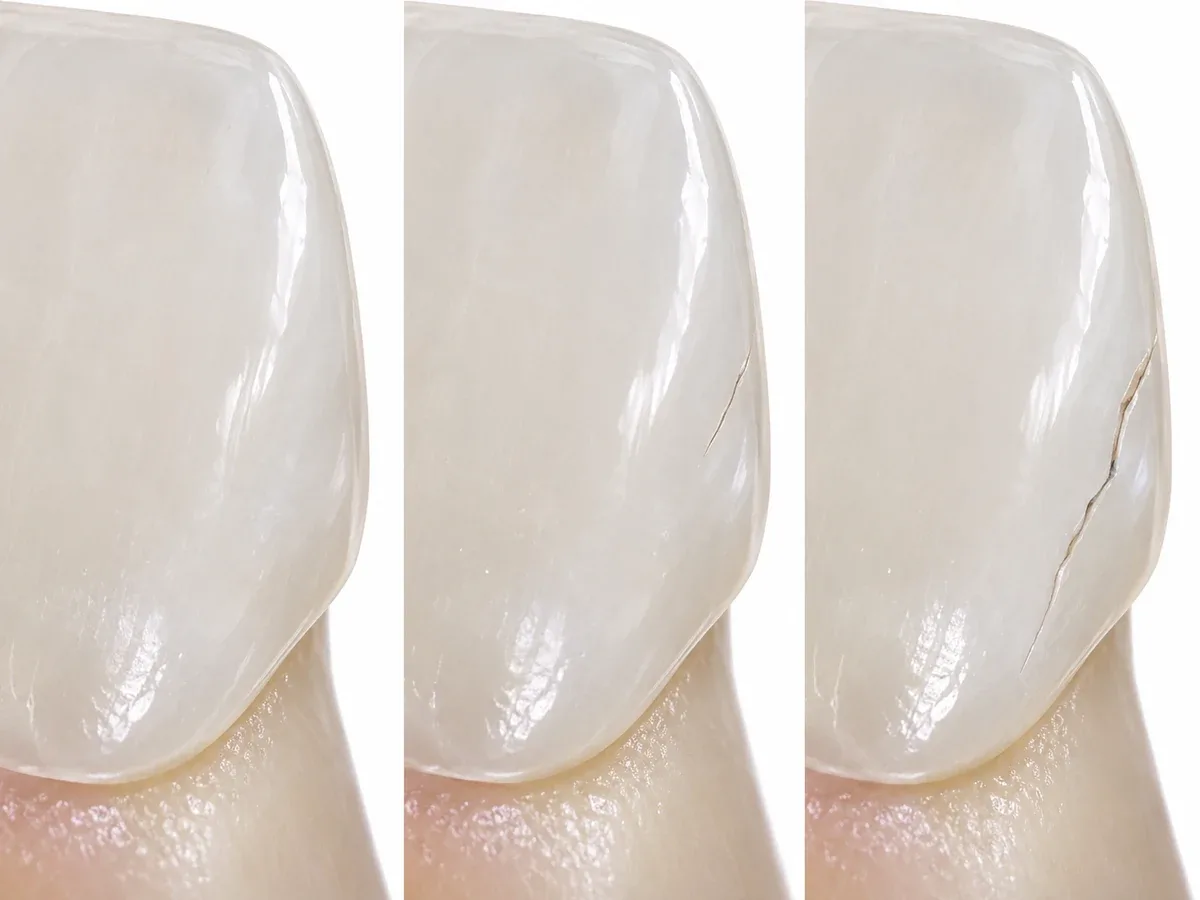
The all-ceramic crown guide describes two ways porcelain breaks. One is a single large force: biting suddenly on something hard can snap it. The other is time: ceramic used for a long time loses strength and develops cracks, becoming more prone to fracture.
For veneers, grinding belongs to the second kind. It is not a force that breaks things in one night, but one that builds up a little every night.
What about switching to a stronger material? The guide attaches a condition. Ceramics with high strength lack translucency, while highly translucent ceramics are weaker.
Moving toward strength means giving up some clarity. On front teeth with veneers, that trade-off shows directly in the result.
Why doesn't the veneer guide mention grinding?
This may come as a surprise. The laminate veneer guide does not name grinding or clenching at all. Instead, it describes a property.
Veneers attach to just part of the tooth surface rather than covering the whole tooth. So they are relatively weaker than other restorations, and may come off under harmful forces. The guide therefore advises against chewing hard foods with treated teeth.
The all-ceramic crown guide does mention grinding directly. It says people who grind or clench in their sleep may need an appliance to keep teeth and restorations from wearing or breaking.
If an appliance is advised even for crowns that cover the whole tooth, we read it as applying all the more to a thin shell bonded on the front surface.
Put the two guides together, and the picture is this. Grinding is not listed as a condition that rules out veneers.
But the weak point the guide names matches exactly the kind of force grinding creates. So we describe grinding not as a reason you cannot have veneers, but as a reason to set the order.
What should come first before veneers in Busan?
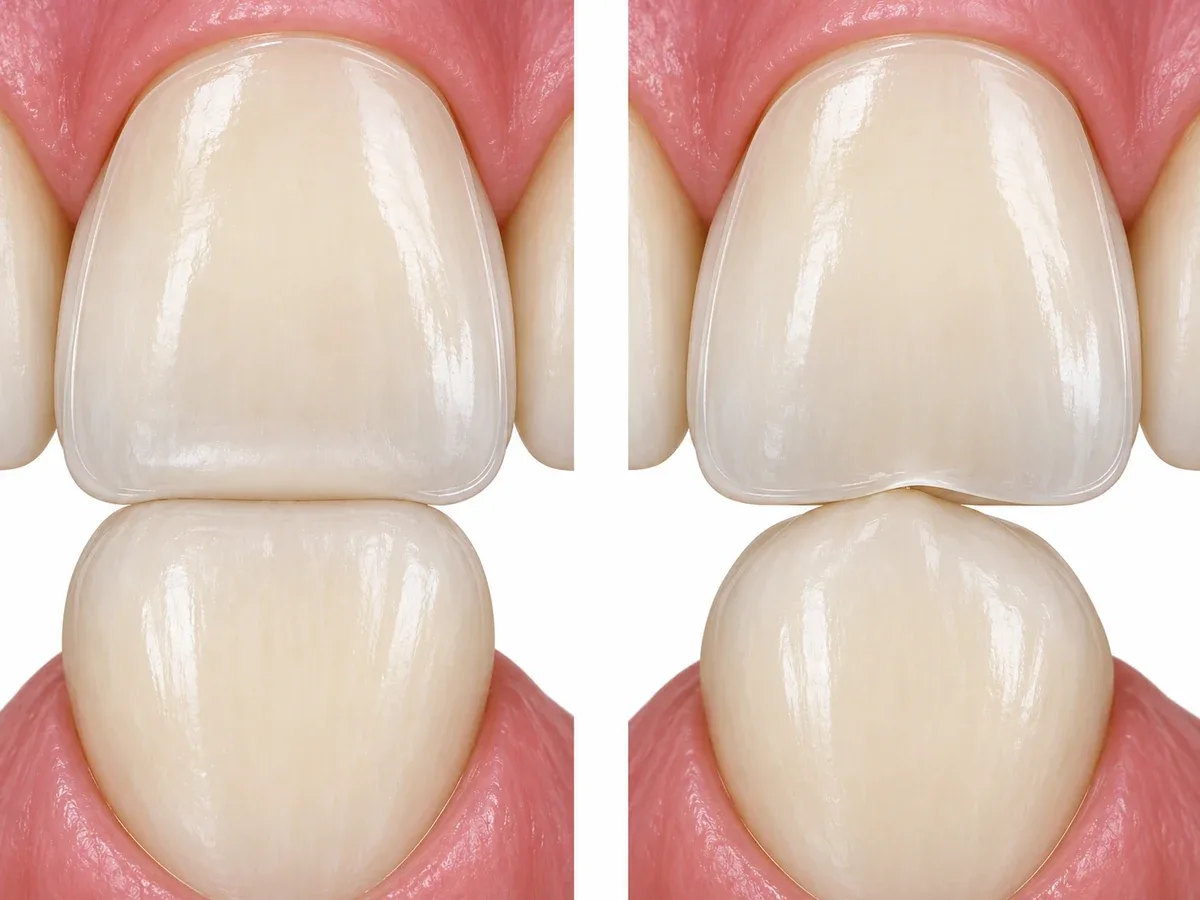
Here are the treatments the guide lists for grinding, as written. First comes an oral appliance, and the guide names an occlusal splint made of hard resin that covers all the teeth as the most widely used one.
| Treatment | What it involves |
|---|---|
| Occlusal splint | A hard resin appliance covering all the teeth |
| Botulinum toxin injections | Injections into the chewing muscles |
| Medication | Used in limited cases |
| Cognitive behavioral therapy | Noticing the habit yourself and changing it |
| Better sleep hygiene | Improving sleep habits |
| Exercise therapy | Stretch-reflex relaxation and mouth-opening muscle training |
One point is easy to misunderstand. An occlusal splint does not make grinding go away.
The guide explains that it blocks force from reaching the teeth, gums, muscles and jaw joints. It does not remove force; it changes where force lands. So wearing a splint does not make any future restoration safe.
In our clinic, we use this order in a practical way. When grinding is confirmed, we make the splint first and ask you to wear it for a while before anything is bonded.
After a few weeks, the splint's surface shows marks where force landed and how much. Whether those marks gather at the front teeth or lean to one side changes the next plan. It is more reliable information than asking in words.

How can veneers still be planned for someone who grinds?
Grinding does not mean giving up on veneers or other esthetic treatment. It does mean setting conditions before starting.
Below, we separate what is based on the guides from what we decide in our clinic.
| What | Why |
|---|---|
| Make the splint first | The guide says grinding or clenching may call for an appliance that prevents wear and breakage |
| Check the bite and jaw spacing | The guide's pre-treatment checks include the bite and the distance between the jaws |
| Check the opposing teeth | The guide lists a separate check of the opposing teeth's material |
| Spread the contact points | In our clinic, we adjust so force does not gather at one point on the shell's edge |
| Start with fewer teeth | In our clinic, we expand step by step after checking, rather than all at once |
| Shorten check-up intervals | Cracks are better found before they grow |
The first three rows come from the checks the all-ceramic crown guide lists before treatment. The same guide also lists these checks:
- oral hygiene and gum disease checks
- pulp vitality tests
- X-rays
- diagnostic models and photos
For people who grind and want veneers, the list itself does not change. What matters is not skipping any of it.
One more point. The veneer guide lists teeth that are badly out of position as a hard case, and suggests crowns or orthodontic treatment instead.
If grinding has already worn the front teeth short, we first ask whether one thin shell can really solve it. The crown guide notes that when a tooth is too short, there may not be enough space to make a crown at all.
Some ask whether a crown is the safer choice if veneers might break. The crown guide says crowns remove a little more tooth than metal crowns, and that grinders may still need an appliance. Removing more tooth does not make the force disappear.
What if your front teeth are already worn down?
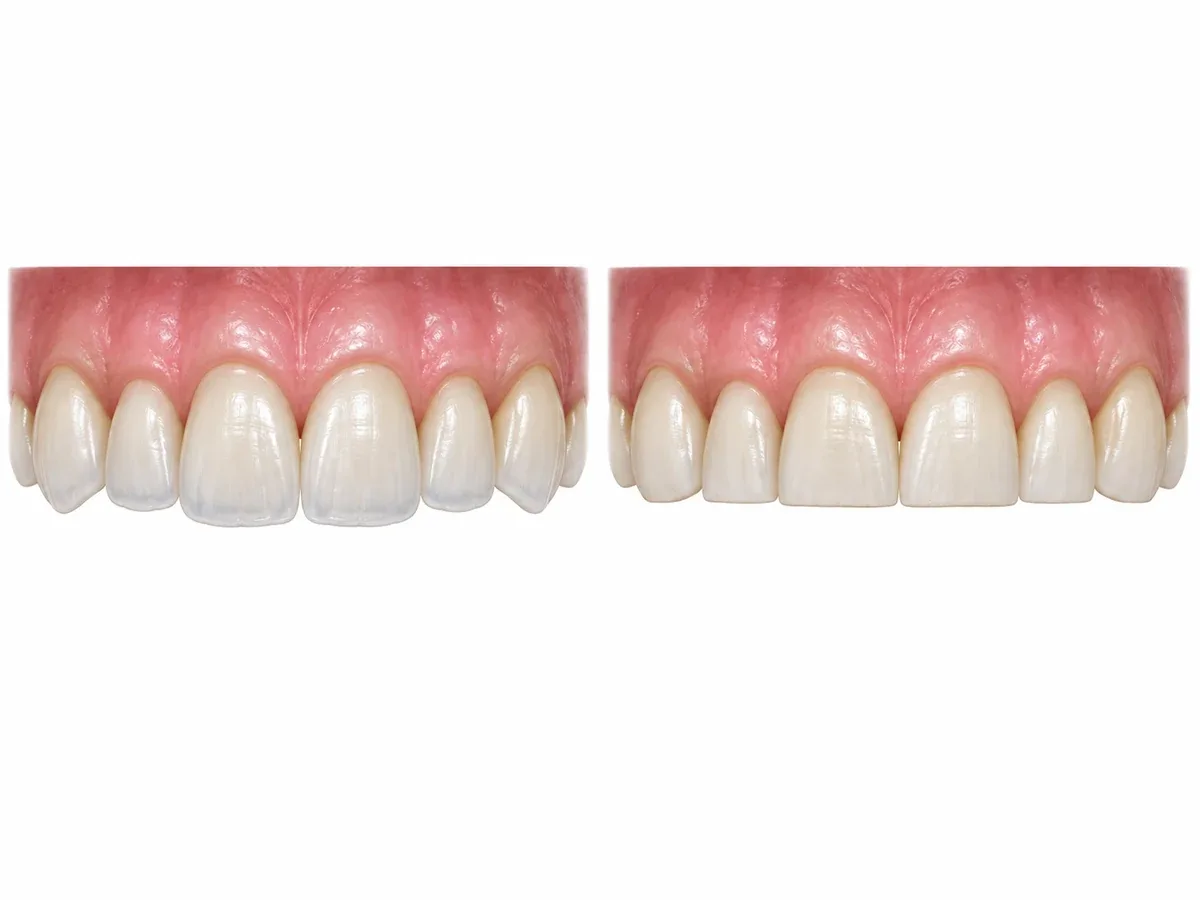
People who have ground their teeth for years often come to us about length, not color or shape. They say their front teeth have become flat and short, so less shows when they smile.
Dailydental, the Korean Dental Association's newspaper, has also run a notice urging readers to check for tooth wear if their teeth feel sensitive.
A tooth worn short has already lost structure. So before removing more, we first look at ways to restore what was lost.
Restoring it, though, comes with the same conditions described above. If the force that wore the tooth down is still there, the restored part will face that same force.
So we set the order like this:
- Prepare the side that manages force, such as the splint.
- Check where and how strongly force lands.
- Then restore the shape and length of the teeth.
- Keep checking at regular intervals.
Done the other way round, the restored teeth or veneers wear or break first. The grinding guide lists repeated breakage of dental restorations among the clinical signs it looks for, which describes what happens when this order goes wrong.
Frequently asked questions
I'm not sure whether I grind my teeth. Can veneers still be planned?
Many people do not know, and the guide notes that much grinding happens during sleep. We look at signs such as the pattern of wear, wear near the gums, and cracks or chips in teeth or restorations. We also ask whether your jaw feels stiff in the morning.
If I wear a splint, are veneers safe?
We would not go as far as calling them safe. The guide says the splint blocks force from reaching the teeth, not that it stops grinding. So even with a splint, we check your teeth regularly.
Would botulinum toxin injections solve the problem?
The guide does list botulinum toxin injections as one treatment. But it is one of several, and the option it names as most widely used is the occlusal splint. Relaxed muscles also do not bring back tooth that has already worn away.
Can I get veneers with English support in Busan?
Yes, Reset Dental Clinic offers 1:1 English interpretation from the first consultation through the end of treatment. We are near Seomyeon Station Exit 2 (5-min walk), opposite Lotte Hotel Busan. Call 010-8555-2854, or +82-10-8555-2854 from abroad.
Grinding is not a reason to rule out veneers.
It is a reason to set the order.
The guides list broken restorations among grinding's complications,
note that veneers may come off under harmful forces,
and say time lowers the strength of porcelain.
Prepare to manage the force first,
then restore the shape.
If you grind your teeth and are considering veneers in Busan, Reset Dental Clinic provides 1:1 English interpretation throughout. Call 010-8555-2854, and we will start by looking at the forces your teeth face now.
References
- KDCA National Health Information Portal, "Bruxism (Teeth Grinding)" — definition, sleep and awake bruxism, prevalence (about 8% ongoing and 15% occasional sleep bruxism, 13–49% in children, 16–32% awake); cause not identified, related factors, and no link to malocclusion or facial and joint shape, so bite adjustment is not needed; complications including broken restorations; the hard resin occlusal splint as the most widely used appliance, which blocks force; botulinum toxin, medication, cognitive behavioral therapy, sleep hygiene and exercise therapy; repeated breakage of restorations as a clinical sign
- KDCA National Health Information Portal, "All-Ceramic Crowns" — an appliance may be needed for grinding or clenching; sudden hard biting and long use can lead to fracture; high-strength ceramics lack translucency; pre-treatment checks including bite, jaw spacing and opposing teeth; slightly more tooth reduction than metal crowns; not possible when a tooth is too short to give enough space
- KDCA National Health Information Portal, "Amalgam and Inlays (Tooth-Colored Inlays)" — porcelain is more esthetic and biocompatible than composite resin and has improved; it breaks more easily in patients who grind or clench; composite resin is more elastic and passes on less biting impact
- KDCA National Health Information Portal, "Laminate Treatment" — bonded to part of the tooth surface, so relatively weaker and may come off under harmful forces; avoid chewing hard foods; crowns or orthodontics suggested for badly misplaced teeth; debonding and partial fracture as side effects
- Dailydental (Chiui Sinbo), Korean Dental Association, "If Your Teeth Feel Sensitive, Suspect Tooth Wear" — a notice published on September 30, 2021, advising readers to consider tooth wear when teeth feel sensitive (the text is provided as an image)
Written by Reset Dental Clinic Support Team
Medical review Dr. Kim Hyun-joo, Head Dentist · Esthetic Restorations
Last updated: September 19, 2026
This column is for general information and does not replace diagnosis or treatment for individual patients. If you have symptoms, please see a dentist.


