

- The sources give numbers. Veneers last around 5–10 years with proper care, all-ceramic crowns about 10 years in the literature, and many people use gold inlays for over 10 years.
- Every source adds the same condition: results vary widely with tooth condition, oral hygiene, diet and maintenance.
- Veneers can be redone, but removing the old one means the tooth is shaped a little more each time.
"How many years will veneers last?" and "Can they be redone later?" almost always come together. At Reset Dental Clinic in Seomyeon, Busan, we answer the first from the sources, and say plainly that they do not answer the second. For patients living in or visiting Korea, we offer 1:1 English interpretation from the first consultation through the end of treatment.
This column sets the Korean government health portal's pages on veneer (laminate) treatment, all-ceramic crowns and gold inlays side by side. We separate what has numbers from what does not.
How long do veneers last, according to the sources?
The portal's veneer page puts it this way: around 5 to 10 years with proper care. The pages on other materials give numbers in the same place. Seeing them together makes things clearer.
| Restoration | What the source says |
|---|---|
| Veneers | Around 5–10 years with proper care, varying with personal habits and care |
| All-ceramic crowns | About 10 years in the literature, but varying widely with tooth condition, oral hygiene, diet and maintenance |
| Gold inlays | Used successfully for a long time, with many people using them for over 10 years |
One thing stands out in the table. No source gives a number on its own.
Even the gold inlay page does not promise ten years. It says many people have used them that long.
A gold inlay is also a metal filling in a back tooth. A veneer is a thin shell bonded to the outer surface of a front tooth. The position, material and forces are all different.
So the numbers cannot simply be compared to say one lasts longer. The figure from one cannot be moved onto the other.
That is why we look first at the conditions behind the number. The same five years can become ten for one person and three for another, and the reason lies in those conditions.
Three conditions decide how long a veneer lasts:
- what it is bonded to
- what forces it takes
- how it is looked after
Why does the surface underneath a veneer matter?
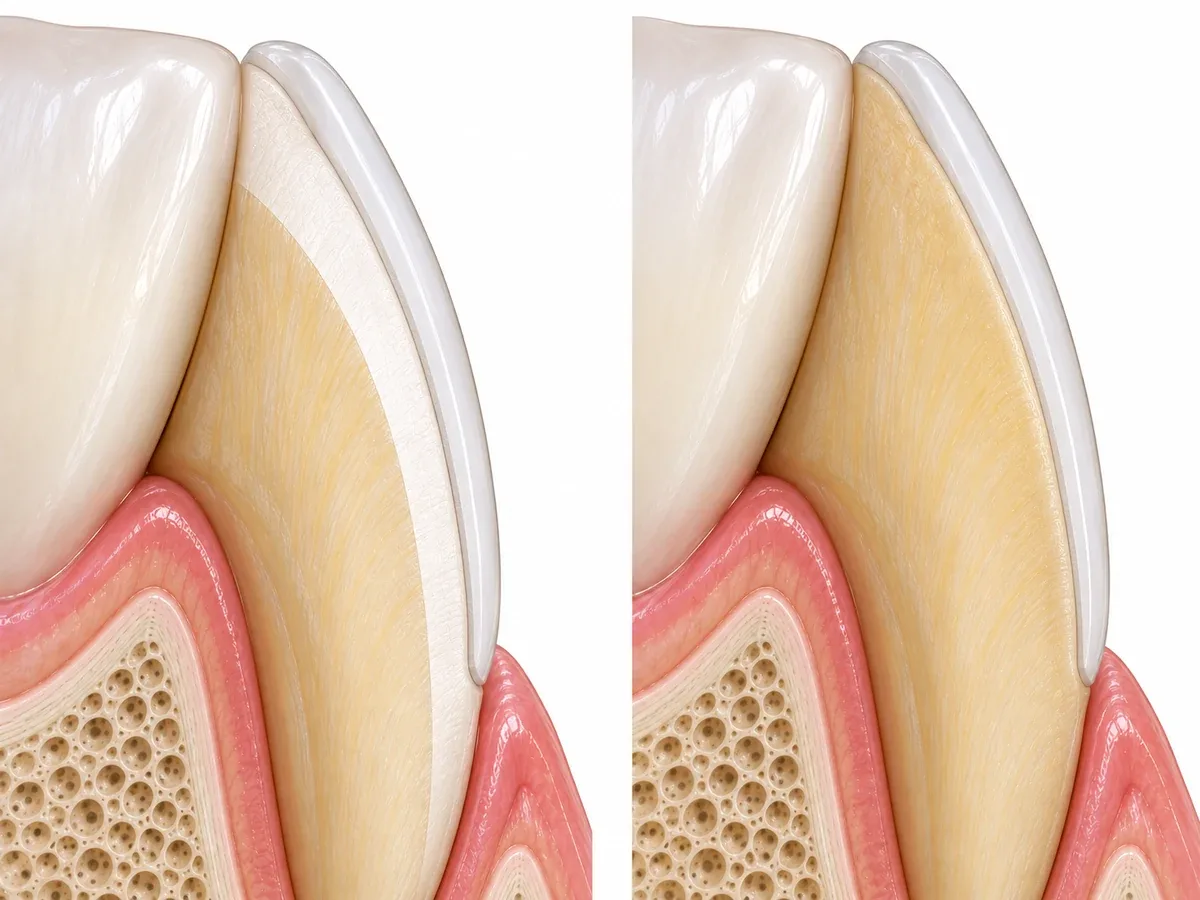
A veneer is not a cap that covers the tooth. It is bonded to the tooth.
The portal describes shaping the tooth surface minimally and then bonding a thin shell about 0.5 to 1.0 mm thick. So the nature of the surface underneath becomes the result.
The outer layer of a tooth is enamel, and underneath it lies dentin. The two behave differently.
In our clinic, we see a different course when a veneer is bonded to remaining enamel than when it is bonded to exposed dentin. So where possible, we aim to finish within the outer layer.
The sources give no figures on this point. It is our own clinical standard, and we say so.
What forces can shorten a veneer's life?
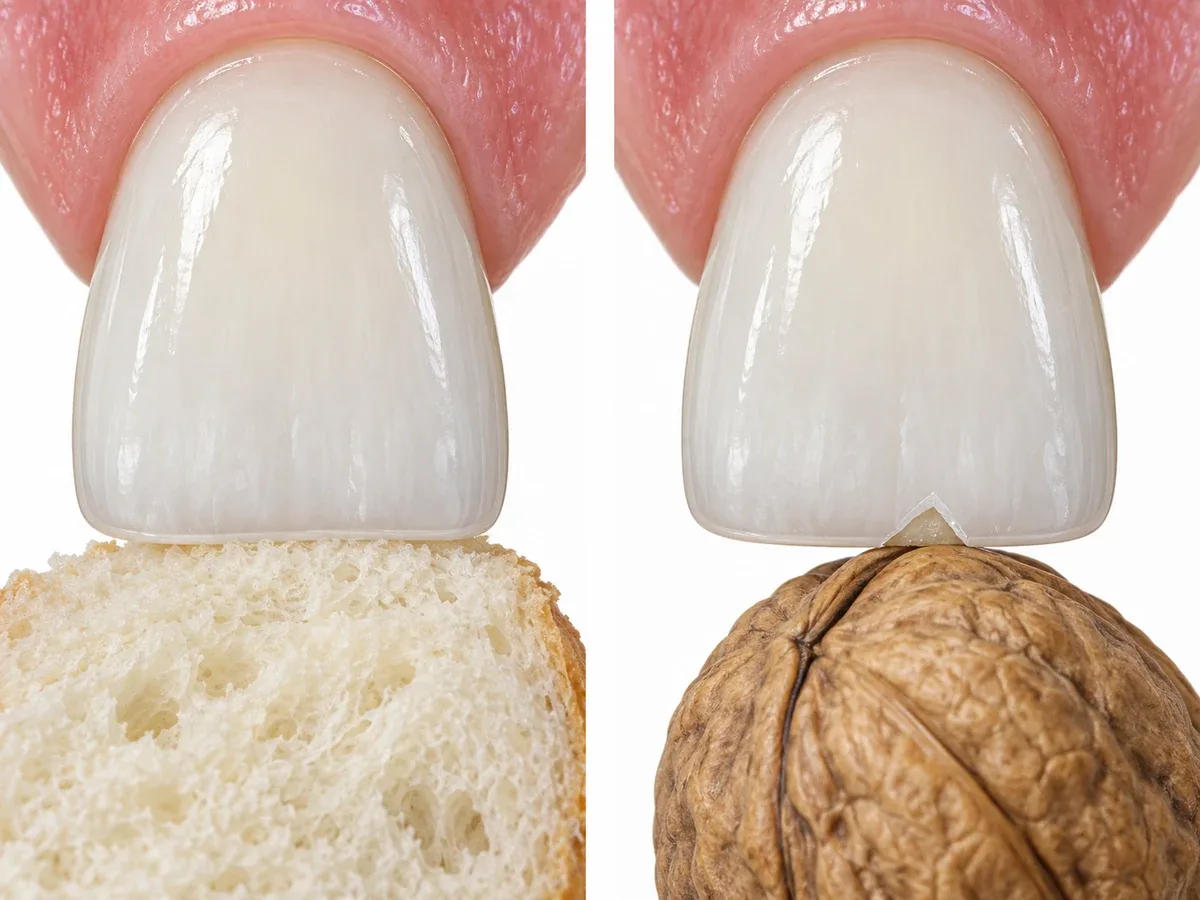
The all-ceramic crown page is frank about ceramics. Strong ceramics are less translucent, and highly translucent ceramics are weaker.
It adds that a ceramic restoration can break under a large, sudden impact from biting something hard. A thin front-tooth shell is made for a natural, translucent look, so take that sentence at face value.
The veneer page's aftercare advice points the same way: avoid hard foods. If you tend to crack or tear things with your front teeth, that habit is the first thing we will talk about.
There is also the force at night. The portal's page on tooth grinding (bruxism) says grinding can cause tooth wear and fracture, gum disease and jaw joint problems.
It names the occlusal splint as the most widely used way to manage it. The same page makes one thing clear: a poor bite is not the cause of grinding.
Straightening the look of the teeth does not stop grinding. So we plan a splint separately from the veneer treatment itself.

How does care affect veneer lifespan?
The veneer page's aftercare advice is specific:
- avoid dark drinks for 2–3 days after bonding
- avoid hard foods
- tell the dental team before scaling, since ultrasonic scalers may damage porcelain
The last point is often forgotten. Mention your veneers whenever you have a cleaning at any clinic.
The page lists complications: coming off, fracture, discoloration at the edges over time, and sensitivity. Of these, edge discoloration is often the first sign you can see.
If color starts to settle in a thin band where the veneer meets the gum, we read it as a sign that the area is getting harder to keep clean.

Some people with the same treatment end up with different results. It is less about material and more about where each of the three conditions falls. Here is how we see it in the clinic.
| Factor | Tends to last longer | Tends to last less |
|---|---|---|
| Bonded surface | Bonded thinly on remaining enamel, with an edge that meets the tooth without a step | Bonded where dentin is widely exposed, with a ledge you can feel at the edge |
| Bite forces | Force spreads across several teeth when chewing | Force lands on one spot, with a habit of cracking things with front teeth |
| At night | A splint is used once grinding is confirmed | Grinding is never checked |
| Daily care | Cleaning between teeth daily, with check-ups at set intervals | Brushing the surface, and putting off check-ups while nothing hurts |
These are our clinical standards, not figures from the sources. Even if the right-hand column fits you, some of it can change now.
The bonded surface is already set, but forces and habits can change from today. That is why we ask about them at length in consultation.
What is checked at a veneer check-up in Busan?
Some patients ask, "If nothing is wrong, do I need to come in?" A check-up looks for changes that do not hurt yet, not for pain.
How often depends on your gums. The portal's page on periodontal care advises cleaning and a check once a year without gum disease. It advises every 3–6 months after gum treatment or when maintenance is needed.
| Area | What we check |
|---|---|
| Edges | Discoloration, and any ledge felt with a fine instrument |
| Bite | Which point touches first when you close and slide side to side |
| Gums | Bleeding and swelling where the veneer ends near the gum |
| Wear | Flattened edges on other teeth that may point to grinding |
We start with the edges, because edge discoloration is often the first visible sign. We look, then run a fine instrument along the edge to feel for a step.
Next is the bite. A contact set at bonding can change over time.
Then the gums, since the veneer ends close to them. Last, we look for wear. The grinding page lists tooth wear and fracture as results, so flattened edges on unbonded teeth can be the first clue.
Can veneers be redone?
Yes. Making and bonding a new veneer is not a difficult treatment in itself. But it does not start from the same point as the first time.
The old shell is bonded to the tooth, so removing it means grinding away the shell and the cement layer. We assume the tooth surface is shaped a little more in the process, and we take as much care removing as bonding.
The sources give no figure for how much tooth this removes. So we cannot give a number, just the direction: each time it is redone, the remaining tooth becomes less, never more.

So the first question we check is not whether it can be redone. It is what can be done with the tooth that remains now.
If enough remains, another thin veneer may be possible. If much less remains, treatment moves to covering the whole tooth. The veneer page describes a crown as shaping the whole tooth surface, stronger and more durable but removing more tooth.
Redoing also changes a few practical things:
- Thickness: removing the old shell sets the surface slightly deeper, so the new material fills that space to keep the same outer size.
- Dark teeth: if a dark tooth must be hidden, getting the thickness right can be harder than the first time.
- Matching one of six: the veneers already in place become the reference, and the tooth under the new one may have changed color.
- Repeat redos: there is no fixed limit on the number of times; the remaining tooth decides each time.
Time passes for both the veneer and the tooth, as the edge discoloration listed among complications shows. When redoing one tooth, we first check its shade under the same conditions as its neighbors.
If the match looks difficult, we discuss in advance how many teeth to include. The next step is also worth knowing ahead of time.
The all-ceramic crown page lists two conditions for a full crown:
- it needs slightly more reduction than a metal restoration
- if a tooth is too short, there may not be enough space, and a crown cannot be made
If more tooth needs to be removed, you should be told in advance and give consent. A court ruling reported by Dailydental held the same: reduction must be explained and agreed in advance.
One more thing should be clear. The sources have no figures on how long a second veneer lasts, or how often veneers are redone. Their number, 5–10 years, refers to first treatment, and even that depends on care.
Instead of making up numbers, we tell you what can be checked today:
- the state of the edges of your current veneers
- where force lands when you move your jaw
- any signs of grinding at night
These three can be checked today. Once they are checked, what comes next can change.
Frequently asked questions
Do veneers have to be redone after 5–10 years?
No. The number in the sources is a reported range, not a deadline. What decides when to act is the state of the edges, bite and gums, not time.
The edge of my veneer is stained. Does it need redoing?
Usually not. Surface staining can often be cleaned up. But if the tip of your tongue catches on a ledge, it may be more than staining and should be checked.
If one veneer comes off, are they all redone?
Usually we look at that tooth alone. But first we find why it came off. If the cause is the bite, the same veneer will come off again unless the cause is treated.
Can I have my veneers checked in English in Busan?
Yes. We provide 1:1 English interpretation from the first consultation through the end of treatment. The clinic is near Seomyeon Station Exit 2 (5-min walk), opposite Lotte Hotel Busan, and you can call 010-8555-2854 (+82-10-8555-2854 from abroad).
The sources say around 5–10 years for veneers.
That number always comes with conditions.
What they are bonded to, what forces they take
and how they are looked after are those conditions.
Redoing is possible, but the remaining tooth never grows back, so removing less at first helps later.
If you want your veneers checked in Busan, Reset Dental Clinic offers 1:1 English interpretation for patients in Korea. Call 010-8555-2854.
References
- KDCA National Health Information Portal, "Laminate Treatment" — veneers as thin shells of about 0.5–1.0 mm bonded after minimal shaping, use for around 5–10 years with proper care, complications such as debonding, fracture, edge discoloration and sensitivity, aftercare (dark drinks for 2–3 days, hard foods, telling the team before ultrasonic scaling), and crowns as stronger but removing more tooth
- KDCA National Health Information Portal, "All-Ceramic Crowns" — lifespan of about 10 years in the literature with wide variation by tooth condition, hygiene, diet and maintenance; the strength–translucency trade-off; risk of fracture from sudden hard biting; more reduction than metal restorations; and appliances for grinding or clenching
- KDCA National Health Information Portal, "Amalgam and Inlays (Gold Inlays)" — gold inlays used successfully for a long time, with many people using them for over 10 years; pros and cons of lab-made inlays
- KDCA National Health Information Portal, "Bruxism (Tooth Grinding)" — grinding as a cause of tooth wear and fracture, gum disease, jaw joint problems and headaches; a poor bite is not the cause; the occlusal splint as the most widely used management
- KDCA National Health Information Portal, "Systemic Disease and Periodontal Treatment" — scaling and check-ups once a year without gum disease, or every 3–6 months after treatment or during maintenance
- Korean Dental Association newspaper Dailydental, "Court orders damages for excessive tooth reduction in laminate treatment" — a ruling that when usual reduction is needed, unlike the ad, the patient must be told and consent in advance
Written by Reset Dental Clinic Support Team
Medical review Dr. Kim Hyun-joo, Head Dentist · Integrated Dentistry Specialist
Last updated: September 19, 2026
This column is for general information and does not replace diagnosis or treatment for individual patients. If you have symptoms, please see a dentist.


