

- A sealant is not a filling for decay. It fills the deep, narrow grooves on the chewing surface of back teeth so they are easier to clean.
- These grooves decay easily because they trap food and bacteria, and the enamel there is thinner.
- It does not replace fluoride. Fluoride works well on flat surfaces, and sealants were developed for the deep grooves fluoride reaches poorly.
- Timing matters. Sealing too early can backfire, and a groove that has already decayed is not simply sealed over.
At Reset Dental Clinic in Seomyeon, Busan, parents are often told after a child's check-up that the back teeth should have their grooves sealed. Many then ask why a tooth with no decay needs any treatment. For families living in or visiting Korea, we provide 1:1 English interpretation from the first consultation through the end of treatment.
This column draws on the Korea Disease Control and Prevention Agency (KDCA) pages on sealants, tooth decay, oral disease prevention and fluoride application. We explain what a sealant is, when it is placed and how it differs from fluoride.
Why do the chewing surfaces of back teeth decay so easily?
The KDCA material groups tooth decay by where it starts. There is decay on smooth surfaces, decay in pits and fissures, and decay on roots.
Pit and fissure decay is the most common type. It starts in valley-like grooves, mainly on the chewing surfaces of back teeth and the inner surfaces of upper front teeth.
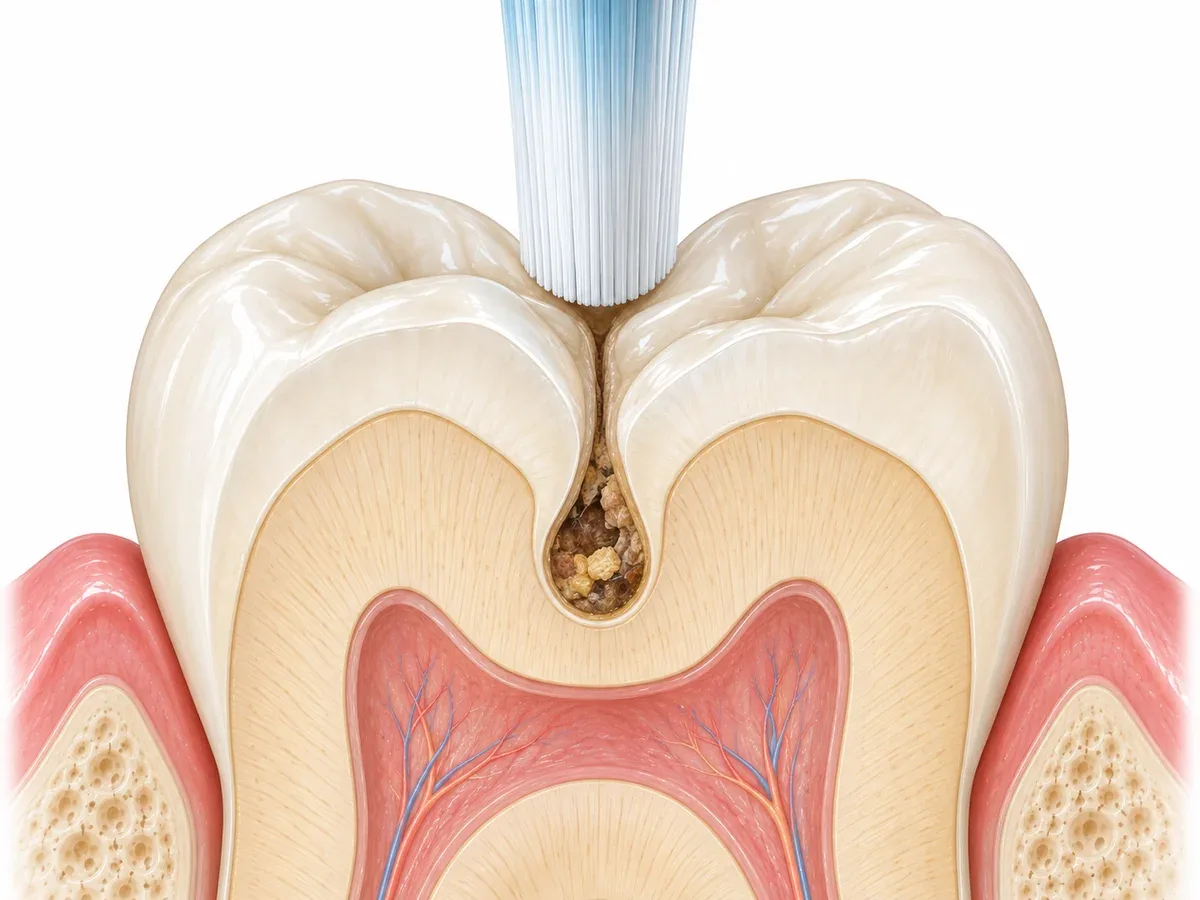
The material gives two reasons. First, the grooves are deep and narrow, so food and bacteria get trapped and are hard to clean out.
Second, the enamel there is thinner than elsewhere, so decay moves faster. That is why the material says most decay in adult teeth starts in these grooves.
The oral disease prevention page adds an age pattern. In children and teenagers, decay tends to start on the chewing surfaces of back teeth. In adults, it tends to start between teeth.
During elementary and middle school, as the back teeth settle in, decay forms easily in these grooves. It can spread inside the tooth quickly, and the right time for treatment can be missed.
The page also cites a 2022 survey. Among 12-year-olds with all adult teeth in place, 58.4% had already had decay treated or had decay.
What is a sealant, and how is it placed in Busan?
First, a note on words. The material explains that "pit and fissure sealant" and "sealant" are names for the material. The procedure that uses it is called sealing the grooves.
In everyday speech, "getting a sealant" names the treatment after its material. Either way, the goal is the same: to make a groove that cannot be brushed into a surface that can.
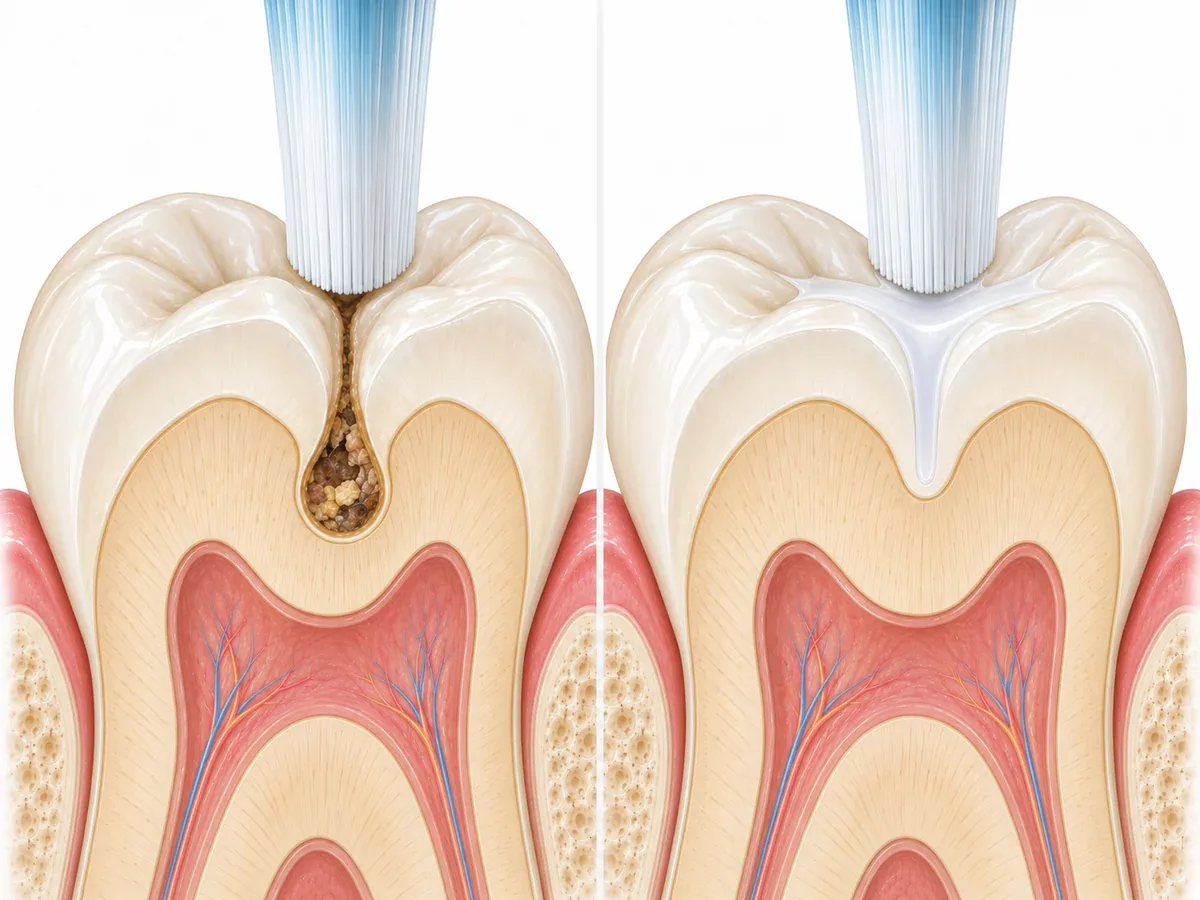
The procedure is simple, but the material says each step strongly affects success, so care is needed. It has four stages: isolating the tooth, cleaning, etching and applying the material, then checking the bite.

The material stresses the first step most. Keeping the area free of contamination is the key factor in whether a sealant succeeds.
The ideal method is a rubber dam, a thin rubber sheet with a hole that exposes the one tooth being treated. The steps then follow in order.
| Step | What is done | Detail from the material |
|---|---|---|
| 1. Isolation | The tooth is kept away from saliva | Ideally with a rubber dam |
| 2. Cleaning | Debris is removed from the grooves | A clean surface helps the material bond |
| 3. Etching | 30–40% phosphoric acid is applied | For 20–30 seconds, then rinsed with running water for 10 seconds or more |
| 4. Drying | The surface is dried well | Leftover moisture stops the material from flowing in |
| 5. Applying and curing | A thin layer is applied and hardened with light | Light-cured for 10–20 seconds |
| 6. Bite check | The bite is checked for any high spot | Adjusted if something touches first |
Etching makes the surface very slightly rough so the material holds better. If moisture remains after rinsing, the material cannot flow into the groove properly.
When should a child get a sealant?
The material opens with a clear point. Placing a sealant very early does not increase the protection, and wrong timing can even backfire.
It explains why. The material is sensitive to moisture, so a tooth that has not fully come in cannot be kept dry, and the result lasts less well.
If material spills under a partly erupted tooth, food and plaque can collect there. This can raise the risk of decay. So it is better to wait until the tooth is well through the gum.
The first tooth to seal is usually the first adult molar, which comes in around age six. Other teeth may also be sealed, depending on the case:
- the chewing surfaces of second molars, which are hard to brush
- premolars with clear grooves
- adult front teeth with deep grooves on the inner side
- baby molars
The oral disease prevention page advises sealing as soon as the back teeth are seen to have come in. It encourages active treatment from about age five.
Why young? When a tooth first comes in, its grooves are deepest and its cusps highest. With years of chewing, they wear down and become much flatter by adulthood.
Groove depth and shape differ from person to person because they are inborn. The dentist judges them by looking and by feeling with a fine probe. Decay activity, fluoride toothpaste use and oral hygiene are considered as well.
Some adults with deep, narrow grooves and a high risk of decay can also benefit, the material adds.
When is a sealant not recommended?
The material lists cases where sealing is not done. They are summarized in the table below.
| Situation | What the material advises |
|---|---|
| The groove already has decay | Remove the decay and fill it with composite resin; a sealant can then be placed |
| Decay between teeth | A sealant is not placed on its own, even if the chewing surface is sound |
| The tooth is still coming in | Teach brushing and wait until the tooth is well through before sealing |
| Shallow or worn-flat grooves | Decay is unlikely; brushing lessons and regular check-ups can be enough |
The material names one situation as especially undesirable. That is placing a sealant over decay that is already there.
Once covered, decay underneath is hard to spot early. If it is found late, treatment can become complicated.
The procedure looks simple, the material concludes, but it must always be done carefully and precisely. That is why the decision is made after an examination.
How is a sealant different from fluoride?
The two are not rivals. They cover different places.
The KDCA fluoride page says fluoride enters the enamel and stabilizes its crystal structure. This makes the tooth more resistant to acid made by bacteria, strengthening the whole surface.
The sealant page is clear about the limits. Fluoride works well on flat tooth surfaces, but its structure-based effect drops in deep, narrow grooves. Sealants were developed to make up for this.

| Treatment | What it does | Where it mainly acts |
|---|---|---|
| Fluoride application | Stabilizes enamel crystals to raise resistance to acid | Flat tooth surfaces in general; repeated every 3–6 months |
| Sealant | Fills deep, narrow grooves to make a cleanable surface | Pits and fissures on chewing surfaces; one application lasts a long time |
So a child who has had fluoride applied may still need sealants. The two treatments do different jobs.
The material also describes two main materials used for sealing:
- Glass ionomer cement releases fluoride and is less sensitive to moisture, which makes it easier to use in children. It bonds less strongly, though, and comes off more easily.
- Composite resin is widely used, but keeping the tooth dry is important with it.
An opaque white color is often chosen. It lets the dentist easily see where the material was placed and whether any of it has come off at a later visit.
What happens if a sealant comes off?
The material says sealed teeth should be checked regularly. The dentist looks at the sealant and feels it with a probe, checking for bubbles and a smooth, even surface.
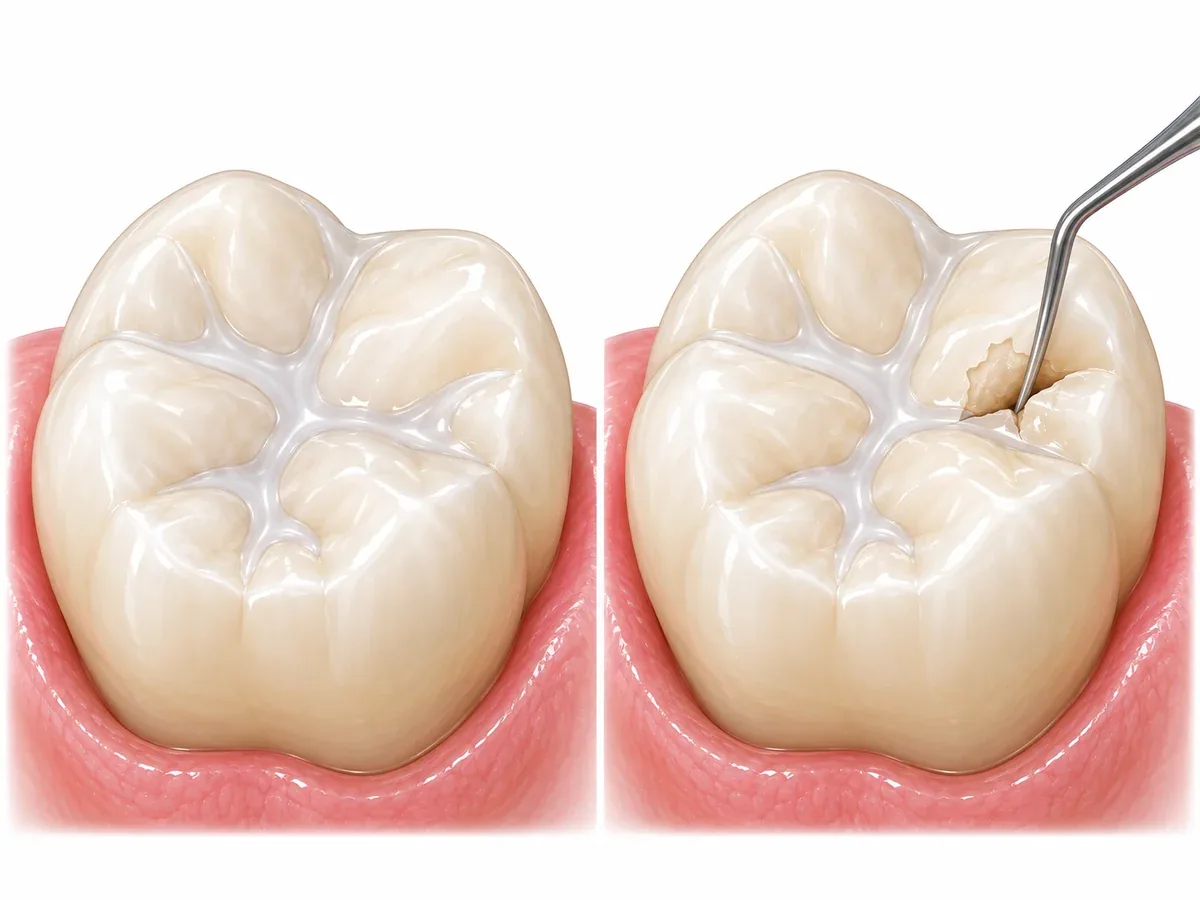
If part of it has come off, the material describes how it is redone:
- What remains of the old material is removed with a small round instrument.
- The enamel is cleaned down to an area with no decay or staining.
- The groove is sealed again using the same steps as before.
In effect, it starts over. The material also warns that a poor bond can cause microleakage, a tiny gap at the edge. An uneven surface can make decay harder to control.
So "we sealed it, so we are done" is not the right mindset. Checking at every regular visit is half of this treatment.
Health insurance in Korea
For children enrolled in Korean national health insurance, the material notes coverage since 2013 for sealants on first and second adult molars up to age 18. The patient's share was lowered further from 2017.
Daily care still matters
A sealant covers the grooves on the chewing surface, nothing more. Remember that in adulthood, decay tends to start between teeth. The basics from the oral disease prevention page still apply:
- brush at least twice a day with fluoride toothpaste for two minutes or more, checking in a mirror
- clean between teeth with floss, where a toothbrush cannot reach
- cut down both the amount and frequency of sugary snacks
- have check-ups every year if there is no disease, or every six months after recent treatment
Frequently asked questions
Why treat a tooth that has no decay?
A sealant does not drill into a tooth to fill it. It fills a natural groove so it can be cleaned. The material describes good preventive care as treatment that uses a minimal procedure and lasts a long time, and names the sealant as an example.
Will the white material show when my child smiles?
The material's answer is simple. Sealants are mostly placed on back molars, far inside the mouth. Because the mouth is deep and dark there, they are hard to see even with the mouth wide open.
How long does a sealant last?
The material says one application lasts a long time. It also says sealed teeth should be checked regularly and resealed if any part has come off, so it is something to check at each visit.
Can my child get a sealant with English support in Busan?
Yes. We offer 1:1 English interpretation from the first consultation through the end of treatment. The clinic is near Seomyeon Station Exit 2 (5-min walk), opposite Lotte Hotel Busan, and you can call 010-8555-2854 (+82-10-8555-2854 from abroad).
A sealant does not repair a tooth.
It makes a place that cannot be cleaned into one that can.
As the material says, the timing has to be right,
and it is not placed over decay.
That is why the decision is made at a check-up.
If your child's back teeth have just come in, now is a good time to check. For families in Busan, Reset Dental Clinic offers 1:1 English interpretation from your first consultation through the end of treatment. Call 010-8555-2854 to ask whether a sealant is right for your child now.
References
- KDCA National Health Information Portal, "Pit and Fissure Sealants" — pit and fissure decay as the most common type, deep narrow grooves and thin enamel, the definition of sealing and the difference between the material and the procedure, fluoride's weaker effect in deep grooves, why sealing too early backfires and starting with first molars, cases where sealants are not placed, rubber dam isolation and cleaning, 30–40% phosphoric acid etching for 20–30 seconds and rinsing for 10 seconds or more, 10–20 seconds of light curing and bite adjustment, glass ionomer versus composite resin, resealing when it comes off, and national health insurance for first and second molars up to age 18 from 2013
- KDCA National Health Information Portal, "Tooth Decay (Dental Caries)" — decay as teeth dissolving in acid made by bacteria from sugar, symptoms by depth from enamel to dentin to nerve, sealants recommended when adult teeth come in, and the expansion of insurance coverage for sealants on sound first and second molars from October 1, 2012
- KDCA National Health Information Portal, "How to Prevent and Manage Oral Disease" — decay on chewing surfaces in children and teenagers and between teeth in adults, fast decay in these grooves during school years, sealing as soon as back teeth come in and active treatment from age five, the 2022 survey finding 58.4% of 12-year-olds with treated or current decay, brushing at least twice a day with fluoride toothpaste for two minutes, floss, fewer sugary snacks, and check-up intervals
- KDCA National Health Information Portal, "Fluoride Application" — how fluoride ions enter enamel and stabilize its crystal structure against acid, demineralization and remineralization, professional versus home fluoride application, and repeat application every 3–6 months as applied fluoride fades
Written by Reset Dental Clinic Support Team
Medical review Dr. Kim Hyun-joo, Head Dentist · Esthetic Restorations
Last updated: September 19, 2026
This column is for general information and does not replace diagnosis or treatment for individual patients. If you have symptoms, please see a dentist.


