

- Gums are not the background for veneers but the foundation. The first pre-treatment check in the public guide is oral hygiene and gum disease.
- Inflammation limited to the gums can return to normal tissue with tartar removal alone. Once bone is involved, it is different.
- When swollen gums settle, the gum line moves. That is why we do not change the order.
- The guide advises a check once a year without gum disease, and every 3–6 months with a history of it.
Some patients at our clinic in Seomyeon, Busan have been told their gums are not in great shape, yet still want veneers on their front teeth. Our answer is not a no but an order. For patients living in or visiting Korea, we provide 1:1 English interpretation from the first consultation through the end of treatment.
This column draws on the Korea Disease Control and Prevention Agency (KDCA) guides on gum disease, systemic disease and gum treatment, laminate veneers and all-ceramic crowns. It explains why the gums come first, and what needs to happen before veneers.
Why do we check the gums before veneers?
The result of front-tooth treatment does not depend on the teeth alone. What people see when you smile is the teeth and gums together.
Even with good color and shape, veneers can look slightly off if the line of the gum edges is uneven from side to side.
The same holds for function. The all-ceramic crown guide lists what to check before treatment, and the first line is oral hygiene and a gum disease exam.
In other words, the guide already tells us to look at the gums before making anything. Gum color matters too: the gum disease guide describes color change as a sign of inflammation.
If the color comes from inflammation, treatment changes it. If not, another cause has to be checked, and either way it is separate from treating the teeth.
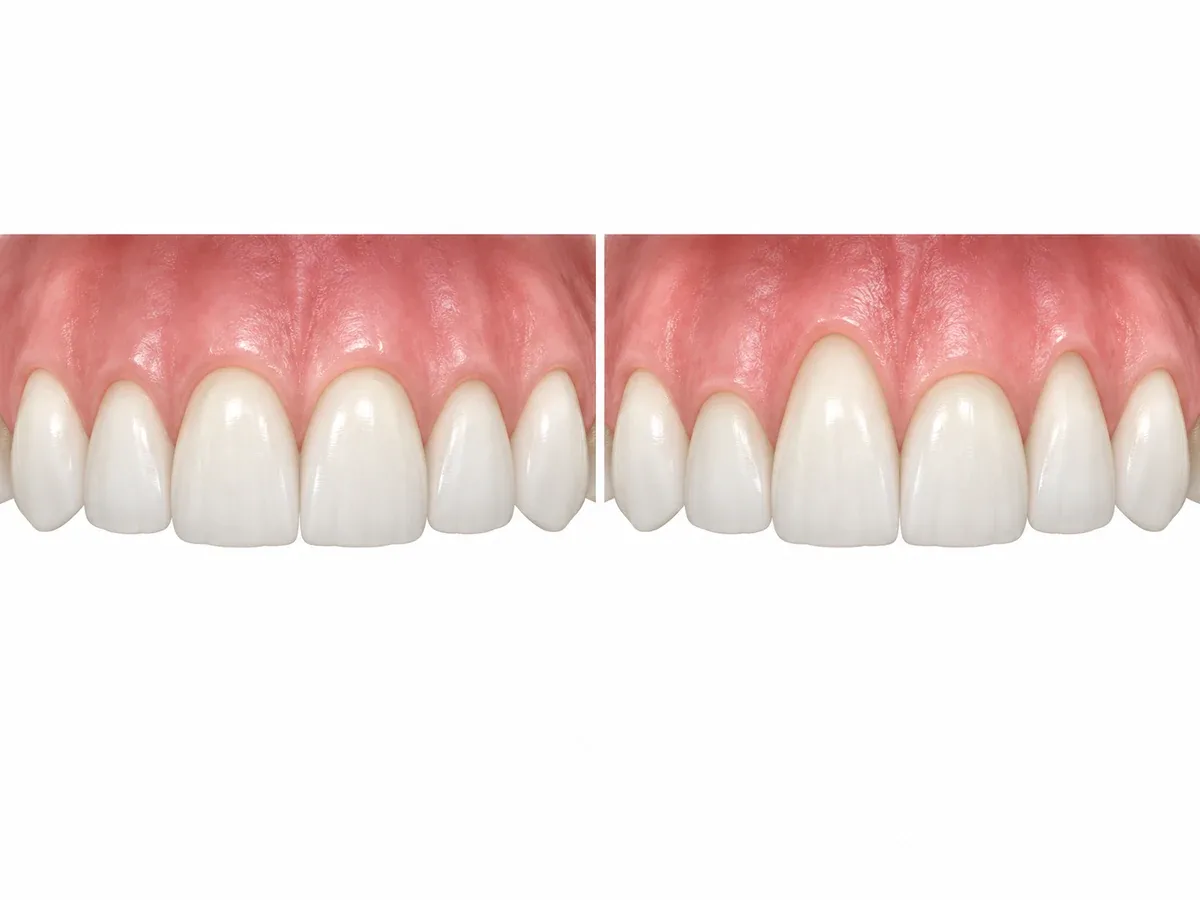
What stage are your gums at?
"Bad gums" can mean two very different conditions. The gum disease guide separates them clearly.
| Stage | Where the inflammation is | What the guides say |
|---|---|---|
| Gingivitis | In the soft gum tissue alone | Can return to normal tissue with tartar removal alone |
| Periodontitis | Has spread to the bone that holds the teeth | Damage with bone loss often remains even after inflammation clears |
This matters because recovery differs. For gingivitis, the guide says removing tartar alone can return the gums to normal tissue.
For periodontitis, the systemic disease guide says damage with bone loss often remains, even after the inflammation clears. It also gives a prognosis marker: when bone height is half the root length or less, extraction later becomes likely.
So it is better to confirm with measurements than to rely on a vague feeling that your gums are bad. The guide describes these checks:
- X-rays to see how much the bone has changed
- a periodontal probe to measure pocket depth
- the amount of gum recession
- the degree of bleeding
Having gum problems does not rule out veneers. The guides show that what needs doing depends on the stage, and inflammation limited to the gums can recover.
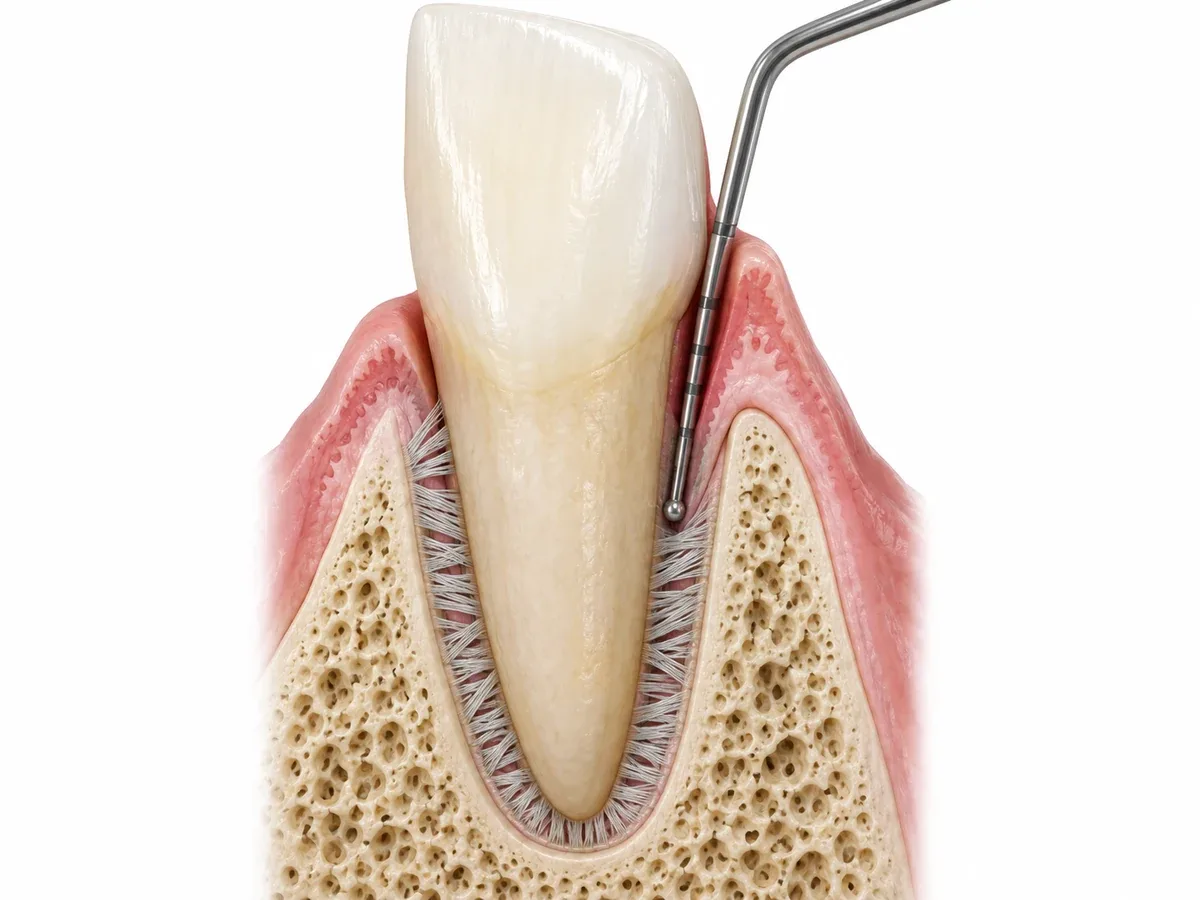
Why does the gum line matter so much for veneers?
This is the most practical reason we never change the order. Inflamed gums are swollen, and swollen gums sit higher on the tooth, so teeth look shorter than they are.
After gum treatment, the swelling goes down and the gum edge settles into place. Then the visible length of each tooth changes.
We see this change every time. If length and shape are set while the gums are swollen, the proportions look off once the gums settle.
So we wait for the gums to stabilize before deciding the shape. It may feel slow, but keeping this order gives a better result.
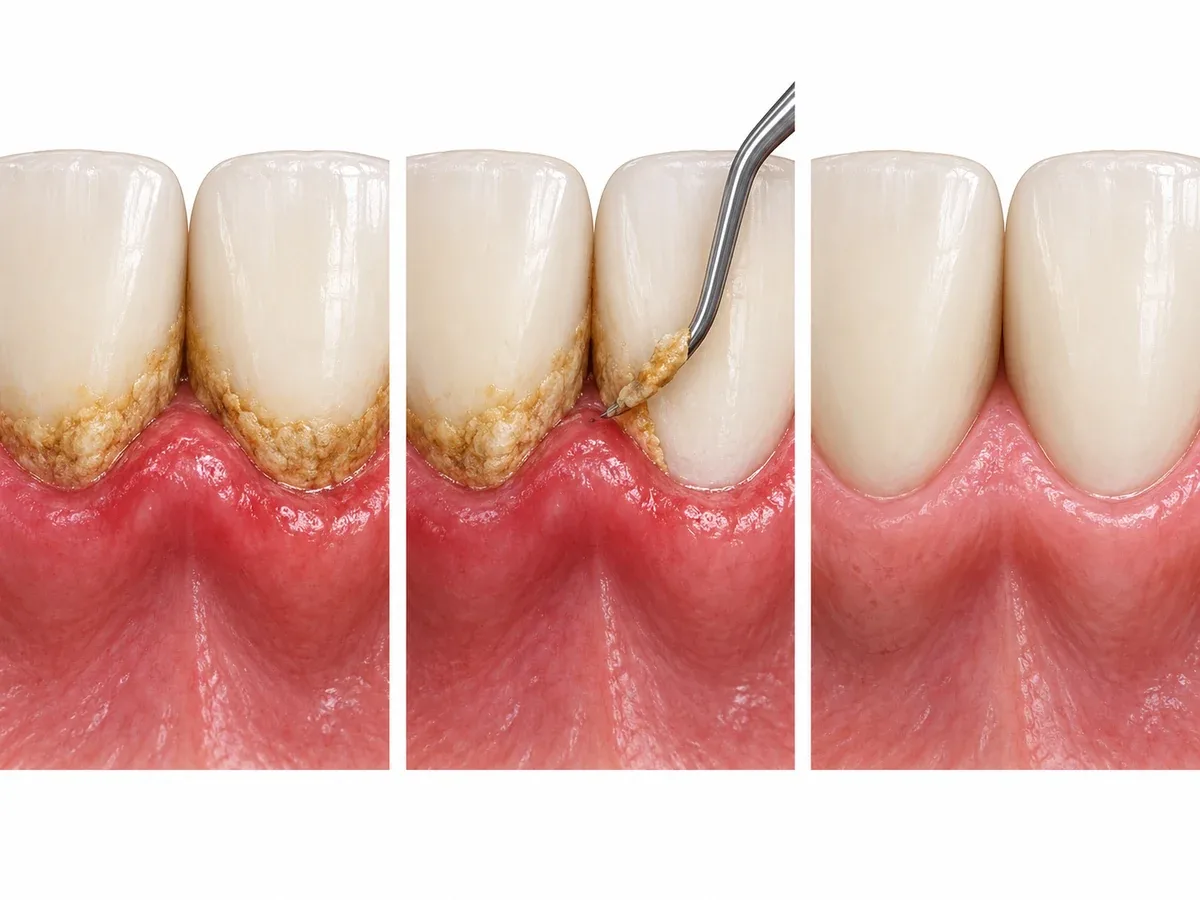
The laminate guide describes veneers as thin shells of about 0.5–1.0 mm, bonded after minimal reduction. The edge of each shell has to end somewhere on the tooth, and on front teeth that is usually close to the gum edge.
So the gums help decide the result. Inflamed gums bleed and swell easily at that spot.
We do not bond veneers while blood or fluid is seeping there, because bonding needs a clean, dry surface. This is our own clinical standard, not a figure from the guides.
Gum treatment does not in itself mean existing veneers must be redone. Sometimes, though, the edge becomes visible as the gums settle, and we decide based on how much shows.

Which gum problems need treatment first?
Here is what the guides say, together with what we see in our clinic.
| Condition | Why it comes first |
|---|---|
| Bleeding when brushing | A typical sign of gum disease; heavy bleeding does not mean severe disease, and scaling may well resolve it |
| Swollen, lifted gum edges | The gum line moves once swelling goes down, so the shape must be set again |
| Deep pockets | Pocket depth and recession are used to judge severity |
| Major bone loss | With half the root or less supported, extraction is likely; the tooth's future comes first |
| Uncontrolled diabetes | The two diseases affect each other, and poor sugar control can worsen periodontitis |
| Smoking | Current smokers have a poorer outlook and gum treatment works less well |
Bleeding is the sign people notice most. The guide treats it as a typical signal, yet says heavy bleeding does not mean the disease is severe.
Diabetes and smoking are also on the list. The guide says diabetes and gum disease affect each other, and that current smokers respond less well to gum treatment than those who quit or never smoked.
Hormones play a part too. The gum disease guide explains that hormonal changes can inflame the gums, including:
- puberty
- menstruation
- pregnancy
- diabetes
If your gums swell easily during pregnancy, put gum care first. It is better to discuss esthetic treatment once things are stable.
How long do you wait before starting veneers in Busan?
This is the question we hear most. First, the guides give no figure in days or weeks. So instead of inventing a number, we explain what must be finished before moving on.
The gum disease guide describes treatment in stages. Which stage you need is decided by the exam:
- Scaling removes plaque and tartar.
- If that is not enough, root planing smooths the root surfaces below the gum.
- If problems remain, flap surgery opens the gum to clean inside.
| Treatment needed | What we check before the next step |
|---|---|
| Tartar removal is enough | Whether the swelling has gone and the gum edge has settled into place |
| Cleaning below the gum | Whether bleeding on brushing has calmed, and whether pocket depth has changed on re-measuring |
| Flap surgery | The healed gum edge sits in a new place; shape is set after it stabilizes |
| Major bone loss | Whether the tooth can be kept is decided first |
That is why we do not book a start date first. We book a review date first.
On that day, we see how far your gums have recovered and plan the next step from there. For patients visiting Korea for a limited time, this review is worth planning into your stay.
What about the dark triangle left after gum recession?
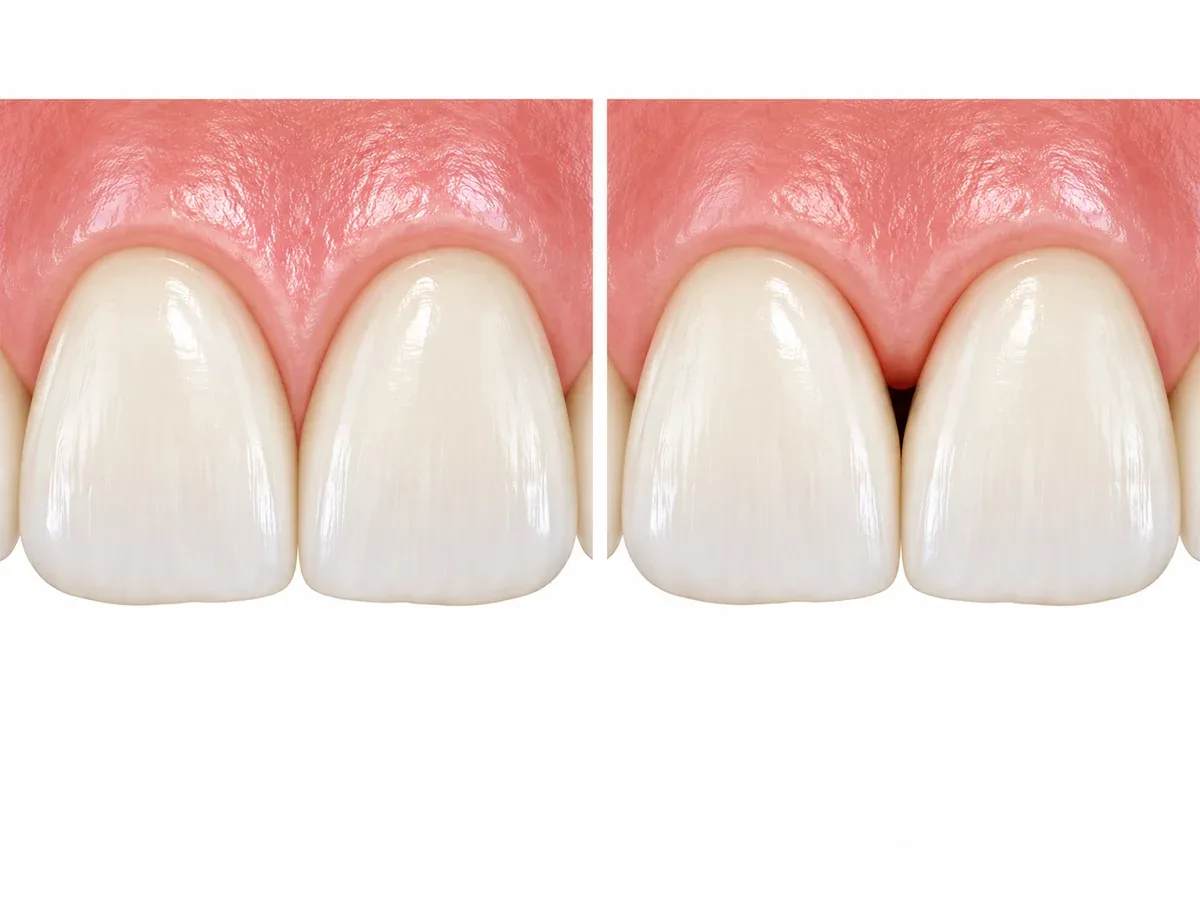
Keeping the order changes one more thing. If veneers are shaped while the gums have receded, a dark triangular gap can remain low between the teeth.
The space below the point where two teeth meet is normally filled with gum. That gum rests on the height of the bone beneath it.
The gum disease guide describes gums receding so teeth look longer. When the supporting height drops, the gum above it drops too, and the empty space looks dark because light passes behind it.
Two situations need telling apart here. In one, swollen gums settle and reveal a gap that was always there. In the other, bone has dropped and the gum has followed.
The systemic disease guide says damage with bone loss often remains even after inflammation clears. The first is part of healing; the second is a lasting condition.
So we do not treat this gap as something to fill with material. Widening the veneers to cover it can hide the gap, but the area underneath becomes hard for a brush or floss to reach.
We first check the size of the gap and the bone height. Then we decide together how far to widen the shape, or whether to leave it. This is our clinical judgment, not a figure from the guides.
How do you care for gums and veneers afterwards?
Gum care is not just for before treatment. The guides recommend these intervals.
| Your situation | Recommended interval |
|---|---|
| No gum disease | Tartar removal once a year |
| Past gum disease, or maintenance after treatment | A check every 3–6 months |
The guides are clear about tools as well. Because gum disease usually starts between the teeth, they give this advice:
- Use floss or an interdental brush at least once a day.
- Treat mouthwash as a supporting aid, not a replacement.
- Brush with the bristles against the gums, starting where tooth and gum meet.
The method is the same even with veneers on your front teeth. It is inflammation, not the tools, that makes gums recede.
Forcing in an interdental brush that is too big can press on the gums, so we help you choose the right size at first. The laminate guide also notes that ultrasonic scalers may damage porcelain, so mention your veneers before scaling.
With veneers, take care when removing floss rather than inserting it. Pulling straight up puts force on the edge near the gum, so slide it out sideways instead; this is our routine advice, not a line from the guides.
If floss catches at the edge, have it checked. It may signal a step at the edge or a change there, and the guide lists edge discoloration and debonding among complications.
Frequently asked questions
Will receded gums come back after treatment?
Swollen gums settling is different from gums dropping after bone loss. The guide says damage with bone loss often remains even after inflammation clears. So it is worth checking your current condition first.
My gums are swollen and bleed. Can't we just go ahead with veneers?
We do not recommend it. Once the swelling goes down, the gum line moves and the shape and length look off. Changing the order means making the result twice.
Why do my teeth look further apart after scaling?
The scaling guide explains that a loose feeling afterwards is swollen gums settling naturally, and that wider-looking gaps are normal. Sensitivity usually fades within a few weeks. The gap is not new but was hidden, and any plan starts from that settled state.
Can I get veneers with English support in Busan?
Yes, Reset Dental Clinic offers 1:1 English interpretation from the first consultation through the end of treatment. We are near Seomyeon Station Exit 2 (5-min walk), opposite Lotte Hotel Busan. Call 010-8555-2854, or +82-10-8555-2854 from abroad.
Gums are not the background of your teeth.
They are the ground your teeth stand on.
Swollen gums move as they settle.
Shape and length are set
once that position is fixed.
Start by checking pocket depth
and bone height.
Keeping the order means not making it twice.
If you are considering veneers in Busan, Reset Dental Clinic provides 1:1 English interpretation throughout. Call 010-8555-2854 to book a consultation.
References
- KDCA National Health Information Portal, "Gum Disease (Periodontal Disease)" — plaque and tartar as causes; gingivitis versus periodontitis; gingivitis can return to normal with tartar removal; symptoms including bleeding, looseness, sensitivity, swelling and color change; receding gums making teeth look longer; hormonal and drug-related gum inflammation; risk factors such as obesity, smoking, diabetes and psychosocial factors; brushing method and 3–6-month checks; scaling, root planing and flap surgery
- KDCA National Health Information Portal, "Systemic Disease and Periodontal Treatment" — damage with bone loss often remains after inflammation clears; extraction likely when bone height is half the root or less; probing pocket depth, recession and bleeding to judge severity; diabetes and gum disease affect each other; poorer outcomes in current smokers; scaling once a year, or every 3–6 months for maintenance; floss or interdental brushes at least daily, with mouthwash as a supporting aid
- KDCA National Health Information Portal, "Laminate Treatment" — thin 0.5–1.0 mm shells bonded after minimal reduction; indications such as gaps, discoloration and mild misalignment; complications including debonding, fracture, edge discoloration and sensitivity; telling the team before ultrasonic scaling
- KDCA National Health Information Portal, "All-Ceramic Crowns" — pre-treatment checks starting with oral hygiene and gum disease, plus bite, opposing teeth, pulp vitality, X-rays, diagnostic models and photos; proper brushing and regular scaling after treatment
- KDCA National Health Information Portal, "Tartar Removal (Scaling)" — the basic treatment for plaque and tartar; shorter intervals with gum disease; sensitivity fading within weeks, and a loose feeling and wider-looking gaps after scaling as a normal part of swollen gums settling
Written by Reset Dental Clinic Support Team
Medical review Dr. Kim Hyun-joo, Head Dentist · Esthetic Restorations
Last updated: September 19, 2026
This column is for general information and does not replace diagnosis or treatment for individual patients. If you have symptoms, please see a dentist.


