

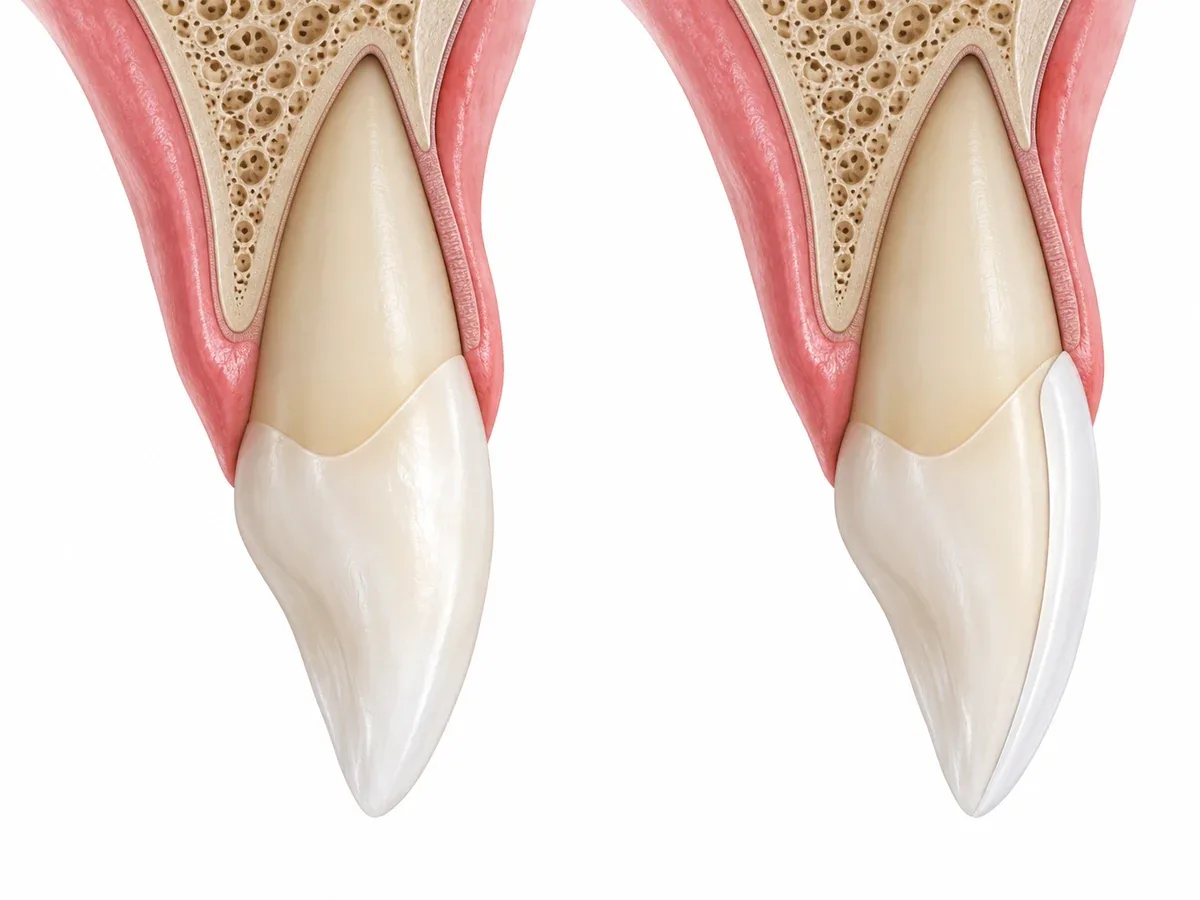
- Veneers (laminates) are thin shells, about 0.5–1.0 mm thick, bonded after minimal trimming of the upper front teeth.
- The source lists six suitable cases, from gaps and discoloration to chipped edges.
- For teeth severely out of position, it recommends crowns or orthodontics instead.
- A model comes first, to choose between a veneer and a crown and to reduce trimming.
"I don't like my front teeth" can mean many different worries, so the question "Should I get veneers?" has no single answer. At Reset Dental Clinic in Seomyeon, Busan, we talk it through with 1:1 English interpretation from the first consultation to the end of treatment.
Some people dislike the color. Others notice a gap, a tooth that looks crooked, or teeth that look too small. They all say the same sentence.
The KDCA National Health Information Portal page on laminate (veneer) treatment separates the cases that suit veneers from the difficult ones. We follow its criteria as written.
What do veneers actually do?
Let us start with the source's definition. Veneer treatment is a prosthetic procedure done mainly for appearance.
The enamel surface of the upper front teeth is trimmed minimally. Then a thin, tooth-colored shell is bonded with resin adhesive, much like attaching an artificial nail. The thickness is given as about 0.5–1.0 mm.
This one definition holds three conditions.
- The purpose is appearance.
- The trimming is limited to the surface.
- What is bonded is a thin shell.
Whether these three fit the situation of your own teeth is what this column is about.
The source also gives a short history. The idea began in the 1930s, when thin facings were briefly attached to actors' teeth with denture adhesive before filming.
In the 1970s, resin versions came into clinical use, but they wore down and stained easily. After the 1980s, etching the inner surface of porcelain to strengthen the bond became known, and porcelain veneers were introduced.
Today, the source says, the term usually refers to these porcelain shells.
Which six cases do the sources list for veneers?
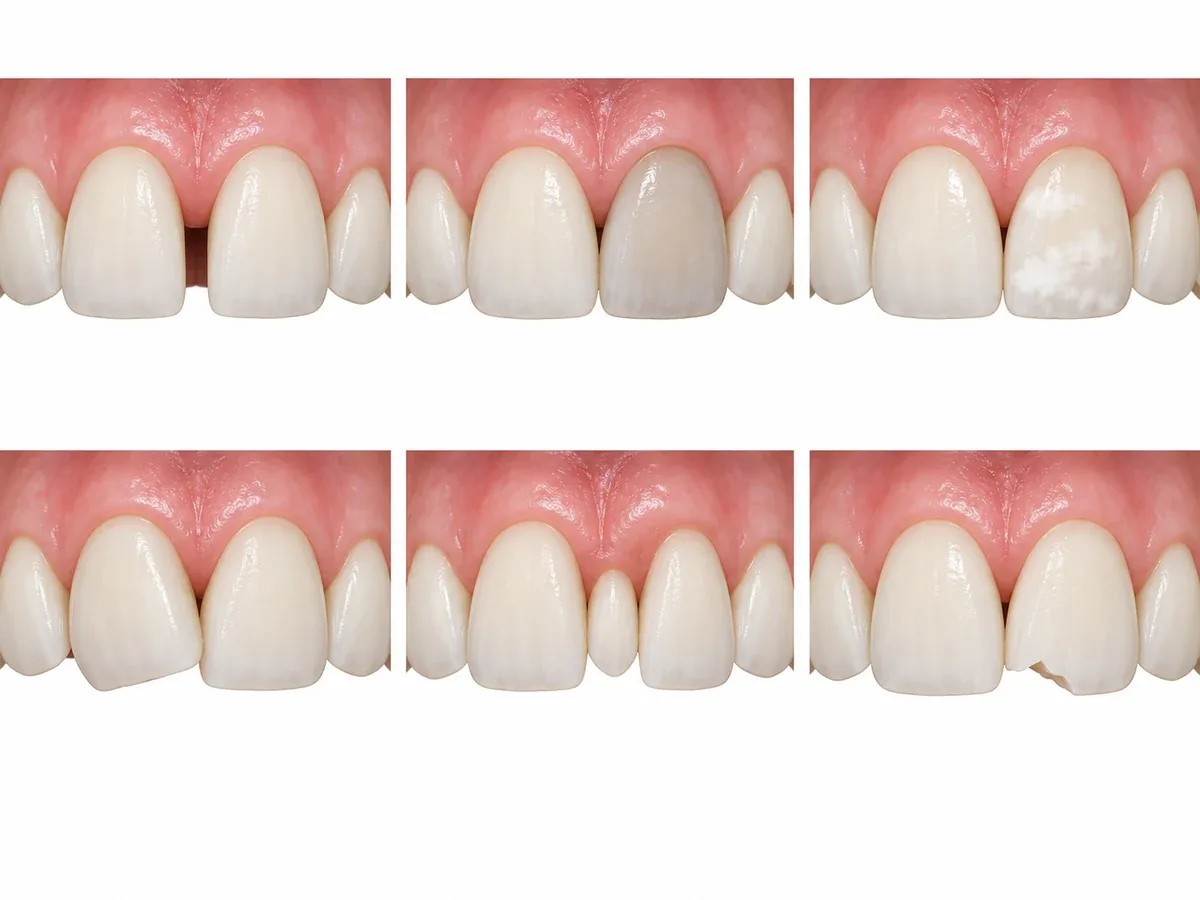
Under the heading of indications, the source lists six numbered cases. We translate them without shortening.
| Case | What the source says |
|---|---|
| Gaps between teeth | Spaces between teeth can be closed with this treatment |
| Discoloration | Teeth discolored by inborn or acquired causes can look much better |
| Small areas of decay | Can be considered for partial demineralization or decay in a small area of the outer surface |
| Mild position problems | Can be considered for teeth that are rotated or stick out from the normal line |
| Inborn shape problems | The shape of small, oddly shaped teeth (microdontia) can be improved |
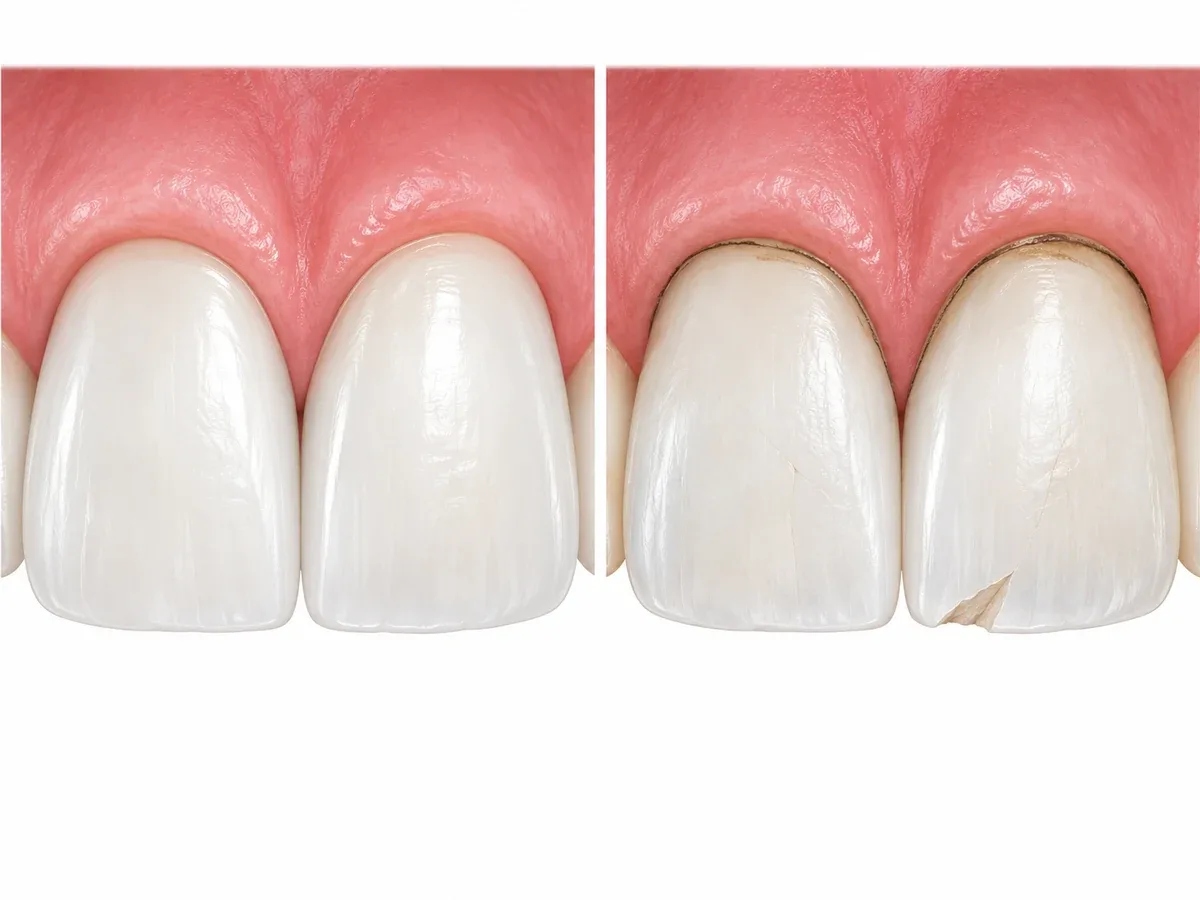
| Chipped teeth | Can be considered when the edge of a tooth is chipped, for example by an outside impact |
Put the six side by side and one thing stands out. They are all problems that can be solved on the front surface of the tooth.
The color sits on the front surface, and the gap sits at its sides. Missing width and length also show on the front. Because the treatment works on the front surface, it fits problems that end there.
The phrase "can be considered" is worth noticing too. The source never says any of the six must be treated this way. It means a tooth is a candidate, not that this treatment is automatic.
Take decay as an example. The source lists partial demineralization or decay in a small area of the outer surface. Wide or deep decay does not fit here, because covering a problem is different from cleaning it out and filling it.
Where do the sources draw the line on veneers?
The fourth case comes with a condition. Right after saying rotated or protruding teeth can be considered, the source adds a sentence.
When teeth are severely out of position, it recommends metal-ceramic or all-ceramic crowns, or orthodontics, rather than veneers.
This line is the most important point in this column. There is a boundary between "mild" and "severe." Past that boundary, the source itself says to turn to a different treatment.
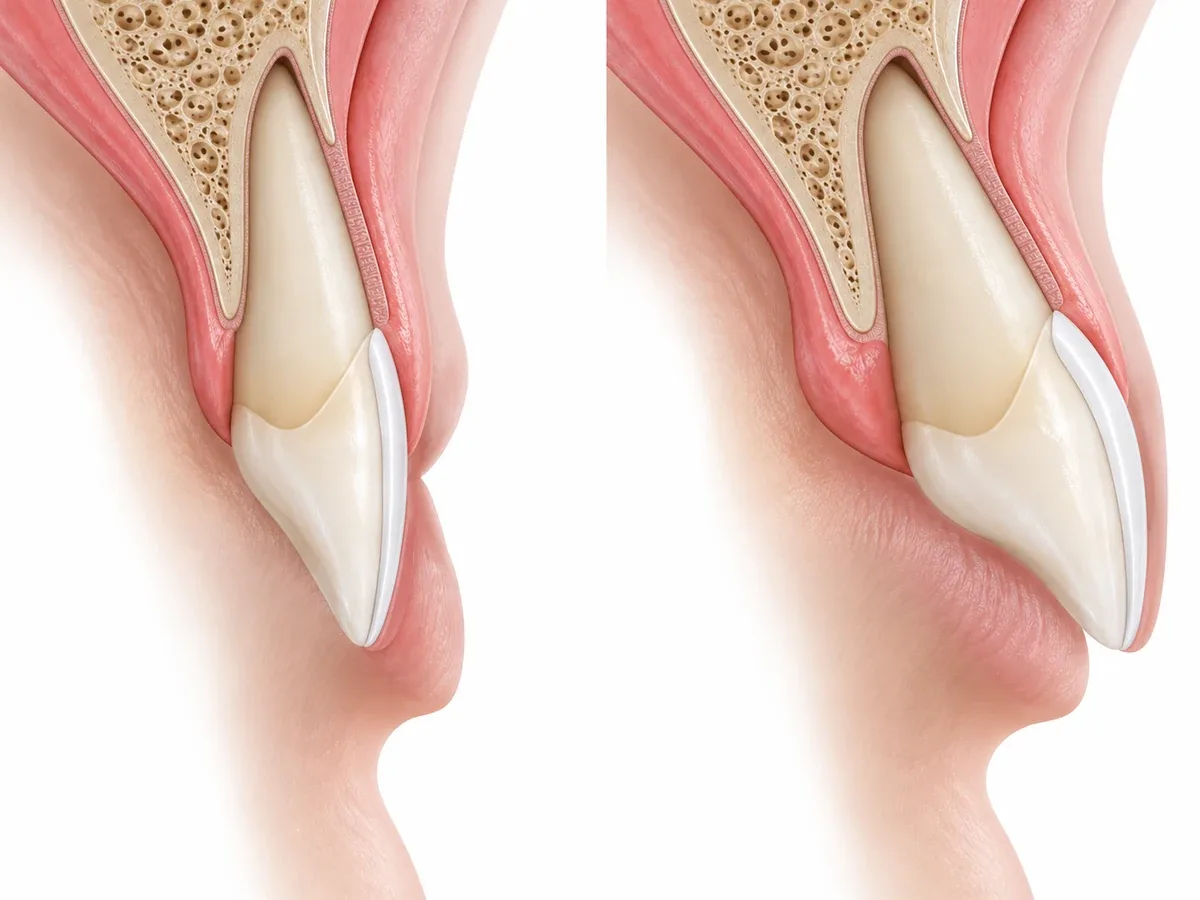
The reason lies in thickness. The shells are thin, about 0.5–1.0 mm thick.
For a tooth set back from the line, that thickness can fill the missing space. But for a tooth that already sticks out, there is no way to bring it back.
The source's summary says the same thing. This treatment can improve appearance, but it may be difficult depending on the position and alignment of the tooth.
There is a line on strength as well. The shells attach to part of the tooth rather than covering all of it, so they are relatively weaker than other restorations. Harmful forces can make them come off.
That is why the source separately advises against chewing hard foods with treated teeth.
In the treatment room, we explain this point plainly. If any of the following applies to you, we need to talk about it first.
- Your front teeth already take a lot of force.
- You often clench your teeth.
- You bite things off with your front teeth.
Their thinness works both ways. It is a strength and a weakness at the same time.
When should orthodontics come first instead of veneers?
Orthodontics is one of the three alternatives the source lists. We make this judgment often in the treatment room.
Orthodontics changes the position of the teeth you have. Veneers change how the teeth look.
If the problem is position but you change the appearance, the teeth may look nicer while the bite stays the same. If the problem is color or shape but you change position alone, the teeth line up yet the worry remains.
That is why the first step is to work out what is actually out of place.
We are especially careful with younger patients. Trimming a tooth cannot be undone, and they have many years ahead with that tooth.
So if orthodontics can solve the problem, we suggest orthodontics. Still, orthodontics moves teeth without changing their shape, size or color. When width is missing or shape is different, orthodontics alone will not finish the job.
Sometimes the two are combined. Orthodontics sets the position, and the remaining space is filled with width, which means less trimming and a more natural result.
Either way, avoid choosing the method first and then fitting the diagnosis to it.
| Where the problem is | What the source suggests |
|---|---|
| Color, small gaps, small or chipped teeth | Veneers can be considered |
| Mild rotation or protrusion | Veneers can be considered |
| Severe position problems | Crowns or orthodontics rather than veneers |
| Position plus missing width | Orthodontics first, then fill the remaining width |
How does veneer treatment work at our clinic in Busan?
Before describing the procedure, the source has a separate section on preparation. It is about making a diagnostic model.
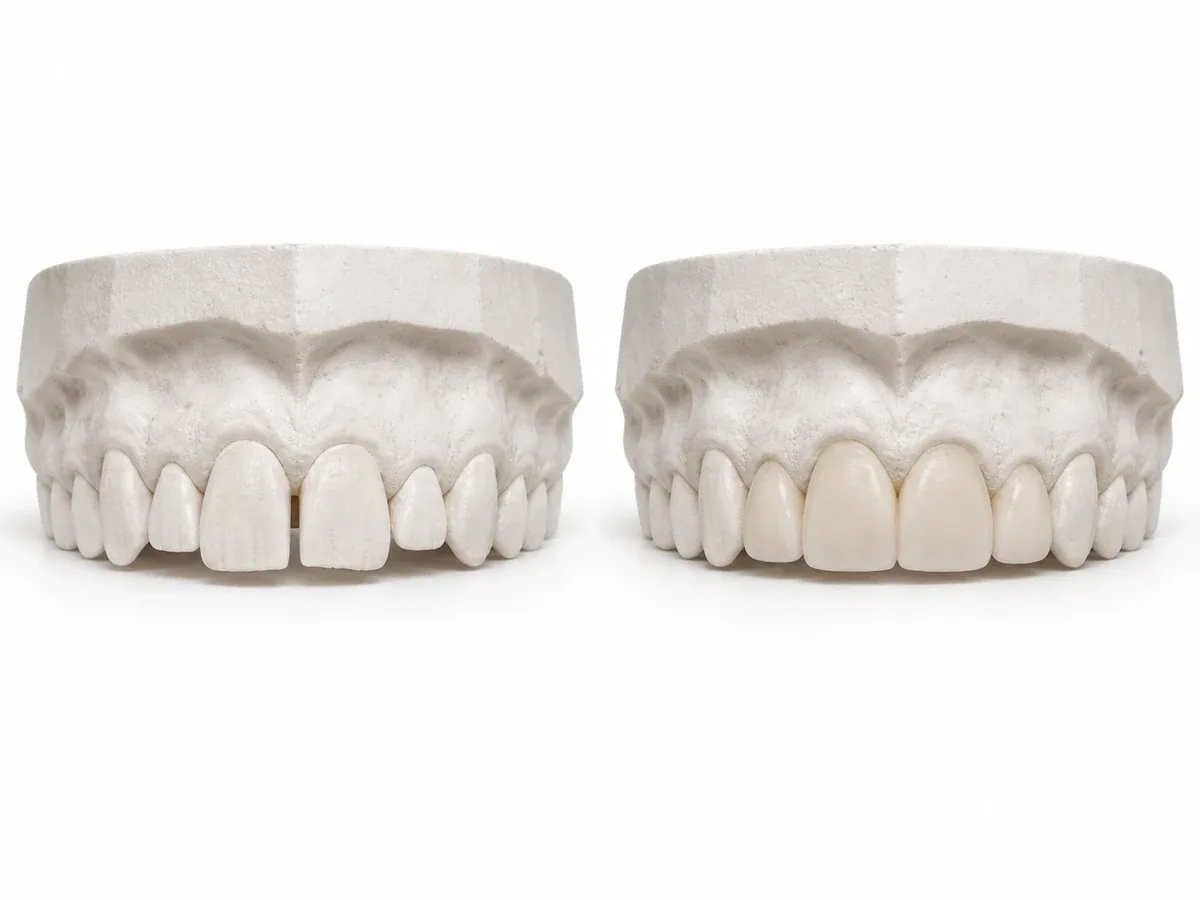
Before treatment, a diagnostic model is made to understand the patient's current state and wishes, and to picture the final result. The source calls this step essential when a large area is treated.
The model helps decide whether veneers are possible or whether a crown is needed. It also lets the dentist predict how much tooth to trim, which helps avoid unnecessary trimming.
Patients can also see the expected result in advance, which helps with the decision.
This short passage ties everything above together. Here the choice between veneers and a crown is made, trimming is reduced, and you see the result before it happens.
If you are not sure what to ask at a consultation, we suggest one question. Ask whether the result can be made on a model of your teeth first.
The same applies if you want to close a gap and wonder whether all six front teeth need veneers. The number is never set first. The width ratio between front teeth affects how they look, so we check it on the model before deciding.
The source then lists the treatment steps in order.
- The teeth are trimmed as much as needed.
- An impression of the trimmed teeth, nearby teeth and gums is taken with precise material.
- Temporary teeth are made and placed if needed.
- The shells are made in a dental lab.
- Color, shape and fit are checked, and they are bonded.
- Finally, bite adjustment smooths any spots that touch too hard.
The source says trimming can usually be done without local anesthesia. If the teeth are very sensitive, local anesthesia is used.
For short, small teeth, width and length are first built on the model and checked against the neighboring teeth. Longer front teeth change where they meet the lower teeth, so the final bite adjustment matters all the more.
What can happen after veneers are bonded?
The source lists four complications and side effects. They are veneers coming off, partial chipping, staining at the edges, and sensitivity, where teeth feel sore or sensitive.
The good news is that the source also explains how each one is handled.
| Complication | How it is handled |
|---|---|
| Veneer comes off | If the tooth has no decay, the same veneer can be bonded again |
| Small chip in the porcelain | If it barely affects looks or function, it can be smoothed and kept in use |
| Severe damage | A new veneer is the better choice when function or appearance suffers |
| Staining at the edges | Listed by the source as a possible side effect |
| Sensitivity | Listed by the source as a possible side effect |
Aftercare is also specific. The source gives these steps after veneers are bonded.
- For about 2–3 days, avoid drinks that can stain, such as cola, black tea and coffee.
- Avoid spicy or irritating foods.
- Do not chew hard foods with the treated teeth, to avoid too much biting force.
- Tell the hygienist about your veneers before scaling, because ultrasonic scalers can damage porcelain.
On lifespan, the source is careful. It first says the average lifespan is hard to state exactly, because it depends on habits, chewing patterns, tooth shape and care.
It then adds that with proper care, veneers can last around 5–10 years. This range varies a lot with oral health and the level of care, so please do not read the number on its own.
Frequently asked questions
Do I need veneers if I just want to change the color?
Not necessarily. The source lists discoloration as an indication, but it does not say color must be treated with veneers. The resin page says partial or single-tooth discoloration can be made natural with composite resin, so first check whether the color problem involves the whole tooth or one spot.
If I don't like my veneers later, can they just be removed?
The source does not treat removal lightly. It covers rebonding veneers that came off and smoothing small damage, but it describes no way to return to the original tooth. The trimmed enamel stays trimmed, and veneers are replaced over time.
I grind my teeth. Can I still get veneers?
Please tell us first. The source says veneers attach to part of the tooth, so they are relatively weaker and can come off under harmful forces. Unless biting force is planned for, the same problem tends to recur in the same place, whatever the material.
Can I get veneers with English support in Busan?
Yes, we provide 1:1 English interpretation from the first consultation to the end of treatment. The clinic is near Seomyeon Station Exit 2 (5-min walk), opposite Lotte Hotel Busan. Call 010-8555-2854 (+82-10-8555-2854 from abroad).
"Should I get veneers?"
is a question to answer by looking at your teeth.
The source lists six cases that suit veneers,
and recommends other treatment
when teeth are severely out of position.
A model made first shows
whether it will work.
That is where we start.
If you are considering veneers in Busan, Reset Dental Clinic offers 1:1 English interpretation from the first consultation to the end of treatment. Call 010-8555-2854 to book a consultation.
References
- KDCA National Health Information Portal, "Laminate Treatment" — the definition of veneers as thin shells about 0.5–1.0 mm thick bonded with resin after minimal trimming of the enamel of the upper front teeth; how porcelain veneers came about; six indications and the note recommending crowns or orthodontics for severe position problems; diagnostic models to judge suitability and trimming in advance; the treatment steps from trimming to bite adjustment; coming off, chipping, edge staining and sensitivity with how each is handled; aftercare for staining drinks, hard foods and ultrasonic scalers; and a lifespan of around 5–10 years with proper care
- KDCA National Health Information Portal, "All-Ceramic Crowns" — crowns covering the whole visible part of a damaged tooth; cosmetic indications such as closing gaps, mildly uneven alignment, discoloration and unusual shape or size; the need to trim slightly more than for metal restorations and the limit for short teeth; and a treatment period of 1–3 weeks with 1–3 visits
- KDCA National Health Information Portal, "Resin Treatment" — composite resin for partial or single-tooth discoloration; closing small gaps with composite resin on the same day; and minimal trimming of the tooth
- KDCA National Health Information Portal, "Teeth Grinding (Bruxism)" — repeated breakage of dental restorations, cracks, fractures and tooth wear as clinical signs of grinding; and occlusal splints that block the force on teeth, gums, muscles and the jaw joint
Written by Reset Dental Clinic Support Team
Medical review Dr. Kim Hyun-joo, Head Dentist · Integrated Dentistry Specialist
Last updated: September 19, 2026
This column is for general information and does not replace diagnosis or treatment for individual patients. If you have symptoms, please see a dentist.


