

- The root canal guide says treated teeth can break easily, because a lot of tooth structure is removed to reach the pulp chamber.
- It sets a condition: back teeth, or teeth with a lot removed, need a crown to prevent fracture.
- The dark color is a change showing through from inside, not a surface stain.
- Whether you choose veneers or a crown, the order is the same: check the root tip first, with yearly checks that include X-rays.
Many patients at our clinic in Seomyeon, Busan who come in with one darker front tooth had root canal treatment on it years ago. They ask whether veneers can fix it, and our answer is neither yes nor no: we look first, then decide. For patients living in or visiting Korea, we provide 1:1 English interpretation from the first consultation through the end of treatment.
This column draws on the Korea Disease Control and Prevention Agency (KDCA) guides on root canal treatment, laminate veneers, all-ceramic crowns and dental injuries. It maps out where the path splits.
What changes inside a front tooth after root canal treatment?
The tooth may look fine from outside, but the inside is not the same as before. The root canal guide explains the structure.
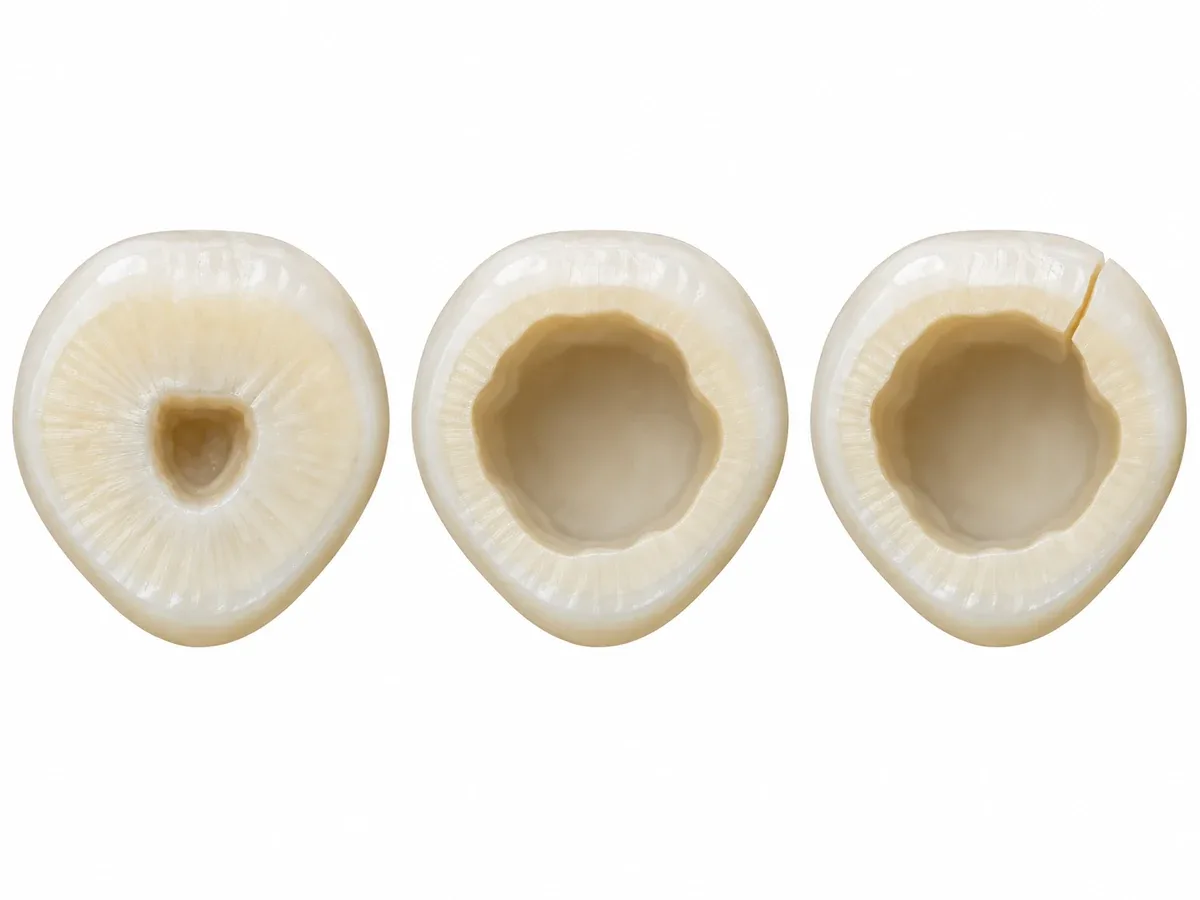
Inside each tooth is a pulp chamber in the crown and root canals running down the roots. They hold the pulp, which contains nerves and blood vessels.
To remove infected pulp, a path has to be opened into that space. So the inside of the tooth is emptied during treatment.
The guide states the result plainly. A treated tooth has had a lot of structure removed to reach the pulp chamber, so it can break easily, and very hard foods should be chewed with care.
Front teeth, where veneers are placed, are no exception. They guide the jaw as it moves side to side and forward, so they often take sideways force.

Why does a root-canal-treated tooth turn dark?
It is not unusual for a treated front tooth to darken over time. This color differs from surface stains such as coffee or tobacco, because it shows through from inside the tooth. No amount of surface cleaning changes it.
Color can come from inside in more than one way:
- tissue and blood components from inside the tooth can seep into the dentin
- the color of filling materials can show through the thinner walls
Either way, the color sits within the thickness of the tooth, not on the surface.
So before planning veneers, we do not judge by color alone. Darkening means something has changed inside, so we read color as a signal, not a result.
That is why we ask when the change began, whether it ever hurt, and whether the tooth was ever knocked.
The dental injury guide lists complications of injured teeth, including pulp death and infection, pulp canal narrowing, and various types of root resorption. It also says follow-up checks should watch for tooth discoloration.
A front tooth that darkens long after being knocked fits this picture. The change may appear not on the day of the injury but months or years later.

Veneers or a crown: what do the guides recommend?
Here is the root canal guide's line as written. For back teeth, or teeth with a lot of structure removed, crown treatment is needed to prevent fracture.
This is a conditional statement. We read it not as "every treated tooth must be crowned," but as advice to consider where the tooth is and how much has been removed.
The all-ceramic crown guide points the same way. Its list of uses includes protecting a tooth after root canal treatment. The guides' default, in other words, is to cover and hold the tooth together.
So in summary, for a front tooth with thick remaining walls, veneers can be considered. If much of the inside is empty, a covering crown is the way to go.
| Option | How it works | Trade-off |
|---|---|---|
| Veneers | A 0.5–1.0 mm shell bonded to the front after minimal reduction | Keeps more tooth, but needs a solid wall underneath |
| Crown | The whole tooth surface is reduced and covered | Higher strength and durability, but more tooth is removed |
Some people just want the color hidden. Color can be hidden, but force cannot, and on a thin-walled tooth, looks and strength are separate problems. That is why the guide explains crowns in terms of fracture prevention.
When can veneers still work on a treated tooth?
Several uses listed in the laminate guide relate to this topic:
- tooth discoloration, inborn or acquired
- gaps between teeth
- mild misalignment
- fractured teeth
A discolored front tooth falls within these uses of veneers. But conditions apply.
The guide describes veneers as thin shells of about 0.5–1.0 mm, bonded after minimal surface reduction. Bonding needs a surface to bond to, and a thin shell needs solid structure behind it.
Bonded onto a hollowed, thin wall, the shell does not carry the force. Instead, the wall has to hold first.
So we look at three things together. These are our clinical standards, since the guides give no figures for them:
- how wide the old access filling on the inside is
- how much of the front and back walls remains
- how force lands on that tooth as the jaw moves
Color needs a word too. A tooth that is dark inside may not be hidden by a thin shell alone.
The all-ceramic crown guide notes that ceramics with high strength lack translucency, while highly translucent ceramics are weaker. Hiding dark color takes thickness or opacity, and a natural look lies the other way, so it is better to agree on the balance before starting.
If just one of two front teeth differs, sometimes one tooth is treated and sometimes the neighbors are included. The tooth that already had root canal treatment does not react to temperature, but prepared neighboring teeth may feel sensitive, which the guide lists as a complication.
Can the tooth be brightened from inside first?
If the color comes from inside, one option comes first in order. Before covering the outside with veneers, we check whether the tooth can be brightened from within.
The Ministry of Food and Drug Safety (MFDS) defines tooth whitening as using whitening agents on stained or discolored teeth. The aim is their original color, or a whiter, brighter one. For a tooth with finished root canal treatment, this is done from the inside.
We consider this first for a clear reason: it does not remove more tooth. A treated tooth is already hollow with thinner walls, so finishing without reduction is preferable.
Conditions apply here too. Before starting, we confirm these points:
- the root canal is properly sealed
- there is no problem at the root tip
- there is no infection or damage that could make irritation stronger
The MFDS warns that using whitening agents differently from the directions can weaken and damage teeth. It advises talking to a professional, which we read as meaning this is not something to buy and do at home.
That concern matters even more for this tooth, whose walls are already thin. So we set the extent and method after seeing its condition.
How much the tooth brightens and how long the color lasts vary by person. The sources give no figures for shades or years, so we do not give numbers either.
We try it, and move to the next step if the result falls short. If the tooth darkens again, we check first whether the root tip has changed, and then discuss covering it.
What do we check first at our Busan clinic?
Whatever the plan, one check comes before any veneers or crown: the condition of the root tip.
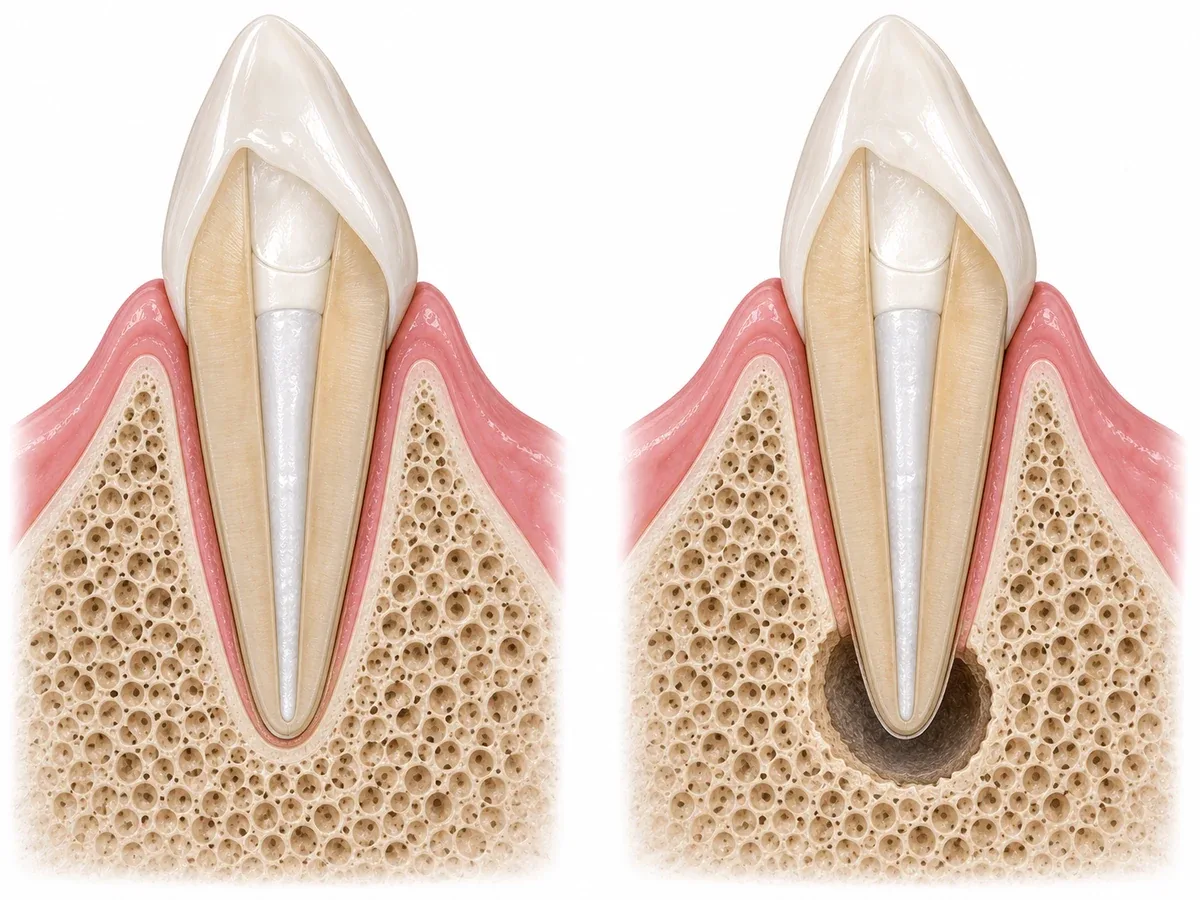
The root canal guide says that after treatment, regular checks including yearly X-rays are done to watch for reinfection. It also notes that infection in accessory canals, which are hard to sterilize, can cause inflammation at the root tip.
If the outside is made first in that state, it may later have to be removed so the root can be treated. Even a treatment done years ago still needs checking, because changes at the root tip can progress without pain.
The guide also describes the next options. If a lesion at the root tip does not heal with continued treatment, surgical root canal treatment follows:
- apicoectomy, which removes the root tip
- intentional replantation, where the tooth is taken out, treated and put back
For a tooth where these remain possible, esthetic treatment is planned afterwards. The outside can be redone later, but treating the root after bonding or crowning means first removing the veneers or crown that was made.
The question we hear most is whether veneers or a crown is right for them. The table below brings the guides and our clinical view together. No single row decides it; we look at how many rows apply.
| Check | Veneers can be considered | Toward a crown |
|---|---|---|
| Root tip | The seal holds and the area around the root tip is clear | If a lesion shows, neither yet; the root comes first |
| Remaining walls | The front and back walls remain thick | The access filling is wide and the walls are thin |
| Amount removed | The access opening is small | A lot has been removed, as the guide describes |
| Color | It can be reduced by brightening | A thin shell cannot hide it |
| Force | Force does not gather on that tooth as the jaw moves | Force gathers on that one tooth |
If even one right-hand item is clear, we recommend a crown over veneers. The root canal guide explains crowns in terms of fracture prevention, and fewer options remain after a tooth breaks.
What if the front tooth was injured in the past?
If a front tooth had root canal treatment after being knocked in childhood, we check one more thing. The dental injury guide says early detection can improve the outlook for the tooth.
It also describes splinting periods for different injuries, with follow-up checks needed afterwards.
| Injury | Approximate splinting period |
|---|---|
| Tooth knocked out completely (avulsion) | About 2 weeks |
| Tooth pushed sideways (lateral luxation) | About 4 weeks |
| Tooth pushed into the bone (intrusion) | About 4 weeks |
| Root fracture | About 4 weeks |
Follow-up checks watch for tooth discoloration, root resorption and fusion of the root to the bone. Some changes appear years later, so a tooth that has changed color now is worth checking now.
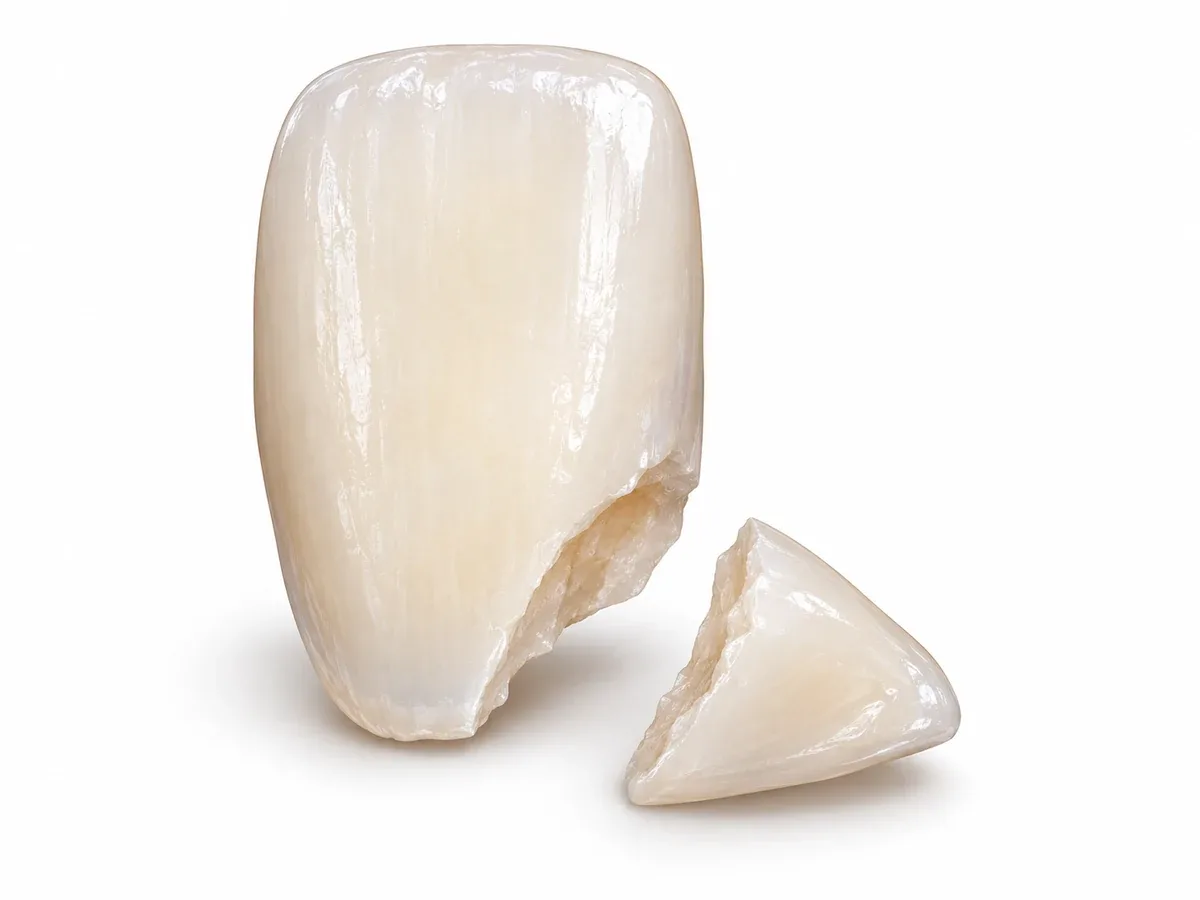
The guide also covers broken pieces. It describes reattaching the fragment as the most esthetic option, so if you can find it right after the injury, bring it to the dentist.
If you have just broken a front tooth and are reading this, find the piece first and then come in.
Frequently asked questions
Does a tooth with root canal treatment always need a crown instead of veneers?
The guide's sentence is conditional: a crown is needed for back teeth or teeth with a lot removed. For a front tooth with thick remaining walls, other options can be considered too. That judgment rests on how much tooth remains, not on the treatment name you prefer.
What happens if a thin veneer breaks later?
It depends on what broke. A shell that came off and a cracked tooth wall underneath are very different situations. In the second case, we move to a covering crown, or first reassess whether the tooth can be kept.
My root canal treatment was years ago. Do I still need a check?
Yes. The guide describes regular checks including yearly X-rays to watch for reinfection. Changes at the root tip can progress even without pain.
Can I get veneers with English support in Busan?
Yes, Reset Dental Clinic offers 1:1 English interpretation from the first consultation through the end of treatment. We are near Seomyeon Station Exit 2 (5-min walk), opposite Lotte Hotel Busan. Call 010-8555-2854, or +82-10-8555-2854 from abroad.
For a front tooth with root canal treatment,
what decides the path is the remaining wall, not the treatment name.
The guide says back teeth, or teeth with a lot removed,
should be crowned to prevent fracture.
For front teeth, we check those conditions one by one.
Whatever the choice, the order is the same.
Check the root tip first, then make the outside.
If you are considering veneers in Busan, Reset Dental Clinic provides 1:1 English interpretation throughout. Call 010-8555-2854 to book a consultation.
References
- KDCA National Health Information Portal, "Root Canal Treatment" — structure of the pulp chamber and canals; removing infected pulp, cleaning and sealing; treated teeth can break easily because much structure is removed; crowns needed for back teeth or heavily reduced teeth to prevent fracture; regular checks including yearly X-rays; root-tip inflammation from accessory canal infection; apicoectomy and intentional replantation when a lesion does not heal
- KDCA National Health Information Portal, "Laminate Treatment" — thin 0.5–1.0 mm shells bonded after minimal reduction; indications including discoloration, gaps, mild misalignment and fractures; complications including debonding, fracture, edge discoloration and sensitivity; crowns reduce the whole surface for more strength and durability but remove more tooth
- KDCA National Health Information Portal, "All-Ceramic Crowns" — covers the whole crown, with protection after root canal treatment among its uses; high-strength ceramics lack translucency; pre-treatment checks including pulp vitality, bite and gum disease
- KDCA National Health Information Portal, "Dental Injuries" — complications such as pulp death and infection, canal narrowing and root resorption; follow-up for discoloration, re-eruption and fusion; reattaching the fragment as the most esthetic option, so bring it in; splinting of about 2 weeks for avulsion and about 4 weeks for lateral luxation, intrusion and root fracture; early detection improving the outlook
- Ministry of Food and Drug Safety · Korea Policy Briefing, "How to Use Tooth Whitening Products Correctly" — definition of tooth whitening; misuse can weaken and damage teeth; infection, tooth damage or gum disease can make irritation stronger, so check your mouth and consult a professional first
Written by Reset Dental Clinic Support Team
Medical review Dr. Kim Hyun-joo, Head Dentist · Esthetic Restorations
Last updated: September 19, 2026
This column is for general information and does not replace diagnosis or treatment for individual patients. If you have symptoms, please see a dentist.


