

- Cavities and gingivitis both start with plaque, and braces add places where plaque can stay.
- A Korean hospital guide lists trauma to the teeth, including braces, tartar and dental restorations, among the causes of a gum abscess.
- Decay confined to the enamel causes almost no pain, so feeling fine during braces does not mean nothing is happening.
- Gingivitis can usually be reversed with careful brushing and flossing.
At Reset Dental Clinic in Seomyeon, Busan, we often remind patients that braces suddenly create spots a toothbrush cannot reach. If the teeth are damaged when the braces come off, much of the reward of straight teeth is lost. For patients living in or visiting Korea, we provide 1:1 English interpretation from the first consultation through the end of treatment.
This column uses Asan Medical Center's guides to tooth decay, gingivitis and gum abscess. It also uses the KDCA National Health Information Portal's guides to preventing oral disease and to scaling. Together they show what to protect, and how, while you wear braces.
Why do cavities form more easily with braces?
Tooth decay starts simply. Asan Medical Center's guide explains that plaque is a film of bacteria on the tooth surface. The bacteria break down sugar and starch left in the mouth.
That process makes acid. The acid attacks the enamel, the outer layer of the tooth, and damages it.
Gingivitis works in a similar way. The guide names plaque as its cause. When hardened tartar builds up as well, the gap between gum and tooth opens, bacteria get in and inflammation starts.
Braces add more places where this film can stay. Brushes cannot sweep every corner around the brackets, under the wire and where the elastics hook on.
The gum abscess guide goes a step further. Among the causes of a periodontal abscess, it lists trauma to the teeth, naming braces, tartar and dental restorations.
So braces do not create decay by themselves. They make the daily job of removing plaque harder.

| Spot | Why it is hard to clean |
|---|---|
| Around the brackets | The edges above and below the bracket are easy to miss |
| Under the wire | A toothbrush cannot reach behind it |
| Where elastics hook on | Small corners where the bristles do not sweep |
| Between the teeth | Needs floss or an interdental brush, as without braces |
Why can tooth decay progress without pain?
The tooth decay guide describes symptoms stage by stage. While decay is confined to the enamel, you feel almost no pain.
When it reaches the border between enamel and dentin, cold things cause sensitivity and sweet things feel sharp. Once it reaches the dentin, hot and cold foods are uncomfortable and chewing hurts.
When decay reaches the pulp, the nerve inside the tooth, pain appears even with no trigger. The guide says painkillers no longer help at that stage.
So feeling fine during braces does not mean nothing is wrong. That is also why the guide says X-rays are essential for diagnosis, alongside a visual exam and a dental probe.
Gums follow a similar pattern. With gingivitis, the guide lists these changes:
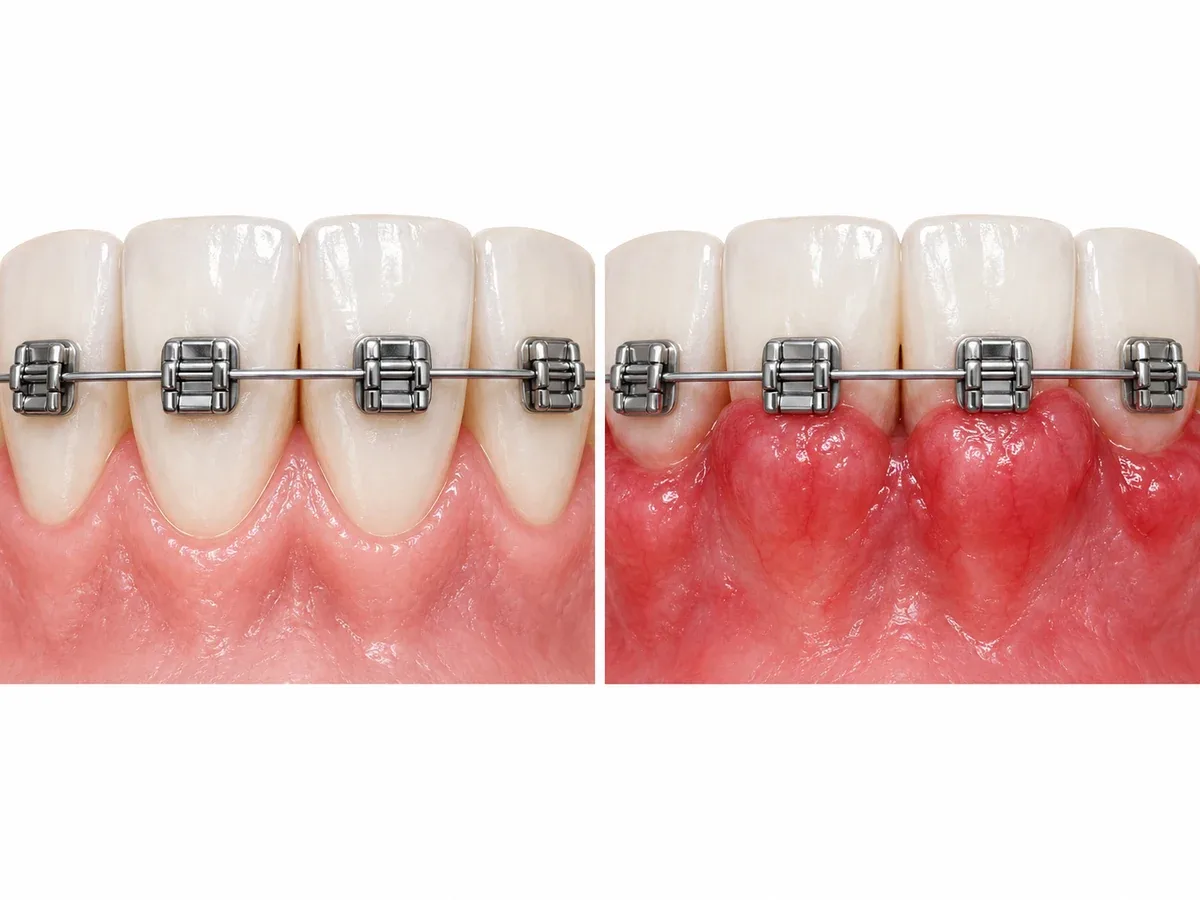
- the gums turn red
- they bleed when you brush
- bad breath can develop as it progresses
- eating can become uncomfortable
If it gets worse, it can progress to periodontitis, inflammation of the tissues around the teeth.
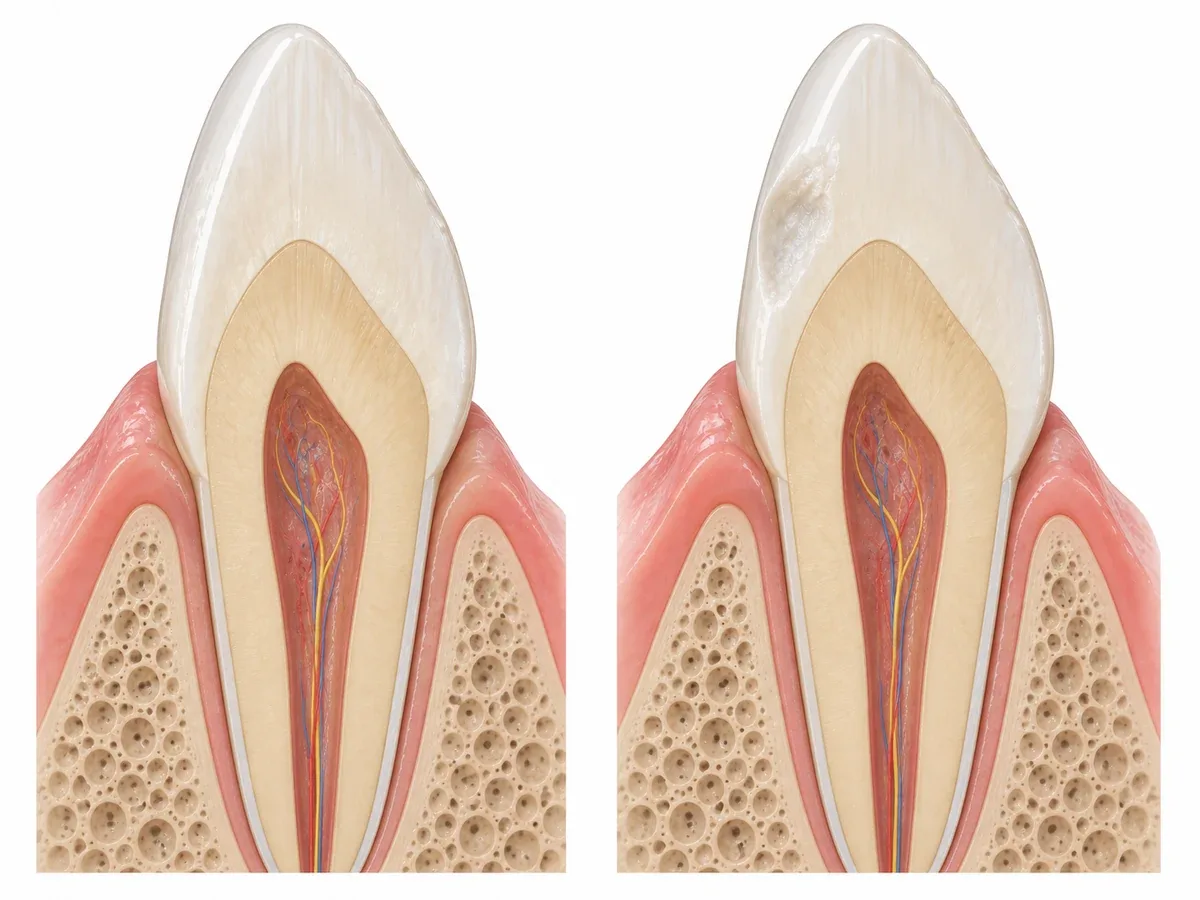
| How far it has gone | What the guides say |
|---|---|
| Confined to the enamel | Almost no pain |
| Enamel–dentin border | Sensitive to cold and to sweet tastes |
| Into the dentin | Discomfort with hot and cold, pain when chewing |
| Into the pulp | Pain with no trigger; painkillers no longer help |
| Gums (gingivitis) | Redness and bleeding when brushing; can progress to periodontitis |
Tooth decay in the enamel causes almost no pain. That is the stage where it is easiest to miss.
How should you brush and floss with braces?
The KDCA guide to preventing oral disease sets out the basics. They apply to everyone, and they matter more with braces.
- Brush at least twice a day with fluoride toothpaste, for 2 minutes or more, while looking in a mirror.
- Floss every day. The guide calls it essential.
- If the gum bone has receded and the gaps are wide, add an interdental brush.
- Rinse less after using fluoride toothpaste, which helps it work better.
- After an acidic drink, wait 30 minutes before brushing.
The advice to brush while looking in a mirror is especially useful with braces. With appliances in the mouth, the usual feel of your teeth does not tell you what has been missed.
Check with your eyes as you go. Brush the upper and lower edges of the brackets separately.
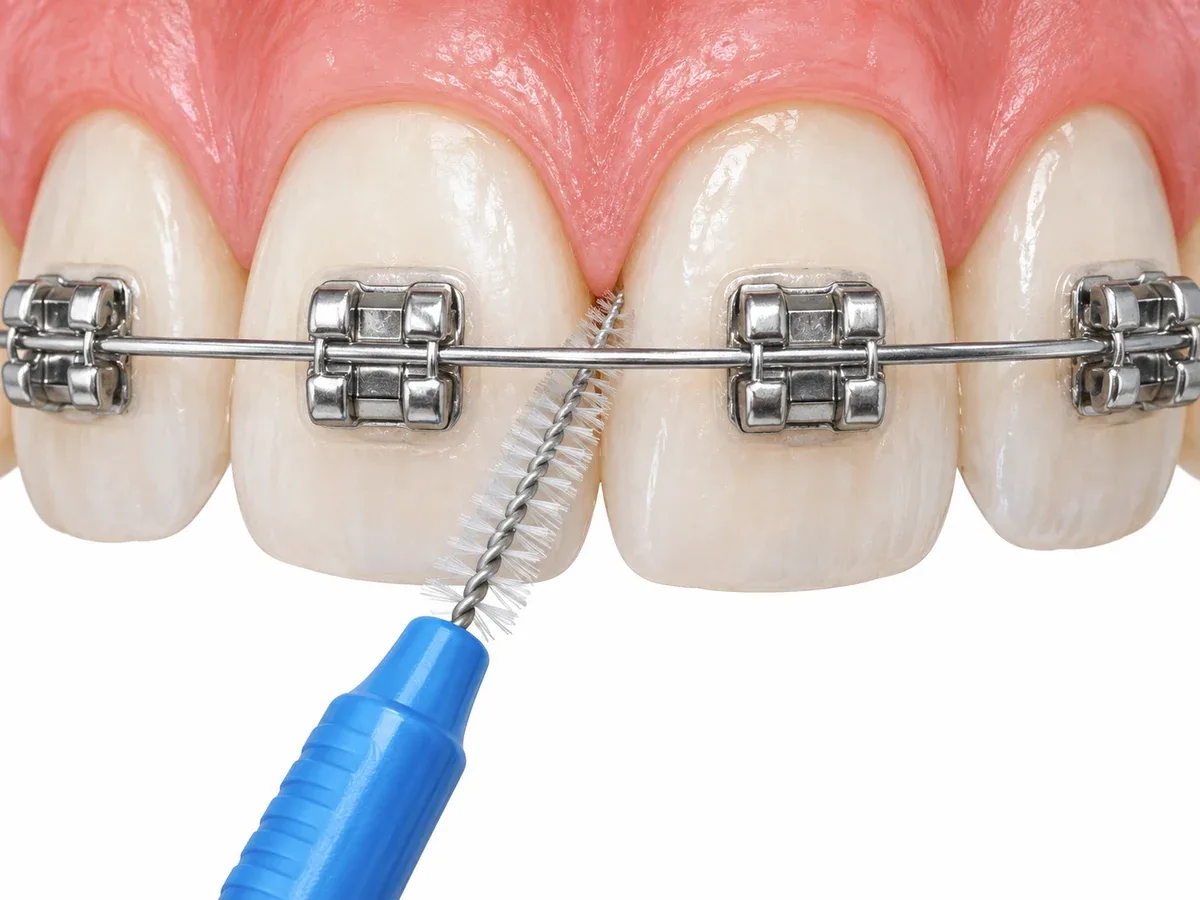
If flossing is hard, an interdental brush can help. It also reaches under the wire, where a toothbrush cannot go.
A Korean dental newspaper reported on an international standard for interdental cleaning. It said floss on a fixed holder works as well as finger flossing. It is especially useful for people with poor dexterity, hand muscle problems or limited mouth opening.
The same report advised cleaning between the teeth before brushing. It also suggested easing the floss in gently with a zigzag, sawing motion.
How often do you need scaling during braces in Korea?
However well you brush, hardened deposits will not come off with a brush. The KDCA's guide describes scaling as the basic treatment for removing plaque and tartar.
The guide says people with gum disease should have scaling at least every 6 months. Korea's national health insurance covers one scaling a year for adults aged 19 and over.
A dental newspaper report on national health insurance guidance adds one detail. The yearly benefit does not carry over, so it is lost if the year ends without it. Braces often last several years, so it is worth using it once each year.
The gingivitis guide also names correct brushing and regular scaling as the way back to healthy gums. It says gingivitis can usually be reversed with careful brushing and flossing.
The key is to catch the problem while it can still be reversed. Scaling during braces is planned around the appliances, so the timing can be arranged with your dental team.

Some people notice changes after scaling. The KDCA guide explains each one:
- sensitivity after scaling fades within a few weeks
- a loose feeling is part of swollen gums settling down
- gaps that look wider are also normal
These gaps are not new. They were hidden by swelling and are now visible again.
| Item | What the references say |
|---|---|
| Brushing | At least twice a day with fluoride toothpaste, 2 minutes or more, using a mirror |
| Between the teeth | Flossing is essential; add an interdental brush if gaps are wide |
| Acidic drinks | Wait 30 minutes before brushing |
| Scaling | At least every 6 months with gum disease; covered once a year for adults 19 and over |
| Yearly benefit | Does not carry over to the next year |
What if a cavity or gum problem has already started?
It is better not to put off treatment. The tooth decay guide says the decayed part is removed completely and then filled with gold or tooth-colored resin.
Even during braces, treatment is often possible. The appliance can be removed briefly, or the dentist can work around it.
If the gums are badly swollen with pus, it may be a periodontal abscess. The gum abscess guide describes it as a pus-filled infection inside the gum tissues, caused by bacteria in the mouth.
The guide lists several situations in which it can form:
- the opening of the gum pocket narrows, so pus cannot drain
- more aggressive bacteria increase
- the body's resistance drops
- the teeth are injured, including by braces, tartar or restorations
In an acute abscess, the guide describes spreading pain and very severe pain when the gum is touched. The tooth may feel loose. Rarely, fever and weakness can occur.
The gum may bulge in a rounded shape, with a red and shiny surface. This is a sign to see a dentist rather than wait.
| Problem | What the guide describes |
|---|---|
| Cavity | Remove the decay completely, then fill with gold or tooth-colored resin |
| Gingivitis | Careful brushing, flossing and regular scaling |
| Gum abscess | Thorough removal of bacterial plaque and tartar |
| Bone loss around the tooth | Gum surgery if regular gum treatment, including scaling, is not enough |
The basis of abscess treatment is removing bacterial plaque and tartar thoroughly. This stops the mouth from becoming a place where bacteria thrive.
If bone around the tooth has already been lost and regular gum treatment does not help enough, the guide says gum surgery is done. Catching problems early during braces keeps things from reaching that point.
What does a daily routine look like with braces?
The advice above is easier to follow as one routine. The order below simply puts the references' points in sequence.
- Clean between the teeth first, with floss, floss on a holder or an interdental brush.
- Pass an interdental brush under the wire around each bracket.
- Brush with fluoride toothpaste for at least 2 minutes, in front of a mirror.
- Brush the upper edge and the lower edge of each bracket separately.
- Spit out the toothpaste and rinse lightly rather than many times.
Do this at least twice a day. If you have just had juice, soda or another acidic drink, wait 30 minutes before you start.
Then look again in the mirror. Check each bracket edge once more, because a missed spot is where plaque stays.
Beyond the daily routine, the KDCA guide recommends a dental check-up once a year. If you have had dental treatment before, it recommends one every 6 months.
During braces, you already visit the clinic regularly for adjustments. Those visits are a good moment to ask the dentist to check for early decay and gum changes too.
Frequently asked questions
Do braces make teeth decay more easily?
The appliance itself does not create decay. But plaque causes both cavities and gingivitis, and braces add places where plaque can stay. The gum abscess guide lists braces among the causes, so care does become harder.
My gums bleed. Should I brush less?
No, it is the opposite. The gingivitis guide says red, bleeding gums usually recover with careful, thorough brushing and flossing, and avoiding the area makes inflammation last longer. If the gums are very swollen and painful, though, see a dentist.
Does scaling interfere with braces?
The references say nothing against scaling during braces. The scaling guide says people with gum disease should have it at least every 6 months. It is done around the appliances, so just arrange the timing with your dental team.
Can I get care during braces in English in Busan?
Yes. We offer 1:1 English interpretation from the first consultation through the end of treatment. The clinic is near Seomyeon Station Exit 2 (5-min walk), opposite Lotte Hotel Busan, and you can call 010-8555-2854 (+82-10-8555-2854 from abroad).
Straight teeth are worth more when they come out healthy.
Braces add places for plaque to hide.
Early decay does not hurt.
So check with your eyes, and do not skip scaling.
If you wear braces in Busan and worry about cavities or gums, Reset Dental Clinic offers 1:1 English interpretation from your first consultation through the end of treatment. Call 010-8555-2854 to book a check-up.
References
- Asan Medical Center Disease Encyclopedia, "Tooth Decay (Dental Caries)" — definition; how acid from plaque bacteria breaking down sugar and starch attacks enamel; symptoms at each stage from almost no pain in enamel to pain that painkillers do not relieve in the pulp; diagnosis by visual exam and probe, with X-rays essential; and treatment by removing decay completely and filling with gold or tooth-colored resin
- Asan Medical Center Disease Encyclopedia, "Gingivitis" — definition as inflammation of the gums; plaque and hardened tartar as causes; red, bleeding gums, bad breath and discomfort when eating, with possible progression to periodontitis; diagnosis by bleeding and swelling; and recovery through careful brushing, flossing and regular scaling
- Asan Medical Center Disease Encyclopedia, "Periodontal Abscess" — definition as a pus-filled infection in the gum tissues; causes including poor drainage, aggressive bacteria, lowered resistance and trauma to the teeth such as braces, tartar and restorations; acute symptoms; and treatment by removing plaque and tartar, with gum surgery when bone loss has progressed
- KDCA National Health Information Portal, "Preventing and Managing Oral Disease" — brushing at least twice a day with fluoride toothpaste for 2 minutes or more using a mirror; flossing and interdental brushes; rinsing less after fluoride toothpaste; waiting 30 minutes after acidic drinks; and check-ups once a year, or every 6 months after treatment
- KDCA National Health Information Portal, "Scaling (Tartar Removal)" — scaling as the basic treatment for removing plaque and tartar; yearly insurance coverage for adults 19 and over and scaling at least every 6 months with gum disease; and why sensitivity, a loose feeling and wider-looking gaps after scaling are normal
Written by Reset Dental Clinic Support Team
Medical review Dr. Kim Hyun-joo, Head Dentist · Integrated Dentistry Specialist
Last updated: September 19, 2026
This column is for general information and does not replace diagnosis or treatment for individual patients. If you have symptoms, please see a dentist.


