

- A crown itself cannot decay, but the natural tooth underneath still can. Decay is caused by acid from the bacterial film on the tooth surface.
- While decay is limited to the enamel, there is almost no pain. If you wait until it hurts, it is often late.
- In the literature, an all-ceramic crown lasts around 10 years, but this varies a great deal with the tooth, oral hygiene, diet and maintenance.
- The care recommended after treatment is simple: proper brushing and regular scaling.
Patients in Seomyeon, Busan often ask us whether a tooth can still decay once it has a crown. The cap itself does not decay, but what sits underneath is still your own tooth. For patients living in or visiting Korea, Reset Dental Clinic provides 1:1 English interpretation from the first consultation through the end of treatment.
This column explains how decay forms under a cap and how to prevent it. It draws on the national health information portal of the KDCA (the national disease control agency) and the disease encyclopedia of Asan Medical Center.
What does a crown actually cover?
A crown is a treatment in which the tooth is shaped and then covered with a cap. The cap is made of ceramic or metal, so bacteria cannot dissolve it.
The weak point is the margin. This is the line where the cap meets your natural tooth, especially the line close to the gums.
However well the cap is made, that line never disappears. If cleaning does not reach it, a film of bacteria settles along it.
The Asan Medical Center material explains how decay starts. Bacteria in plaque, the film that forms on the tooth surface, break down sugar and starch left in the mouth.
The acid produced in that process attacks the enamel, the hard outer surface of the tooth, and damages it. Once the enamel is damaged, decay can form in the dentin and the pulp beneath it.
- Plaque forms on the tooth surface, often along the margin.
- Bacteria in the plaque break down sugar and starch left in the mouth.
- This produces acid, which attacks and damages the enamel.
- If nothing stops it, decay moves into the dentin and then the pulp.
In other words, covering a tooth changes where decay can start. It does not remove the possibility of decay.
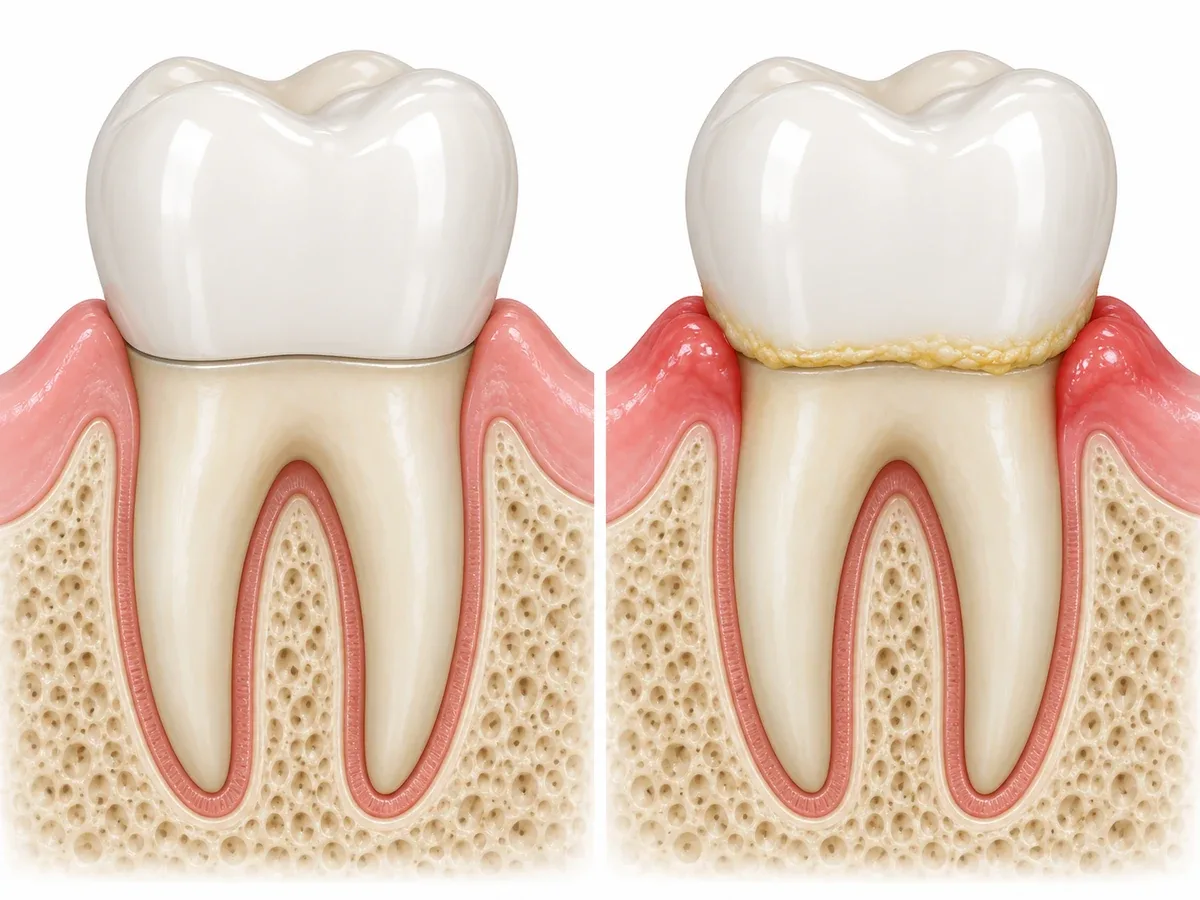
| Part | Can it decay? | Why |
|---|---|---|
| The crown (ceramic or metal) | No | Bacteria cannot dissolve the material |
| The margin near the gums | Plaque settles here | The line remains however well the crown is made |
| The tooth under the cap | Yes | It is still your own tooth, open to acid from plaque |
Why does decay under a crown often cause no pain?
The stage-by-stage symptoms in the tooth decay material show why this problem is often found late.
While decay is limited to the enamel, there is almost no pain. When it reaches the border between enamel and dentin, the tooth becomes sensitive to cold and to sweet tastes.
Once it spreads into the dentin, chewing starts to hurt. When it reaches the pulp, the tooth aches even without any trigger, and painkillers no longer help.
A covered tooth adds one more condition. If the cap was placed after root canal treatment, there is no nerve left, so even the warning signal of sensitivity does not come.
Decay can then progress quietly under the cap. Many people notice it when the cap feels loose, when there is a smell, or when the gum swells.
That is why the material states that X-rays are essential for diagnosis. Nobody can see under a cap with the naked eye.

| How far decay has gone | Symptoms |
|---|---|
| Limited to the enamel | Almost no pain |
| Border of enamel and dentin | Sensitive to cold and to sweet tastes |
| Dentin | Pain when chewing |
| Pulp | Pain without any trigger; painkillers no longer help |
| Tooth crowned after root canal treatment | No nerve, so not even a sensitivity signal |
The material also describes how decay is diagnosed. The dentist examines the tooth by eye, checks it with a probing instrument, and takes X-rays.
For a covered tooth, the first two steps can reach the margin but not the tooth under the cap. The X-ray is what shows the part that stays hidden.
How long does a crown last?
The KDCA material on all-ceramic crowns gives a lifespan of around 10 years in the literature. It adds that the real figure varies a great deal from person to person.
The material names the factors behind that difference:
- the condition of the tooth before treatment
- the patient's ability to keep the mouth clean
- eating habits
- maintenance after treatment
In other words, the number is not set by the material alone. It changes with the person who uses the crown.
That is also why the same material recommends proper brushing and regular scaling after treatment. How you care for a crown is part of how long it lasts.
The material also describes a property of ceramics. Stronger ceramics are less translucent, and more translucent ceramics are less strong.
This is why the choice differs by position. A front tooth that shows when you smile and a back tooth that takes chewing force call for different priorities.
| Property | Stronger ceramic | More translucent ceramic |
|---|---|---|
| Strength | Higher | Lower |
| Translucency | Lower | Higher |
| Position where it tends to be weighed | Back teeth that take chewing force | Front teeth that show when you smile |
How should you clean around a crown?
The KDCA material on preventing oral disease sets out the basics. Brush at least twice a day, for at least two minutes, with fluoride toothpaste while looking in a mirror.
Flossing is essential. If the gum bone has receded and the gaps between teeth are wide, add an interdental brush.
For a covered tooth, floss and interdental brushes are especially important. A toothbrush glides over the rounded face of the cap, but it misses the surfaces where problems start.
Those surfaces are where the cap touches the neighboring teeth, and the line along the gums. Floss and interdental brushes are the tools that reach them.
The same material notes that rinsing less after using fluoride toothpaste makes it more effective. If you have had an acidic drink, wait 30 minutes before brushing.
Here is the routine in order:
- Brush at least twice a day, for two minutes or more, with fluoride toothpaste.
- Use a mirror so you can see the gumline around each cap.
- Floss between the cap and the neighboring teeth.
- If the gaps are wide, add an interdental brush.
- Rinse less after brushing, which helps the fluoride toothpaste work.
- After an acidic drink, wait 30 minutes before you brush.

| Tool | Where it reaches | What the material says |
|---|---|---|
| Toothbrush | The rounded outer and inner faces | Twice a day or more, two minutes or more, with fluoride toothpaste |
| Floss | Surfaces touching the neighboring teeth | Essential |
| Interdental brush | Wider gaps between teeth | Added when the gum bone has receded |
Why do regular scaling and check-ups matter?
The KDCA material on scaling describes it as a basic treatment that removes plaque and tartar. It is one of the two things recommended after a crown, along with brushing.
In Korea, National Health Insurance covers scaling once a year for adults aged 19 and over. If you have gum disease, the material says to have scaling at least every six months.
If you have several crowns, you also have several margins to look after. Each one adds one more line where plaque can settle.
The oral disease prevention material recommends a check-up once a year, or every six months for people who have had dental treatment. If you have crowns or other restorations, you belong to the second group.
It helps to know what can happen after scaling, so the changes do not worry you. The material says that sensitivity after scaling fades within a few weeks.
A feeling that the teeth are slightly loose is part of the natural process of swollen gums settling down. Gaps that look wider between the teeth are also normal.
- Sensitivity: fades within a few weeks
- A slightly loose feeling: swollen gums are settling down
- Gaps that look wider: normal after scaling

| Item | What the material says |
|---|---|
| Brushing | At least twice a day with fluoride toothpaste, two minutes or more, looking in a mirror |
| Floss and interdental brush | Floss is essential; add an interdental brush if the gum bone has receded and gaps are wide |
| Scaling | Covered once a year by National Health Insurance for adults 19 and over; at least every six months with gum disease |
| Check-ups | Once a year; every six months with a history of treatment |
What should patients in Busan watch for after getting a crown?
Early decay under a crown gives almost no pain, so other signs deserve attention. These are the signs described earlier in this column.
- the cap feels loose or moves
- a smell around the cap that brushing does not clear
- the gum around it looks swollen
- sensitivity to cold or sweet foods, if the tooth still has its nerve
- pain when chewing
None of these signs confirms decay by itself. Each one is a reason to have the tooth examined, including an X-ray.
For tooth decay in general, the Asan Medical Center material describes the treatment. The decayed part is removed completely, and the space is filled with gold or tooth-colored resin.
What can be done under a cap depends on how far the decay has gone. That is why finding it earlier leaves more choices.
Replacement is also not a matter of the calendar. A crown does not need replacing just because ten years have passed, and we decide by looking at its condition.
Frequently asked questions
Isn't a crowned tooth safe from decay?
The crown cannot decay, but the tooth beneath it can. Decay starts when acid from plaque dissolves the enamel, and plaque settles on the line where the crown meets the tooth.
Does a crown need replacing after 10 years?
We do not decide by years. The literature gives around 10 years, but it varies a great deal with the tooth before treatment, oral hygiene, eating habits and maintenance. We decide based on the condition we see.
There is a smell around my crown. What does it mean?
Plaque may have built up at the margin, or decay may be progressing underneath. If brushing does not solve it, it is wise to have it checked with an X-ray.
Can I have my crown checked in English in Busan?
Yes. We offer 1:1 English interpretation from the first consultation through the end of treatment. The clinic is near Seomyeon Station Exit 2 (5-min walk), opposite Lotte Hotel Busan, and you can call 010-8555-2854 (+82-10-8555-2854 from abroad).
A crown cannot decay, but the tooth underneath it can.
Decay at the crown margin causes almost no pain at first.
So flossing, scaling and regular X-rays
do the work that pain cannot.
If you have crowns and want them checked in Busan, Reset Dental Clinic offers 1:1 English interpretation from your first consultation through the end of treatment. Call 010-8555-2854 to book a consultation.
References
- KDCA National Health Information Portal, "All-Ceramic Crowns" — the trade-off in which stronger ceramics are less translucent and more translucent ceramics are less strong; a lifespan of around 10 years in the literature that varies a great deal with the tooth before treatment, oral hygiene, eating habits and maintenance; proper brushing and regular scaling after treatment
- Asan Medical Center Disease Encyclopedia, "Dental Caries" — definition of decay as damage to the enamel that reaches the dentin and pulp; acid from plaque bacteria breaking down sugar and starch as the cause; stage-by-stage symptoms from almost no pain in the enamel to pain that painkillers do not relieve in the pulp; diagnosis by visual exam, probing and X-rays, which are essential; treatment by removing the decay and filling with gold or tooth-colored resin
- KDCA National Health Information Portal, "Preventing and Managing Oral Disease" — brushing at least twice a day for two minutes or more with fluoride toothpaste while looking in a mirror; floss as essential and interdental brushes for wider gaps; rinsing less after fluoride toothpaste; brushing 30 minutes after acidic drinks; check-ups once a year, or every six months with a history of treatment
- KDCA National Health Information Portal, "Scaling" — scaling as a basic treatment that removes plaque and tartar; once-a-year National Health Insurance coverage for adults 19 and over, and at least every six months with gum disease; sensitivity that fades within a few weeks, a loose feeling as swollen gums settle, and wider-looking gaps as normal after scaling
Written by Reset Dental Clinic Support Team
Medical review Dr. Kim Hyun-joo, Head Dentist · Integrated Dentistry Specialist
Last updated: September 19, 2026
This column is for general information and does not replace diagnosis or treatment for individual patients. If you have symptoms, please see a dentist.


