

- Sensitive teeth happen because the inner layer of the tooth is exposed.
- The worst spot is usually the neck of the tooth, where hard brushing wears a V-shaped notch.
- Desensitizing toothpaste helps when exposure is slight, but not alone for deep notches or gum disease.
- Care starts with the least invasive option and moves up step by step.
I switched to a toothpaste for sensitive teeth, but nothing changed. We often hear this at our clinic in Seomyeon, Busan, where patients can consult with 1:1 English interpretation. The difference is not the toothpaste brand; it is why your teeth are sensitive.
For some people, the toothpaste works well. For others, toothpaste alone does not help.
This column explains the reasons step by step, and the order in which to manage them. It is written for anyone living in or visiting Korea.
Why do sensitive teeth happen?
The crown of a tooth is covered by hard enamel, with dentin underneath. The root is covered by cementum. Enamel and dentin themselves contain no nerves.
Dentin, however, is made of densely packed, very fine tubes called dentinal tubules. While the dentin is covered, this causes no trouble.
Once dentin is exposed, stimuli such as cold water or air travel quickly along these tubes to the nerve inside. That is the sharp twinge we feel.
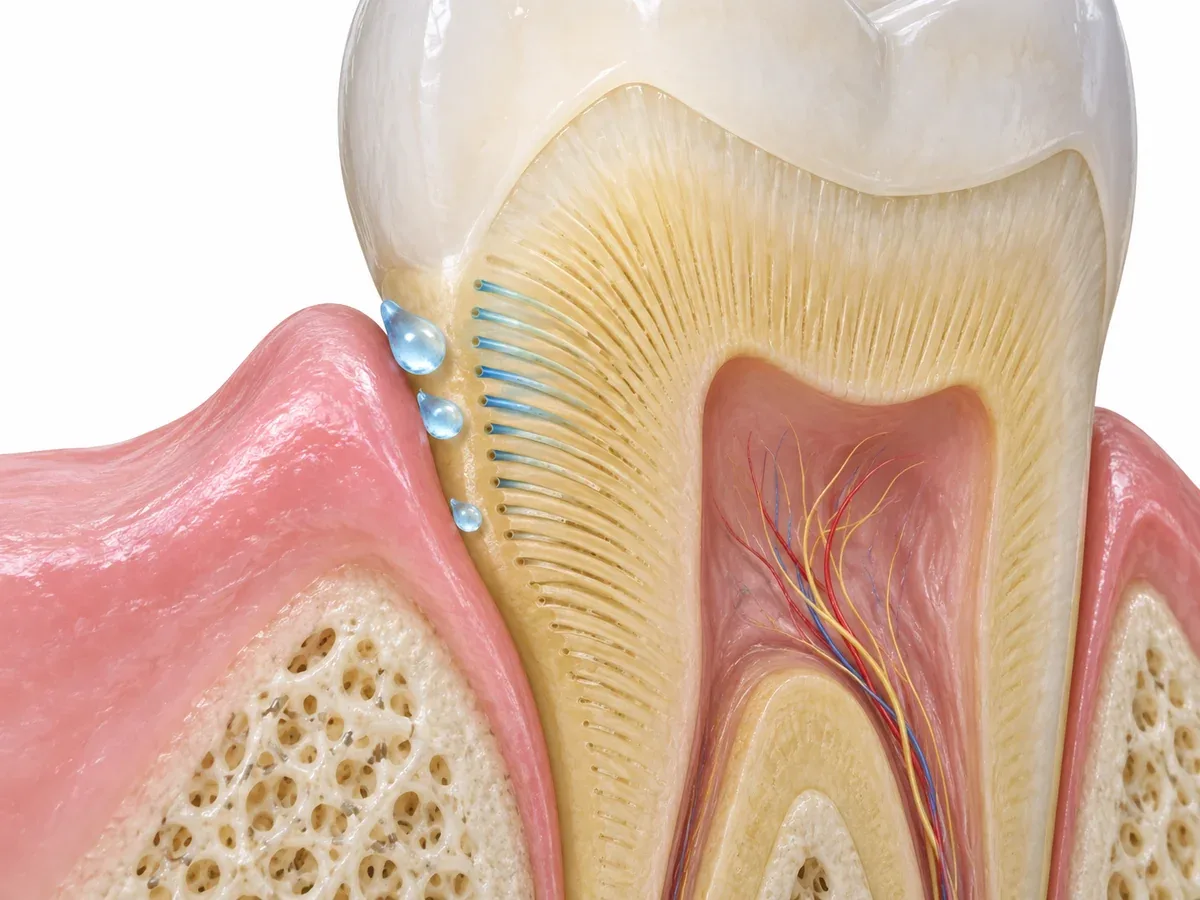
The medical name for sensitive teeth is dentin hypersensitivity. According to the KDCA National Health Information Portal, 8–57% of adults experience it.
It is most common in people in their 30s and 40s, but it can appear at any age.
Why the neck of the tooth?
In more than 90% of cases, the worst pain is at the cervical area, the border where the tooth meets the gum. It is most common on the canines and small premolars.
Enamel is thickest on the chewing surface and gets thinner toward the gum.
On top of that, in about 10% of teeth the enamel and cementum never met in the first place. The dentin there is exposed from the start.
This is the weakest spot, so it is often the first place where sensitive teeth start.
Why does the neck of the tooth wear away?
Dailydental, the Korean Dental Association's newspaper, advises that tooth wear should be suspected when teeth feel sensitive. When the neck of a tooth wears away, the dentin is exposed.
There are three main causes. Each one leaves a different shape.
| Cause | Where | Shape |
|---|---|---|
| Hard side-to-side brushing | The neck of the tooth, especially canines and premolars | A deep V-shaped notch |
| Excessive biting force | The neck of the tooth, where enamel is thinnest | Tiny fractures that deepen into a V shape |
| Grinding | The whole chewing surface | Even wear that exposes dentin in places |
| Acidic food, acid reflux | The neck of the tooth | A smooth, U-shaped hollow |
Brushing
The first cause usually named is the wrong way of brushing. Scrubbing hard from side to side irritates the gums and pushes them down toward the root.
The thin enamel and cementum in that spot then wear away. When the habit lasts a long time, a V-shaped notch forms at the neck of the tooth.
In right-handed people, it is common on the cheek side of the left canines and premolars, where more force goes in.
Biting force and grinding
When biting force is excessive, the tooth is twisted, and the strain gathers at the thin neck. Enamel chips away there bit by bit, forming a V shape much like one from brushing.
If you grind your teeth, the whole chewing surface can wear and become sensitive.
Acid
Enamel slowly dissolves when acidic foods stay in the mouth for long or stomach acid comes back up. Examples include sour fruit, pickles, fizzy drinks and wine.
A tooth neck worn by acid forms a rounded U shape.

So we first look at what shape the sensitive spot has worn into. If the cause is left in place, the same spot can keep wearing.
Can receding gums cause sensitive teeth?
Yes. You can have sensitive teeth even without a notch, when the gums recede and the root is exposed. This is called gingival recession.
Unlike enamel, the cementum covering the root wears easily. So once a root is exposed, the dentin is soon exposed too.
There are two common reasons for receding gums:
- Age: even without any disease, gums can recede with age and expose the roots.
- Gum disease: as the bone around the teeth weakens, the gums recede, and acid made by bacteria in tartar makes the exposed root more sensitive.
Gum disease in particular should not be brushed aside. Reports say 60–98% of people with gum disease also have sensitive teeth.
In a 2018 survey, 23.4% of Korean adults aged 19 and over had gum disease.
When gums recede, teeth look longer and food gets caught more often. If you notice these changes along with sensitivity, a gum check comes before any toothpaste for sensitive teeth.

When does toothpaste work for sensitive teeth, and when does it not?
There are two ways to reduce sensitivity. One is to block the exposed tubes again; the other is to make the nerve react less strongly.
Desensitizing toothpaste contains ingredients that help with this, so brushing alone sometimes calms the symptoms.
However, toothpaste cannot fill in tooth structure that has worn away. That is why the result depends on the cause.
| Your current condition | With toothpaste | What else is needed |
|---|---|---|
| Slight exposure, mild symptoms | Often helps | Correcting how you brush |
| Brief sensitivity after scaling or whitening | Usually settles with time | A check if it continues |
| A clearly visible notch at the tooth neck | Has limits | Filling the notch |
| Receding gums with an exposed root | Has limits | Checking and caring for the gums |
| Clenching or grinding | The cause remains | Correcting the habit |
| Cavities, cracks or gaps at a restoration | Does not solve it | Treating the cause |
If you still have sensitive teeth after using desensitizing toothpaste, it is a good idea to get checked at a dental clinic. Cavities, cracked teeth and gaps at restorations feel the same, so it is hard to tell them apart yourself.
Sensitive teeth after scaling are also common. When tartar covering the tooth neck is removed, the hidden root is exposed and becomes sensitive for a while.
This is usually temporary. Putting off scaling to avoid it can let gum disease progress, so regular scaling is the better choice.
Sensitivity after whitening is common as well, and in most cases it fades within a few days. If it does not settle, or if the tooth hurts even at rest, see a dentist.
Which treatment comes first for sensitive teeth in Busan?
Sensitive teeth are rarely solved with a single method. More often, the next step is added if symptoms do not improve. At our clinic in Busan, we set the order like this:
- Brushing habits and desensitizing toothpaste, when symptoms are mild and there is little wear.
- Medication or fluoride applied at the clinic, when toothpaste is not enough.
- Filling notches with resin, when the tooth neck is clearly notched.
- Gum surgery, considered carefully when receding gums have exposed the root.
| Step | When | What to know |
|---|---|---|
| Brushing and toothpaste | Mild sensitivity | Must be used consistently; get checked if it continues |
| Medication or fluoride | Toothpaste is not enough | Works right away but does not last long |
| Resin filling | The tooth neck is notched | Lasts much longer than a coating |
| Gum graft | The root is exposed | Gums can recede again, so results are hard to predict |
1. Change how you brush first
This is the simplest step and a very important one. If hard side-to-side scrubbing is the cause, the same spot keeps wearing even with a new toothpaste.
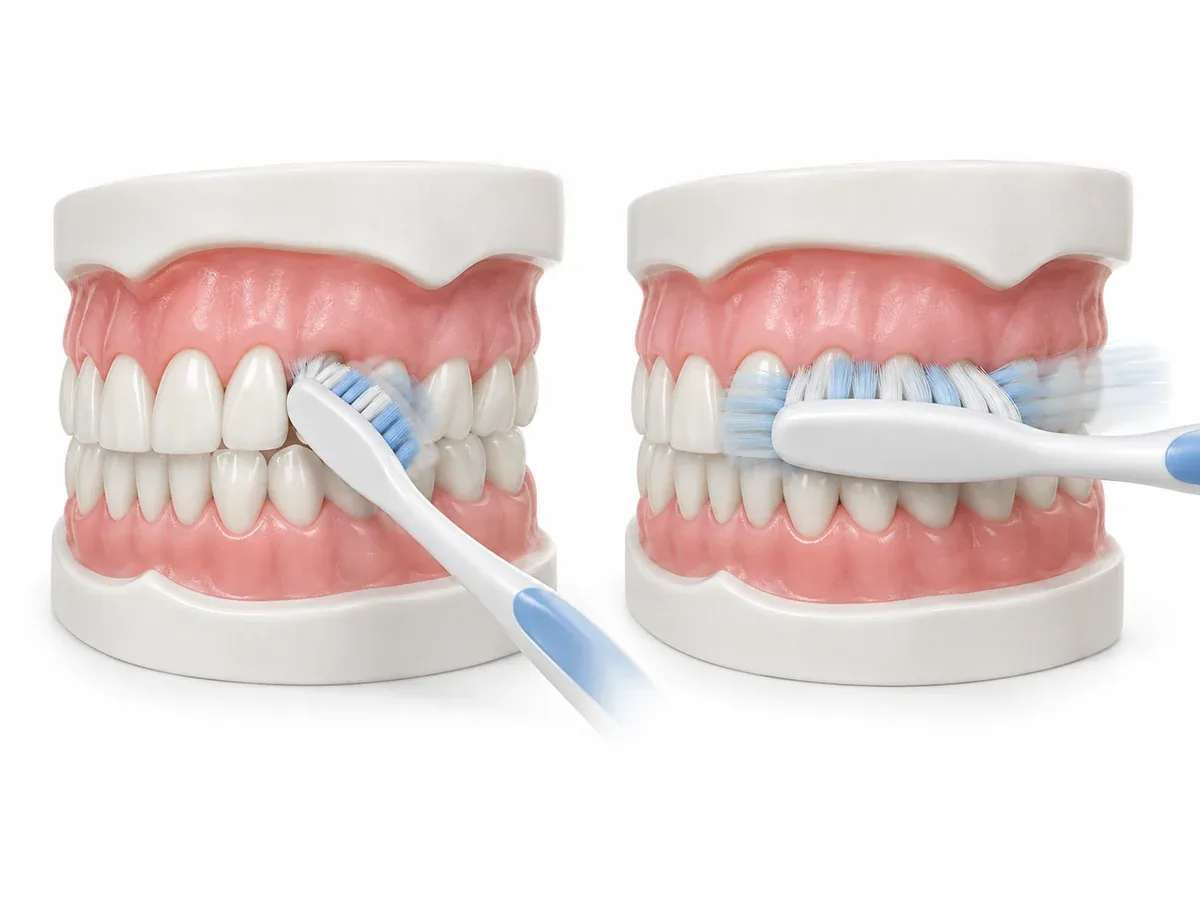
- Choose a soft toothbrush.
- Relax your grip and use short strokes.
- Clean gently along the gum line instead of scrubbing.
- If you clench or grind, look at correcting that habit too.
2. We apply a coating at the clinic
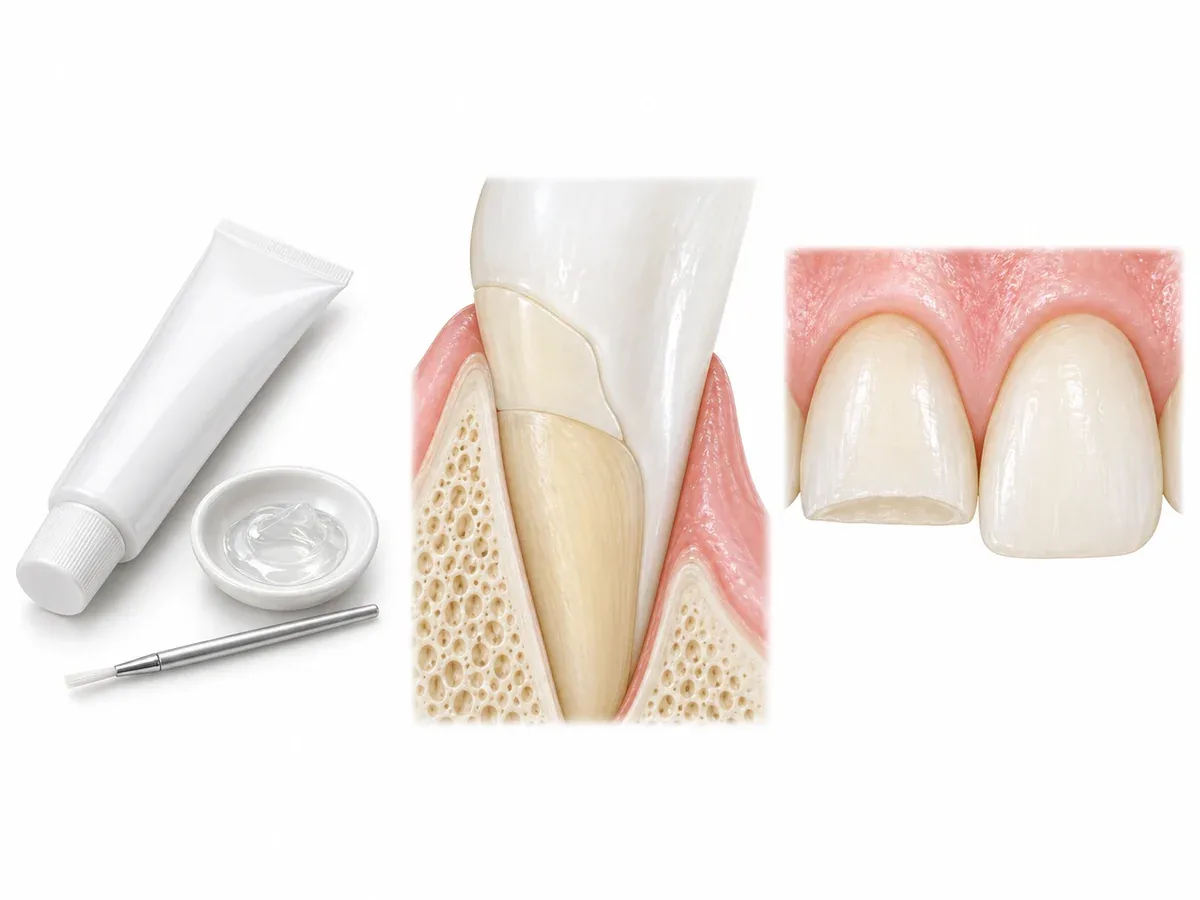
If toothpaste is not enough, fluoride or a desensitizing agent is applied directly to the exposed area. If the tooth shape has not changed much, a thin coat of dental adhesive may also be used.
The effect is immediate, but it does not last long.
Lasers are sometimes used as well, also to block the tubes. Reported results vary widely, from 5.2% to 100%, depending on the type and method.
3. We fill the notch
If the tooth neck is clearly notched, it is filled with composite resin. The idea is the same as a coating, covering the exposed surface, but the effect lasts much longer.
Wear at the tooth neck becomes more common with age. If it deepens, the nerve may be exposed, or the tooth may break while chewing. The KDCA recommends composite resin for these areas.
A shallow notch does not always need filling. If the shape has changed little and symptoms are mild, watching it is an option; teeth can defend themselves against small damage and may grow less sensitive over time.
If the notch keeps deepening, it is better to fill it before too long. We consider rebuilding the tooth's shape when wear is so deep that the shape itself has broken down.
4. Gum surgery, with care
Where receding gums have exposed a root, gum tissue can be grafted to cover it. It can improve the shape, but the gums can recede again after surgery, so the result is hard to predict.
That is why we look at the earlier steps thoroughly first. We explain what can be expected and what is difficult before any surgery.
Root canal treatment is the very last option. It is considered when nothing else helps or daily life becomes hard, and it affects that single tooth alone, so other teeth may still be sensitive.
When should sensitive teeth be checked by a dentist?
Most sensitive teeth are simple dentin hypersensitivity. Sometimes, though, it is a sign of another problem. Get checked if any of these apply:
- It keeps hurting long after the cold is gone: the nerve may be inflamed.
- It throbs even when you are doing nothing: this is different from simple sensitivity.
- Your gums bleed or swell, or a tooth feels loose: these can be signs of gum disease.
- One spot is especially sensitive, or it hurts when you bite: this needs to be told apart from a cavity, a crack or a gap at a restoration.
- Desensitizing toothpaste makes no difference: the cause may be somewhere toothpaste cannot reach.
At the clinic, we lightly touch the sensitive spot or blow air on it to see if the symptom returns. If needed, X-rays check for cavities or cracks.
During a gum check, we also measure how far the gums have receded.
If you have had gum disease, scaling every 3–6 months is a good idea. In Korea, adults aged 19 and over with National Health Insurance can have one scaling a year covered.
Frequently asked questions
How long should I use toothpaste for sensitive teeth?
There is no set period. If the sensitivity is mild, you can keep using it and watch how things go. If it does not help or keeps getting worse, have the cause checked at a dental clinic.
Once the notch is filled, will it never be sensitive again?
We cannot promise that. Resin can wear or chip over time, and the problem may return if hard brushing or clenching continues. Filling and changing the habit have to go together.
Will a gum graft bring my gums back to how they were?
It can cover an exposed root, but the gums can recede again after surgery, so the result is hard to predict. We explain what can be expected and what is difficult before deciding.
Can I get treatment for sensitive teeth in English in Busan?
Yes. We provide 1:1 English interpretation from your first consultation through the end of treatment. The clinic is near Seomyeon Station Exit 2 (5-min walk), opposite Lotte Hotel Busan; call 010-8555-2854 (+82-10-8555-2854 from abroad).
With sensitive teeth, the reason comes first.
Slight exposure can be managed with toothpaste and habits.
Deep notches or receding gums need other methods.
If you have sensitive teeth in Busan, Reset Dental Clinic offers 1:1 English interpretation.
We will find out why, starting with the least invasive option.
Call 010-8555-2854 to book a consultation.
References
- KDCA National Health Information Portal, "Dentin Hypersensitivity" — how sensitivity works and how many people have it, why it centers on the tooth neck, causes of V- and U-shaped wear, and features of toothpaste, coatings, resin, lasers and gum grafts
- KDCA National Health Information Portal, "Gum Disease (Periodontal Disease)" — changes when gums recede, gum grafts, 3–6 month check-ups, insurance-covered scaling and the prevalence of gum disease
- KDCA National Health Information Portal, "Resin Treatment" — the risks when wear at the tooth neck deepens, and composite resin restoration
- KDCA National Health Information Portal, "Systemic Disease and Periodontal Treatment" — scaling intervals after gum disease, and measuring gum recession at diagnosis
- KDA newspaper Dailydental (Chiui Sinbo), "If Your Teeth Feel Sensitive, Suspect Tooth Wear" — why sensitive teeth can be a sign of tooth wear
Written by Reset Dental Clinic Support Team
Medical review Dr. Kim Hyun-joo, Head Dentist · Esthetic Restorations
Last updated: September 19, 2026
This column is for general information and does not replace diagnosis or treatment for individual patients. If you have symptoms, please see a dentist.


