

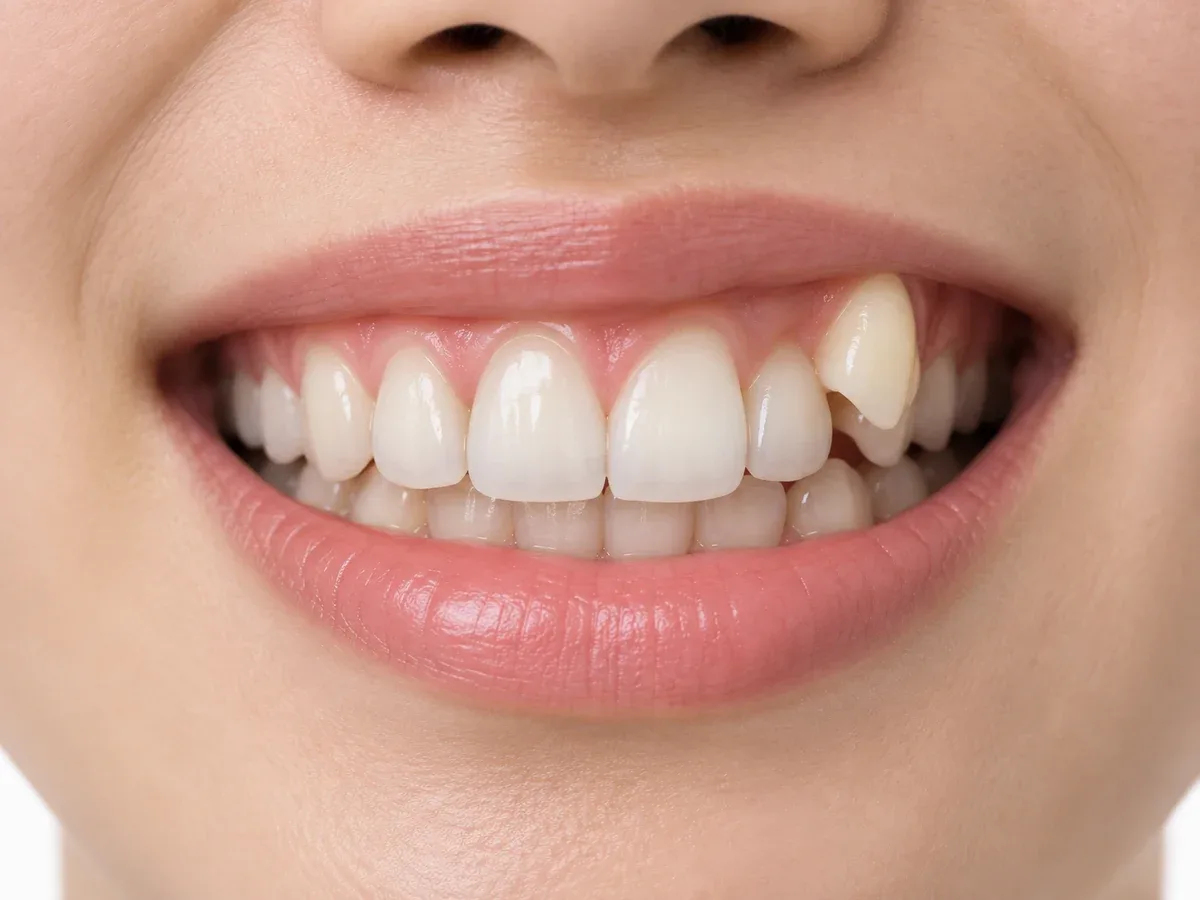
- A snaggletooth often forms when teeth are too large for the jaw, so there is not enough room to line up, says Seoul National University Hospital.
- Upper canines often erupt in the wrong place. A Korean survey reported about 2% of people have eruption problems with the upper canine.
- Treatment starts by making room for the canine, either by removing a tooth or by moving the whole row back.
- A severe snaggletooth is listed as a case that is difficult to treat with clear aligners.
A canine that sticks out toward the lip when you smile is one of the most common worries we hear at orthodontic consultations in Busan. Many people ask, "Can't you just push the tooth back in?" Before that, one problem has to be solved first: where the tooth will go.
For patients living in or visiting Korea, we provide 1:1 English interpretation from the first consultation through the end of treatment.
This column draws on Seoul National University Hospital's guides to malocclusion and clear aligners, and on national health portal guides to eruption problems and tooth extraction. We also look at a study on treating a snaggletooth without extraction.
Why does a snaggletooth form?
The hospital's malocclusion guide first points to a mismatch between tooth size and jaw size. When the teeth are large for the jaw, there is not enough space for them to line up neatly.
The teeth then twist or come in at odd angles. This is called crowding, and a snaggletooth is one of its signs.
Why does a snaggletooth so often involve the canine? The national health portal describes ectopic eruption, a tooth coming in at an abnormal spot. According to the portal, a tooth travels from the jawbone into its place in three stages.
- The tooth bud starts to move from its spot inside the jawbone.
- The tooth enters the mouth and moves toward the opposite tooth.
- After the teeth meet, it settles into its final position as the jaw grows.
If the balance of this process breaks down, a tooth can erupt in the wrong place. The portal says this often happens with upper first molars, lower lateral incisors and upper canines.
Causes include too little room, or a tooth bud that has strayed from its normal path. A supernumerary tooth (an extra tooth) or a cyst blocking the way can also be the cause. Sometimes no clear cause is found, so the diagnosis relies on tests, not appearance alone.
In a Korean survey cited by the portal, about 4.5% of pediatric dental patients had eruption problems with permanent teeth. Upper teeth made up 75% of impacted cases. Eruption problems of the upper canine, which can have serious effects, were reported in about 2%.
Childhood also plays a part. The malocclusion guide says baby teeth lost too early to decay can leave the permanent teeth without enough room if the gap is not kept.
| Cause | What the sources say |
|---|---|
| Mismatch between tooth size and jaw size | There is not enough room, so teeth twist or come in at odd spots |
| Tooth bud off its normal path | Listed as a cause of ectopic eruption |
| Extra tooth or cyst in the way | Listed as a cause of ectopic eruption |
| Baby tooth lost too early, gap not kept | Permanent teeth lack room, leading to malocclusion |
What happens if a snaggletooth is left alone?
It is not just about looks. The malocclusion guide says uneven teeth trap food and are hard to brush clean. As a result, they easily develop cavities or gum disease.
The gap beside a snaggletooth is exactly that kind of spot. Teeth far out of line also break more easily from a blow, and can make some sounds harder to pronounce.
If the canine never came in properly, more checks are needed. The national health portal groups delayed eruption, ectopic eruption and impaction together as eruption disorders. It lists these possible problems:
- Neighboring teeth tilt into the gap and the midline shifts, which affects appearance.
- Neighboring teeth move, and their roots can be resorbed.
- The dental arch gets shorter, leading to a bad bite.
- A cyst, a sac-like growth, can form around the tooth.
- Infection, and referred pain felt away from the real cause.
An upper canine erupting in the wrong place can resorb the root of the upper incisor next to it. Root canal treatment may then be needed. If resorption is severe, the incisor can loosen and may have to be removed.
These eruption problems often cause no symptoms. That is why the portal stresses regular checkups that include X-rays. Most people cannot notice the problem by themselves.

Where does a protruding canine go in snaggletooth treatment?
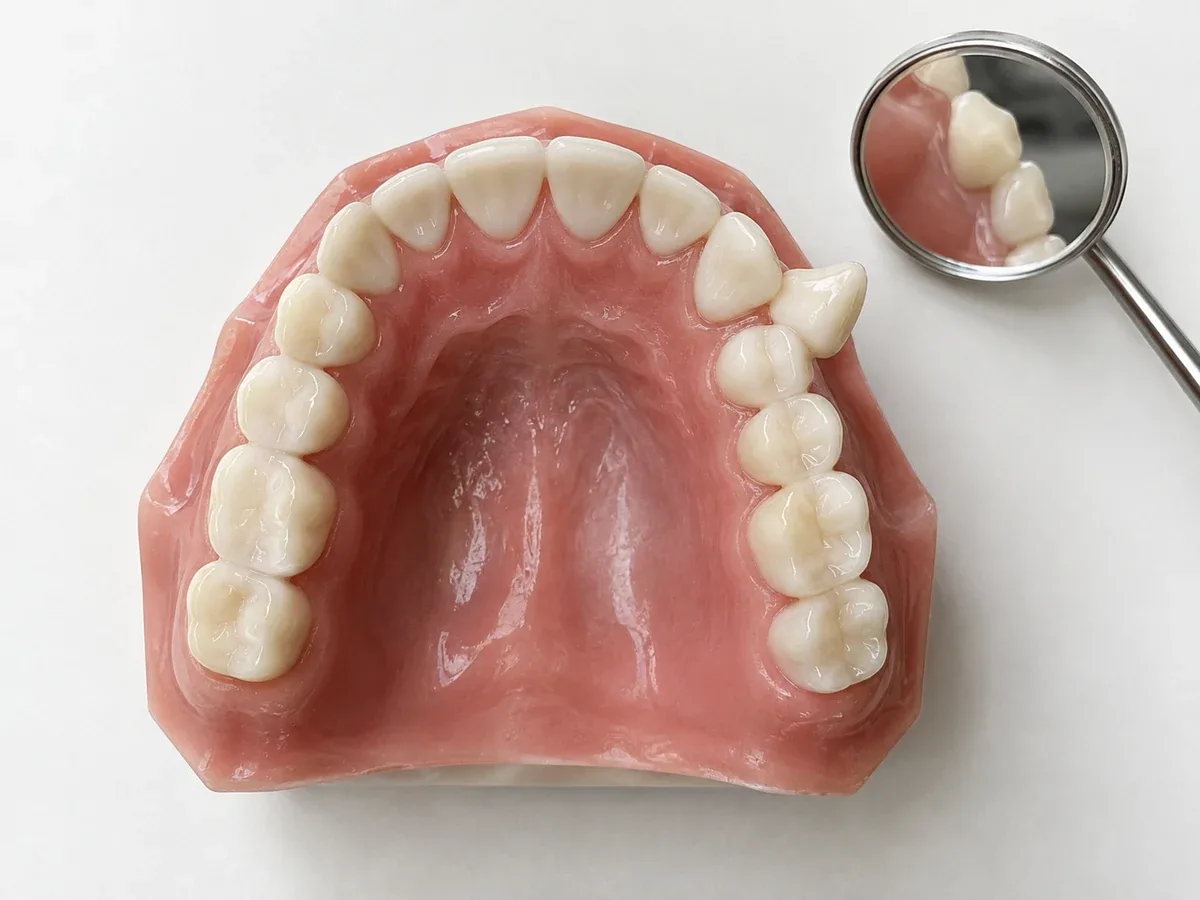
If a snaggletooth came from a lack of space, treatment also starts by making space. There is simply no room to push the canine straight back in. There are two main ways to gain room.
One is removing a tooth to make room. The national health portal's extraction guide lists extraction to gain space for orthodontic treatment as one reason to remove a tooth.
The other is moving the whole row of teeth back. The Korean Dental Association's newspaper reported a study by an orthodontic team at Seoul St. Mary's Hospital, published in the American Journal of Orthodontics and Dentofacial Orthopedics.
The team treated 24 patients without extraction. They lacked at least 10 mm of space in the upper jaw and 6 mm in the lower jaw. A skeletal device anchored in the palate was used above, and orthodontic miniscrews below.
The article says the crowding was corrected with a good esthetic result. It also notes that a 10 mm shortage in the upper jaw was commonly treated with extraction before. The palatal device moves the molars and the whole row backward.
The study shows that non-extraction treatment is possible even for a severe snaggletooth. Still, it is the result of one team with 24 patients. The right method depends on how much room is lacking, how far the mouth protrudes, and how the teeth meet.
| Item | Removing a tooth | Moving the row back |
|---|---|---|
| Method | A tooth is removed to gain space for orthodontic treatment | A palatal anchor device and miniscrews, with no extraction |
| What the sources say | Commonly used when the upper jaw lacks about 10 mm of room | A study treated 24 patients lacking at least 10 mm above and 6 mm below |
| Keep in mind | Extraction cannot be undone | The result of one team with 24 patients |
Either way, snaggletooth treatment follows the same order: make room, move the canine there, and keep it there.
Extraction cannot be undone, so hear the difference between the two methods fully before deciding.
What should you watch for if a tooth is removed?
If you choose extraction, there are things to know. The national health portal's extraction guide says it cannot be reversed. It should be decided carefully, when truly needed.
The guide calls extraction a small, common surgery. With enough anesthesia and good aftercare, it usually goes without major problems. Sedation may be added for anxious patients.
Your health is checked first. The guide advises caution with heart disease, high blood pressure, blood disorders, diabetes, and liver or kidney disease. Please tell us in advance about certain medications or early or late pregnancy.
The guide also gives specific aftercare advice:
- Keep biting on the gauze for about 1 hour 30 minutes.
- Do not touch the area with your tongue or fingers, and brush gently.
- For 1–2 days, use an ice pack on that cheek and eat mild food.
- For 1–2 days, avoid hot baths and saunas.
- Do not use a straw for 3 days, and avoid alcohol and smoking for at least a week.
Pain, swelling and limited mouth opening can appear for 1–2 days. If they continue, contact your dentist.
Swelling is usually worst on day two or three and can last about a week.
How is the canine moved once there is room?
Once space is made, the canine is moved into it. The malocclusion guide describes fixed braces, with brackets moved by the spring of wires and elastics.
This is widely used for snaggletooth cases and many other kinds of malocclusion. Less visible resin or ceramic brackets, and lingual braces on the tongue side, are also options.
The hospital's clear aligner guide puts a severe snaggletooth among the difficult cases, because tooth movement is large or complex. Slightly crooked teeth, by contrast, are listed as treatable. Teeth sitting far outward or inward are also on the difficult list, and a canine far out toward the lip is close to that case.
Fixed braces need extra care. The malocclusion guide says food and plaque collect around them easily. It advises brushing slowly with a soft brush and using floss or an interdental brush.
If the canine is an impacted tooth, buried in the gum or bone, the process is different. The national health portal describes these steps:
- First, remove whatever blocks the way, such as an extra tooth, a cyst or an overdue baby tooth.
- If nothing blocks it, watch the tooth regularly as the child grows.
- If it still does not come in, open the gum and bone to expose the tooth.
- Attach an orthodontic device and pull it down slowly with light force.
Light force is needed so the tooth stays alive. Teeth tend to erupt toward the side of least resistance. So an upper canine buried on the palate side sometimes comes in after exposure surgery alone.
The farther a tooth lies from its normal position, the poorer the outlook is likely to be. If pulling it down is not suitable, moving your own tooth to a new spot (autotransplantation) is considered. If that is not possible either, extraction is reviewed.

When should a child be checked?
The national health portal says eruption problems are often easier to treat when found early. If the timing is missed, treatment can take longer or harm nearby teeth.
Teeth change from primary school to middle school. The portal says regular X-rays help spot problems early. Panoramic and occlusal X-rays are mainly used, with CT when needed.
If a tooth erupts on one side of a jaw and its partner has not appeared after 4 months or more, an X-ray is needed. The same applies when a baby tooth stays past its time.
Can a buried tooth be left alone if it causes no pain? The portal warns of lost space, root resorption of neighboring teeth and cysts. Early assessment matters.
When room is short, early treatment to widen the dental arch may be needed. Protecting baby teeth from early loss to decay also keeps room for permanent teeth. The malocclusion guide advises stopping habits such as thumb-sucking, tongue-thrusting and lip-biting early.
What should you check first about snaggletooth treatment in Busan?
One snaggletooth may look like another, but causes and treatment differ. The approach depends on whether the canine has already come in or is still buried in bone. The malocclusion guide says treatment usually takes 1–3 years, depending on the case.
| What to check | Why it matters |
|---|---|
| How much room is lacking | It decides between extraction and moving the row back |
| Where the canine is | The process differs if it has erupted or is still buried |
| The root of the incisor next to it | An upper canine can resorb the neighboring incisor's root |
| Keeping the result | Relapse is a typical after-effect of all orthodontic treatment |
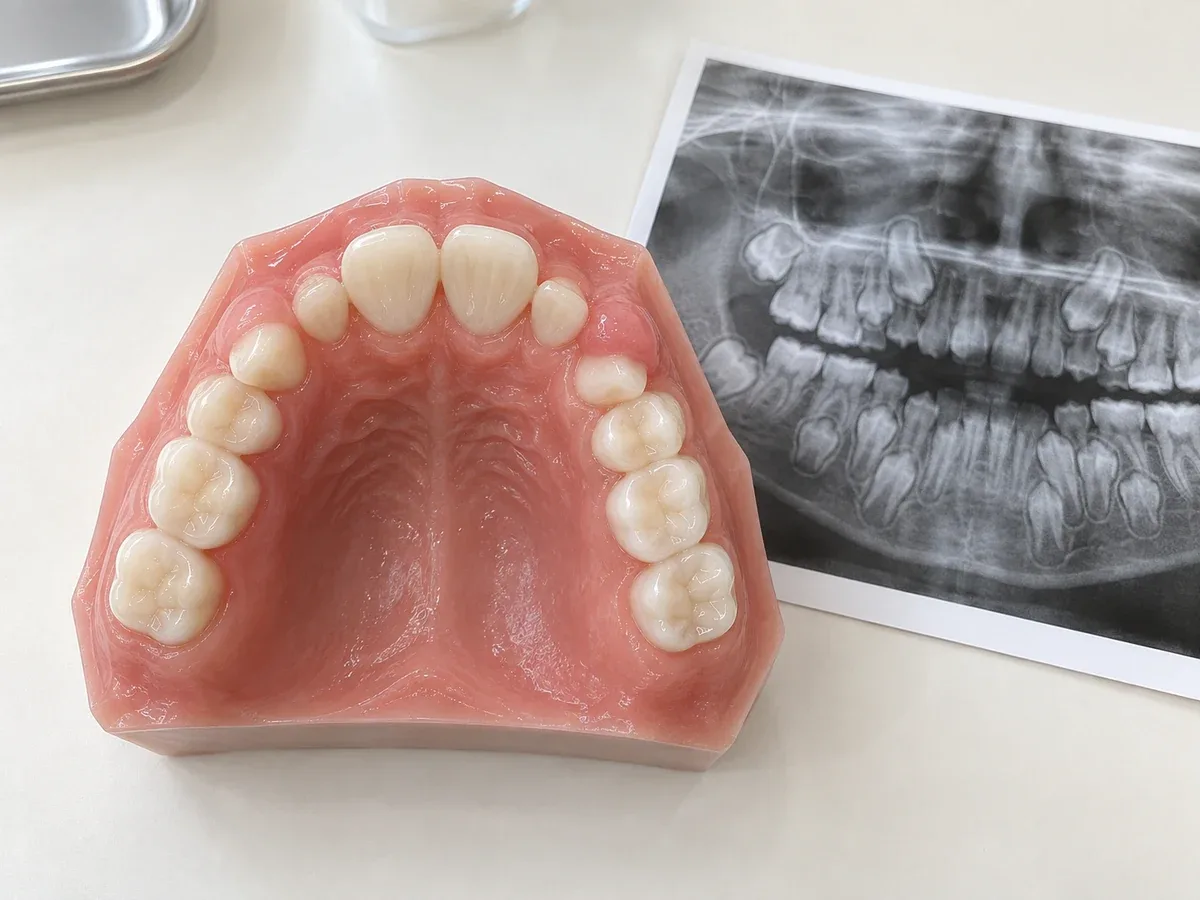
Diagnosis needs X-rays, not just photos. The root direction of the canine and its distance from other teeth cannot be seen from outside. The portal notes that CT may be used to see a buried tooth and any root resorption next to it.
Please tell us about any medication and health conditions, since a snaggletooth plan may include extraction.
If a snaggletooth bothers you in Seomyeon, Busan, start by finding the cause and the room the canine needs. Whether to remove a tooth can be decided after that.
At Reset Dental Clinic, we explain the two methods side by side, using X-rays and tooth models.
Frequently asked questions
Does fixing a snaggletooth always mean removing a tooth?
Not always. Extraction to gain space is common, but results without extraction have also been reported. It depends on how much room is lacking, your lip profile and your bite.
Can clear aligners fix a snaggletooth?
It depends on the degree. The hospital guide lists slightly crooked teeth as treatable and a severe snaggletooth as difficult. How high and how far out the canine sits guides the decision.
Can the treated canine stick out again?
The hospital guide calls relapse a typical after-effect of all orthodontic treatment. It advises wearing a retainer and attending regular checkups after treatment ends.
Can I get this treatment in English in Busan?
Yes. We offer 1:1 English interpretation from the first consultation through the end of treatment. The clinic is near Seomyeon Station Exit 2 (5-min walk), opposite Lotte Hotel, and you can call 010-8555-2854 (+82-10-8555-2854 from abroad).
A snaggletooth is usually a problem of space, not of one tooth.
First find out why the canine lacks room,
then decide how to make that room,
and finally keep the result.
If you are considering snaggletooth treatment in Busan, Reset Dental Clinic offers 1:1 English interpretation from your first consultation through the end of treatment. Call 010-8555-2854 to book a consultation.
References
- Seoul National University Hospital Medical Information, "Malocclusion" — teeth too large for the jaw leading to crowding (snaggletooth) or teeth erupting in odd places; early loss of baby teeth leaving too little room for permanent teeth; uneven teeth trapping food and raising the risk of cavities, gum disease and fractures; treatment usually taking 1–3 years; fixed braces with brackets, wires and elastics; preventing early loss of baby teeth
- KDCA National Health Information Portal, "Tooth Eruption Disorders" — ectopic eruption in upper first molars, lower lateral incisors and upper canines; causes such as lack of space, a misplaced tooth bud or an extra tooth; a Korean survey reporting about 4.5% of pediatric patients with permanent tooth eruption problems and about 2% with upper canine eruption problems; incisor root resorption; removing local causes, exposure surgery, slow light-force traction, autotransplantation and extraction; the 4-month rule for X-rays; early detection and arch expansion
- KDCA National Health Information Portal, "Tooth Extraction" — extraction to gain space for orthodontic treatment, and for tooth position problems that orthodontics cannot solve
- Korean Dental Association newspaper Chiui Sinbo, "Severe Crowding Can Be Treated Without Extraction" (Dec 28, 2022) — a study published in the American Journal of Orthodontics and Dentofacial Orthopedics in which 24 patients lacking at least 10 mm of space in the upper jaw and 6 mm in the lower jaw were treated without extraction, using a palatal skeletal anchor above and miniscrews below; the note that extraction was commonly used for such cases before
- Seoul National University Hospital Medical Information, "Clear Aligners" — slightly crooked teeth listed as treatable and a severe snaggletooth as difficult with clear aligners; relapse as a typical after-effect of all orthodontic treatment, with advice to wear a retainer and attend regular checkups
Written by Reset Dental Clinic Support Team
Medical review Dr. Kim Hyun-joo, Head Dentist · Integrated Dentistry Specialist
Last updated: September 19, 2026
This column is for general information and does not replace diagnosis or treatment for individual patients. If you have symptoms, please see a dentist.


